
Culture and sustainable development Chapter 8 Avril Joffe
Culture and sustainable development Chapter 8 - Avril Joffe Presentation to authors meeting in Stockholm, March 1 -3, 2017
Structure of the chapter Section 1: Contextual Setting – 1. 1. Importance of SD in the 2005 Convention (#13/14/2. 6/2. 5/1 f) and linkage to culture as driver and enabler of development – 1. 2. Context of the MDGs/2030 SDGs affirming alignment briefly – use table Section 2: Contemporary engagement (evidence rich)/ report against indicators/ D/E of Development and ECSE outcomes – 2. 1. National level measures (highlight NDPs but focus on implementation (IDC, P&M) and the local, community level) – 2. 2. Regional measures (focus on cross border/ south) – 2. 3. International measures ( changing nature of ODA assistance and trends in budget) Section 3: Indicators (either leave as is and comment on indicators or also evidence rich) – Assess existing indicators using QPRs and establish priority directions for Parties – BOP data requirement Summary – The way in which the Convention understands and commits to the integration of Culture in Sustainable Development (Interpretation of article 2/6 and article 13 in relation to rest of the convention and how it intersects with other parts of the convention). – Link the Convention’s understanding to the SD goals 2030 and using that to highlight the different levels at which the Convention needs to work and thereby making visible the evidence base on the implementation of the key entry points for culture in the 2030 agenda.
Progress made/ challenges to implement indicators/ amendments needed an interpretative dance ….
8. 1. 1 National sustainable development policies and plans that integration culture • S/LT national growth and development policies and plans incorporate culture and recognize their potential eco, social and environ outcomes (report on this separately): many such as Brazil, Bulgaria, Costa Rica (PNDC Unit on Culture and Economics with coordination at institutional and interinstitutional level with private sector and civil society on local and national SD), Denmark, Georgia, Indonesia, Italy, Kenya, Latvia (good exemplar), Lithuania, Mexico, Namibia, New Zealand, Palestine, Swaziland; Sweden, Vietnam, Zimbabwe • Evaluation reports (see extra slide) on the impact of NS policies and plans that integrate culture: Cyprus has rectified lack of strat plan for Culture; Exemplar - Indonesia had achieved no of objectives by 2015 (workforce absorption, IP registration; consumption growth; new cultural parks; film titles, events and infrastructure / many not and only a few with indicators – eg Swaziland – expect to meet objectives by 2022 re cultural industries, import and export, making a living; ; Brazil’s national cultural conferences for CS and Govt to evaluate CPs (no indication that it has done);
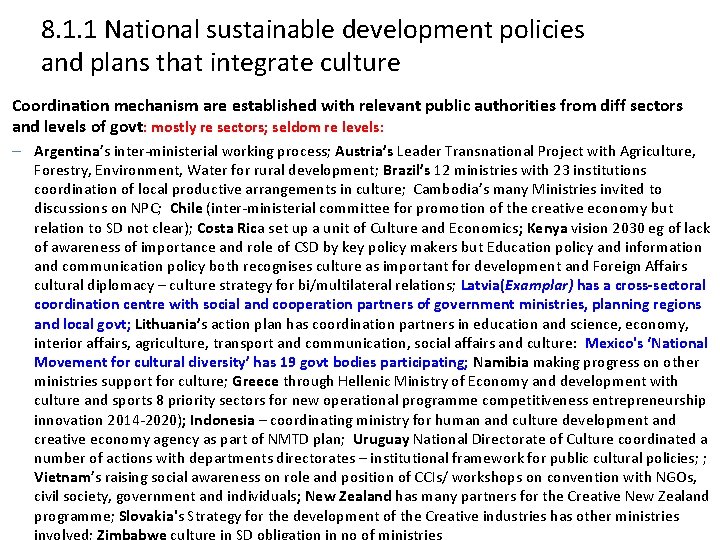
8. 1. 1 National sustainable development policies and plans that integrate culture Coordination mechanism are established with relevant public authorities from diff sectors and levels of govt: mostly re sectors; seldom re levels: – Argentina’s inter-ministerial working process; Austria’s Leader Transnational Project with Agriculture, Forestry, Environment, Water for rural development; Brazil’s 12 ministries with 23 institutions coordination of local productive arrangements in culture; Cambodia’s many Ministries invited to discussions on NPC; Chile (inter-ministerial committee for promotion of the creative economy but relation to SD not clear); Costa Rica set up a unit of Culture and Economics; Kenya vision 2030 eg of lack of awareness of importance and role of CSD by key policy makers but Education policy and information and communication policy both recognises culture as important for development and Foreign Affairs cultural diplomacy – culture strategy for bi/multilateral relations; Latvia(Examplar) has a cross-sectoral coordination centre with social and cooperation partners of government ministries, planning regions and local govt; Lithuania’s action plan has coordination partners in education and science, economy, interior affairs, agriculture, transport and communication, social affairs and culture: Mexico's ‘National Movement for cultural diversity’ has 19 govt bodies participating; Namibia making progress on other ministries support for culture; Greece through Hellenic Ministry of Economy and development with culture and sports 8 priority sectors for new operational programme competitiveness entrepreneurship innovation 2014 -2020); Indonesia – coordinating ministry for human and culture development and creative economy agency as part of NMTD plan; Uruguay National Directorate of Culture coordinated a number of actions with departments directorates – institutional framework for public cultural policies; ; Vietnam’s raising social awareness on role and position of CCIs/ workshops on convention with NGOs, civil society, government and individuals; New Zealand has many partners for the Creative New Zealand programme; Slovakia's Strategy for the development of the Creative industries has other ministries involved; Zimbabwe culture in SD obligation in no of ministries
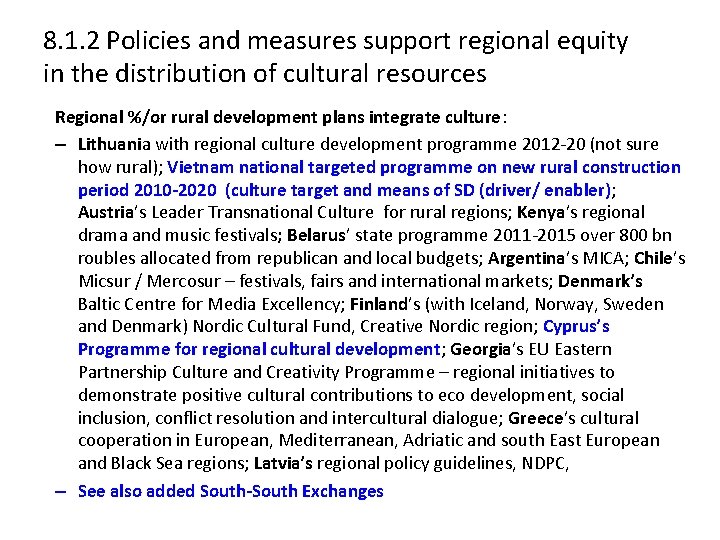
8. 1. 2 Policies and measures support regional equity in the distribution of cultural resources Regional %/or rural development plans integrate culture: – Lithuania with regional culture development programme 2012 -20 (not sure how rural); Vietnam national targeted programme on new rural construction period 2010 -2020 (culture target and means of SD (driver/ enabler); Austria’s Leader Transnational Culture for rural regions; Kenya’s regional drama and music festivals; Belarus’ state programme 2011 -2015 over 800 bn roubles allocated from republican and local budgets; Argentina’s MICA; Chile’s Micsur / Mercosur – festivals, fairs and international markets; Denmark’s Baltic Centre for Media Excellency; Finland’s (with Iceland, Norway, Sweden and Denmark) Nordic Cultural Fund, Creative Nordic region; Cyprus’s Programme for regional cultural development; Georgia’s EU Eastern Partnership Culture and Creativity Programme – regional initiatives to demonstrate positive cultural contributions to eco development, social inclusion, conflict resolution and intercultural dialogue; Greece’s cultural cooperation in European, Mediterranean, Adriatic and south East European and Black Sea regions; Latvia’s regional policy guidelines, NDPC, – See also added South-South Exchanges
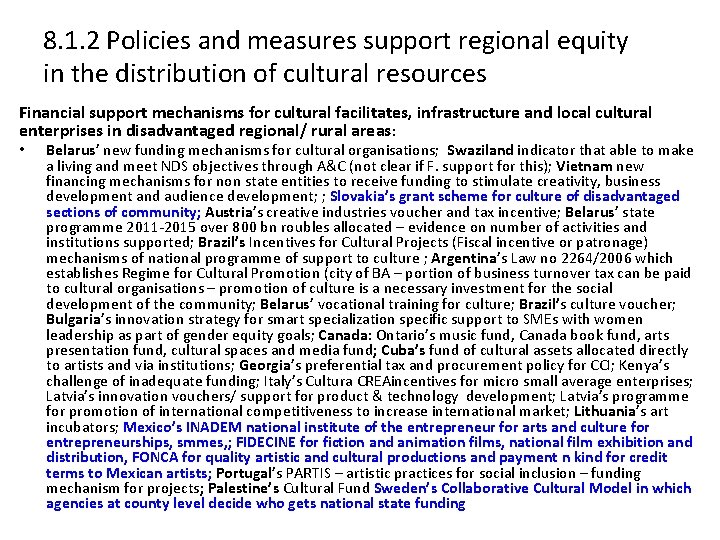
8. 1. 2 Policies and measures support regional equity in the distribution of cultural resources Financial support mechanisms for cultural facilitates, infrastructure and local cultural enterprises in disadvantaged regional/ rural areas: • Belarus’ new funding mechanisms for cultural organisations; Swaziland indicator that able to make a living and meet NDS objectives through A&C (not clear if F. support for this); Vietnam new financing mechanisms for non state entities to receive funding to stimulate creativity, business development and audience development; ; Slovakia’s grant scheme for culture of disadvantaged sections of community; Austria’s creative industries voucher and tax incentive; Belarus’ state programme 2011 -2015 over 800 bn roubles allocated – evidence on number of activities and institutions supported; Brazil’s Incentives for Cultural Projects (Fiscal incentive or patronage) mechanisms of national programme of support to culture ; Argentina’s Law no 2264/2006 which establishes Regime for Cultural Promotion (city of BA – portion of business turnover tax can be paid to cultural organisations – promotion of culture is a necessary investment for the social development of the community; Belarus’ vocational training for culture; Brazil’s culture voucher; Bulgaria’s innovation strategy for smart specialization specific support to SMEs with women leadership as part of gender equity goals; Canada: Ontario’s music fund, Canada book fund, arts presentation fund, cultural spaces and media fund; Cuba’s fund of cultural assets allocated directly to artists and via institutions; Georgia’s preferential tax and procurement policy for CCI; Kenya’s challenge of inadequate funding; Italy’s Cultura CREAincentives for micro small average enterprises; Latvia’s innovation vouchers/ support for product & technology development; Latvia’s programme for promotion of international competitiveness to increase international market; Lithuania’s art incubators; Mexico’s INADEM national institute of the entrepreneur for arts and culture for entrepreneurships, smmes, ; FIDECINE for fiction and animation films, national film exhibition and distribution, FONCA for quality artistic and cultural productions and payment n kind for credit terms to Mexican artists; Portugal’s PARTIS – artistic practices for social inclusion – funding mechanism for projects; Palestine’s Cultural Fund Sweden’s Collaborative Cultural Model in which agencies at county level decide who gets national state funding
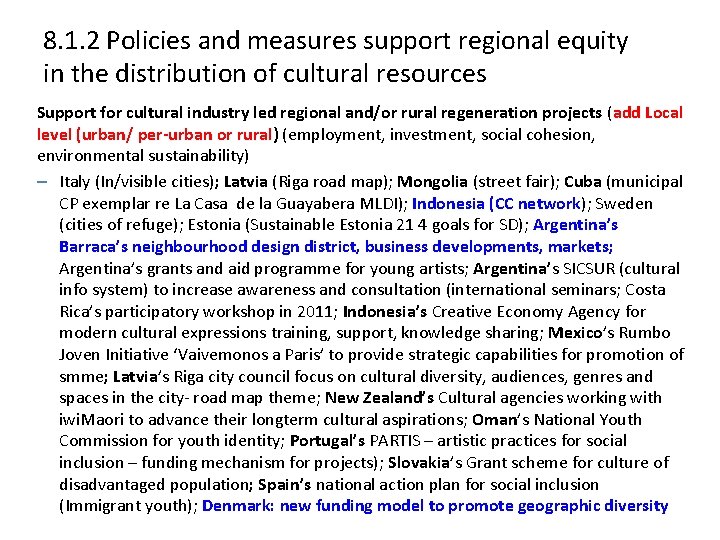
8. 1. 2 Policies and measures support regional equity in the distribution of cultural resources Support for cultural industry led regional and/or rural regeneration projects (add Local level (urban/ per-urban or rural) (employment, investment, social cohesion, environmental sustainability) – Italy (In/visible cities); Latvia (Riga road map); Mongolia (street fair); Cuba (municipal CP exemplar re La Casa de la Guayabera MLDI); Indonesia (CC network); Sweden (cities of refuge); Estonia (Sustainable Estonia 21 4 goals for SD); Argentina’s Barraca’s neighbourhood design district, business developments, markets; Argentina’s grants and aid programme for young artists; Argentina’s SICSUR (cultural info system) to increase awareness and consultation (international seminars; Costa Rica’s participatory workshop in 2011; Indonesia’s Creative Economy Agency for modern cultural expressions training, support, knowledge sharing; Mexico’s Rumbo Joven Initiative ‘Vaivemonos a Paris’ to provide strategic capabilities for promotion of smme; Latvia’s Riga city council focus on cultural diversity, audiences, genres and spaces in the city- road map theme; New Zealand’s Cultural agencies working with iwi. Maori to advance their longterm cultural aspirations; Oman’s National Youth Commission for youth identity; Portugal’s PARTIS – artistic practices for social inclusion – funding mechanism for projects); Slovakia’s Grant scheme for culture of disadvantaged population; Spain’s national action plan for social inclusion (Immigrant youth); Denmark: new funding model to promote geographic diversity
8. 1. 2 Policies and measures support regional equity in the distribution of cultural resources Support infrastructural mechanisms for independent artists and cultural professional (cultural centres, clusters that provide space, resources and equipment for independent professionals – Vietnam re cultural infrastructure; Brazil’s Creative Brazil Incubators Network Rede de incubadoras Brasil Criativo; Portugal's educational programmes; ; Costa Rica’s new spaces for cultural creation; Brazils’ creative brazil incubators new 2 ork , Cultura Viva programme; New Zealand's plan to value cultural assets and priortise investment in cultural infrastructure; Zimbabwe’s urban grooves and Zimdancehall movement Evaluation reports on the impact of policies and measures to support regional equity in the distribution of cultural resources; Brazil’s national cultural conferences for CS and Govt to evaluate CPs;
8. 1. 3 Policies and measures support equity in access to cultural resources by vulnerable groups in the community Programmes to facilitate full access of disadvantage or vulnerable groups to artistic engagement and participation in cultural life: (added no of dimensions) • Social security: (Lithuania for art creators, New Zealand for Wanjua Ora; Mexico occupational health for crafters; • Youth: Vietnam’ the Lucky Duck - professional counseling and finance for young artistic talent; • Marginalised communities: Uruguay’s Urbano Culture centres right of access to A&C for homeless; Spain’s En Clave Afrocaribe – for musicians of African descent; Afghanistan’s ministry involvement of civil society (protection of small ethnic groups under threat; Austria’s Leader Transnational Culture project locals, immigrants, refugees and visitors; • General: Belarus conferences and tv channel to inform public on various issues/ policy on culture • Gender equality: Bulgaria’s national strategy to promote quality between men and women 2016 -2020 (promotion, creation, participation); Brazil’s 3 rd national plan of women's policies to promote visibility of the cultural contribution of women in the Brazilian society and access to cultural production, media and content; Finish arts and culture policy discourse; Germany’s figures from various sources such as study on publishing industry, artists social insurance fund, film and cinema, theatre performances, awards etc, leadership roles; Denmark’s C: Ontact focused on immigrant women and culture; Greece’s National Anion Plan for GE (2016 -2020)now includes theme ‘Gender and culture’; Mongolia’s Voices of Women initiative and mobile library ; NZ’s women in film; Norwegian film fund for GE; Oman’s involvement of women in cultural events (training workshops); Portugal’s VIDArte prize/ art against domestic violence; award for women creators; Slovakia’s grant scheme; Vietnam’s Women innovation day’ • Disability: Belarus’ access to cultural benefits for people with special needs (Barrier Free environment state programme for the disabled 2011 -2015); Canada’s Council for the Arts deaf and disability arts strategy and Quebec’s govt action plan on gender equality
8. 1. 3 Policies and measures support equity in access to cultural resources by vulnerable groups in the community Support is provided to community projects that have both an artistic and social value; • Cuba’s El Canal community in Cerro municipality -’channeling my neighbourhood; Cyprus’ Countryside Animafest Cyprus; Germany’s Cultural education - programme of the Lander; Lithuania's promotion of arts impact on human welfare; Portugal’s preschool to secondary arts education and artistic practices for social inclusion; Vietnam’s audience development, cinema, art space; Zimbabwe 75% local content policy and rise of Zimdancehall movement; Cuba’s El Canal Community in Cerro municipality – Eco Art – project; Chile’s programme Interculturality and inclusion of migrants for promotion of artistic/ cultural expression and Afrodescendant community’ Chile’s CECREA promoting development of creative learning processes and creative skills for young people (7 -19 yrs); Chile mentions lack of adequate funds; Indonesia focus on youth training in CEA; Kenya’s civil society awareness of social cultural rights and desire to participate in cultural governance; Latvia’s social dialogue with NGO sector and culture and development; Latvia’s creativiity week ‘Radi!”; Sweden’s Creative Schools Initiative targeting immigrants and Taking Place focus on cultural activities where low electoral turnout or other socialeco challenges; Uruguay’s Urbano Cultural Centre to empower homeless through education and cultural production; Vietnam’s Measure 2 ‘ Develop cultural life in the national targeted programme on new rural construction’ system of cultural facilities – community based cultural houses and community learning centres ensuring equal accessibility and enjoyment and cultural houses at village level; • (add economic and environmental value)
8. 1. 3 Policies and measures support equity in access to cultural resources by vulnerable groups in the community • Survey evaluating individual participation or reasons for non participation in cultural events and level of satisfaction with variety and quality of cultural events (Why focus so specifically on a survey and why only on participation? ) • Evaluation reports on the impact of policies and measure to support equity in access to cultural resources by vulnerable groups ; Brazil’s national cultural conferences for CS and Govt to evaluate CPs;

8. 2. 1 International sustainable development programmes that integrate culture Evidence of strategies to promote culture in international sustainable development programmes; – No obvious evidence from QPRs – BOP evidence) Evaluation reports on the impact of international sustainable development strategies and programmes
8. 2. 2 Technical assistance programmes aimed at strengthening human and institutional capacities in the cultural and creative industries in developing countries Evidence of international technical assistance programmes for CCI policy development and implementation; small medium and micro enterprise development (technology, skills development to enhance entrepreneurial and business competences); cultural industry professionals to exchange information and build professional networks: – eg Swedish Agency for Economic and Regional Growth- export strategy for CCIs (to what extent does it provide incentives to import CCI products); Cyprus’s creation of new theatre plays by lesser known playwriters and younger ones; Italy’s DE. MO supporting innovative design projects and arts – promoting international young artists mobility; Evaluation reports on the impact of technical assistance programmes
8. 2. 3 Financial assistance to support creativity in developing countries Incorporation of culture into donor countries’ official development assistance programmes and strategies (e. g. share of culture in ODA, number of countries targeted, total level of expenditure for culture per head of donor country population) – see BOP slides Annual contributions to the IFCD: – see BOP slides; Provision of low interest loans, grants and other funding mechanisms; Evaluation reports on the impact of financial assistance to support creativity in developing countries
Discussion of indicators • • • Indicator asks if established, functioning and evaluated - Mostly only established – seldom evidence of functioning and almost no evidence of evaluation (or terms need to be questioned re impact) MOV don’t allow for a discussion of what Global North countries are doing wrt to finance and technical assistance (Indicator 8. 2. 2 aimed at GN in developing countries) (potential loss of good practices from GN) although it could be reported on in 8. 1. 2 but that is specific to regional equity Where are the MOV for general finance and technical assistance or in urban areas by Global South countries (currently only in respect of regional equity, or disadvantaged regional/ rural areas) (e. g. list of assistance in 8. 2. 2. sme, professionals, exchange, networks) MOV: survey for participation in this section- Why the priority re C and SD? Indicator 8. 2. 1 seems very specific – are there many international SD programmes that this warrants its own – it could appear in 8. 2. 2/ or 8. 2. 3 re donor countries support In General it is not clear why these chosen above others in relation to establishing the conditions for the integration of C in SD and to ensure that the technical assistance impacts on SD E. g. Latvia mentions need for in depth discussion on the qualitative indicators/ difficulties to estimate the value of culture in other sectors, such as social and regional development; in expressing qualitative contribution of culture in other sectors such as education promoting creativity, innovative business and wise governance
Add to indicators 8. 1. 2 South-South exchanges • Latin America: Southern Cultural Industries market to create and consolidate a platform for the knowledge, dissemination, promotion, distribution and trading of goods and services generated by the regions CCIs, strengthening business corridors, promoting appreciation of value chains; Sicsur as programme of cultural MERCOSUR – with attendant national CIS; Ibero-American region: regional programmes of cultural cooperation (Mexico); Iber. Cultura Viva and MICSUL (Belarus) programme (cultural industries market of the South); Cambodia’s International Aboriginal peoples collaborative exchange; Mongolian dance festival (Mongolia, North China and Southern East Russia – non state international cooperation)(Mongolia); Africa and Latin America: Support for the development of universities of the Arts (Venezuela, Ecuador, Angola, Mozambique); CELAC: meeting of Ministers of Culture of Latin America and Caribbean states; Invitations to Global South participants to present, Indonesia’s Bali Arts Festival, Indonesian Arts Summit, National Performing Arts Festival, Indonesian International Book Fair- winners can attend international festivals; East African Community: culture and arts council and law on promotion of CCIs (Kenya); Asia-New Zealand Foundation and Pacific Cultural Exchange (New Zealand); Organisation for Islamic Cooperation: 60 member states – draft action plan for promotion of cultural mediation role in Islamic world – preparation of cultural policies, expansion of trading brokerage department to include cultural field; SADC protocol and Swaziland, South Africa and Mozambique: development through arts (Swaziland policy on Culture); Vietnam cultural and artistic activities with Cambodia, Laos, India, Greece, Czech Republic, as well as events in Philippines, Kazakhstan
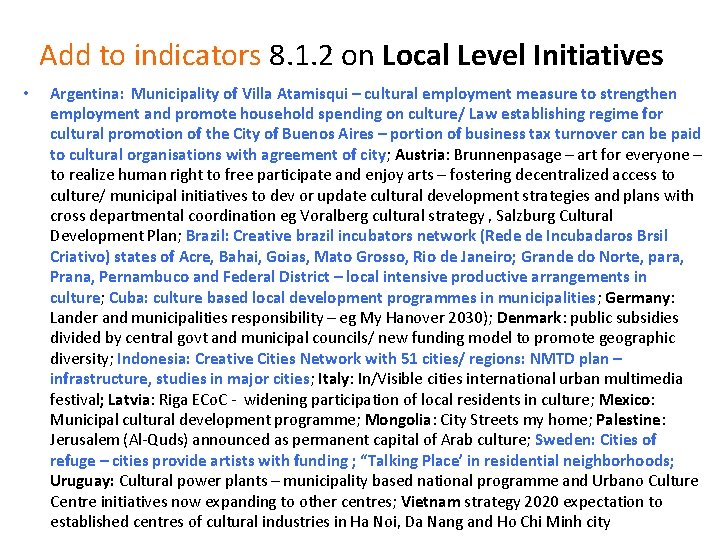
Add to indicators 8. 1. 2 on Local Level Initiatives • Argentina: Municipality of Villa Atamisqui – cultural employment measure to strengthen employment and promote household spending on culture/ Law establishing regime for cultural promotion of the City of Buenos Aires – portion of business tax turnover can be paid to cultural organisations with agreement of city; Austria: Brunnenpasage – art for everyone – to realize human right to free participate and enjoy arts – fostering decentralized access to culture/ municipal initiatives to dev or update cultural development strategies and plans with cross departmental coordination eg Voralberg cultural strategy , Salzburg Cultural Development Plan; Brazil: Creative brazil incubators network (Rede de Incubadaros Brsil Criativo) states of Acre, Bahai, Goias, Mato Grosso, Rio de Janeiro; Grande do Norte, para, Prana, Pernambuco and Federal District – local intensive productive arrangements in culture; Cuba: culture based local development programmes in municipalities; Germany: Lander and municipalities responsibility – eg My Hanover 2030); Denmark: public subsidies divided by central govt and municipal councils/ new funding model to promote geographic diversity; Indonesia: Creative Cities Network with 51 cities/ regions: NMTD plan – infrastructure, studies in major cities; Italy: In/Visible cities international urban multimedia festival; Latvia: Riga ECo. C - widening participation of local residents in culture; Mexico: Municipal cultural development programme; Mongolia: City Streets my home; Palestine: Jerusalem (Al-Quds) announced as permanent capital of Arab culture; Sweden: Cities of refuge – cities provide artists with funding ; “Talking Place’ in residential neighborhoods; Uruguay: Cultural power plants – municipality based national programme and Urbano Culture Centre initiatives now expanding to other centres; Vietnam strategy 2020 expectation to established centres of cultural industries in Ha Noi, Da Nang and Ho Chi Minh city

Economic Environment Outcomes for sustainable development Social Cultural
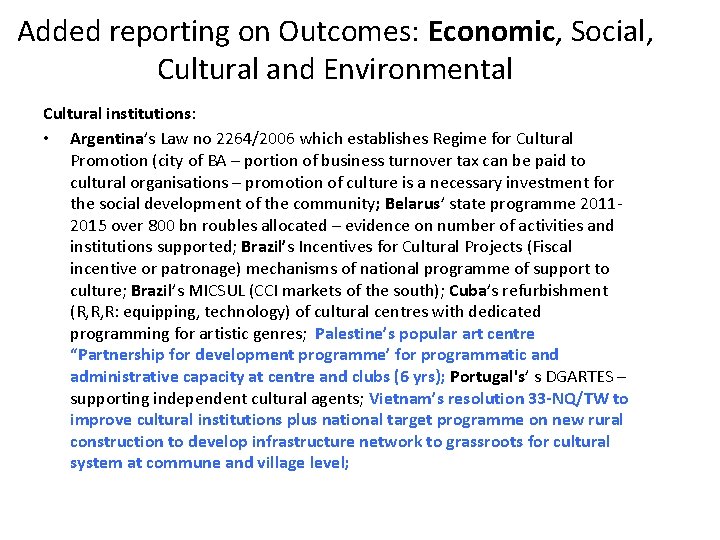
Added reporting on Outcomes: Economic, Social, Cultural and Environmental Cultural institutions: • Argentina’s Law no 2264/2006 which establishes Regime for Cultural Promotion (city of BA – portion of business turnover tax can be paid to cultural organisations – promotion of culture is a necessary investment for the social development of the community; Belarus’ state programme 20112015 over 800 bn roubles allocated – evidence on number of activities and institutions supported; Brazil’s Incentives for Cultural Projects (Fiscal incentive or patronage) mechanisms of national programme of support to culture; Brazil’s MICSUL (CCI markets of the south); Cuba’s refurbishment (R, R, R: equipping, technology) of cultural centres with dedicated programming for artistic genres; Palestine’s popular art centre “Partnership for development programme’ for programmatic and administrative capacity at centre and clubs (6 yrs); Portugal's’ s DGARTES – supporting independent cultural agents; Vietnam’s resolution 33 -NQ/TW to improve cultural institutions plus national target programme on new rural construction to develop infrastructure network to grassroots for cultural system at commune and village level;
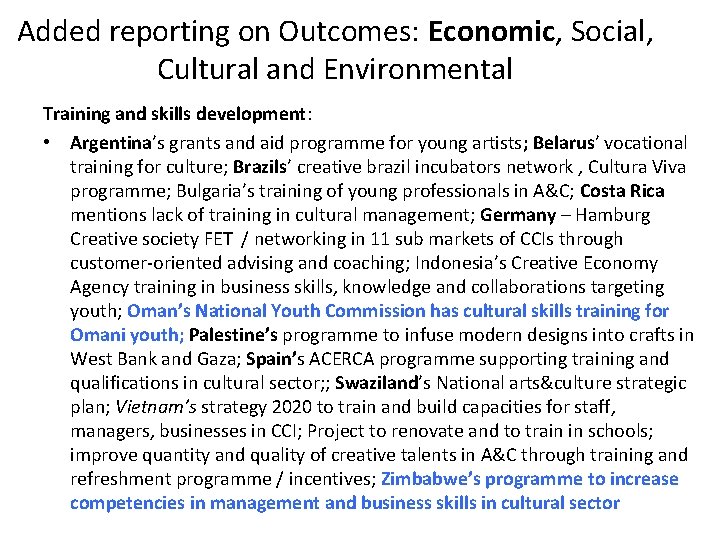
Added reporting on Outcomes: Economic, Social, Cultural and Environmental Training and skills development: • Argentina’s grants and aid programme for young artists; Belarus’ vocational training for culture; Brazils’ creative brazil incubators network , Cultura Viva programme; Bulgaria’s training of young professionals in A&C; Costa Rica mentions lack of training in cultural management; Germany – Hamburg Creative society FET / networking in 11 sub markets of CCIs through customer-oriented advising and coaching; Indonesia’s Creative Economy Agency training in business skills, knowledge and collaborations targeting youth; Oman’s National Youth Commission has cultural skills training for Omani youth; Palestine’s programme to infuse modern designs into crafts in West Bank and Gaza; Spain’s ACERCA programme supporting training and qualifications in cultural sector; ; Swaziland’s National arts&culture strategic plan; Vietnam’s strategy 2020 to train and build capacities for staff, managers, businesses in CCI; Project to renovate and to train in schools; improve quantity and quality of creative talents in A&C through training and refreshment programme / incentives; Zimbabwe’s programme to increase competencies in management and business skills in cultural sector
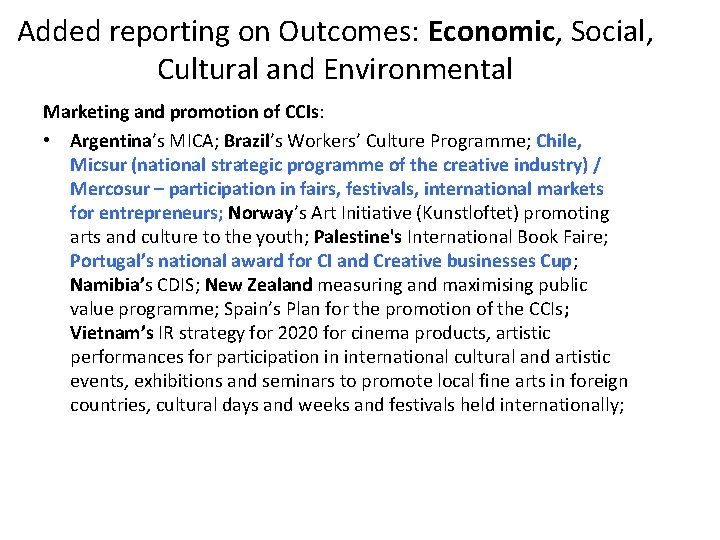
Added reporting on Outcomes: Economic, Social, Cultural and Environmental Marketing and promotion of CCIs: • Argentina’s MICA; Brazil’s Workers’ Culture Programme; Chile, Micsur (national strategic programme of the creative industry) / Mercosur – participation in fairs, festivals, international markets for entrepreneurs; Norway’s Art Initiative (Kunstloftet) promoting arts and culture to the youth; Palestine's International Book Faire; Portugal’s national award for CI and Creative businesses Cup; Namibia’s CDIS; New Zealand measuring and maximising public value programme; Spain’s Plan for the promotion of the CCIs; Vietnam’s IR strategy for 2020 for cinema products, artistic performances for participation in international cultural and artistic events, exhibitions and seminars to promote local fine arts in foreign countries, cultural days and weeks and festivals held internationally;
Added reporting on Outcomes: Economic, Social, Cultural and Environmental SME support: • Austria’s Creative Industries voucher for all smes to use creative services to implement innovative projects (exemplar); Belarus’ new funding mechanism to support cultural organisations; Brazil’s Creative Brazil Incubators network incentives, vouchers, markets, (exemplar); Bulgaria’s innovation strategy for smart specialization specific support to SMEs with women leadership as part of gender equity goals; Indonesia’s National medium Term Development Plan 2010 -2014 setting up a creative economy agency for knowledge sharing, collaborations, business skills training (esp targeting youth); Italy’s DE: MO supports innovative design projects on art shop/ bookshop, young artist mobility; Culturalbility is open platform for cultural and social innovation projects that promote well being and SD; Cultura Creainitiatives for micro enterprises; Oman’s IP training for smes in crafts; Palestine’s Cultural Fund; Portugal’s ADDICT – Creative Industries Agency Portugal for value chain and internationalisation platform; Slovakia’ Strategy for the development of the creative industries; Uruguay’s Cultural Factories which create spaces for socio cultural interaction of local people for production and innovative SMEs; Vietnam’s start up programme supporting entrepreneurial training for youth
Added reporting on Outcomes: Economic, Social, Cultural and Environmental Tax, Finance and incentives: • Austrians tax incentives to donate to art and culture; • Canada’s Ontario Music Fund; Canada book fund; Arts Presentation Fund; Media fund, Cultural Spaces funds’ • Chile’s culture funds; • Georgia’s preferential tax and procurement policy for culture and creative sector; • Latvia’s innovation vouchers; • Mexico’s Funds (Film investment and incentive; fund for culture and arts, payment in Kind re artworks for tax; • Slovakia’s Audio Visual Fund; • Vietnams’ incentive mechanisms for investments in infrastructure, technical equipment and modern technologies; Zimbabwe’s duty rebate on music equipment to enhance production of cultural activities; and 75% local content policy for music;
Added reporting on Outcomes: Economic, Social, Cultural and Environmental Community awareness/engagement: § Afghanistan’s ministry involvement of civil society (protection of small ethnic groups under threat); Argentina’s SICSUR (cultural info system) to increase awareness and consultation (international seminars); Austria’s Leader Transnational Culture project locals, immigrants, refugees and visitors; Belarus conferences and tv channel to inform public on various issues/ policy on culture; Brazil’s national cultural conferences for CS and Govt to evaluate CPs; Cambodia’s first Arts Forum for creative industries; Costa Rica’s policy on on cultural rights; Namibia’s annual IFCD workshop; Oman’s workshop ‘ national capacity building for the preparation of projects submitted to IFCD; Portugal’s Colloquium in 2015 with Lisbon municipality and P CCD and National Commission/ Place of culture and Culture and Development colloquium with civil society; Swaziland recognises need for this; Vietnam’s raising social awareness on role and position of CCIs/ workshops on convention; Zimbabwe’s popularization of C and IFCD;
Added reporting on Outcomes: Economic, Social, Cultural and Environmental Community participation: § Argentina’s national network of points of culture (formed by 450 indigenous communities and organisations); Costa Rica’s Puntos de Cultura new programme to encourage cultural organisations to play a stronger role in promotion of CD/ broad consultation on National cultural rights policy; Kenya’s civil society engagement in social cultural rights and cultural governance; Latvia’s social dialogue with civil society and Latvian Rucksack for national identity, civil education and social unity; Sweden’s ‘Taking Place’ initiative focusing on cultural activity in residential areas with low electoral turnout or other socio-economic challenges; Vietnam’s Measure 2 ‘ Develop cultural life in the national targeted programme on new rural construction’ system of cultural facilities – community based cultural houses and community learning centres ensuring equal accessibility and enjoyment and cultural houses at village level;
Added reporting on Outcomes: Economic, Social, Cultural and Environmental Social cohesion: § Argentina’s IBERRUTAS creates common space for protection of immigrants rights; Canada’s international Aboriginal peoples collaborative exchange; Chile’s programme Interculturality and inclusion of migrants for promotion of artistic/ cultural expression and Afrodescendant community; Georgia’s social cohesion and integration policy to raise awareness about gender equality through culture and arts; New Zealand’s cultural agencies work with iwi. Maori; Oman’s National Youth Commission work on Omani identity; Portugal’s PARTIS – Artistic practices for social inclusion; Slovakia’s Grant scheme fo rthe culture of disadvantages sections; Spain’s national action plan for social inclusion targeting immigrant youth; Swaziland’s NACP; Sweden’s Creative Schools Initiative targeting immigrants; Vietnam’s Ha Noi international film festival; Zimbabwe’s culture week celebrations
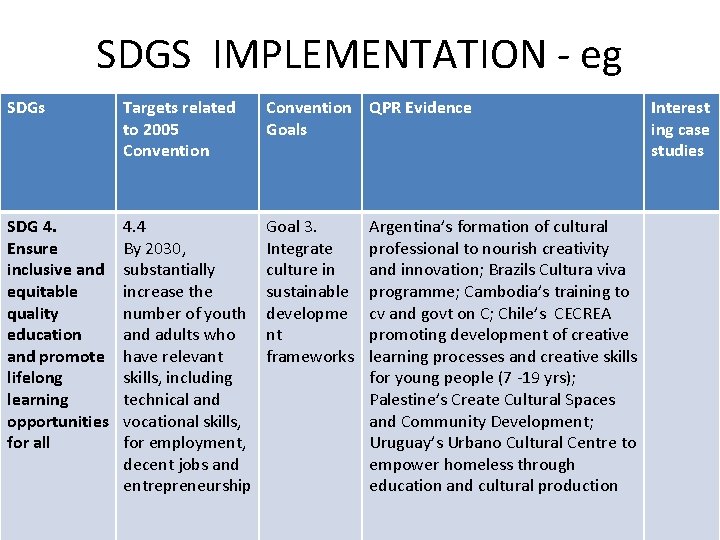
Added reporting on Outcomes: Economic, Social, Cultural and Environmental Community education and training: • Argentina’s formation of cultural professional to nourish creativity and innovation; Brazil’s Cultura viva programme; Cambodia’s training to cv and govt on C; Chile’s CECREA promoting development of creative learning processes and creative skills for young people (7 -19 yrs); Germany’s cross regional-national cultural education programmes of the Lander Greece’s young artist programme through European Cultural Centre of Delphi; Palestine’s Create Cultural Spaces and Community Development; Uruguay’s Urbano Cultural Centre to empower homeless through education and cultural production
Added reporting on Outcomes: Economic, Social, Cultural and Environmental Stimulation of creativity: • Argentina’s Barracas neighbourhood in Buenos Aires – design district promotes urban interventions to promote areas, identity , design in public space 27 businesses and IBERRUTAS stimulation through competitions etc. ; Austria’s Leader Transnational culture – positive transformation processes in rural areas through arts, culture and creativity; Costa Rica’s focus on promotion and stimulation of creativity in diverse forms facilitating new spaces for cultural creation; Cyprus’s Programme PLAY – creation of new theatre plays by young or lesser known ones ; Finland’s support for artistic creativity – favourable conditions for the work of artists and other creative workers (financing); Kenya’s regional drama and music festivals and competitions for artistic work with airing on local broadcaster; Kuwaits’ young people expression of own artistic work; Portugal’s national strategy for education and culture/ DGARTES to encourage innovation and experimentation and PARTIS artistic practices for social inclusion
Added reporting on Outcomes: Economic, Social, Cultural and Environmental Intrinsic value and artistic identity: • Mexico affirms its key value; Namibia and Swaziland's CP; Norwegian film fund; Oman’s support for fine arts, music and crafts; Palestine's intl book fair; Sweden’s creative schools initiative – right of children to access CE, respect for intrinsic value of culture; Uruguay’s Urbano Cultural centres; Vietnam’s explicit mention of the trade offs, the value chain, the cultural cycle and reaffirming fundamental role of culture as spiritual foundation of society, Zimbabwe’s culture week celebrations; Latvia’s RIGA ECo. C – celebration of multiple cultural forms; Kuwait’s encouragement of diverse cultural expressions (NCCAL); Germany’s programme of the Lander – cultural education; Cambodia- artist labour needs to be valued for creativity and the work of art itself: Indonesia’s NMTD 19 ‘appreciation of arts and creativity’; Belarus’s President’s Spiritual revival award and special prizes to artists and cultural workers
Added reporting on Outcomes: Economic, Social, Cultural and Environmental Sustainable practice/ Green design principle: § Finland's’ cultural environment strategy (Ministries of Environment and Culture); Germany’s Werkstatt-N seal for innovative initiatives and cultural projects; Italy’s S&T Med focus on environmental assets; Mexico’s national competition young creators of Mexican popular art promotes sustainable use of natural resources; Swaziland’s CP promotes environmental protection; Uruguay’s Plantar es Cultura to strengthen urban and peri-urban community gardening Awareness/education: § Latvia’s survival kit theme of Riga ECo. C; Mexico’s workshops culture and artistic meetings about environmental protection; Mongolia’s city streets – my home – with university of culture and arts – access to c and appeal for cleaner and friendlier living environment
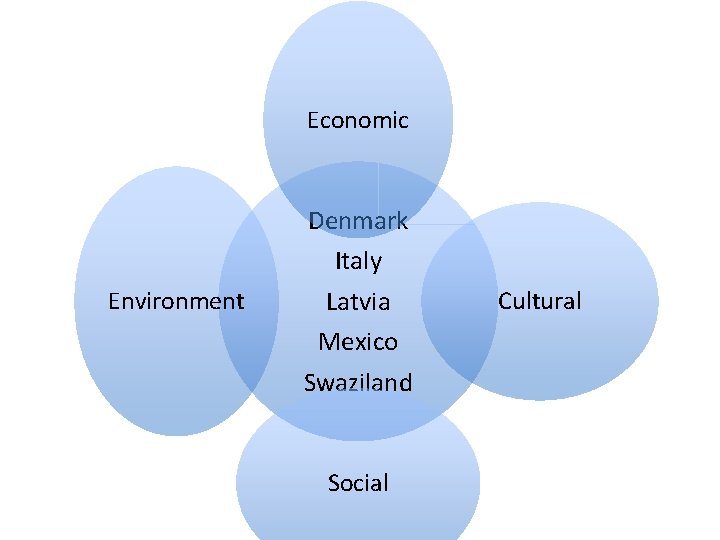
Economic Environment Denmark Italy Latvia Mexico Swaziland Social Cultural
Added: C as Driver of development Focus on community wide social, economic, cultural and environmental impacts • Contribution of cultural sector to Economic development / poverty alleviation – Cultural and creative industries, and cultural infrastructures serve as strategic tools for revenue (new jobs opportunities, greater income levels, improved living conditions, community based eco growth, empowerment) – Culture led urban revitalization – Culture based local economic development Culture-led development also includes a range of non-monetized benefits, such as greater social inclusiveness and rootedness, resilience, innovation, creativity and entrepreneurship for individuals and communities, and the use of local resources, skills, and knowledge. • Social inclusiveness: including focus on Gender equality; youth; Marginalised people: Community participation developing entrepreneurship, programmes • Use of local resources, skills and knowledge: • Do. CE strengthens the social capital of a community and fosters trust in public institutions • Influence on values related to environmental stewardship and interaction with natural environment • Power of culture to respond to gender issues, health & environment concerns, challenges of education and livelihoods
Added: C as Enabler of Development Demonstrate how culture-sensitive approaches can address • economic and human rights dimensions of poverty The transformative power of culture broadening terms of debate and relevance to local people • Sensitivity to particularities of place and community • Evidence of sustainability, inclusivity, equitable outcomes? Focus on Do. CE • facilitate intercultural dialogue • Protect rights of Marginalised groups
Data collection ongoing • Detailed analysis of QPRs –underway • Assessment of Culture Urban Future/ Agenda 21/ Websites cases – underway • Academic texts on C and SD – underway • Need to still – NDPs more detail and evaluation (BOP) – South south examples (eg Agenda 2063 AU; Nigeria non state initiatives west Africa) – Search for non QPR cases (BOP/AJ) – International SD programmes (BOP) – Following up on case studies from QPRs (BOP/AJ)
Comment on what to ask Parties re new initiatives/ evaluation • Important to be able to differentiate between initiatives that are new, updated, recently evaluated, continuing: • New: any measure that has been initiated/implemented for the first time in the reporting period • Updated: any measure that has been in place since before the reporting period but has been changed/updated within the reporting period • ****Recently evaluated: any measure that was in place since before the reporting period (or during) but was evaluated (again or for the first time) within the reporting period • Continuing: any measure that was put in place before the reporting period but is still being run and plays a significant role in that countries cultural policy
Concerns to be addressed • Too many projects mentioned which are intentions – ie not yet established let alone functioning or evaluated; limited no of projects evaluated is a cause for concern. • No of projects focusing only on artisans (crafters) – eg Argentina – many of these projects could be replicated for other forms of creative expressions Or on traditional arts/ heritage as their key exemplar of the I of c in SD eg Oman support for traditional arts and other forms of heritage • Need to distinguish between projects that are new (and hence not yet evaluated) such as the Creative Brazil Incubators Network created in 2015) and those that have been evaluated and the results have been shared • Potential instrumentalisation argument of the mainstream definition of SD (3 integrated pillars) – Convention included it for instrumental reasons to protect against open market and as give away to developing countries claim on funding – demonstrate reality that it is addressing broader outcomes (ESCE) • Argument that focus of first report is on sustainable systems of governance rather than integration of culture in sustainable development frameworks
Concerns to be addressed • Criticism that Throsby’s chapters reduced DOCE to the CI – this chapter needs to right this. Could simply be a key message / concluding comment? Diversity of cultural expressions is not equivalent to ‘cultural industries’. This is the problem of reading articles without relation to the guiding principles or indeed to associated articles – e. g. if you read article 14 to the 4 levels where parties are encouraged to support cooperation fo SD and poverty reduction (strengthening the cultural industries, capacity building, technology transfer and financial support. • Linked to this is that DCE is a fundamentally broader and more transformative concept than the cultural industries which are still seen by many as those that create jobs, earn foreign exchange or add to the fiscus through revenue generation. The concept of the c and ce ----- creativity, etc. human development, social inclusion are at the forefront • Data problems remain with many developing countries lamenting lack of funding/ ability to collect data • Challenges raised by countries in meeting obligations
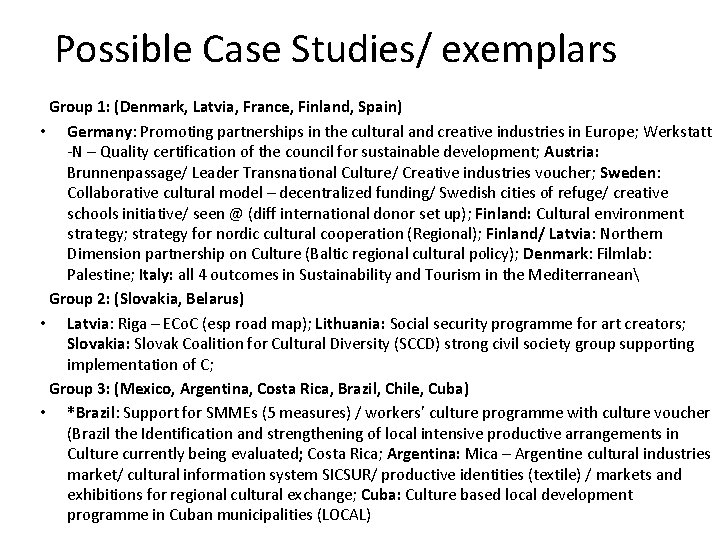
Possible Case Studies/ exemplars Group 1: (Denmark, Latvia, France, Finland, Spain) • Germany: Promoting partnerships in the cultural and creative industries in Europe; Werkstatt -N – Quality certification of the council for sustainable development; Austria: Brunnenpassage/ Leader Transnational Culture/ Creative industries voucher; Sweden: Collaborative cultural model – decentralized funding/ Swedish cities of refuge/ creative schools initiative/ seen @ (diff international donor set up); Finland: Cultural environment strategy; strategy for nordic cultural cooperation (Regional); Finland/ Latvia: Northern Dimension partnership on Culture (Baltic regional cultural policy); Denmark: Filmlab: Palestine; Italy: all 4 outcomes in Sustainability and Tourism in the Mediterranean Group 2: (Slovakia, Belarus) • Latvia: Riga – ECo. C (esp road map); Lithuania: Social security programme for art creators; Slovakia: Slovak Coalition for Cultural Diversity (SCCD) strong civil society group supporting implementation of C; Group 3: (Mexico, Argentina, Costa Rica, Brazil, Chile, Cuba) • *Brazil: Support for SMMEs (5 measures) / workers’ culture programme with culture voucher (Brazil the Identification and strengthening of local intensive productive arrangements in Culture currently being evaluated; Costa Rica; Argentina: Mica – Argentine cultural industries market/ cultural information system SICSUR/ productive identities (textile) / markets and exhibitions for regional cultural exchange; Cuba: Culture based local development programme in Cuban municipalities (LOCAL)
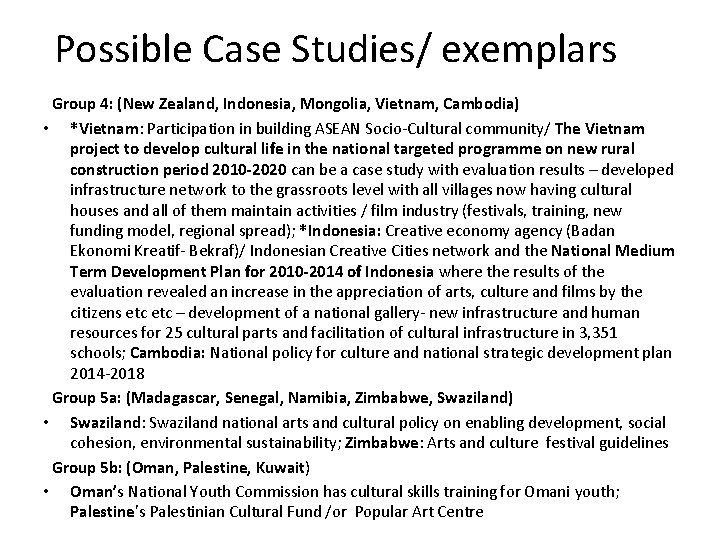
Possible Case Studies/ exemplars Group 4: (New Zealand, Indonesia, Mongolia, Vietnam, Cambodia) • *Vietnam: Participation in building ASEAN Socio-Cultural community/ The Vietnam project to develop cultural life in the national targeted programme on new rural construction period 2010 -2020 can be a case study with evaluation results – developed infrastructure network to the grassroots level with all villages now having cultural houses and all of them maintain activities / film industry (festivals, training, new funding model, regional spread); *Indonesia: Creative economy agency (Badan Ekonomi Kreatif- Bekraf)/ Indonesian Creative Cities network and the National Medium Term Development Plan for 2010 -2014 of Indonesia where the results of the evaluation revealed an increase in the appreciation of arts, culture and films by the citizens etc – development of a national gallery- new infrastructure and human resources for 25 cultural parts and facilitation of cultural infrastructure in 3, 351 schools; Cambodia: National policy for culture and national strategic development plan 2014 -2018 Group 5 a: (Madagascar, Senegal, Namibia, Zimbabwe, Swaziland) • Swaziland: Swaziland national arts and cultural policy on enabling development, social cohesion, environmental sustainability; Zimbabwe: Arts and culture festival guidelines Group 5 b: (Oman, Palestine, Kuwait) • Oman’s National Youth Commission has cultural skills training for Omani youth; Palestine’s Palestinian Cultural Fund /or Popular Art Centre
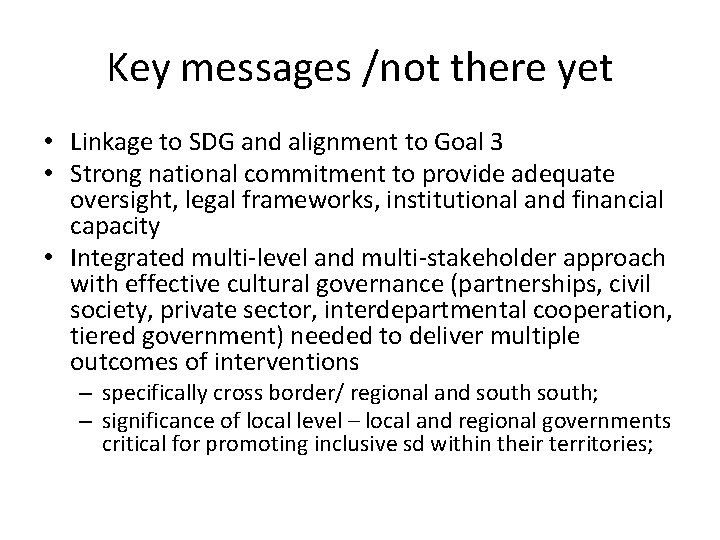
Key messages /not there yet • Linkage to SDG and alignment to Goal 3 • Strong national commitment to provide adequate oversight, legal frameworks, institutional and financial capacity • Integrated multi-level and multi-stakeholder approach with effective cultural governance (partnerships, civil society, private sector, interdepartmental cooperation, tiered government) needed to deliver multiple outcomes of interventions – specifically cross border/ regional and south; – significance of local level – local and regional governments critical for promoting inclusive sd within their territories;
Going forward • New sustainable models in which the social, cultural, political and economic values coexist
Messages from Personalities • Ideas needed
SDGS IMPLEMENTATION - eg SDGs Targets related to 2005 Convention QPR Evidence Goals SDG 4. Ensure inclusive and equitable quality education and promote lifelong learning opportunities for all 4. 4 By 2030, substantially increase the number of youth and adults who have relevant skills, including technical and vocational skills, for employment, decent jobs and entrepreneurship Goal 3. Integrate culture in sustainable developme nt frameworks Argentina’s formation of cultural professional to nourish creativity and innovation; Brazils Cultura viva programme; Cambodia’s training to cv and govt on C; Chile’s CECREA promoting development of creative learning processes and creative skills for young people (7 -19 yrs); Palestine’s Create Cultural Spaces and Community Development; Uruguay’s Urbano Cultural Centre to empower homeless through education and cultural production Interest ing case studies

THE WORK CONTINUES …
- Slides: 45