
Culture and Perception Dr K A Korb University

Culture and Perception Dr. K. A. Korb University of Jos 27 May 2009
Sensory Memory n Cross-cultural differences in sensory functions can be the result of: 1. Direct physical environmental conditions n Kalahari Bushmen report less hearing loss in older individuals than in the US n 2. Indirect physical environmental conditions n Dr. K. A. Korb University of Jos The desert has considerably less ambient noise than the US Poor nutrition and diseases in South African mine-workers are likely causes of difficulty seeing in poorly lit conditions
Sensory Memory n Cross-cultural differences in sensory functions can be the result of: 3. Genetic factors n 4. Cultural differences in interaction with the environment n n Europeans have a greater incidence of red-green color blindness than non-Europeans Cultures differ in judgments of loudness However, cross-cultural differences in sensory functioning are rare Dr. K. A. Korb University of Jos
Perception of Pictures n Ethiopians with little experience with pictorial representations were shown various pictures (Deregowski, Muldrow, & Muldrow, 1972) n n n Most people identified the leopard, but only after time and effort Some would touch or smell the picture Experience with pictures is necessary for accurate perception of clear pictures and photographs Dr. K. A. Korb University of Jos
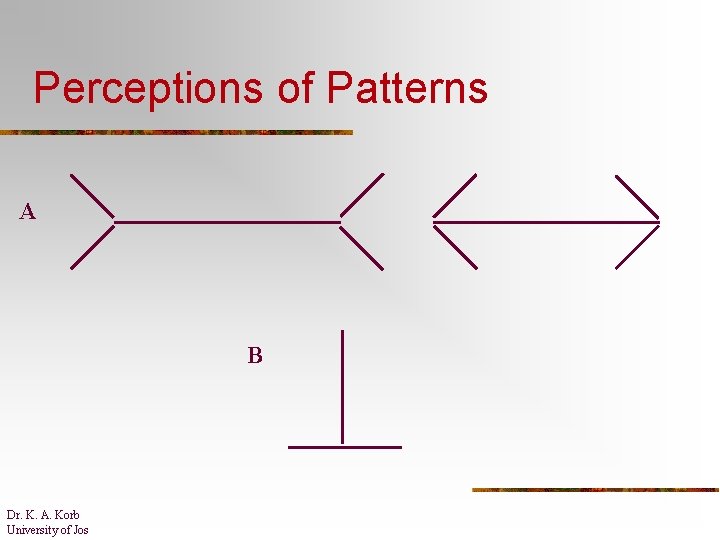
Perceptions of Patterns A B Dr. K. A. Korb University of Jos
Perception of Patterns n Repeated experience with perceptual cues affects how stimuli are perceived n n Perception of stimuli is learned based on a person’s experience with the environment and pictures Hypothesis 1: Carpentered World Hypothesis n n n Dr. K. A. Korb University of Jos An environment with many carpenters tends to be rectangular – furniture, houses, street patterns People raised in a carpentered world interpret nonrectangular figures as rectangular figures in perspective Evidence: People raised in industrial urban environments are more susceptible to Müller-Lyer visual illusion
Perception of Patterns n Hypothesis 2: Foreshortening Hypothesis n n Dr. K. A. Korb University of Jos Lines extending into space appear as vertical lines in pictures People living in environments with wide vistas perceive vertical lines as long distances Evidence: Non-western people are more prone to the horizontal-vertical illusion Evidence: People living in areas with wide spaces are more prone than people living in the rain forest
Perception of Depth in Pictures n South Africans were asked whether the elephant or the antelope was closer to the man (Hudson, 1967) n n n Dr. K. A. Korb University of Jos Schooled participants gave 3 D answers Unschooled participants almost always gave 2 D answers Ability to interpret western-style materials increases as people are acculturated to the west and schooled in western education
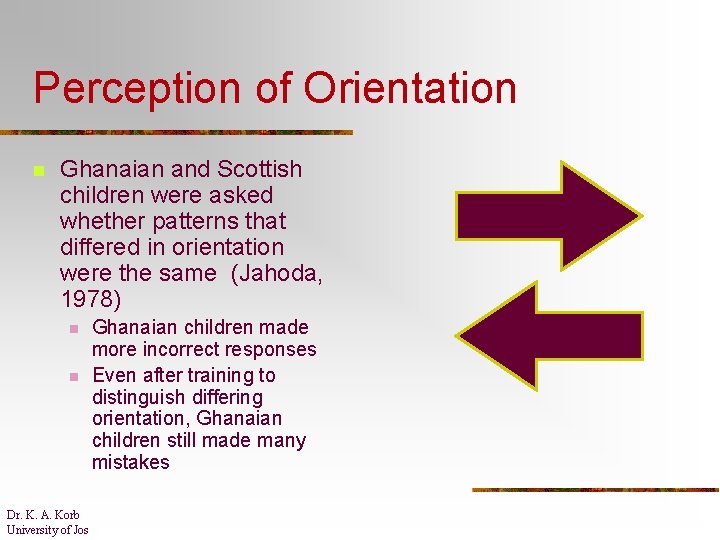
Perception of Orientation n Ghanaian and Scottish children were asked whether patterns that differed in orientation were the same (Jahoda, 1978) n n Dr. K. A. Korb University of Jos Ghanaian children made more incorrect responses Even after training to distinguish differing orientation, Ghanaian children still made many mistakes
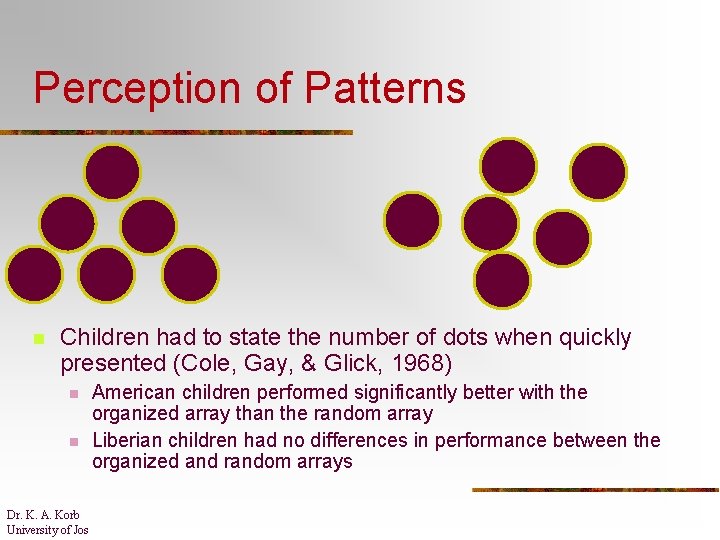
Perception of Patterns n Children had to state the number of dots when quickly presented (Cole, Gay, & Glick, 1968) n n Dr. K. A. Korb University of Jos American children performed significantly better with the organized array than the random array Liberian children had no differences in performance between the organized and random arrays
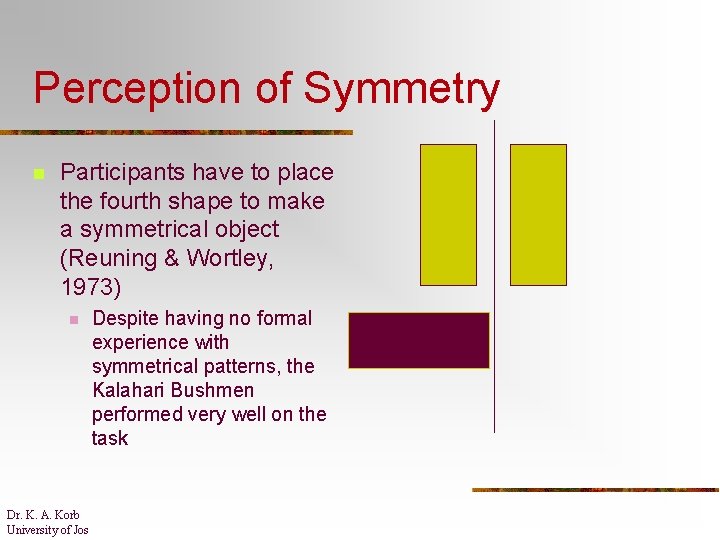
Perception of Symmetry n Participants have to place the fourth shape to make a symmetrical object (Reuning & Wortley, 1973) n Dr. K. A. Korb University of Jos Despite having no formal experience with symmetrical patterns, the Kalahari Bushmen performed very well on the task
Perception of Simple Patterns n Currently, cross-cultural research only describes similarities and differences between cultures in perception of simple patterns n n Dr. K. A. Korb University of Jos No theory has been developed that can explain cultural or environmental factors that influence perception of patterns One major problem is that conventions of representing a 3 D world in two dimensions are arbitrary
Perception of Pictures n Picture perception is a set of learned skills. n n Culture-specific conditions determines how picture perceptual skills develop School children easily recognize photographs and clear drawings n n Perception of pictures becomes difficult when: n n Dr. K. A. Korb University of Jos Simple visual aids are effective in education in virtually all cultures People have little experience with pictures The patterns become more complex
Revision n What cross-cultural similarities have been found in perception? What cross-cultural differences have been found in perception? What are some factors that are thought to influence these cross-cultural differences? Dr. K. A. Korb University of Jos
- Slides: 14