
Culture and Organizational Behavior Chapter 2 Comparative Management
Culture and Organizational Behavior Chapter 2 Comparative Management, Dr. Yang 2003 2 -1
Learning Objectives Understand what culture is and levels of culture Explain how culture develops Describe the major frameworks for explaining the cultures of different societies Discuss the relation of culture to the study of OB Debate the issue of cultural convergence Vs. divergence Comparative Management, Dr. Yang 2003 2 -2
What is Culture? A way of life of a group of people That complex whole which includes knowledge, belief, art, morals, law, custom, and any other capabilities and habits acquired by man as a member of society Everything that people have, think, and do as members of society Comparative Management, Dr. Yang 2003 2 -3
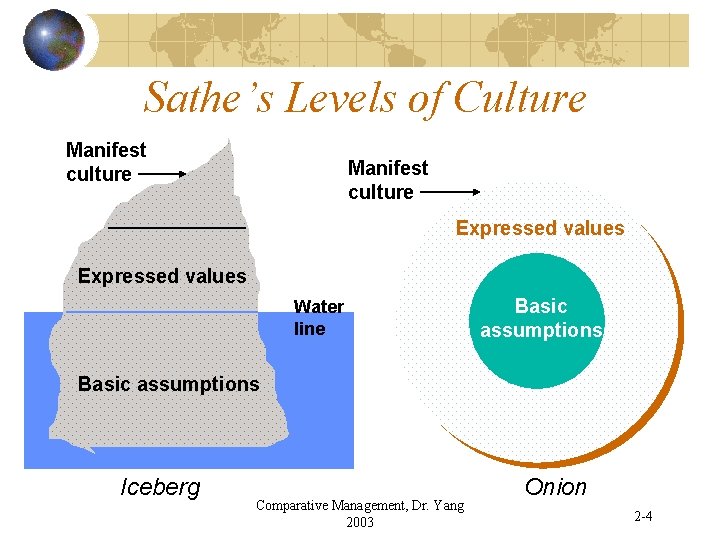
Sathe’s Levels of Culture Manifest culture Expressed values Water line Basic assumptions Iceberg Comparative Management, Dr. Yang 2003 Onion 2 -4
How is Culture Learned? Primary Socialization Cultures and Subcultures Secondary Socialization Comparative Management, Dr. Yang 2003 2 -5
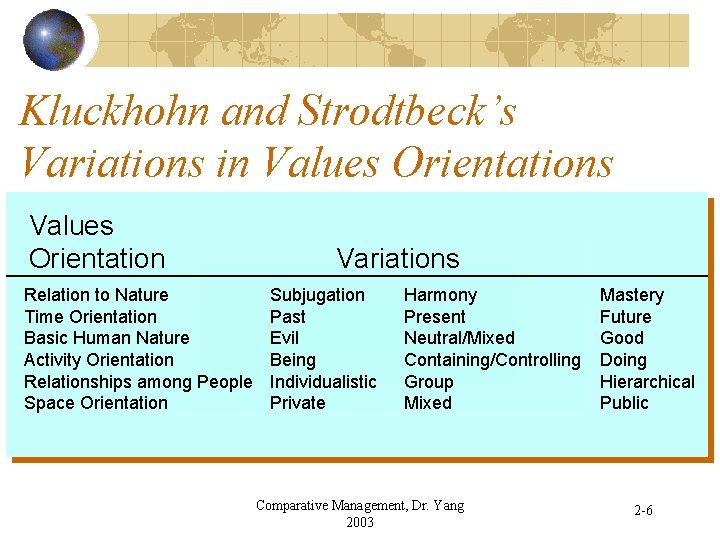
Kluckhohn and Strodtbeck’s Variations in Values Orientations Values Orientation Relation to Nature Time Orientation Basic Human Nature Activity Orientation Relationships among People Space Orientation Variations Subjugation Past Evil Being Individualistic Private Harmony Present Neutral/Mixed Containing/Controlling Group Mixed Comparative Management, Dr. Yang 2003 Mastery Future Good Doing Hierarchical Public 2 -6
Hofstede’s Dimensions of Cultural Values Individualism/Collectivism Power Distance Uncertainty Avoidance Masculinity/Femininity Comparative Management, Dr. Yang 2003 2 -7
The Chinese Value Survey Confucian Work Dynamism Long Term vs. Short Term Orientation Persistence Thrifty Comparative Management, Dr. Yang 2003
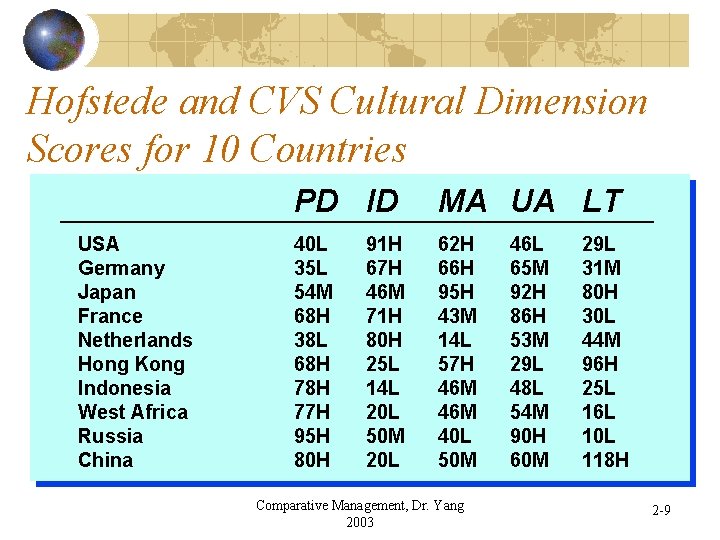
Hofstede and CVS Cultural Dimension Scores for 10 Countries USA Germany Japan France Netherlands Hong Kong Indonesia West Africa Russia China PD ID MA UA LT 40 L 35 L 54 M 68 H 38 L 68 H 77 H 95 H 80 H 62 H 66 H 95 H 43 M 14 L 57 H 46 M 40 L 50 M 91 H 67 H 46 M 71 H 80 H 25 L 14 L 20 L 50 M 20 L Comparative Management, Dr. Yang 2003 46 L 65 M 92 H 86 H 53 M 29 L 48 L 54 M 90 H 60 M 29 L 31 M 80 H 30 L 44 M 96 H 25 L 16 L 10 L 118 H 2 -9
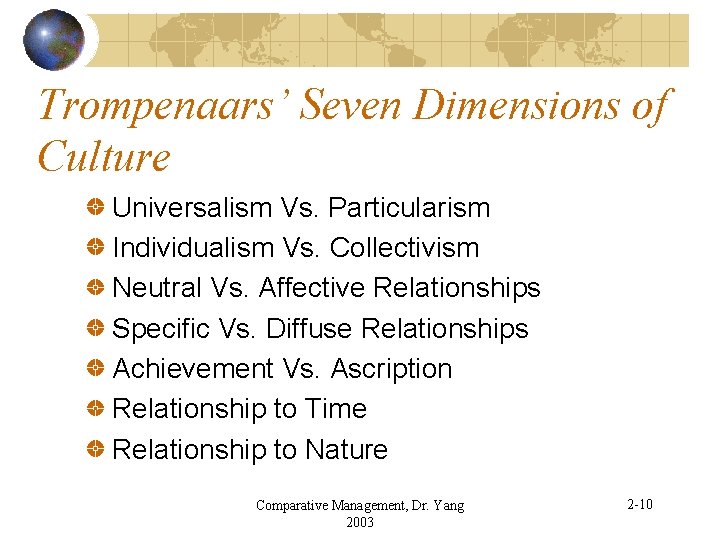
Trompenaars’ Seven Dimensions of Culture Universalism Vs. Particularism Individualism Vs. Collectivism Neutral Vs. Affective Relationships Specific Vs. Diffuse Relationships Achievement Vs. Ascription Relationship to Time Relationship to Nature Comparative Management, Dr. Yang 2003 2 -10
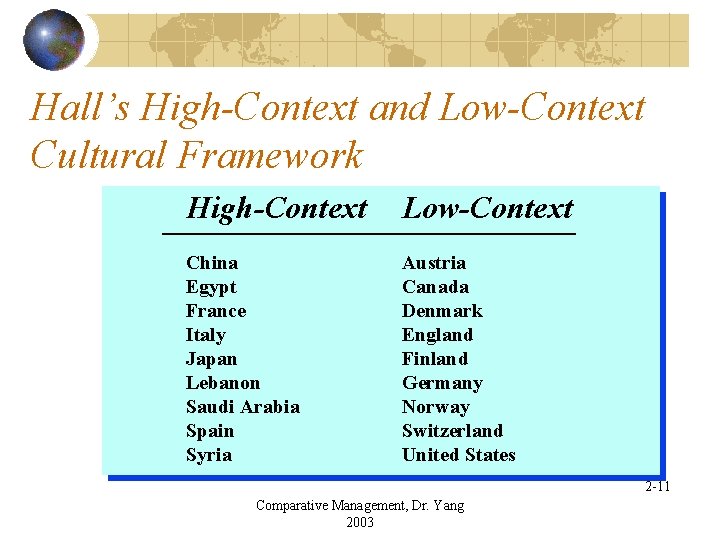
Hall’s High-Context and Low-Context Cultural Framework High-Context Low-Context China Egypt France Italy Japan Lebanon Saudi Arabia Spain Syria Austria Canada Denmark England Finland Germany Norway Switzerland United States 2 -11 Comparative Management, Dr. Yang 2003
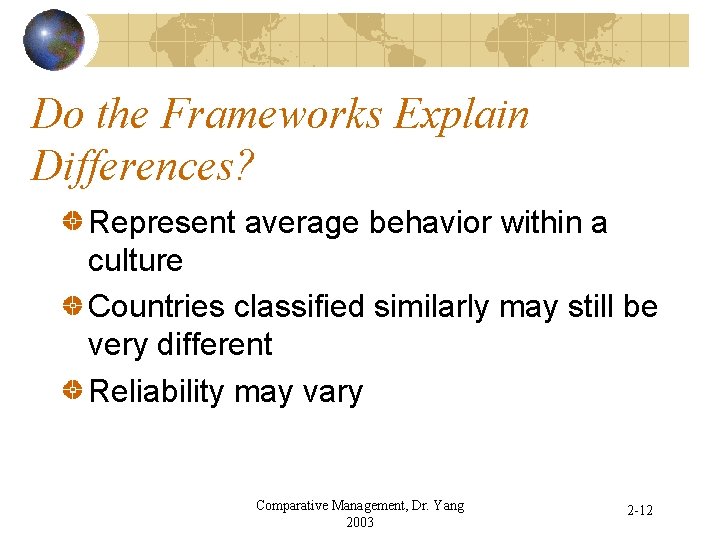
Do the Frameworks Explain Differences? Represent average behavior within a culture Countries classified similarly may still be very different Reliability may vary Comparative Management, Dr. Yang 2003 2 -12
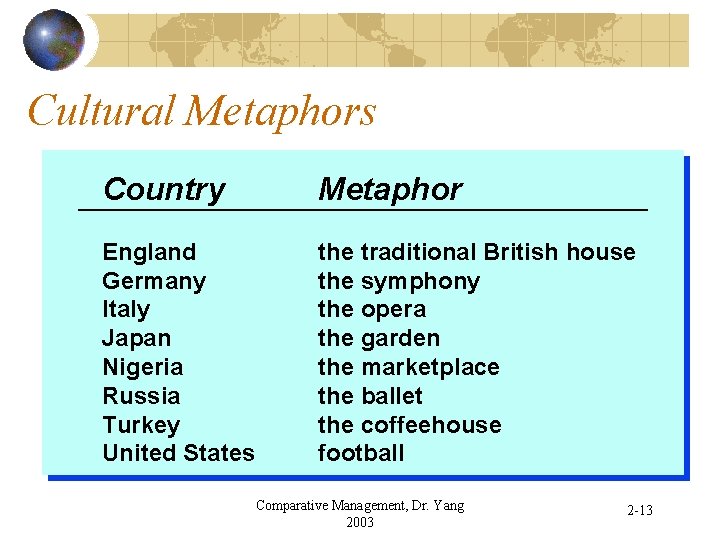
Cultural Metaphors Country Metaphor England Germany Italy Japan Nigeria Russia Turkey United States the traditional British house the symphony the opera the garden the marketplace the ballet the coffeehouse football Comparative Management, Dr. Yang 2003 2 -13
Convergence or Divergence? Closer communication and trade links Worldwide markets and products Different cultural interpretations Need to maintain cultural identity Comparative Management, Dr. Yang 2003 2 -14
Implications for Managers Understanding culture important even in home country Organization’s stakeholders could be from another culture Need to look for underlying cultural meanings Comparative Management, Dr. Yang 2003 2 -15
- Slides: 15