
Culture and Leadership Chapter 16 Northouse Leadership 8
- Slides: 28
Culture and Leadership Chapter 16 Northouse, Leadership 8 e. © SAGE Publications, 2019. 2
Overview ÷ Culture and Leadership Description ÷ Culture Defined ÷ Related Concepts ÷ Dimensions of Culture ÷ Clusters of World Cultures ÷ Characteristics of Clusters ÷ Leadership Behavior and Culture Clusters ÷ Universally Desirable and Undesirable Leadership Attributes ÷ Culture and Leadership Northouse, Leadership 8 e. © SAGE Publications, 2019. 3
Culture and Leadership Description ÷ Culture and Leadership--focuses on a collection of related ideas rather than a single unified theory ÷ Globalization: ® Increased after World War II ® Increased interdependence between nations • Economic, social, technical, political ® Has created many challenges • Need to design multi-national organizations • Identify and select leaders for these organizations • Manage organizations with culturally diverse employees Northouse, Leadership 8 e. © SAGE Publications, 2019. 4
Culture and Leadership Description Five cross-cultural competencies for Leaders (Adler Bartholomew, 1992) 1. Understand business, political, and cultural environments worldwide 2. Learn the perspectives, tastes, trends, and technologies of many cultures 3. Be able to work simultaneously with people from many cultures 4. Be able to adapt to living and communicating in other cultures 5. Need to learn to relate to people from other cultures from a position of equality rather than superiority Northouse, Leadership 8 e. © SAGE Publications, 2019. 5
Culture Defined ÷ Culture: ® learned beliefs, values, rules, norms, symbols, and traditions that are common to a group of people ® shared qualities of a group that make them unique ® is the way of life, customs, and scripts of a group of people ÷ Terms related to culture: ® Multicultural--approach or system that takes more than one culture into account ® Diversity--existence of different cultures or ethnicities within a group or organization Northouse, Leadership 8 e. © SAGE Publications, 2019. 6
Ethnocentrism ® The tendency for individuals to place their own group (ethnic, racial, or cultural) at the center of their observations of the world ® Perception that one’s own culture is better or more natural than other cultures ® Is a universal tendency, and each of us is ethnocentric to some degree ÷ Ethnocentrism can be a major obstacle to effective leadership ® Prevents people from understanding or respecting other cultures Northouse, Leadership 8 e. © SAGE Publications, 2019. 7
Prejudice ÷ A largely fixed attitude, belief, or emotion held by an individual about another individual or group ÷ ÷ ®based on faulty or unsubstantiated data Involves inflexible generalizations that are resistant to change or evidence Is self-oriented rather than other-oriented Leaders face the challenge of dealing with their own prejudices and those of followers ®Can be toward the leader or leader’s culture ®Can face followers who represent culturally different groups, and they may have their own prejudices toward one another A skilled leader needs to find ways to negotiate with followers from various cultural backgrounds Northouse, Leadership 8 e. © SAGE Publications, 2019. 8
Dimensions of Culture ÷ Hall (1976) reported that a primary characteristic of cultures is degree of focus--on the individual (individualistic) or on the group (collectivistic) ÷ Trompenaars (1994) classified an organization’s culture into two dimensions: ®Egalitarian-hierarchical--degree to which cultures exhibit shared power versus hierarchical power ®Person-task orientation--extent to which cultures emphasize human interaction versus focusing on tasks ÷ Hofstede (1980, 2001) benchmark research identified five major dimensions on which cultures differ Northouse, Leadership 8 e. © SAGE Publications, 2019. 9
Dimensions of Culture ÷ House et al. ’s (2004) research on the relationship between culture and leadership resulted in the GLOBE research program ® Initiated in 1991 --this program involved more than 160 investigators ® Used quantitative methods to study the responses of 17, 000 managers in more than 950 organizations, 62 different cultures ® Developed a classification of cultural dimensions-- identified nine cultural dimensions Northouse, Leadership 8 e. © SAGE Publications, 2019. 10
Nine Cultural Dimensions Uncertainty Avoidance ÷ Extent to which a society, organization, or group relies on established social norms, rituals, and procedures to avoid uncertainty ÷ For example, United States promotes entrepreneurship; Middle Eastern countries value careful business negotiations built on longterm trusted relationships Power Distance ÷ Degree to which members of a group expect and agree that power should be shared unequally ÷ Which power bases (legitimate, expert, etc. ) are preferred in a culture ÷ For example, India caste system where everyone has his/her “rightful place” Northouse, Leadership 8 e. © SAGE Publications, 2019. 11
Nine Cultural Dimensions Institutional Collectivism ÷ Degree to which an organization or society encourages institutional or societal collective action ÷ For example, North Korean Supreme Leader Kim Jong-II, who uses military to oversee development of cultural values of collective effort and non-material incentives In-Group Collectivism ÷ Degree to which people express pride, loyalty, and cohesiveness in their organizations or families ÷ For example, some Middle Eastern cultures regard family and religious affiliation above all else; honor killings of family members who have disgraced or defied the paternal leader of the family Northouse, Leadership 8 e. © SAGE Publications, 2019. 12
Nine Cultural Dimensions Gender Egalitarianism ÷ Degree to which an organization or society minimizes gender role differences and promotes gender equality ÷ For example, in Sweden, men and women share power equally. Extensive welfare system allows both sexes to balance work and family life Assertiveness ÷ Degree to which people in a culture are determined, assertive, confrontational, and aggressive in their social relationships ÷ For example, German managers use straightforward and direct language; conflict and confrontational discussion are acceptable workplace behaviors Northouse, Leadership 8 e. © SAGE Publications, 2019. 13
Nine Cultural Dimensions Future Orientation ÷ Extent to which people engage in future-oriented behaviors such as planning, investing in the future, and delaying gratification ÷ For example, many Middle Eastern countries are concerned with traditional values and ways of doing things; North Americans believe they can plan and control the future and idealize change for the sake of changing Performance Orientation ÷ Extent to which an organization or society encourages and rewards group members for improved performance and excellence ÷ For example, standardized testing in U. S. schools Northouse, Leadership 8 e. © SAGE Publications, 2019. 14
Nine Cultural Dimensions Humane Orientation ÷ Degree to which a culture encourages and rewards people for being fair, altruistic, generous, caring, and kind to others. ÷ For example, Switzerland’s helpfulness to others during and after WW I and WW II. The country espouses tolerance and responsibility as central educational goals. Northouse, Leadership 8 e. © SAGE Publications, 2019. 15
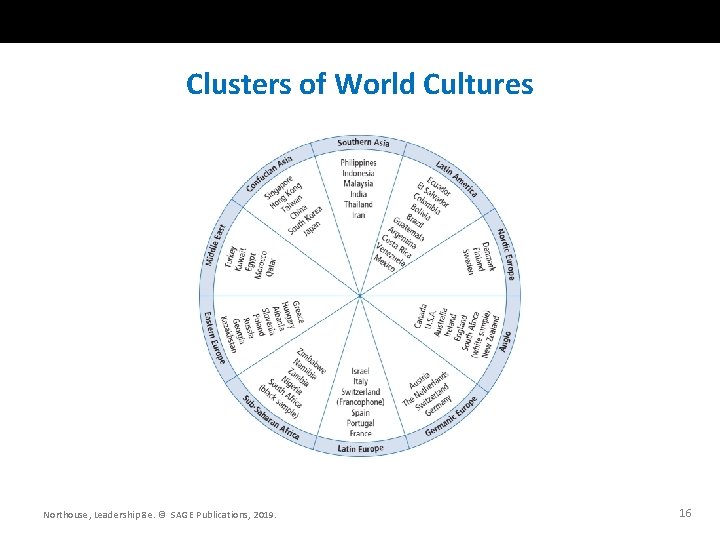
Clusters of World Cultures Northouse, Leadership 8 e. © SAGE Publications, 2019. 16
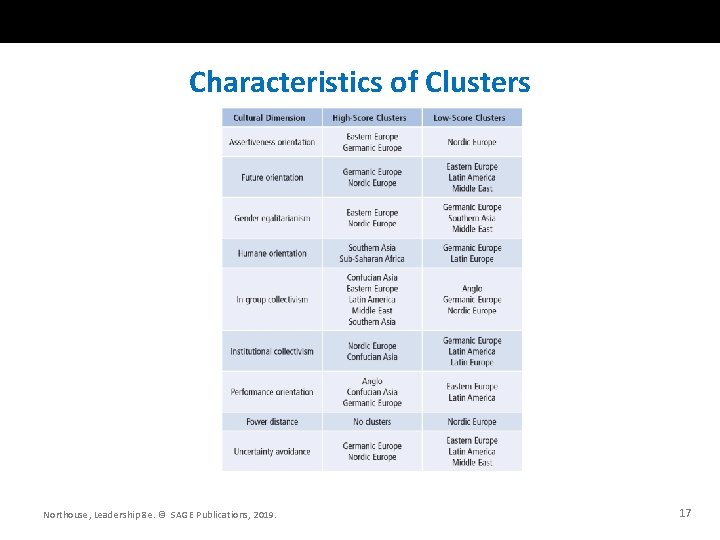
Characteristics of Clusters Northouse, Leadership 8 e. © SAGE Publications, 2019. 17
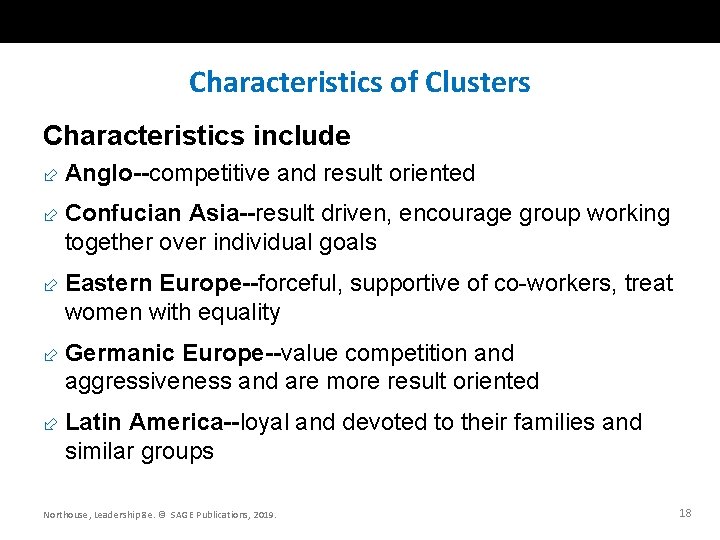
Characteristics of Clusters Characteristics include ÷ Anglo--competitive and result oriented ÷ Confucian Asia--result driven, encourage group working together over individual goals ÷ Eastern Europe--forceful, supportive of co-workers, treat women with equality ÷ Germanic Europe--value competition and aggressiveness and are more result oriented ÷ Latin America--loyal and devoted to their families and similar groups Northouse, Leadership 8 e. © SAGE Publications, 2019. 18
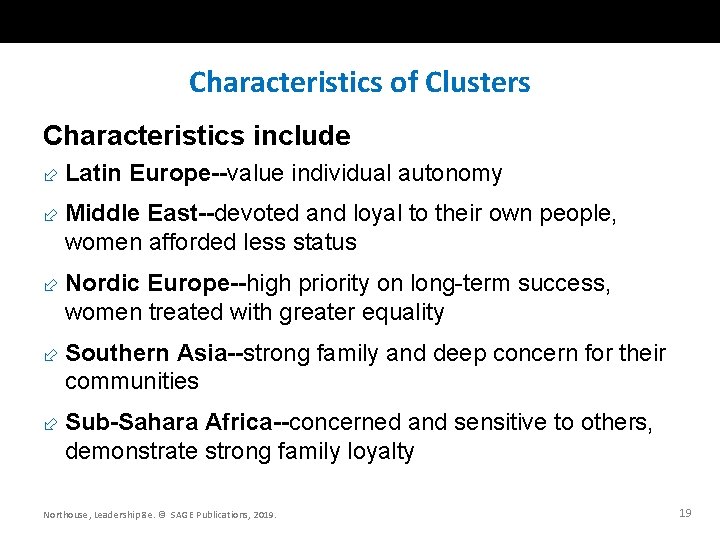
Characteristics of Clusters Characteristics include ÷ Latin Europe--value individual autonomy ÷ Middle East--devoted and loyal to their own people, women afforded less status ÷ Nordic Europe--high priority on long-term success, women treated with greater equality ÷ Southern Asia--strong family and deep concern for their communities ÷ Sub-Sahara Africa--concerned and sensitive to others, demonstrate strong family loyalty Northouse, Leadership 8 e. © SAGE Publications, 2019. 19
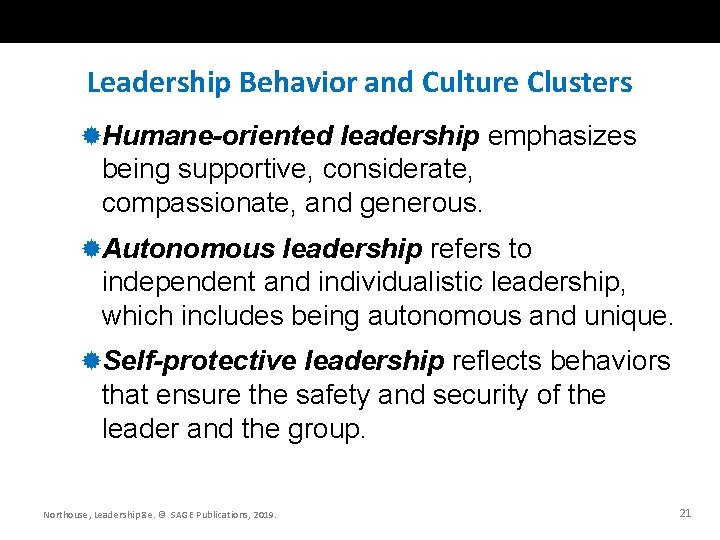
Leadership Behavior and Culture Clusters ÷ GLOBE research identified six global leadership behaviors ® Charismatic/value-based leadership reflects the ability to inspire, to motivate, and to expect high performance from others based on strongly held core values. ® Team-oriented leadership emphasizes team building and a common purpose among team members. ® Participative leadership reflects the degree to which leaders involve others in making and implementing decisions. Northouse, Leadership 8 e. © SAGE Publications, 2019. 20
Leadership Behavior and Culture Clusters ®Humane-oriented leadership emphasizes being supportive, considerate, compassionate, and generous. ®Autonomous leadership refers to independent and individualistic leadership, which includes being autonomous and unique. ®Self-protective leadership reflects behaviors that ensure the safety and security of the leader and the group. Northouse, Leadership 8 e. © SAGE Publications, 2019. 21
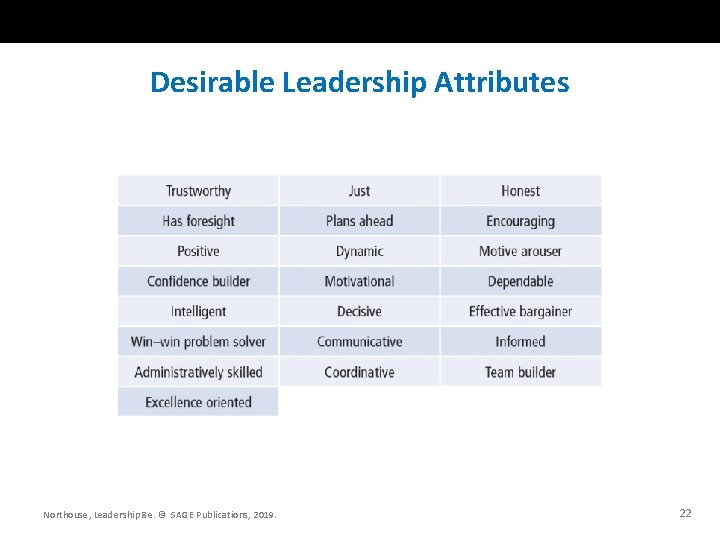
Desirable Leadership Attributes Northouse, Leadership 8 e. © SAGE Publications, 2019. 22
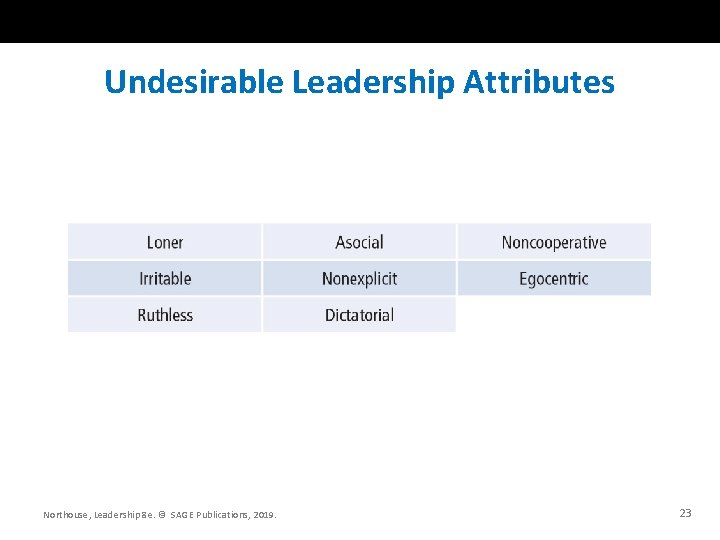
Undesirable Leadership Attributes Northouse, Leadership 8 e. © SAGE Publications, 2019. 23
Culture and Leadership ÷ Strengths ÷ Criticisms ÷ Application Northouse, Leadership 8 e. © SAGE Publications, 2019. 24
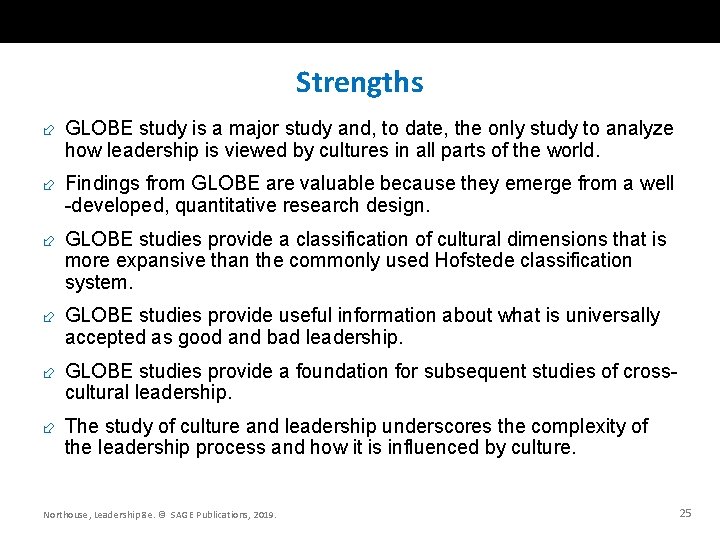
Strengths ÷ GLOBE study is a major study and, to date, the only study to analyze how leadership is viewed by cultures in all parts of the world. ÷ Findings from GLOBE are valuable because they emerge from a well -developed, quantitative research design. ÷ GLOBE studies provide a classification of cultural dimensions that is more expansive than the commonly used Hofstede classification system. ÷ GLOBE studies provide useful information about what is universally accepted as good and bad leadership. ÷ GLOBE studies provide a foundation for subsequent studies of cross- cultural leadership. ÷ The study of culture and leadership underscores the complexity of the leadership process and how it is influenced by culture. Northouse, Leadership 8 e. © SAGE Publications, 2019. 25
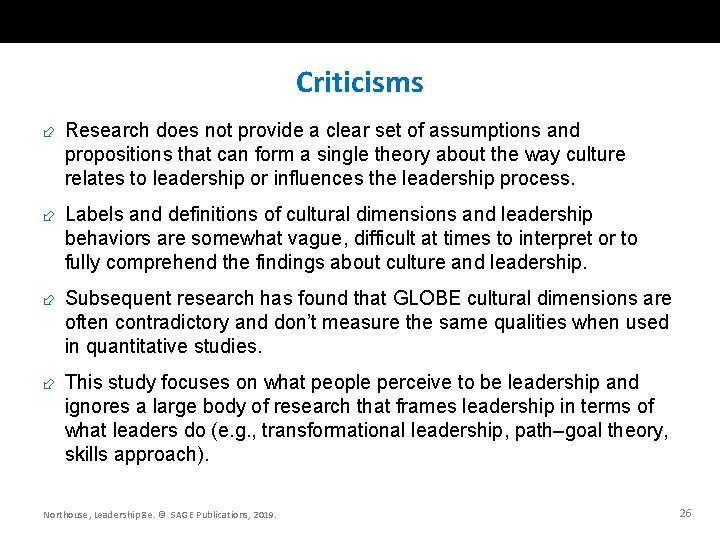
Criticisms ÷ Research does not provide a clear set of assumptions and propositions that can form a single theory about the way culture relates to leadership or influences the leadership process. ÷ Labels and definitions of cultural dimensions and leadership behaviors are somewhat vague, difficult at times to interpret or to fully comprehend the findings about culture and leadership. ÷ Subsequent research has found that GLOBE cultural dimensions are often contradictory and don’t measure the same qualities when used in quantitative studies. ÷ This study focuses on what people perceive to be leadership and ignores a large body of research that frames leadership in terms of what leaders do (e. g. , transformational leadership, path–goal theory, skills approach). Northouse, Leadership 8 e. © SAGE Publications, 2019. 26
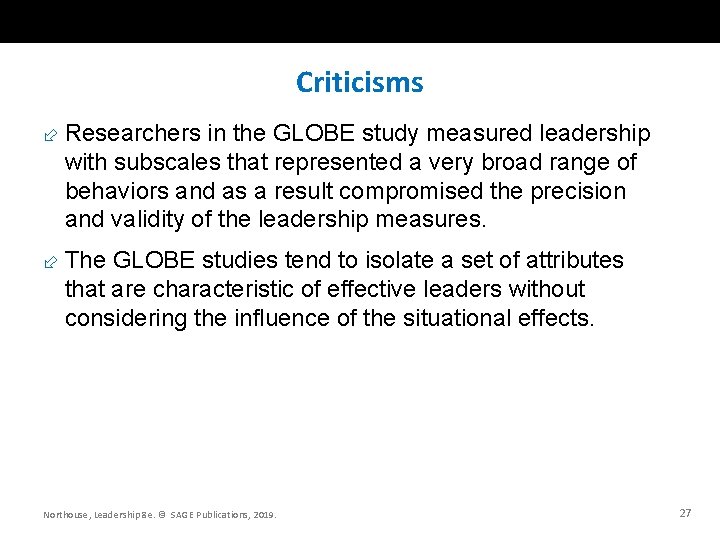
Criticisms ÷ Researchers in the GLOBE study measured leadership with subscales that represented a very broad range of behaviors and as a result compromised the precision and validity of the leadership measures. ÷ The GLOBE studies tend to isolate a set of attributes that are characteristic of effective leaders without considering the influence of the situational effects. Northouse, Leadership 8 e. © SAGE Publications, 2019. 27
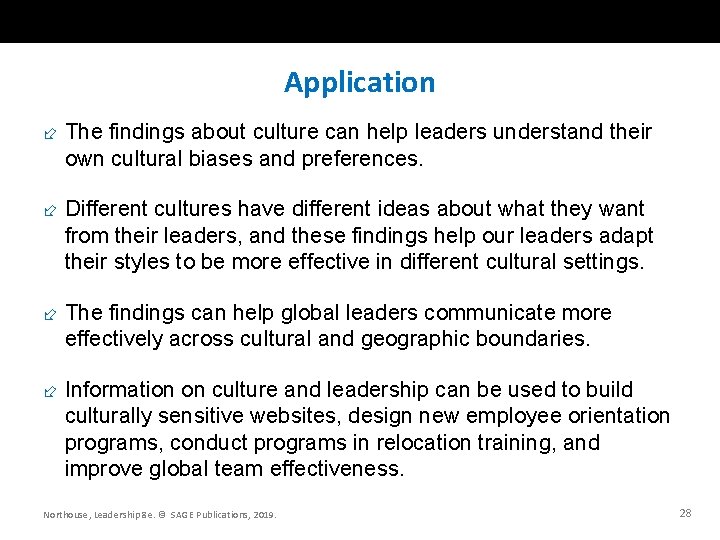
Application ÷ The findings about culture can help leaders understand their own cultural biases and preferences. ÷ Different cultures have different ideas about what they want from their leaders, and these findings help our leaders adapt their styles to be more effective in different cultural settings. ÷ The findings can help global leaders communicate more effectively across cultural and geographic boundaries. ÷ Information on culture and leadership can be used to build culturally sensitive websites, design new employee orientation programs, conduct programs in relocation training, and improve global team effectiveness. Northouse, Leadership 8 e. © SAGE Publications, 2019. 28