
Culture and Leadership Chapter 16 Culture and Leadership
- Slides: 26
Culture and Leadership Chapter 16: Culture and Leadership
Overview ÷ Culture and Leadership Description ÷ Culture Defined ÷ Related Concepts ÷ Dimensions of Culture ÷ Clusters of World Cultures ÷ Characteristics of Clusters ÷ Leadership Behavior & Culture Clusters ÷ Universally Desirable & Undesirable Leadership Attributes ÷ Culture and Leadership Peter G. Northouse, Leadership: Theory and Practice, Seventh Edition. © 2016 SAGE Publications, Inc.
Culture & Leadership Description ÷ Culture & Leadership – focuses on a collection of related ideas rather than a single unified theory ÷ Globalization – ® Increased after World War II ® Increased interdependence between nations • Economic, social, technical, political ® Has created many challenges • Need to design multi-national organizations • Identify and select leaders for these organizations • Manage organizations with culturally diverse employees
Culture & Leadership Description Five cross-cultural competencies for Leaders (Adler Bartholomew, 1992) 1. Understand business, political, & cultural environments 2. 3. 4. 5. worldwide Learn the perspectives, tastes, trends, & technologies of many cultures Be able to work simultaneously with people from many cultures Be able to adapt to living & communicating in other cultures Need to learn to relate to people from other cultures from a position of equality rather than superiority Peter G. Northouse, Leadership: Theory and Practice, Seventh Edition. © 2016 SAGE Publications, Inc.
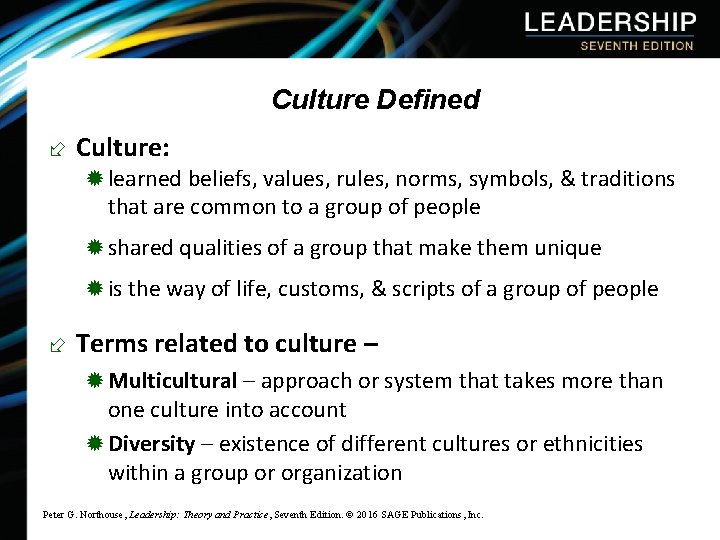
Culture Defined ÷ Culture: ® learned beliefs, values, rules, norms, symbols, & traditions that are common to a group of people ® shared qualities of a group that make them unique ® is the way of life, customs, & scripts of a group of people ÷ Terms related to culture – ® Multicultural – approach or system that takes more than one culture into account ® Diversity – existence of different cultures or ethnicities within a group or organization Peter G. Northouse, Leadership: Theory and Practice, Seventh Edition. © 2016 SAGE Publications, Inc.
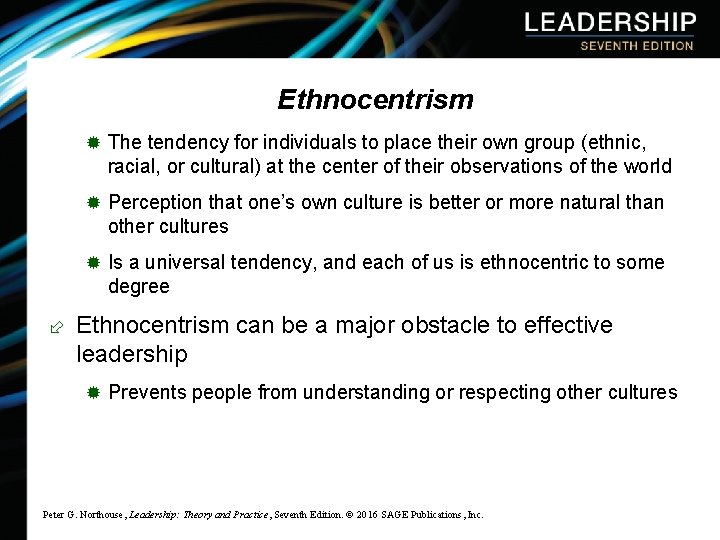
Ethnocentrism ® The tendency for individuals to place their own group (ethnic, racial, or cultural) at the center of their observations of the world ® Perception that one’s own culture is better or more natural than other cultures ® Is a universal tendency, and each of us is ethnocentric to some degree ÷ Ethnocentrism can be a major obstacle to effective leadership ® Prevents people from understanding or respecting other cultures Peter G. Northouse, Leadership: Theory and Practice, Seventh Edition. © 2016 SAGE Publications, Inc.
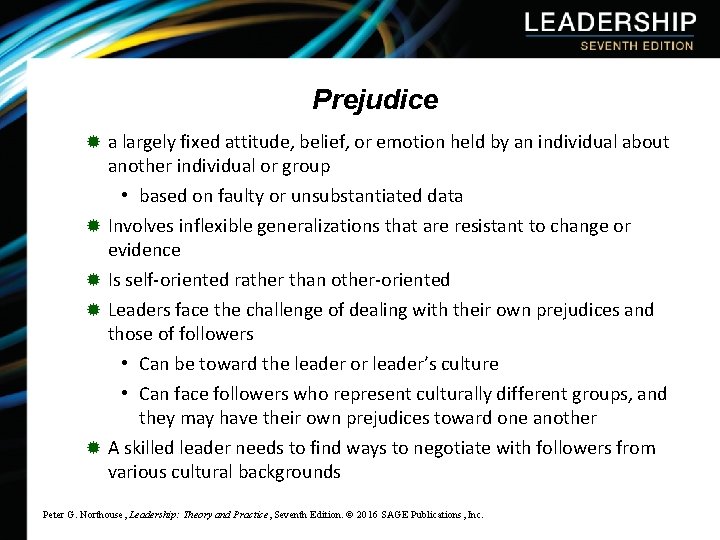
Prejudice ® a largely fixed attitude, belief, or emotion held by an individual about ® ® another individual or group • based on faulty or unsubstantiated data Involves inflexible generalizations that are resistant to change or evidence Is self-oriented rather than other-oriented Leaders face the challenge of dealing with their own prejudices and those of followers • Can be toward the leader or leader’s culture • Can face followers who represent culturally different groups, and they may have their own prejudices toward one another A skilled leader needs to find ways to negotiate with followers from various cultural backgrounds Peter G. Northouse, Leadership: Theory and Practice, Seventh Edition. © 2016 SAGE Publications, Inc.
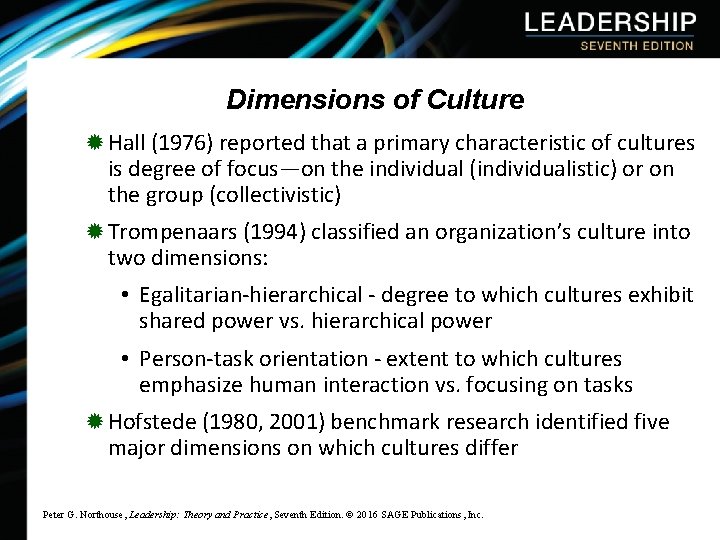
Dimensions of Culture ® Hall (1976) reported that a primary characteristic of cultures is degree of focus—on the individual (individualistic) or on the group (collectivistic) ® Trompenaars (1994) classified an organization’s culture into two dimensions: • Egalitarian-hierarchical - degree to which cultures exhibit shared power vs. hierarchical power • Person-task orientation - extent to which cultures emphasize human interaction vs. focusing on tasks ® Hofstede (1980, 2001) benchmark research identified five major dimensions on which cultures differ Peter G. Northouse, Leadership: Theory and Practice, Seventh Edition. © 2016 SAGE Publications, Inc.
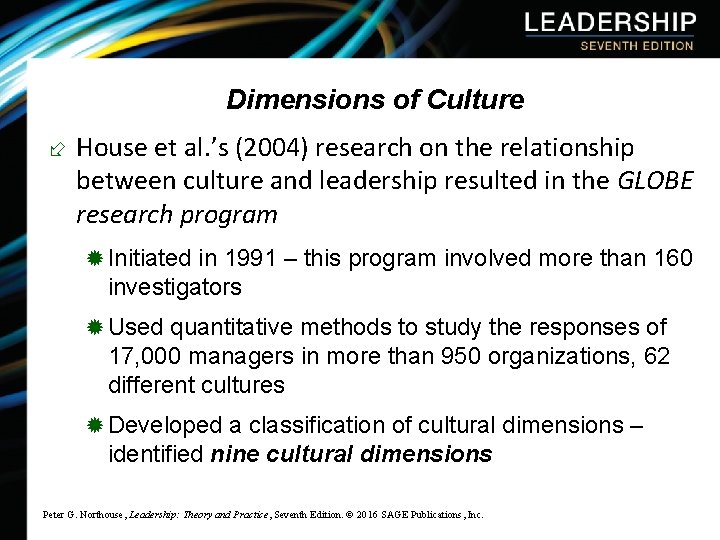
Dimensions of Culture ÷ House et al. ’s (2004) research on the relationship between culture and leadership resulted in the GLOBE research program ® Initiated in 1991 – this program involved more than 160 investigators ® Used quantitative methods to study the responses of 17, 000 managers in more than 950 organizations, 62 different cultures ® Developed a classification of cultural dimensions – identified nine cultural dimensions Peter G. Northouse, Leadership: Theory and Practice, Seventh Edition. © 2016 SAGE Publications, Inc.
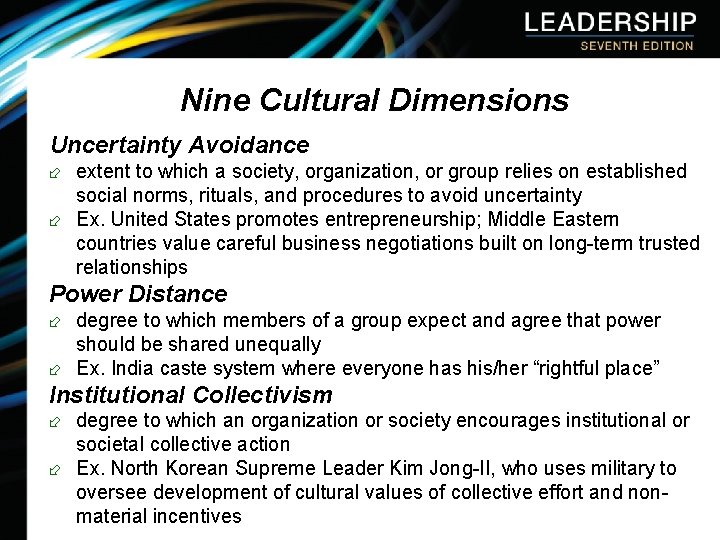
Nine Cultural Dimensions Uncertainty Avoidance ÷ extent to which a society, organization, or group relies on established social norms, rituals, and procedures to avoid uncertainty ÷ Ex. United States promotes entrepreneurship; Middle Eastern countries value careful business negotiations built on long-term trusted relationships Power Distance ÷ degree to which members of a group expect and agree that power should be shared unequally ÷ Ex. India caste system where everyone has his/her “rightful place” Institutional Collectivism ÷ degree to which an organization or society encourages institutional or societal collective action ÷ Ex. North Korean Supreme Leader Kim Jong-II, who uses military to oversee development of cultural values of collective effort and nonmaterial incentives
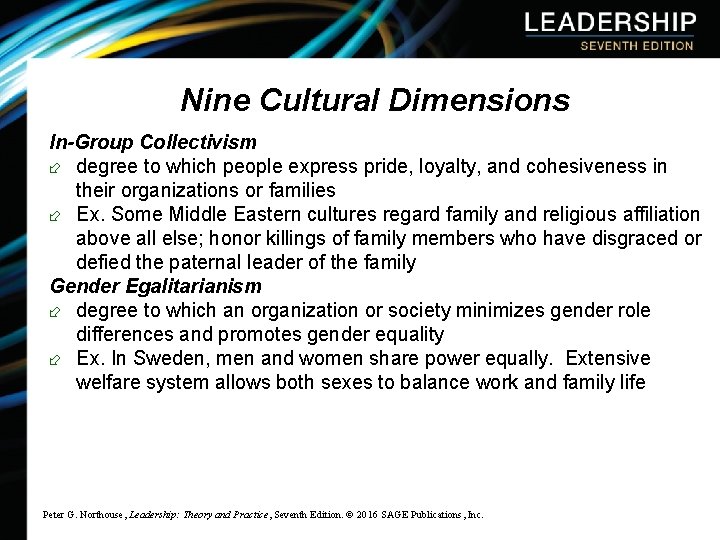
Nine Cultural Dimensions In-Group Collectivism ÷ degree to which people express pride, loyalty, and cohesiveness in their organizations or families ÷ Ex. Some Middle Eastern cultures regard family and religious affiliation above all else; honor killings of family members who have disgraced or defied the paternal leader of the family Gender Egalitarianism ÷ degree to which an organization or society minimizes gender role differences and promotes gender equality ÷ Ex. In Sweden, men and women share power equally. Extensive welfare system allows both sexes to balance work and family life Peter G. Northouse, Leadership: Theory and Practice, Seventh Edition. © 2016 SAGE Publications, Inc.
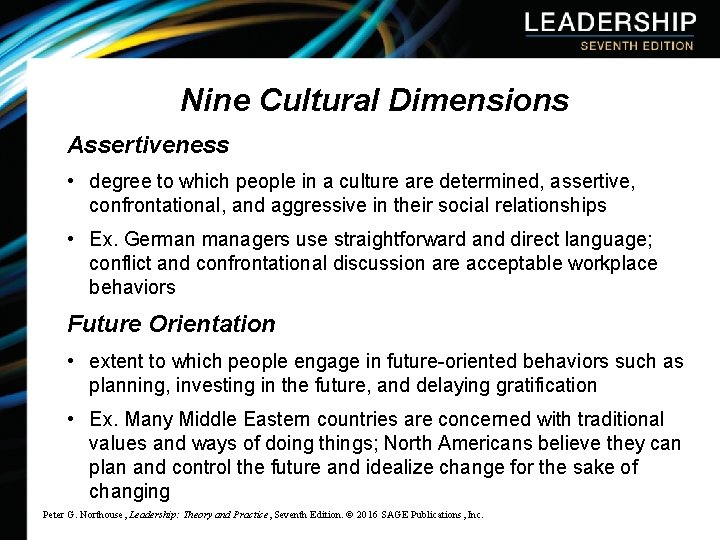
Nine Cultural Dimensions Assertiveness • degree to which people in a culture are determined, assertive, confrontational, and aggressive in their social relationships • Ex. German managers use straightforward and direct language; conflict and confrontational discussion are acceptable workplace behaviors Future Orientation • extent to which people engage in future-oriented behaviors such as planning, investing in the future, and delaying gratification • Ex. Many Middle Eastern countries are concerned with traditional values and ways of doing things; North Americans believe they can plan and control the future and idealize change for the sake of changing Peter G. Northouse, Leadership: Theory and Practice, Seventh Edition. © 2016 SAGE Publications, Inc.
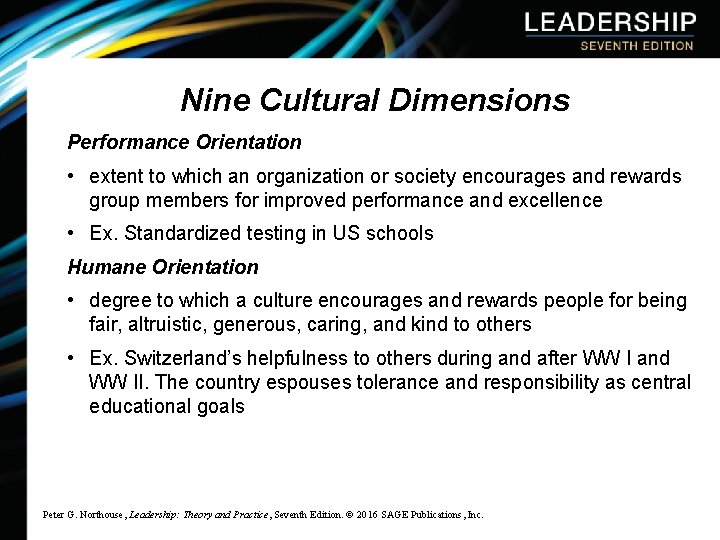
Nine Cultural Dimensions Performance Orientation • extent to which an organization or society encourages and rewards group members for improved performance and excellence • Ex. Standardized testing in US schools Humane Orientation • degree to which a culture encourages and rewards people for being fair, altruistic, generous, caring, and kind to others • Ex. Switzerland’s helpfulness to others during and after WW I and WW II. The country espouses tolerance and responsibility as central educational goals Peter G. Northouse, Leadership: Theory and Practice, Seventh Edition. © 2016 SAGE Publications, Inc.
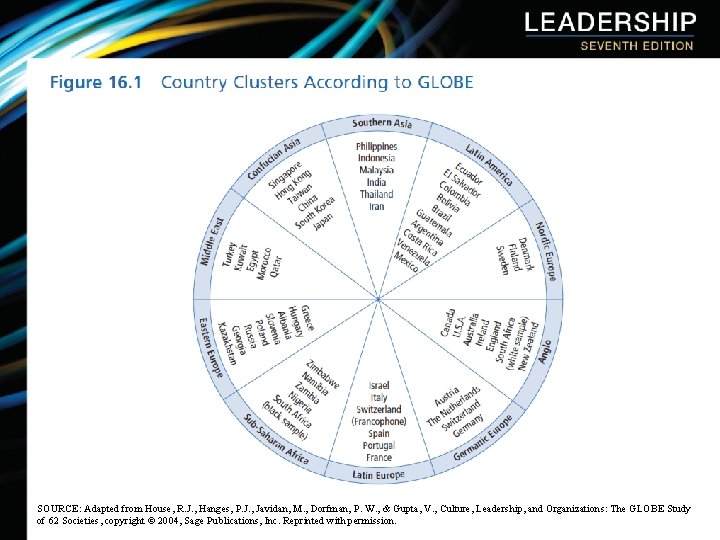
SOURCE: Adapted from House, R. J. , Hanges, P. J. , Javidan, M. , Dorfman, P. W. , & Gupta, V. , Culture, Leadership, and Organizations: The GLOBE Study of 62 Societies, copyright © 2004, Sage Publications, Inc. Reprinted with permission.
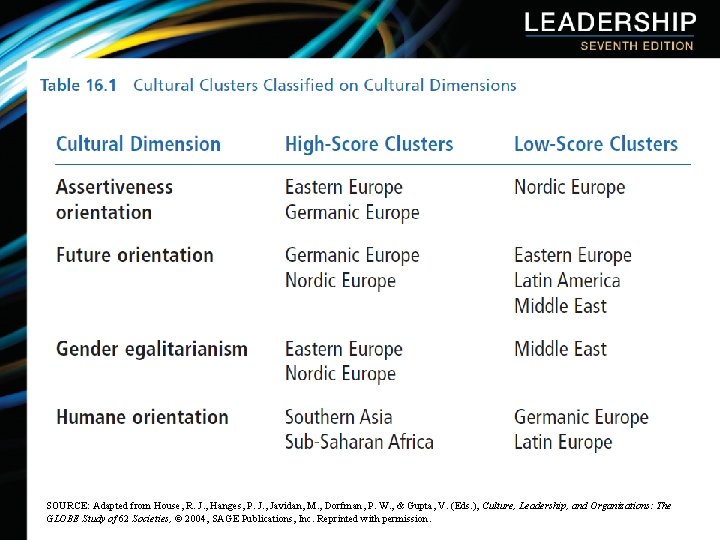
SOURCE: Adapted from House, R. J. , Hanges, P. J. , Javidan, M. , Dorfman, P. W. , & Gupta, V. (Eds. ), Culture, Leadership, and Organizations: The GLOBE Study of 62 Societies, © 2004, SAGE Publications, Inc. Reprinted with permission.
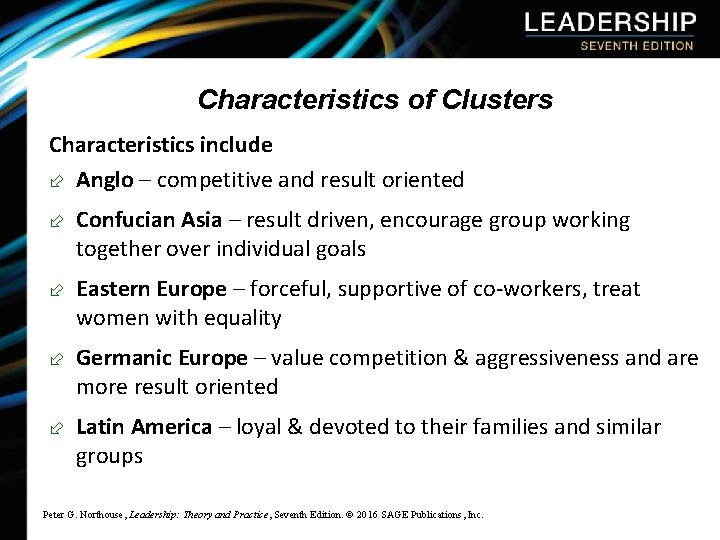
Characteristics of Clusters Characteristics include ÷ Anglo – competitive and result oriented ÷ Confucian Asia – result driven, encourage group working together over individual goals ÷ Eastern Europe – forceful, supportive of co-workers, treat women with equality ÷ Germanic Europe – value competition & aggressiveness and are more result oriented ÷ Latin America – loyal & devoted to their families and similar groups Peter G. Northouse, Leadership: Theory and Practice, Seventh Edition. © 2016 SAGE Publications, Inc.
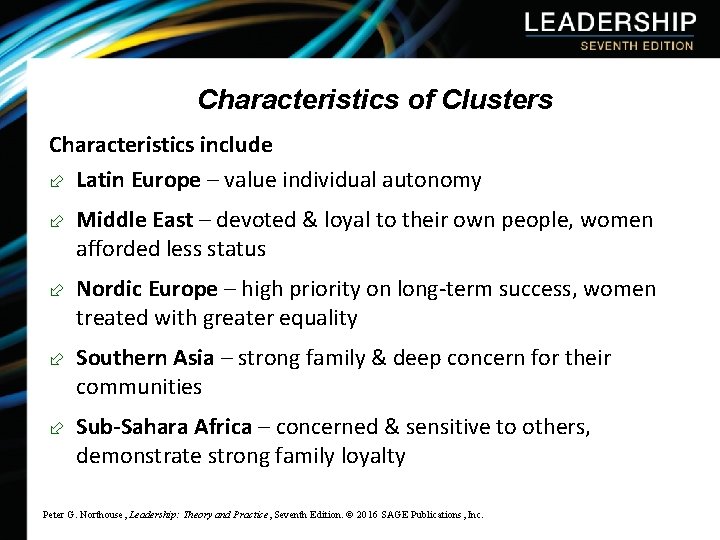
Characteristics of Clusters Characteristics include ÷ Latin Europe – value individual autonomy ÷ Middle East – devoted & loyal to their own people, women afforded less status ÷ Nordic Europe – high priority on long-term success, women treated with greater equality ÷ Southern Asia – strong family & deep concern for their communities ÷ Sub-Sahara Africa – concerned & sensitive to others, demonstrate strong family loyalty Peter G. Northouse, Leadership: Theory and Practice, Seventh Edition. © 2016 SAGE Publications, Inc.
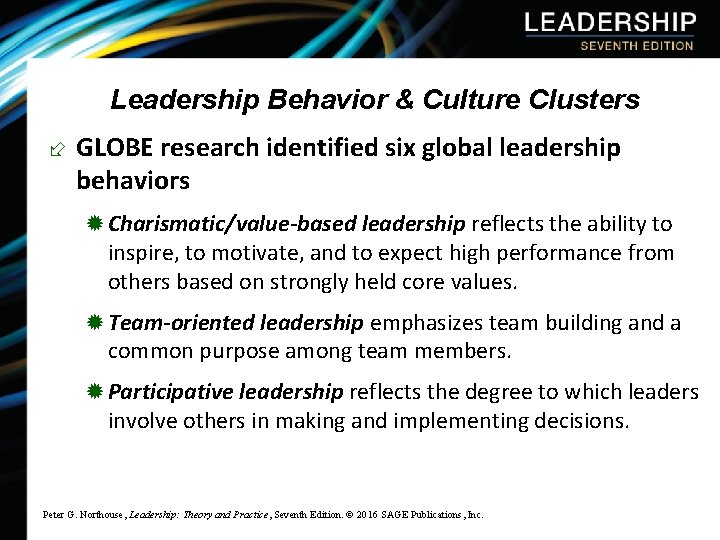
Leadership Behavior & Culture Clusters ÷ GLOBE research identified six global leadership behaviors ® Charismatic/value-based leadership reflects the ability to inspire, to motivate, and to expect high performance from others based on strongly held core values. ® Team-oriented leadership emphasizes team building and a common purpose among team members. ® Participative leadership reflects the degree to which leaders involve others in making and implementing decisions. Peter G. Northouse, Leadership: Theory and Practice, Seventh Edition. © 2016 SAGE Publications, Inc.
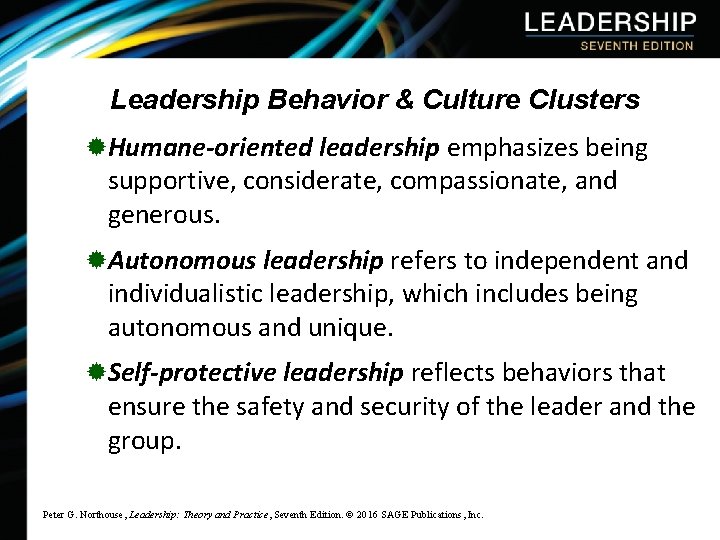
Leadership Behavior & Culture Clusters ®Humane-oriented leadership emphasizes being supportive, considerate, compassionate, and generous. ®Autonomous leadership refers to independent and individualistic leadership, which includes being autonomous and unique. ®Self-protective leadership reflects behaviors that ensure the safety and security of the leader and the group. Peter G. Northouse, Leadership: Theory and Practice, Seventh Edition. © 2016 SAGE Publications, Inc.
SOURCE: Adapted from House, R. J. , Hanges, P. J. , Javidan, M. , Dorfman, P. W. , & Gupta, V. , Culture, Leadership, and Organizations: The GLOBE Study of 62 Societies, copyright © 2004, Sage Publications, Inc. Reprinted with permission.
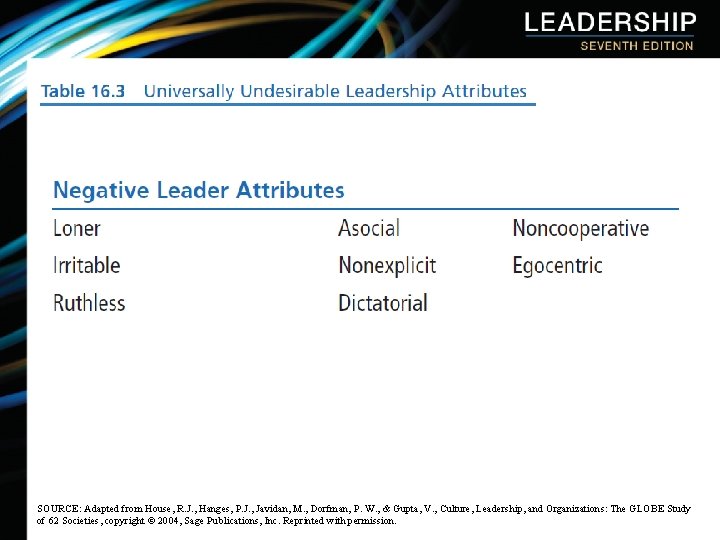
SOURCE: Adapted from House, R. J. , Hanges, P. J. , Javidan, M. , Dorfman, P. W. , & Gupta, V. , Culture, Leadership, and Organizations: The GLOBE Study of 62 Societies, copyright © 2004, Sage Publications, Inc. Reprinted with permission.
Culture and Leadership ÷ Strengths ÷ Criticisms ÷ Application
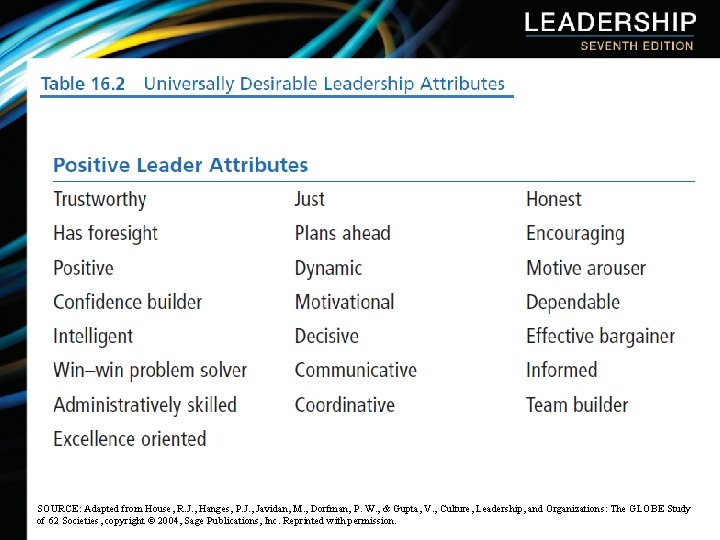
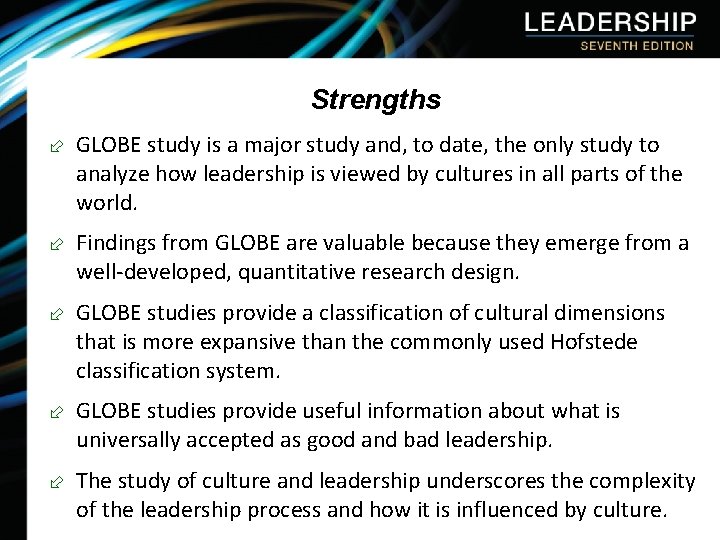
Strengths ÷ GLOBE study is a major study and, to date, the only study to analyze how leadership is viewed by cultures in all parts of the world. ÷ Findings from GLOBE are valuable because they emerge from a well-developed, quantitative research design. ÷ GLOBE studies provide a classification of cultural dimensions that is more expansive than the commonly used Hofstede classification system. ÷ GLOBE studies provide useful information about what is universally accepted as good and bad leadership. ÷ The study of culture and leadership underscores the complexity of the leadership process and how it is influenced by culture.
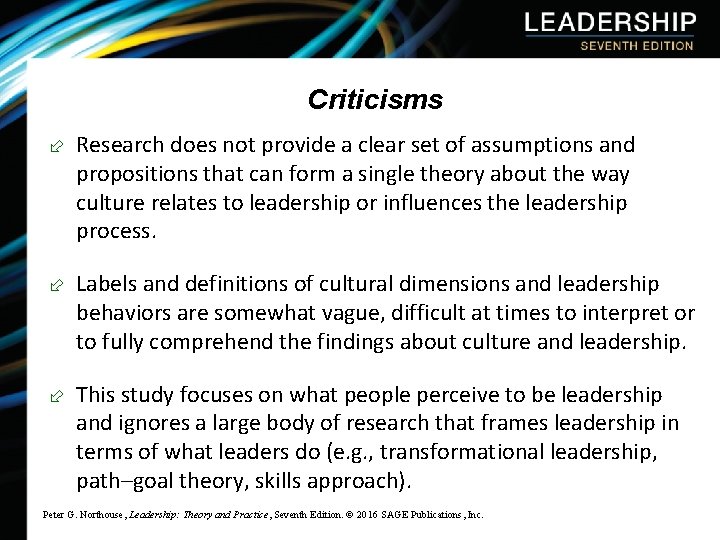
Criticisms ÷ Research does not provide a clear set of assumptions and propositions that can form a single theory about the way culture relates to leadership or influences the leadership process. ÷ Labels and definitions of cultural dimensions and leadership behaviors are somewhat vague, difficult at times to interpret or to fully comprehend the findings about culture and leadership. ÷ This study focuses on what people perceive to be leadership and ignores a large body of research that frames leadership in terms of what leaders do (e. g. , transformational leadership, path–goal theory, skills approach). Peter G. Northouse, Leadership: Theory and Practice, Seventh Edition. © 2016 SAGE Publications, Inc.
Criticisms ÷ Researchers in the GLOBE study measured leadership with subscales that represented a very broad range of behaviors and as a result compromised the precision and validity of the leadership measures. ÷ The GLOBE studies tend to isolate a set of attributes that are characteristic of effective leaders without considering the influence of the situational effects. Peter G. Northouse, Leadership: Theory and Practice, Seventh Edition. © 2016 SAGE Publications, Inc.
Application ÷ The findings about culture can help leaders understand their own cultural biases and preferences. ÷ Different cultures have different ideas about what they want from their leaders, and these findings help our leaders adapt their styles to be more effective in different cultural settings. ÷ The findings can help global leaders communicate more effectively across cultural and geographic boundaries. ÷ Information on culture and leadership can be used to build culturally sensitive websites, design new employee orientation programs, conduct programs in relocation training, and improve global team effectiveness.