
Culture and Isolation of Bacteria Copyright Mc GrawHill
Culture and Isolation of Bacteria Copyright © Mc. Graw-Hill Education. All rights reserved. No reproduction or distribution without the prior written consent of Mc. Graw-Hill Education.
2 Copyright © Mc. Graw-Hill Education. All rights reserved. No reproduction or distribution without the prior written consent of Mc. Graw-Hill Education.
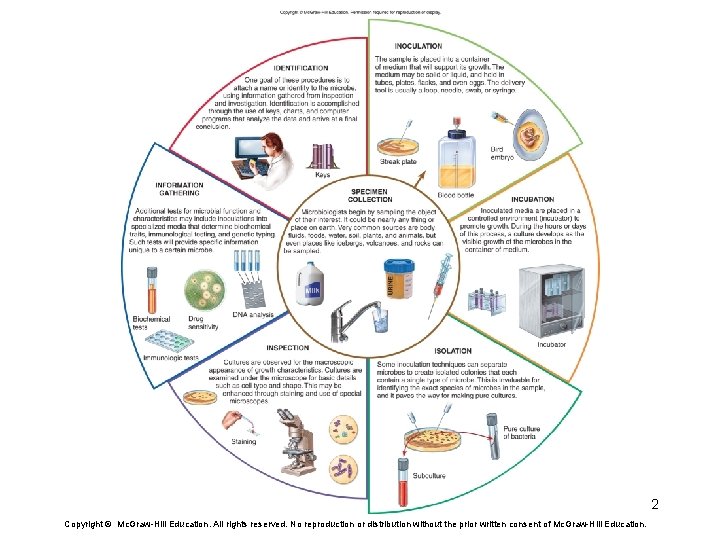
1. Streak Plate Method: • This method is used most commonly to isolate pure cultures of bacteria. • a small amount of mixed culture is placed on the tip of an inoculation loop/needle and is streaked across the surface of the agar medium • successive streaks “thin out” the inoculum sufficiently and the micro-organisms are separated from each other. 3 Copyright © Mc. Graw-Hill Education. All rights reserved. No reproduction or distribution without the prior written consent of Mc. Graw-Hill Education.
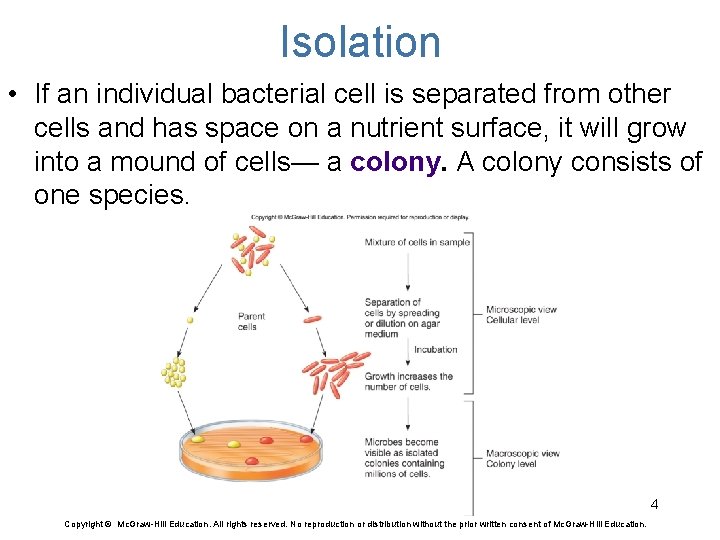
Isolation • If an individual bacterial cell is separated from other cells and has space on a nutrient surface, it will grow into a mound of cells— a colony. A colony consists of one species. 4 Copyright © Mc. Graw-Hill Education. All rights reserved. No reproduction or distribution without the prior written consent of Mc. Graw-Hill Education.
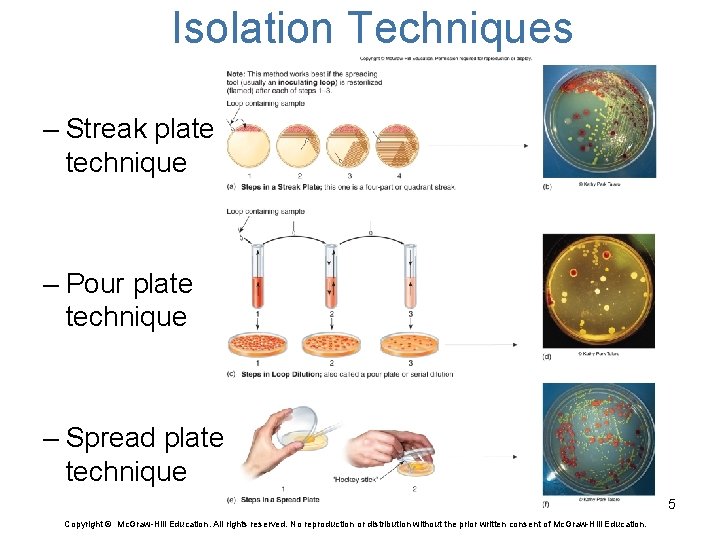
Isolation Techniques – Streak plate technique – Pour plate technique – Spread plate technique 5 Copyright © Mc. Graw-Hill Education. All rights reserved. No reproduction or distribution without the prior written consent of Mc. Graw-Hill Education.
Media: Providing Nutrients in the Laboratory Media can be classified according to three properties: 1. Physical state – liquid, semisolid, and solid 2. Chemical composition – synthetic (chemically defined) and complex 3. Functional type – general purpose, enriched, selective, differential, anaerobic, transport, assay, enumeration 6 Copyright © Mc. Graw-Hill Education. All rights reserved. No reproduction or distribution without the prior written consent of Mc. Graw-Hill Education.
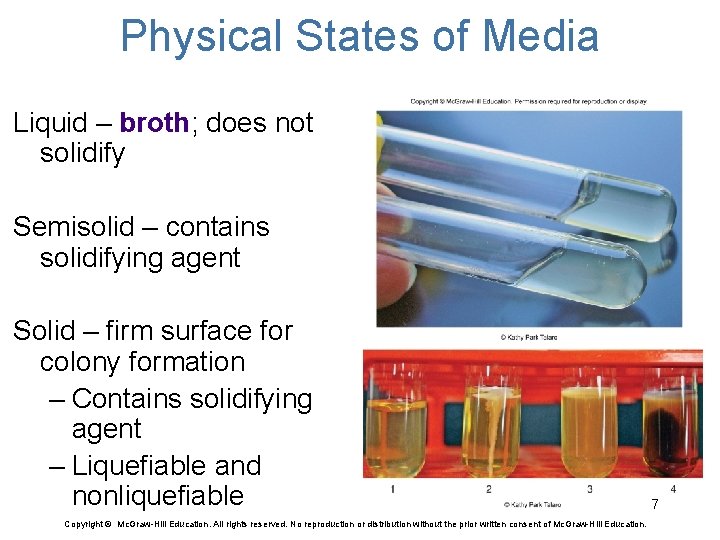
Physical States of Media Liquid – broth; does not solidify Semisolid – contains solidifying agent Solid – firm surface for colony formation – Contains solidifying agent – Liquefiable and nonliquefiable Copyright © Mc. Graw-Hill Education. All rights reserved. No reproduction or distribution without the prior written consent of Mc. Graw-Hill Education. 7
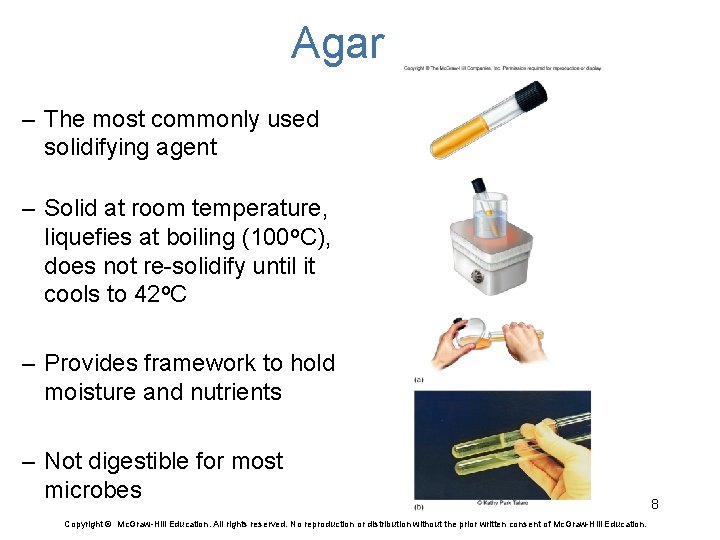
Agar – The most commonly used solidifying agent – Solid at room temperature, liquefies at boiling (100 o. C), does not re-solidify until it cools to 42 o. C – Provides framework to hold moisture and nutrients – Not digestible for most microbes Copyright © Mc. Graw-Hill Education. All rights reserved. No reproduction or distribution without the prior written consent of Mc. Graw-Hill Education. 8
Most Commonly Used Media – Nutrient broth – liquid medium containing beef extract and peptone – Nutrient agar – solid media containing beef extract, peptone, and agar 9 Copyright © Mc. Graw-Hill Education. All rights reserved. No reproduction or distribution without the prior written consent of Mc. Graw-Hill Education.
Chemical Content of Media • Synthetic – contains pure organic and inorganic compounds in an exact chemical formula • Complex or nonsynthetic – contains at least one ingredient that is not chemically definable • General purpose media – grows a broad range of microbes, usually nonsynthetic • Enriched media – contains complex organic substances such as blood, serum, hemoglobin, or special growth factors required by fastidious microbes 10 Copyright © Mc. Graw-Hill Education. All rights reserved. No reproduction or distribution without the prior written consent of Mc. Graw-Hill Education.
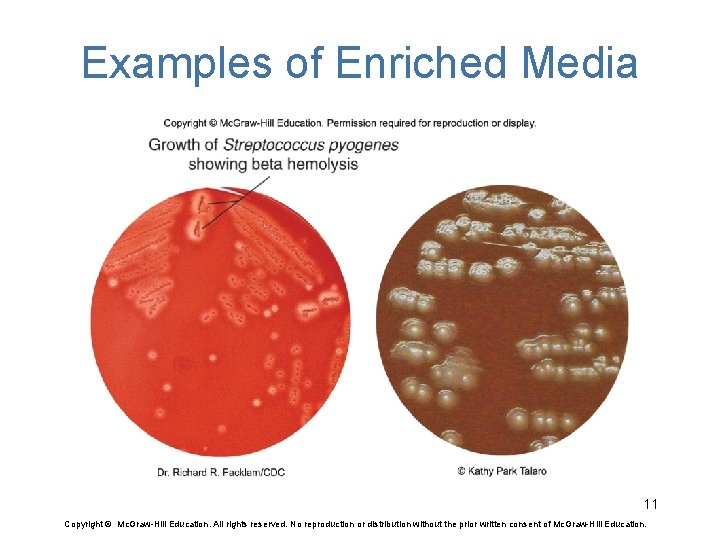
Examples of Enriched Media 11 Copyright © Mc. Graw-Hill Education. All rights reserved. No reproduction or distribution without the prior written consent of Mc. Graw-Hill Education.
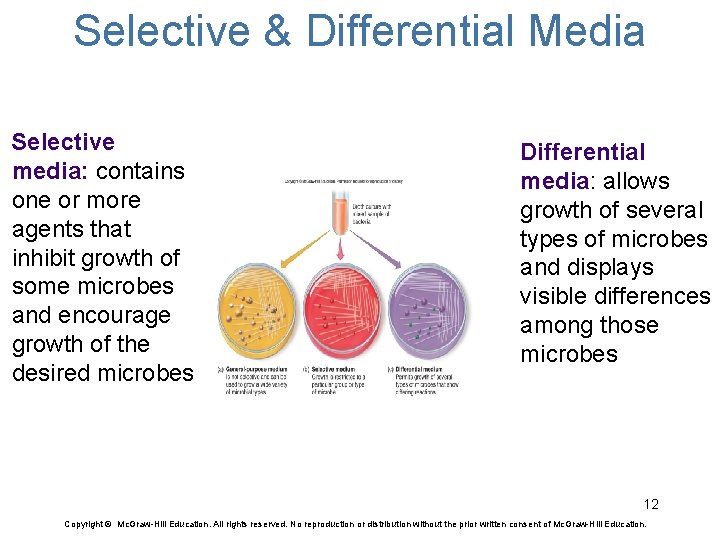
Selective & Differential Media Selective media: contains one or more agents that inhibit growth of some microbes and encourage growth of the desired microbes Differential media: allows growth of several types of microbes and displays visible differences among those microbes 12 Copyright © Mc. Graw-Hill Education. All rights reserved. No reproduction or distribution without the prior written consent of Mc. Graw-Hill Education.
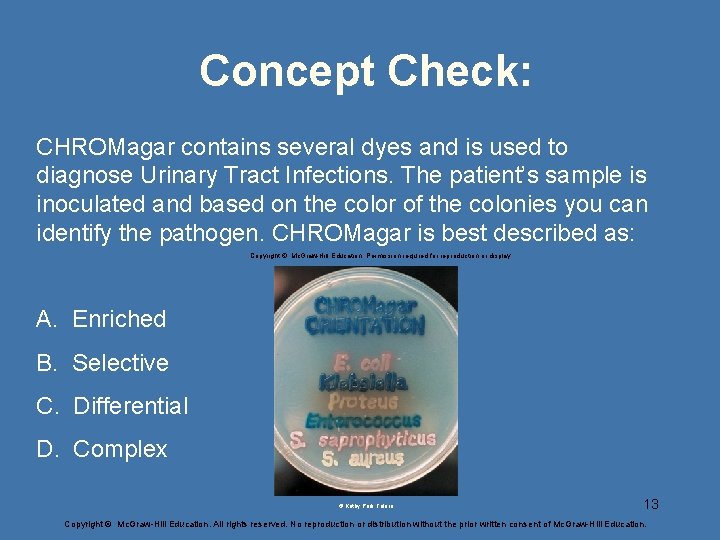
Concept Check: CHROMagar contains several dyes and is used to diagnose Urinary Tract Infections. The patient’s sample is inoculated and based on the color of the colonies you can identify the pathogen. CHROMagar is best described as: Copyright © Mc. Graw-Hill Education. Permission required for reproduction or display. A. Enriched B. Selective C. Differential D. Complex © Kathy Park Talaro 13 Copyright © Mc. Graw-Hill Education. All rights reserved. No reproduction or distribution without the prior written consent of Mc. Graw-Hill Education.
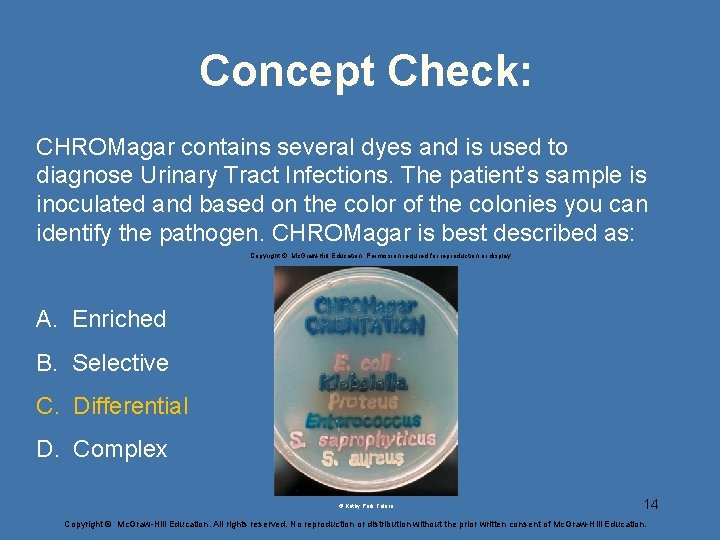
Concept Check: CHROMagar contains several dyes and is used to diagnose Urinary Tract Infections. The patient’s sample is inoculated and based on the color of the colonies you can identify the pathogen. CHROMagar is best described as: Copyright © Mc. Graw-Hill Education. Permission required for reproduction or display. A. Enriched B. Selective C. Differential D. Complex © Kathy Park Talaro 14 Copyright © Mc. Graw-Hill Education. All rights reserved. No reproduction or distribution without the prior written consent of Mc. Graw-Hill Education.
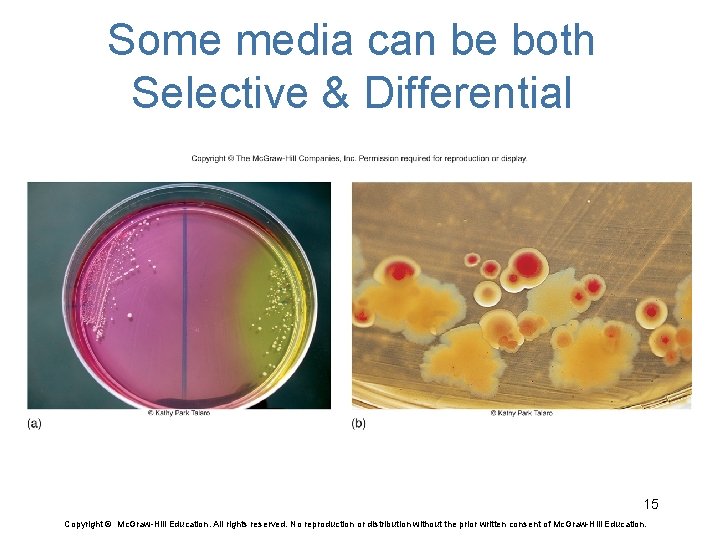
Some media can be both Selective & Differential 15 Copyright © Mc. Graw-Hill Education. All rights reserved. No reproduction or distribution without the prior written consent of Mc. Graw-Hill Education.
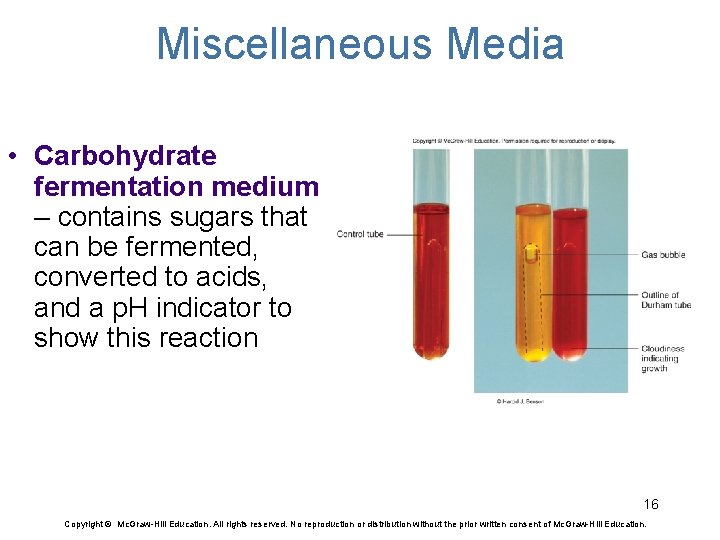
Miscellaneous Media • Carbohydrate fermentation medium – contains sugars that can be fermented, converted to acids, and a p. H indicator to show this reaction 16 Copyright © Mc. Graw-Hill Education. All rights reserved. No reproduction or distribution without the prior written consent of Mc. Graw-Hill Education.
- Slides: 16