
Culture and History Im not talking about bacterial
Culture and History I’m not talking about bacterial cultures and those boring classes on the 3 rd floor.
Objective �SWBAT define “Culture” and describe the influences which force cultural change, as well as identify the major influences which caused the 2 major cultural changes to occur for modern humans.

Culture �What is “Culture”? �Webster says it is – “the customs, arts, social institutions, and achievements of a particular nation, people, or other social group. ” �Does culture remain constant? �What might induce cultural change? �A “seminal event”. �Since early humans, their have been 2 major cultural shifts. We need to understand the forces that created the conditions for these changes.
Early Humans �Modern humans have walked the Earth for arguably 60, 000 years. �The earliest human societies were “huntergatherer”. �What does this mean? �Nomadic �Subsistence farming �Populations grew slowly �“Dwellers in Nature” �Environmental impact was limited and local �Inter-societal conflict was rare, due to vast distances �But, populations began to grow, and…. . ?
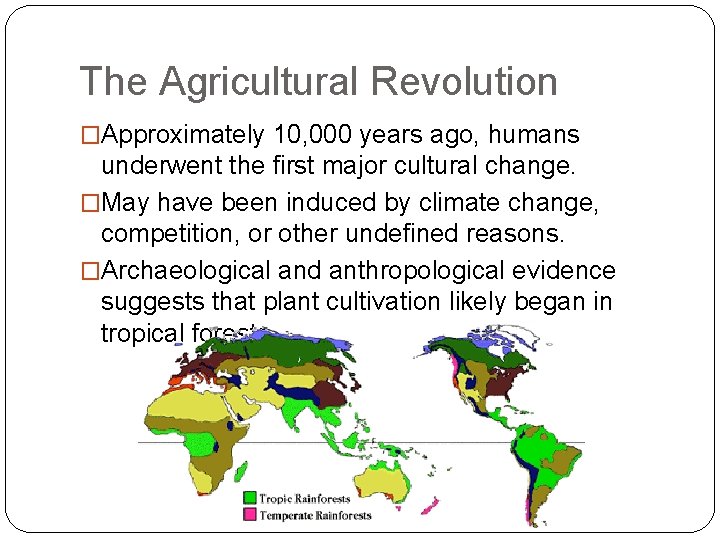
The Agricultural Revolution �Approximately 10, 000 years ago, humans underwent the first major cultural change. �May have been induced by climate change, competition, or other undefined reasons. �Archaeological and anthropological evidence suggests that plant cultivation likely began in tropical forests.

Cultivation �The planting, care, and harvesting of crops. �Evidence suggests early farmers practiced a technique of “slash-and-burn” cultivation.
Cultivation (continued) �What metalurgical development allowed humans to ease the task of planting crops? �The humble plow. �Eventually, humans turned to beasts of burden to make farming easier and more efficient. �Larger fields were employed and irrigation developed. �What happened to the birth rate as a result of these changes in farming practices? �Populations began to grow more rapidly.
Cultivation (continued) �Nomadic lifestyles gave way to (relatively) permanent settlements. �Subsistence farming faded as farmers could grow more than they needed to survive. �As a result of these 2 changes, urbanization occurred. Villages, small towns, and cities formed. �Competition for land between societies and conflict arose over land-use and water-rights issues.
Industrial Revolution �Societal pressures forced the need for inventions. �Efficiency became essential. �In graphing the timeline, it is clear major inventions came in “bunches”. �Often one invention would provide the idea for another. �In graphing the clusters of inventions, we can see an example of “punctuated equilibrium”.
What were the pressures? � 1712 – Invention of the steam engine �Population growing rapidly in colonies. �Need to improve machinery operation. �Discovery of rich fuel supply in central PA and WV. � 1764 – Spinning Jenny invented �War is looking likely �Supplies are needed (tents, packs, clothing, sails, etc. ) � 1769 – Improvement to the steam engine �Less dependent on sail power �Factories gear up for war machine
What were the pressures? (cont. ) � 1794 – Cotton Gin invented �Improving efficiency �Enormous profits create uber-rich class in South �Eventually led to dissatisfaction with Union � 1844 – Telegraph invented �Transatlantic travel more commonplace �Need to communicate more quickly � 1846 – Sewing machine invented �Growing population �International trade growing
What were the pressures? (cont. ) � 1853 – Elevator brake invented �Growing cities began to grow “up”, not “out” �Tragedies had people scared of tall buildings �One thought was people would pass out in high rises. � 1855 – Bessemer Method developed �Steel manufacturing accelerated �Quality could be more tightly controlled �War machine needed arms and vehicles �This is where Industrialization truly “took off”.
What were the pressures? (cont. ) � 1866 – Nobel and Dynamite �Construction safety �Building “frenzy” �Nitroglycerine used for blasting (highly unstable) � 1870 – Pasteur invents vaccines �Theory of Spontaneous Generation recently disproved �Need to understand what caused disease �City populations were increasing rapidly � 1876 – Bell invents telephone �Easier communication, less training �Available in every home � 1879 – Edison invents light bulb �Extend the workday � 1883 – Brooklyn Bridge opens (links Brooklyn and Manhattan) �Ease of transportation �How would horses, carriages, and pedestrians cross the East River prior to this?
What were the pressures? (cont. ) � 1903 – Wright Brothers fly �Fulfilling Icarus’ dream �Faster transportation �Lighter and stronger materials � 1908 – Henry Ford and the Model T �Automation of assembly �Growing population with means �Expansion of roads
- Slides: 14