
Culture and Ethnography What is Culture The more
- Slides: 48
Culture and Ethnography What is Culture? “The more or less integrated systems of ideas, feelings, and values and their associated patterns of behavior and products shared by a group of people who organize and regulate what they think, feel and
Culture and Ethnography What is Culture? An integrated system
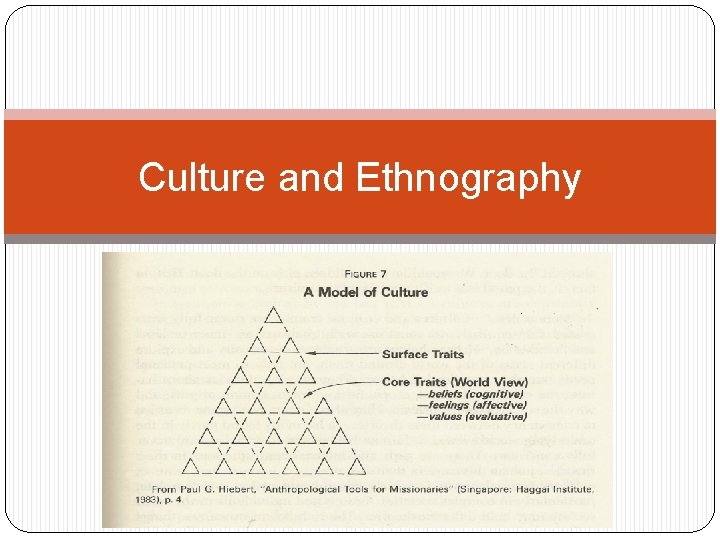
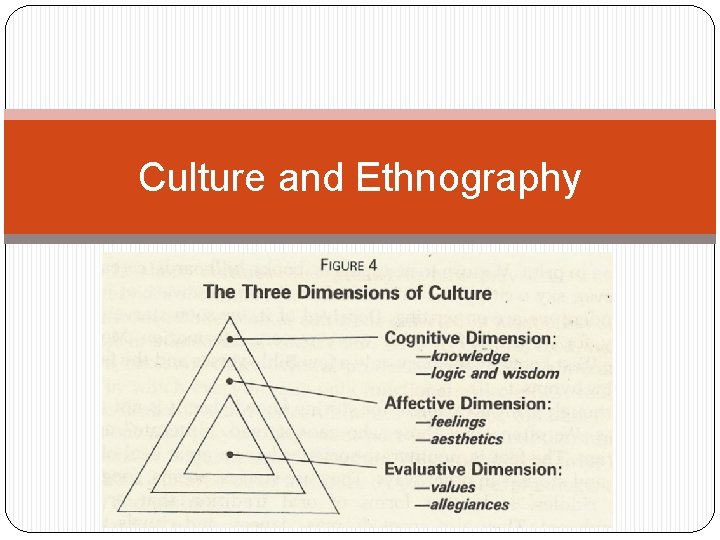
Culture and Ethnography
Culture and Ethnography What is Culture? A system of ideas, feelings, and values
Culture and Ethnography
Culture and Ethnography What is Culture? Patterns of behavior and products shared by a group of people
Culture and Ethnography What is Culture? Organize and regulate what they think, feel and do
Culture and Ethnography Challenges to Learning About Cultures
Culture and Ethnography Challenges to Learning About Cultures q. We tend to focus on the most obvious things.
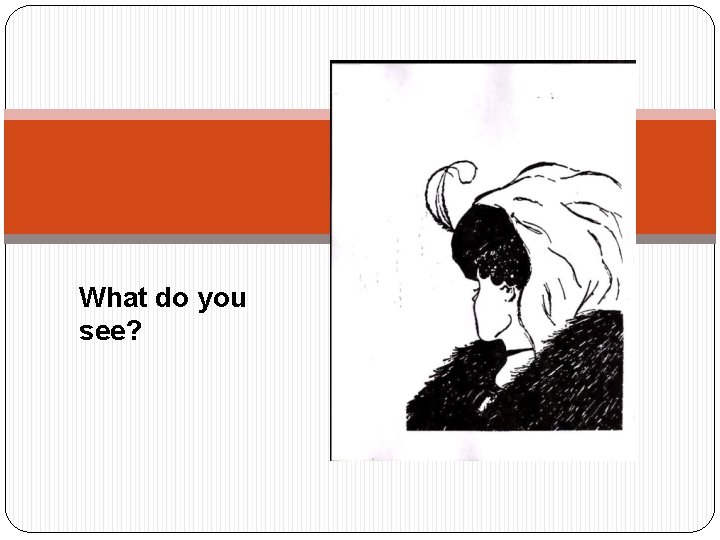
What do you see?
Culture and Ethnography Challenges to Learning About Cultures q. We tend to focus on the most obvious things. q. We tend to jump to conclusions, make quick interpretations for behavior, and make value
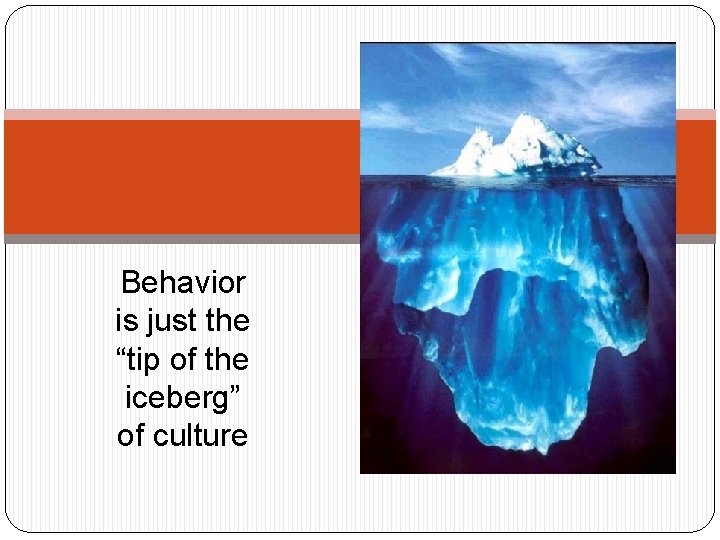
Behavior is just the “tip of the iceberg” of culture
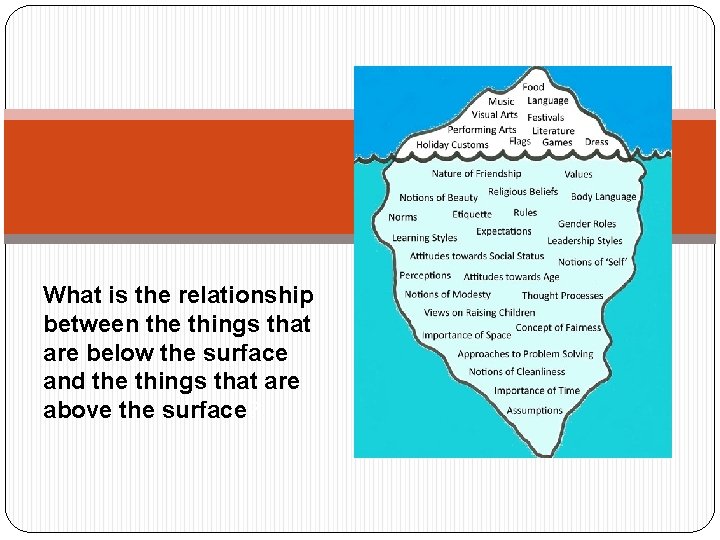
What is the relationship between the things that are below the surface and the things that are above the surface?
Culture and Ethnography Terminology: Enculturation: The process a child goes through learning his/her own culture. Inculturation: The process of an outsider learning a new culture. Acculturation: Normally used of the effect of one culture on another culture but some anthropologists seem to use it in place of
Culture and Ethnography Terminology: Ethnocentrism: Interpreting and evaluating customs of another culture by the standard of one’s own culture. Cultural Relativism: Interpreting and evaluating customs of a culture by standards within that culture.
Culture and Ethnography Two key perspectives on culture: Emic: The insider's perspective of a culture. Etic: The outsider's perspective on a culture.
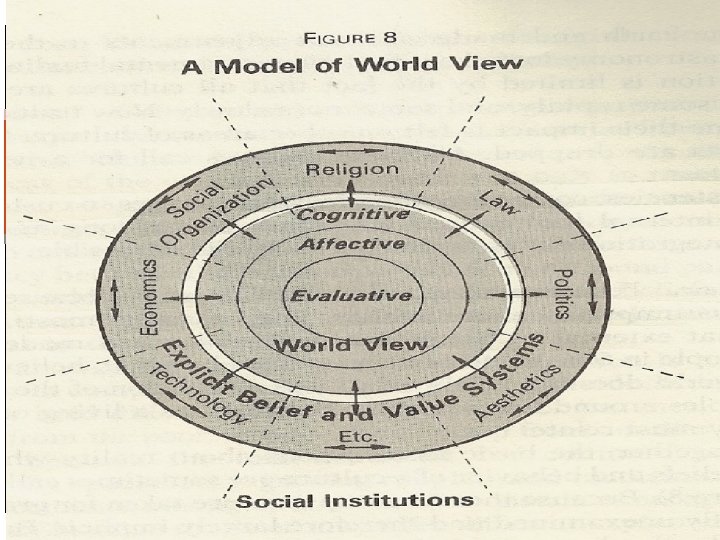
Culture and Ethnography Worldview and Culture: “Worldviews are part of cultures. They are the substructures on which cultures are built. ” - Paul G. Hiebert, Transforming Worldviews: An Anthropological Understanding of How People Change, Grand
Culture and Ethnography “A worldview is the most fundamental and encompassing view of reality shared by a people in a common culture. It is their mental picture of reality that ‘makes sense’ of the world around them. This worldview is based on foundational assumptions about the nature of reality, the ‘givens’ of life, and clothese belief systems with an aura of certainty that this is, in fact, the way reality is. To question worldviews is to challenge the very foundations of life, and people resist such challenges with deep emotional reactions. There are few human fears greater than a loss of a sense of order and
Culture and Ethnography
Culture and Ethnography What is Ethnography?
Culture and Ethnography What is Ethnography? “Ethnography is the work of describing a culture. The central aim of ethnography is to understand another way of life from the native point of view. ” – James Spradley, Participant Observation, New York: Rinehart and Winston, 1980, 3.
Culture and Ethnography What is Ethnography? q. Ethnography is a form of research focused on the qualitative properties of observation. q. Subjective and less focused on numbers and statistics.
Culture and Ethnography What is Ethnography? q. Ethnography is a form of research focused on the qualitative properties of observation. q. Subjective and less focused on numbers and statistics. q. Ethnographic studies focus on compiling data about human cultures and societies around the world.
Culture and Ethnography Types of Ethnography
Culture and Ethnography Types of Ethnography 1. Participant Observation
Culture and Ethnography Types of Ethnography 1. Participant Observation q Long-term engagement in the field setting or place where the ethnography takes place
Culture and Ethnography Types of Ethnography 1. Participant Observation q Long-term engagement in the field setting or place where the ethnography takes place q Participates in life of setting they are observing
Culture and Ethnography Types of Ethnography 1. Participant Observation q Long-term engagement in the field setting or place where the ethnography takes place q Participates in life of setting they are observing q Describes what they experience in a
Culture and Ethnography Types of Ethnography 1. Participant Observation 2. Non-Participant Observation
Culture and Ethnography Types of Ethnography 1. Participant Observation 2. Non-Participant Observation q data is collected by observing behavior without interacting with the participants
Culture and Ethnography Types of Ethnography 1. Participant Observation 2. Non-Participant Observation q data is collected by observing behavior without interacting with the participants q researcher stays uninvolved and conducts research from an outside perspective
Culture and Ethnography Two basic phases: 1. Observation: descriptive of social situations one observes and/or participates in. 2. Interpretation: analyzing what you have observed. These two phases cycle – interpretation leads to more focused observation and more
Culture and Ethnography Observation vs. Interpretation (Inference) Observation: using one or more of your five senses to know or determine something.
Culture and Ethnography Observation vs. Interpretation (Inference) Observation: using one or more of your five senses to know or determine something. Interpretation: making an explanation for the observation.
Culture and Ethnography Guidelines for Observation
Culture and Ethnography Guidelines for Observation ØTake notes during the observation if you can. If this isn’t possible record observations as soon as you can.
Culture and Ethnography Guidelines for Observation ØTake notes during the observation if you can. If this isn’t possible record observations as soon as you can. ØBe detailed and specific.
Culture and Ethnography Guidelines for Observation ØTake notes during the observation if you can. If this isn’t possible record observations as soon as you can. ØBe detailed and specific. ØResist urge to interpret what you see at this point.
Culture and Ethnography Guidelines for Interpretation
Culture and Ethnography Guidelines for Interpretation ØInterpretation involves finding patterns and lessons in what you observed.
Culture and Ethnography Guidelines for Interpretation ØInterpretation involves finding patterns and lessons in what you observed. ØAsk questions about your observations – as many as you can think of.
Culture and Ethnography Guidelines for Interpretation ØInterpretation involves finding patterns and lessons in what you observed. ØAsk questions about your observations – as many as you can think of. ØThe questions are endless!
Culture and Ethnography Questions to Ask How does the group use spoken language? How does the group use written language? Why does this group meet? What is their purpose? What does one get from being a member? What beliefs, values, or tastes does this group share? Do their specific actions demonstrate those beliefs, values or tastes? How does this group act towards each other? Do they treat each other differently than they would in other circumstances? How does this group see its place in the larger community?
Culture and Ethnography Questions to Ask See Descriptive Question Matrix in “Participant Observation as a Culture Learning Tool
Culture and Ethnography Tools/Methods How to Map a People COATS Participant Observation as a culture learning tool
Culture and Ethnography Fast Food Society 4 Culture Game Muslim Community Visit Ethnic Church Visits
Culture and Ethnography Grow 2 Serve Course “Learning Culture through Purposeful Observation” https: //www. grow 2 serve. com/resources/learni ng-culture-purposeful-observation/ Take during first year on the field