
Culturally Proficient Educational Practice Changing the Conversation Summit
- Slides: 26
Culturally Proficient Educational Practice: Changing the Conversation Summit on School Climate and Culture Randall Lindsey August 8 & 9, 2016 DMPS
Learning Agreements O Tech check – use appropriately, O Hand signals, chimes O Be 100% present, O Participate to seek to understand, O Learn about self and others and O Enjoy the day! DMPS
Intended Outcomes O Participants to view Cultural Proficiency as a shared priority; O Participants to experience Cultural Proficiency as personal and professional work; O Participants to use the lens of Cultural Proficiency as a guide with colleagues in addressing access and achievement gap issues; and O Participants to use Tools of Cultural Proficiency to build professional capital for changing conversations. DMPS
Agenda – Triple Track O Use strategies to support our learning today; O Explore applications for these strategies with adult groups as facilitators within our communities; and O Consider application of these strategies in classrooms focused on student achievement. DMPS
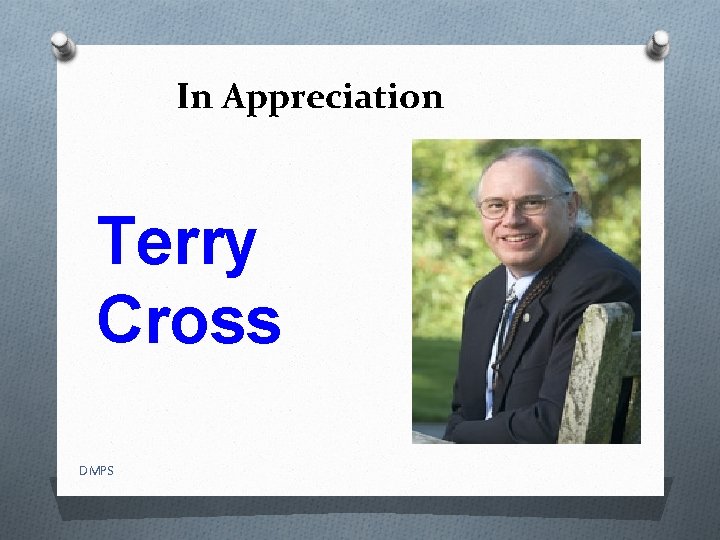
In Appreciation Terry Cross DMPS
Our ‘Community of Practice’ Raymond Terrell, Kikanza Nuri, Delores B. Lindsey, Randall B. Lindsey, Brenda Campbell. Jones, Franklin Campbell. Jones, Laraine Roberts, Richard S. Martinez, Stephanie Graham, R. Chris Westphal, Jr. , Cynthia Jew, Linda Jungwirth, Jarvis Pahl, Keith Myatt, Michelle Karns, Diana Stephens, Carmella Franco, Maria Ott, Darline Robles, Reyes Quezada, Richard Diaz, Karen Kearney, Delia Estrada, Trudy Arriaga, Lewis Bundy, Tracey Du. Est, Ian Jones, John Krownapple, and Fernando Rodriguez-Valls. DMPS
What’s in a Name? An Inclusion Activity – Manual 3 rd Ed, p 217 O Find 2 discussion partners who you do not know well O Wait for us to model activity O Share O Your complete name O Your preferred name O Who gave your name O How you experience your name O How you think others experience your name DMPS
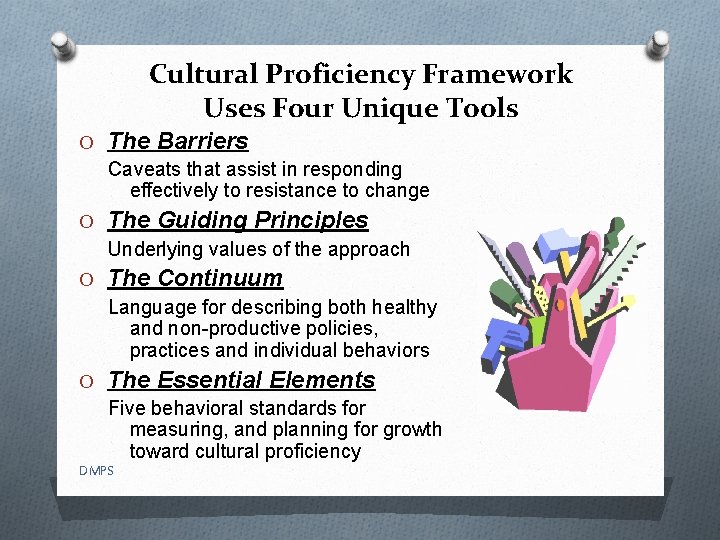
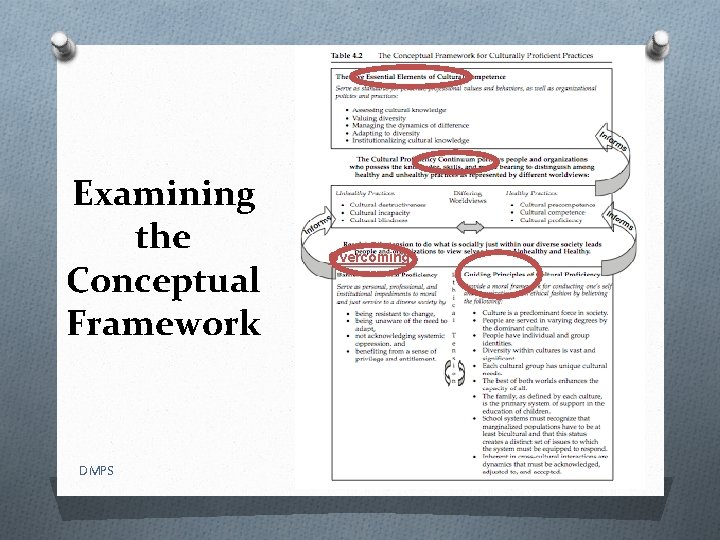
Cultural Proficiency Framework Uses Four Unique Tools O The Barriers Caveats that assist in responding effectively to resistance to change O The Guiding Principles Underlying values of the approach O The Continuum Language for describing both healthy and non-productive policies, practices and individual behaviors O The Essential Elements Five behavioral standards for measuring, and planning for growth toward cultural proficiency DMPS
Examining the Conceptual Framework DMPS Overcoming
Cultural Proficiency An inside-out approach that is about. . . O Being aware of how we - as individuals and as schools - work with others O Being aware of how we respond to those different from us O Visible and not so visible differences O Preparing to live in a world of differences O Is a worldview, a mindset; it is the manner in which we lead our lives O Can NOT be mandated, but can be DMPS nurtured O
Cultural Proficiency functions as… A lens, through which to view your work O The manner in which we lead our lives. O DMPS
Reflection and Dialogue are essential processes for individuals and organizations engaged in a journey toward Cultural Proficiency: O Reflection is the discussion we have with ourselves to understand our values and behaviors O Dialogue is the discussion we have with others to understand their values and behaviors Reflection and Dialogue are fundamental to probing and understanding organizations’ policies and practices DMPS
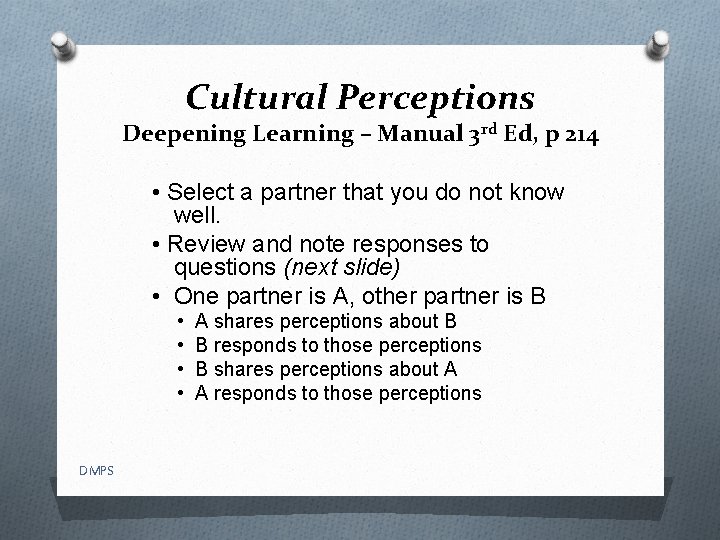
Cultural Perceptions Deepening Learning – Manual 3 rd Ed, p 214 • Select a partner that you do not know well. • Review and note responses to questions (next slide) • One partner is A, other partner is B • • DMPS A shares perceptions about B B responds to those perceptions B shares perceptions about A A responds to those perceptions
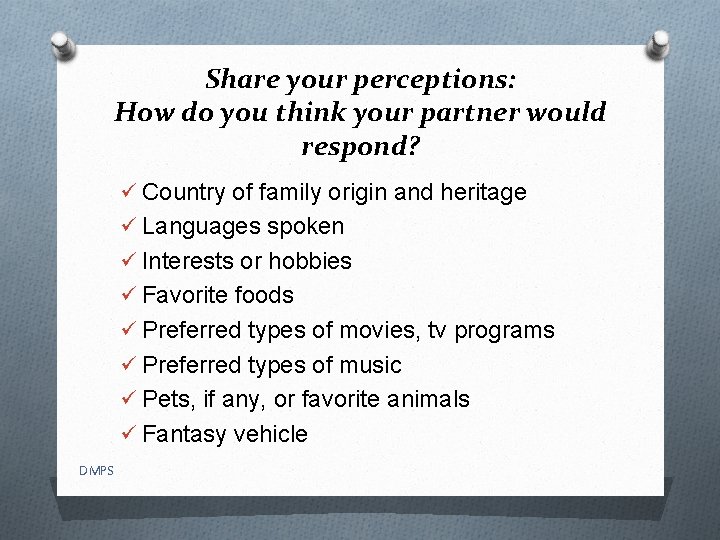
Share your perceptions: How do you think your partner would respond? ü Country of family origin and heritage ü Languages spoken ü Interests or hobbies ü Favorite foods ü Preferred types of movies, tv programs ü Preferred types of music ü Pets, if any, or favorite animals ü Fantasy vehicle DMPS
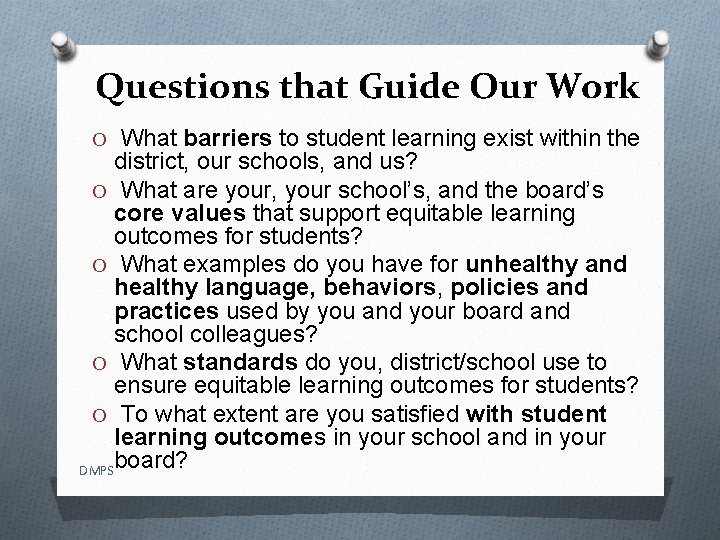
Questions that Guide Our Work O What barriers to student learning exist within the district, our schools, and us? O What are your, your school’s, and the board’s core values that support equitable learning outcomes for students? O What examples do you have for unhealthy and healthy language, behaviors, policies and practices used by you and your board and school colleagues? O What standards do you, district/school use to ensure equitable learning outcomes for students? O To what extent are you satisfied with student learning outcomes in your school and in your board? DMPS
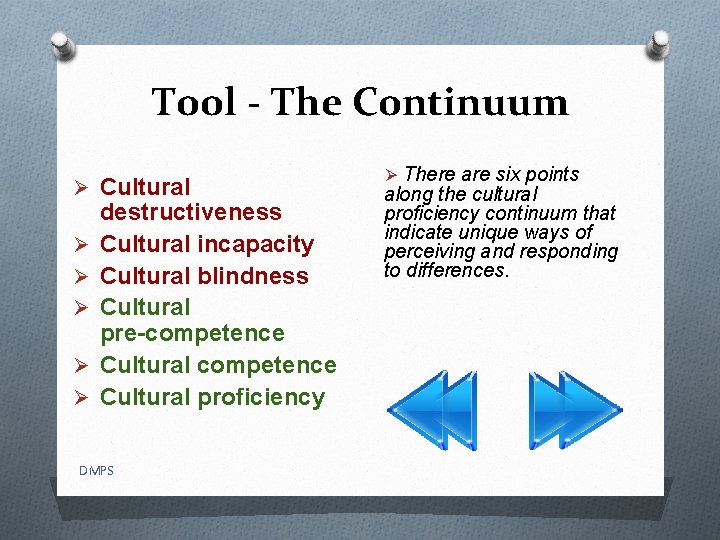
Tool - The Continuum Ø Cultural Ø Ø Ø destructiveness Cultural incapacity Cultural blindness Cultural pre-competence Cultural proficiency DMPS Ø There are six points along the cultural proficiency continuum that indicate unique ways of perceiving and responding to differences.
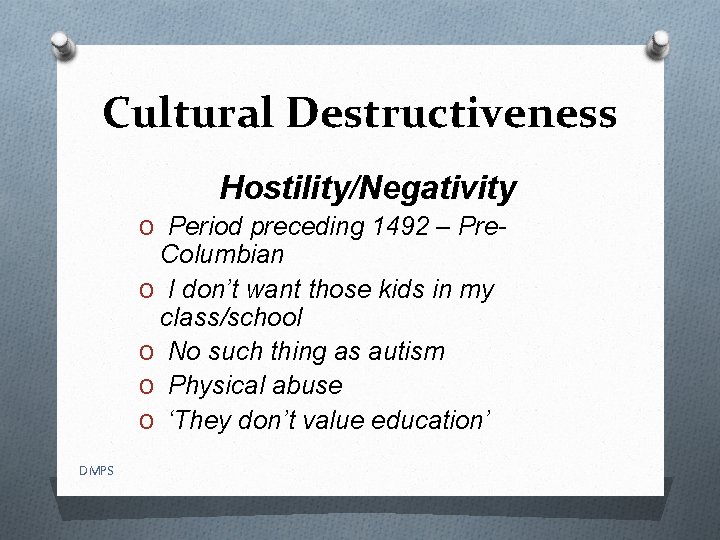
Cultural Destructiveness Hostility/Negativity O Period preceding 1492 – Pre- Columbian O I don’t want those kids in my class/school O No such thing as autism O Physical abuse O ‘They don’t value education’ DMPS
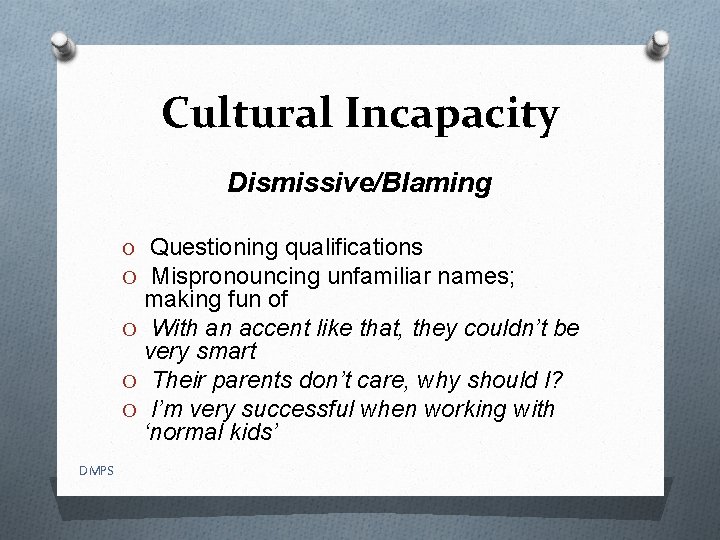
Cultural Incapacity Dismissive/Blaming Questioning qualifications O Mispronouncing unfamiliar names; making fun of O With an accent like that, they couldn’t be very smart O Their parents don’t care, why should I? O I’m very successful when working with ‘normal kids’ O DMPS
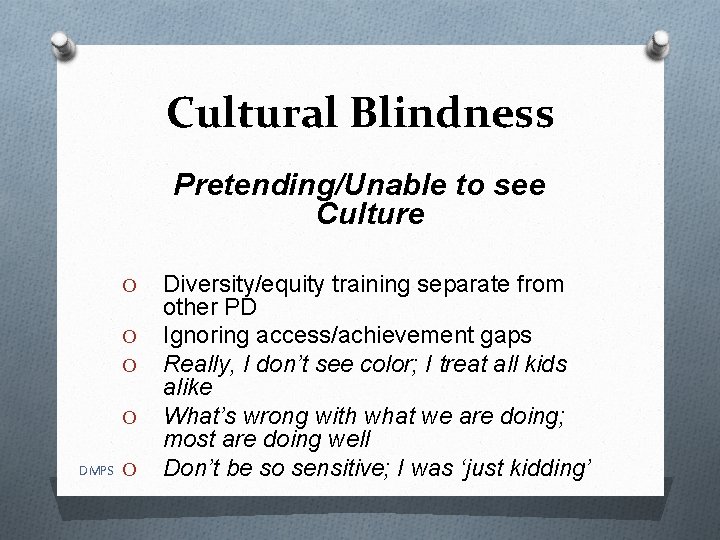
Cultural Blindness Pretending/Unable to see Culture O O DMPS O Diversity/equity training separate from other PD Ignoring access/achievement gaps Really, I don’t see color; I treat all kids alike What’s wrong with what we are doing; most are doing well Don’t be so sensitive; I was ‘just kidding’
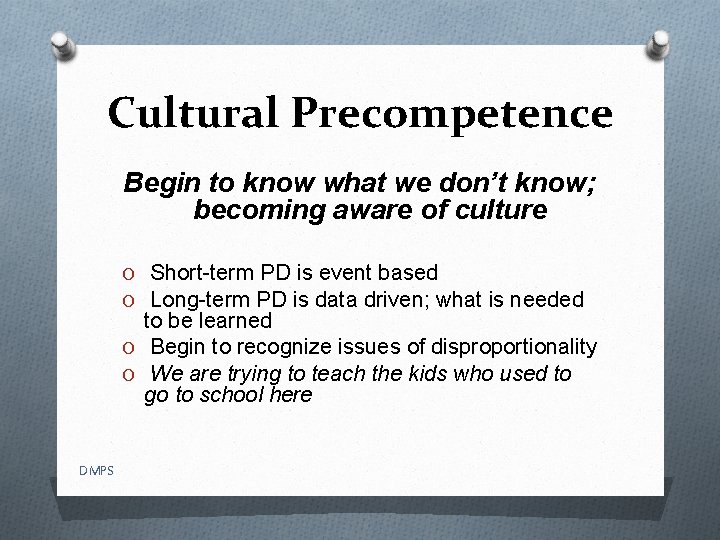
Cultural Precompetence Begin to know what we don’t know; becoming aware of culture O Short-term PD is event based O Long-term PD is data driven; what is needed to be learned O Begin to recognize issues of disproportionality O We are trying to teach the kids who used to go to school here DMPS
Cultural Competence Doing/Speaking Up O Students and visitors can see images like and O O DMPS different from them School is using disaggregated data to drive decision making Access data gathered analyzed for developing strategies for inclusion School functions as a learning community Multiple perspectives invite speaking out against unfairness
Cultural Proficiency Advocacy for social justice O Lived commitments to O Advocacy O Social justice; doing what’s right for students O Life-long learning O Realization that Cultural Proficiency is a ‘process’ O Commitment to mentoring at 2 levels DMPS
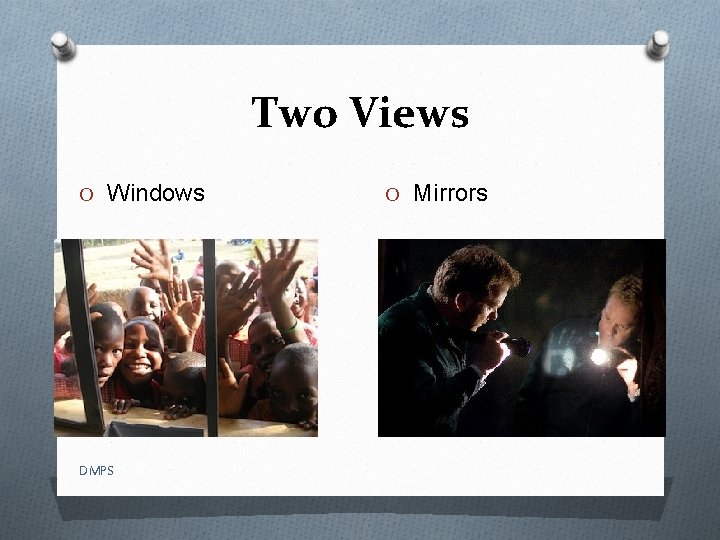
Two Views O Windows DMPS O Mirrors
Other Cultures The world in which you were born is just one model of reality. Other cultures are not failed attempts at being you: They are unique manifestations of the human spirit DMPS Wade Davis, Anthropologist
Cultural Proficiency is attainable when. . . O We believe all students deserve high-level education O We believe students’ cultures are foundations upon which to build their educational experiences O We believe that we can educate each and all of our students DMPS
Voices that Resonate DMPS