
Cultural Values Intercultural CommunicationCOM 372 John R Baldwin
Cultural Values Intercultural Communication—COM 372 John R. Baldwin Department of Communication Illinois State University jrbaldw@ilstu. edu

But first…Some review
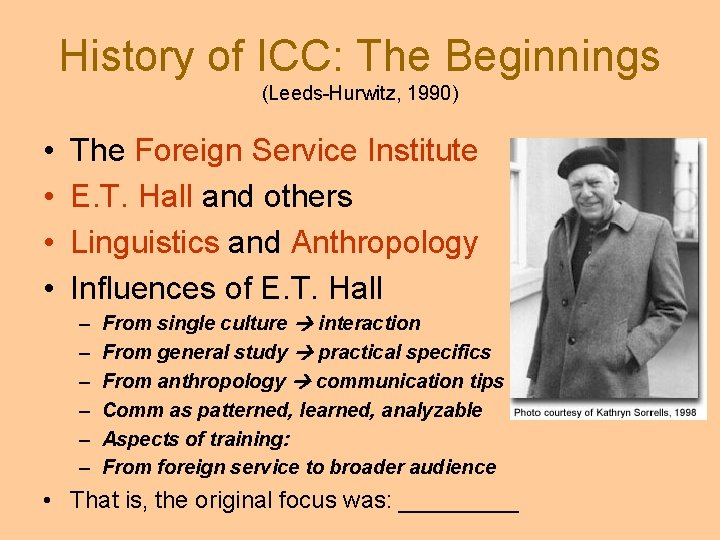
History of ICC: The Beginnings (Leeds-Hurwitz, 1990) • • The Foreign Service Institute E. T. Hall and others Linguistics and Anthropology Influences of E. T. Hall – – – From single culture interaction From general study practical specifics From anthropology communication tips Comm as patterned, learned, analyzable Aspects of training: From foreign service to broader audience • That is, the original focus was: _____
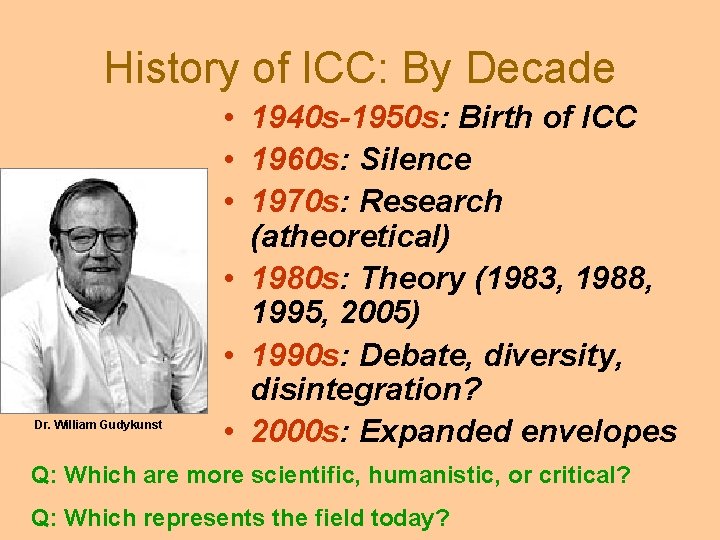
History of ICC: By Decade Dr. William Gudykunst • 1940 s-1950 s: Birth of ICC • 1960 s: Silence • 1970 s: Research (atheoretical) • 1980 s: Theory (1983, 1988, 1995, 2005) • 1990 s: Debate, diversity, disintegration? • 2000 s: Expanded envelopes Q: Which are more scientific, humanistic, or critical? Q: Which represents the field today?
Cultural Filters: Rules & Stuff Rules: A prescription for what we can, cannot, should or should not do, but without a moral component. (If you violate this, you’re weird) Norms: A prescription with a moral component: If you do this, you’re bad. Mores: // Norms Taboos: A very strong norm Laws: A norm that is strong enough to be “codified” by legal sanction
• Values: Something an individual or group holds to be important • Beliefs: A mental construct that links two ideas together (e. g. , Beyoncé // good singer; world // mostly round) • Attitudes: Disposition to react toward something in a certain way (e. g. , like/dislike) • Worldview: A specific set of beliefs pertaining to the relationship between humans and larger elements around them (nature, divinity, etc. )
Ways to Study Values Emic Studies behavior from within system Examines only one culture Structure discovered by analyst Criteria relative to internal characteristics “Cultural” Communication Etic Studies behavior from outside of system Examines many cultures (comparing) Structure created by analyst Criteria considered absolute, universal Cross-Cultural Communication
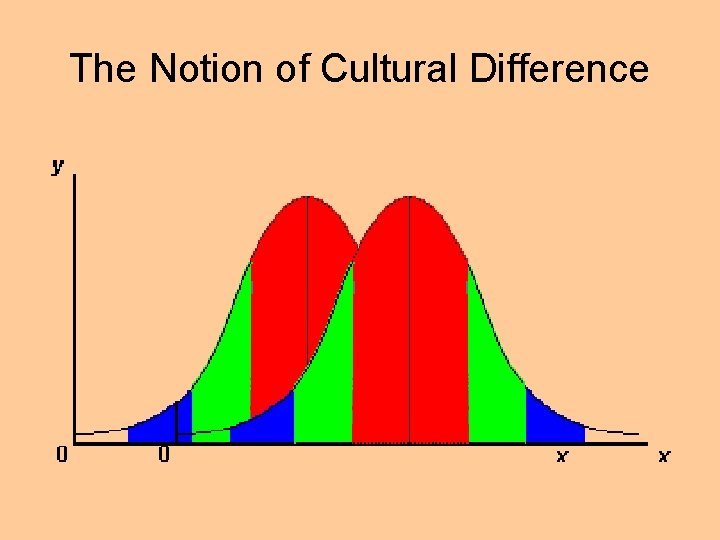
The Notion of Cultural Difference
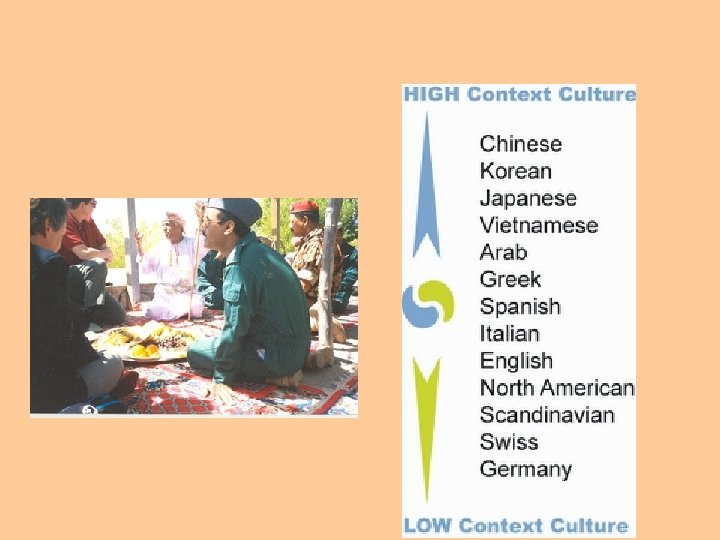
Value Dimensions High & Low Context (E. T. Hall) Low Context High Context
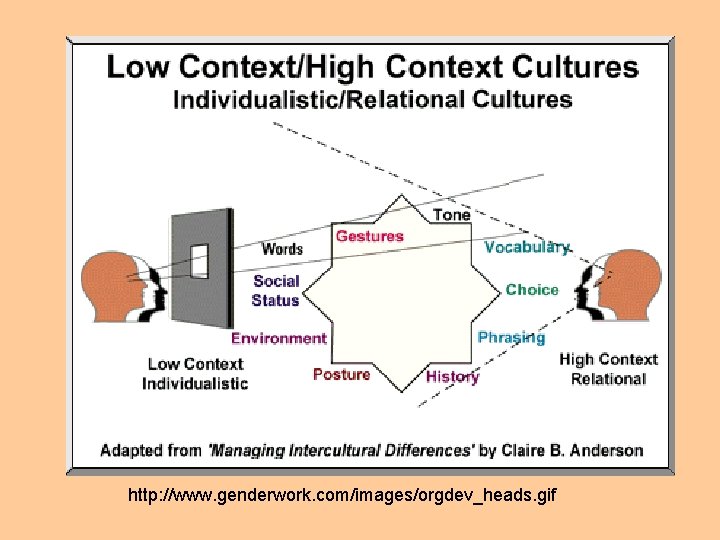
http: //www. genderwork. com/images/orgdev_heads. gif
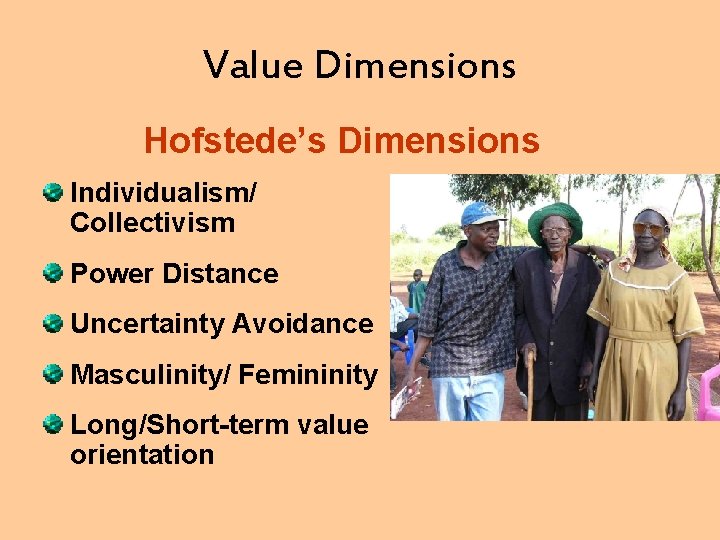
Value Dimensions Hofstede’s Dimensions Individualism/ Collectivism Power Distance Uncertainty Avoidance Masculinity/ Femininity Long/Short-term value orientation
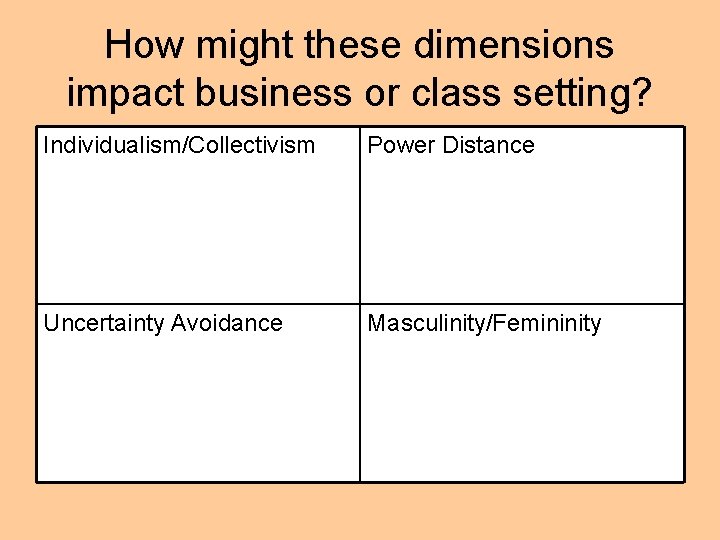
How might these dimensions impact business or class setting? Individualism/Collectivism Power Distance Uncertainty Avoidance Masculinity/Femininity
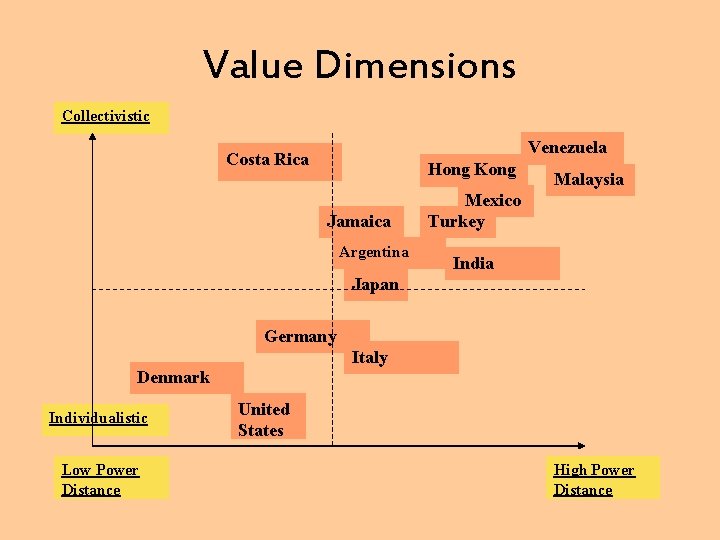
Value Dimensions Collectivistic Venezuela Costa Rica Hong Kong Jamaica Argentina Malaysia Mexico Turkey India Japan Germany Italy Denmark Individualistic Low Power Distance United States High Power Distance
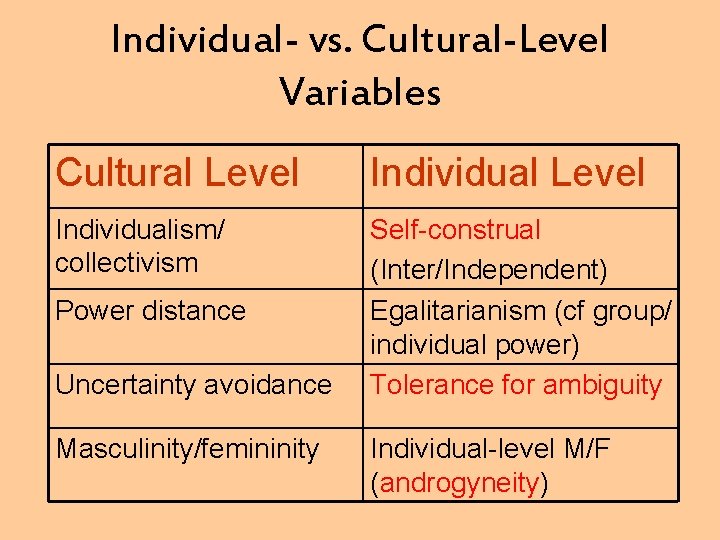
Individual- vs. Cultural-Level Variables Cultural Level Individualism/ collectivism Self-construal (Inter/Independent) Egalitarianism (cf group/ individual power) Tolerance for ambiguity Power distance Uncertainty avoidance Masculinity/femininity Individual-level M/F (androgyneity)
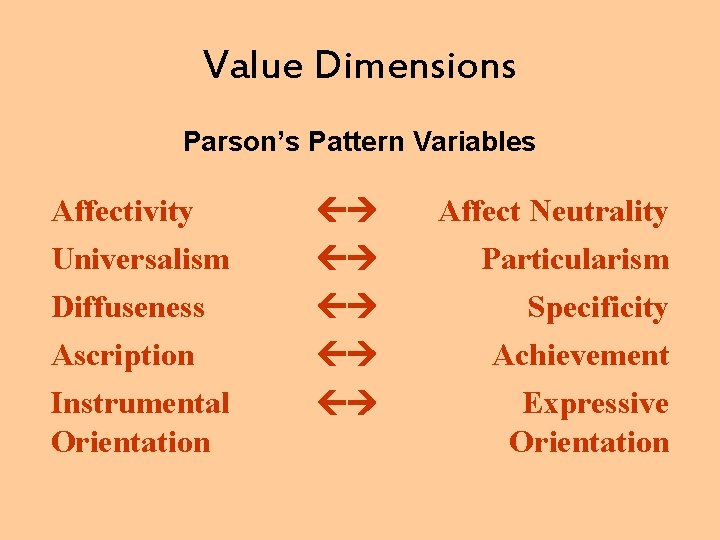
Value Dimensions Parson’s Pattern Variables Affectivity Affect Neutrality Universalism Particularism Diffuseness Specificity Ascription Achievement Instrumental Orientation Expressive Orientation
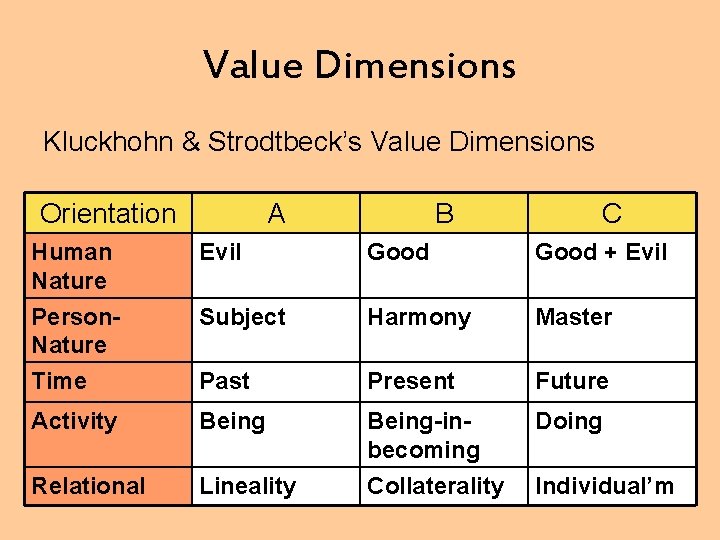
Value Dimensions Kluckhohn & Strodtbeck’s Value Dimensions Orientation A B C Human Nature Evil Good + Evil Person. Nature Subject Harmony Master Time Past Present Future Activity Being-inbecoming Doing Relational Lineality Collaterality Individual’m
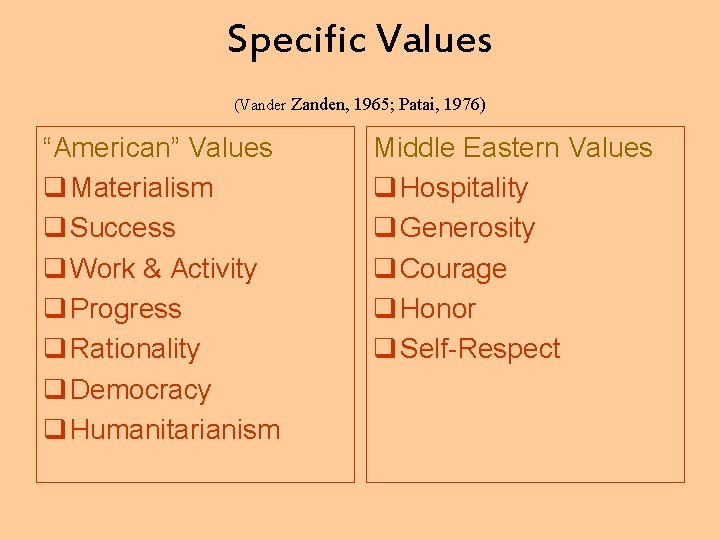
Specific Values (Vander Zanden, 1965; Patai, 1976) “American” Values q Materialism q Success q Work & Activity q Progress q Rationality q Democracy q Humanitarianism Middle Eastern Values q Hospitality q Generosity q Courage q Honor q Self-Respect
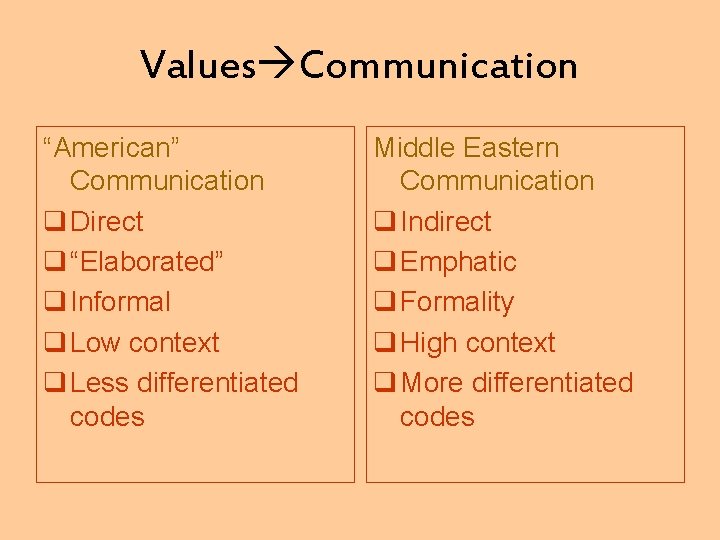
Values Communication “American” Communication q Direct q “Elaborated” q Informal q Low context q Less differentiated codes Middle Eastern Communication q Indirect q Emphatic q Formality q High context q More differentiated codes
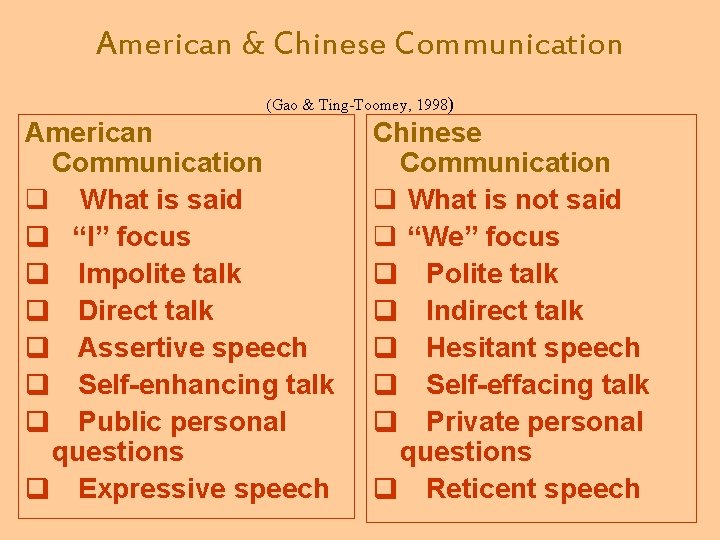
American & Chinese Communication (Gao & Ting-Toomey, 1998) American Communication q What is said q “I” focus q Impolite talk q Direct talk q Assertive speech q Self-enhancing talk q Public personal questions q Expressive speech Chinese Communication q What is not said q “We” focus q Polite talk q Indirect talk q Hesitant speech q Self-effacing talk q Private personal questions q Reticent speech
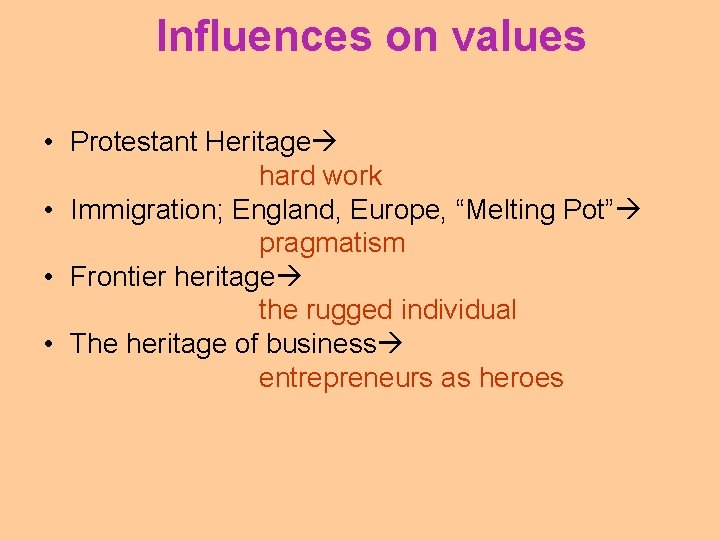
Influences on values • Protestant Heritage hard work • Immigration; England, Europe, “Melting Pot” pragmatism • Frontier heritage the rugged individual • The heritage of business entrepreneurs as heroes

American Proverbs m s Tim ha e is mo ney le ob pr ry on i ve t E lu so e Ea h r t l y t e is sae penny ris saved A penny p s o e r e o o Cleanliness is next to v … h m l t a b h e earned e s a s s s p t s d l k m e godliness out for e k w. Look , e e d g h r h e s e t g n d a o n a p a i o l r a lthhe gom l G Number One! y w h e y t o a h g s o h , t n e n ’ i l a l n W o h i e n g d h e d t v I W gh… e w alt e g h h d i u g s o y u t e , o t e h t a
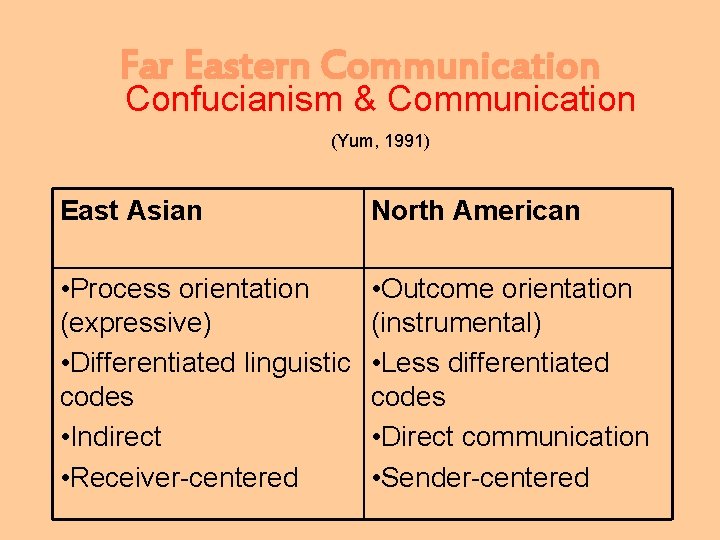
Far Eastern Communication Confucianism & Communication (Yum, 1991) East Asian North American • Process orientation (expressive) • Differentiated linguistic codes • Indirect • Receiver-centered • Outcome orientation (instrumental) • Less differentiated codes • Direct communication • Sender-centered
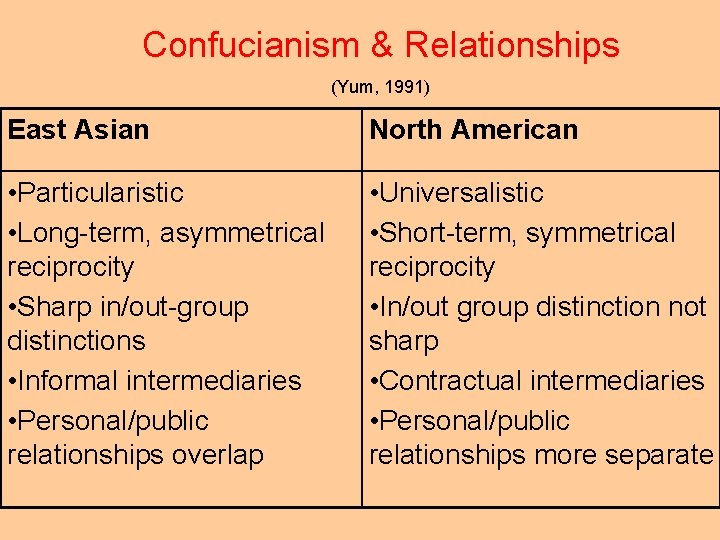
Confucianism & Relationships (Yum, 1991) East Asian North American • Particularistic • Long-term, asymmetrical reciprocity • Sharp in/out-group distinctions • Informal intermediaries • Personal/public relationships overlap • Universalistic • Short-term, symmetrical reciprocity • In/out group distinction not sharp • Contractual intermediaries • Personal/public relationships more separate
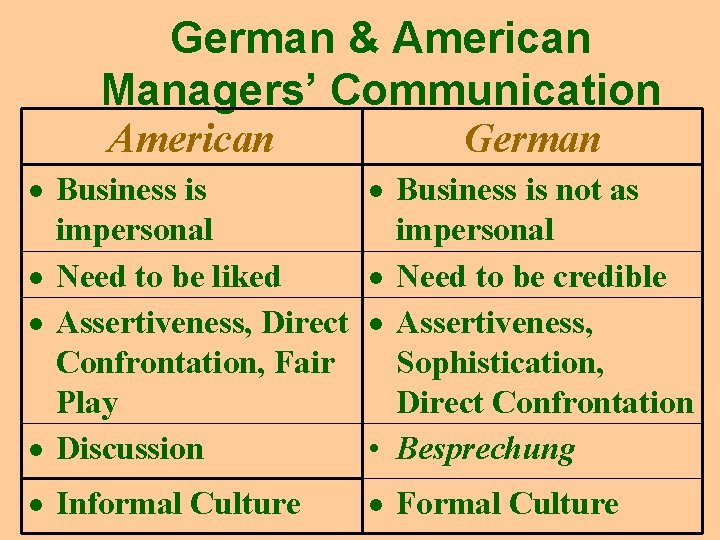
German & American Managers’ Communication American German Business is impersonal Need to be liked Assertiveness, Direct Confrontation, Fair Play Discussion Business is not as impersonal Need to be credible Assertiveness, Sophistication, Direct Confrontation • Besprechung Informal Culture Formal Culture
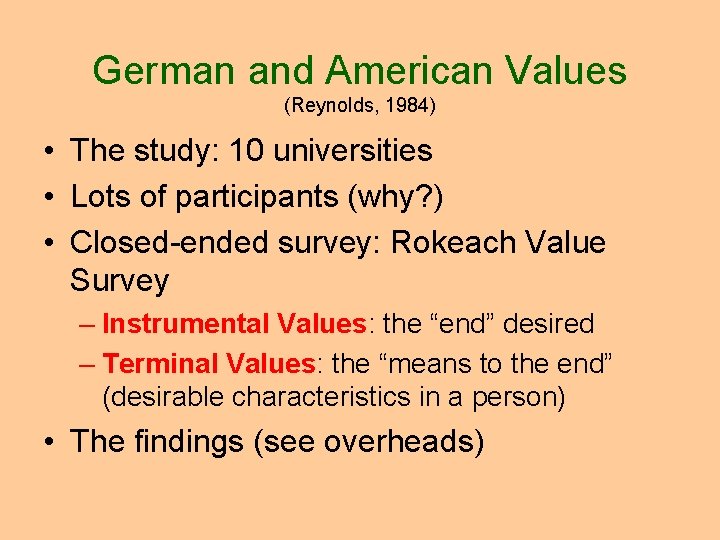
German and American Values (Reynolds, 1984) • The study: 10 universities • Lots of participants (why? ) • Closed-ended survey: Rokeach Value Survey – Instrumental Values: the “end” desired – Terminal Values: the “means to the end” (desirable characteristics in a person) • The findings (see overheads)
![SWISS & GERMANS: [Kopper, 1993] German Swiss Assertiveness Dynamism Confrontation Hierarchy Authority Self-Reliance Provincialism](http://slidetodoc.com/presentation_image/04bf6cd71d8511d33bf18f664f3eb8e1/image-27.jpg "SWISS & GERMANS: [Kopper, 1993] German Swiss Assertiveness Dynamism Confrontation Hierarchy Authority Self-Reliance Provincialism")
SWISS & GERMANS: [Kopper, 1993] German Swiss Assertiveness Dynamism Confrontation Hierarchy Authority Self-Reliance Provincialism Polite Behavior Reserve, Discretion Compromise Democracy Consensus Conformity Cosmopolitanism Both Quality (Perfectionism) Security Reliability Inflexibility Social Order & Rules Formality Seriousness
Any questions? • • John R. Baldwin Fell 451 438 -7969 jrbaldw@ilstu. edu But…. just call me John…
- Slides: 28