
Cultural Transformations Religion Science 1450 1750 Objective Explore
Cultural Transformations Religion & Science 1450 -1750 Objective: Explore the early modern roots of tension between religion & science
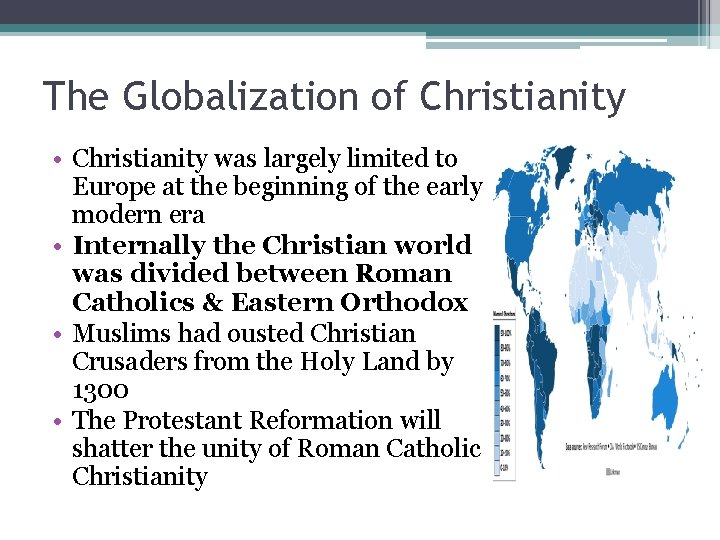
The Globalization of Christianity • Christianity was largely limited to Europe at the beginning of the early modern era • Internally the Christian world was divided between Roman Catholics & Eastern Orthodox • Muslims had ousted Christian Crusaders from the Holy Land by 1300 • The Protestant Reformation will shatter the unity of Roman Catholic Christianity
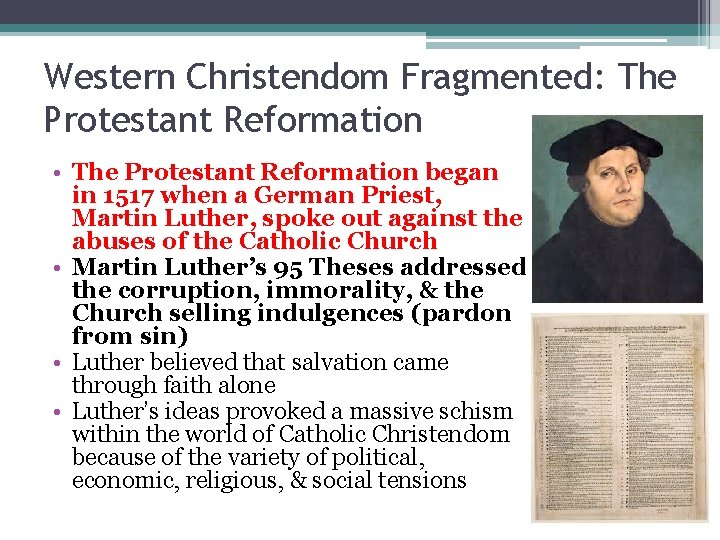
Western Christendom Fragmented: The Protestant Reformation • The Protestant Reformation began in 1517 when a German Priest, Martin Luther, spoke out against the abuses of the Catholic Church • Martin Luther’s 95 Theses addressed the corruption, immorality, & the Church selling indulgences (pardon from sin) • Luther believed that salvation came through faith alone • Luther’s ideas provoked a massive schism within the world of Catholic Christendom because of the variety of political, economic, religious, & social tensions
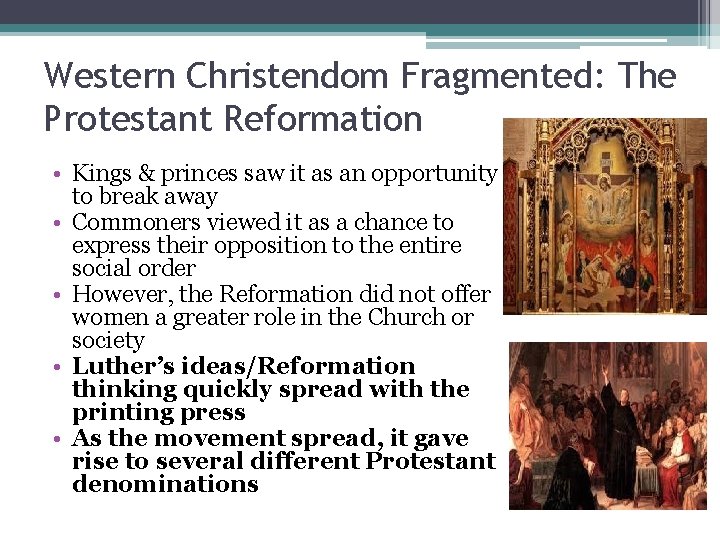
Western Christendom Fragmented: The Protestant Reformation • Kings & princes saw it as an opportunity to break away • Commoners viewed it as a chance to express their opposition to the entire social order • However, the Reformation did not offer women a greater role in the Church or society • Luther’s ideas/Reformation thinking quickly spread with the printing press • As the movement spread, it gave rise to several different Protestant denominations
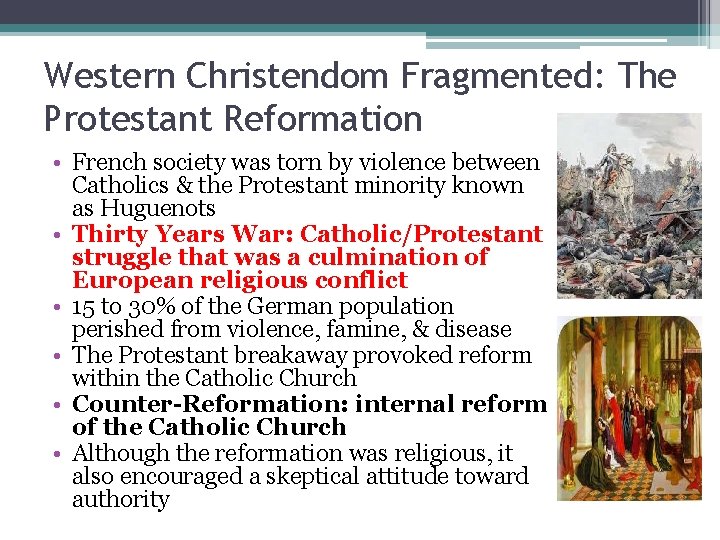
Western Christendom Fragmented: The Protestant Reformation • French society was torn by violence between Catholics & the Protestant minority known as Huguenots • Thirty Years War: Catholic/Protestant struggle that was a culmination of European religious conflict • 15 to 30% of the German population perished from violence, famine, & disease • The Protestant breakaway provoked reform within the Catholic Church • Counter-Reformation: internal reform of the Catholic Church • Although the reformation was religious, it also encouraged a skeptical attitude toward authority
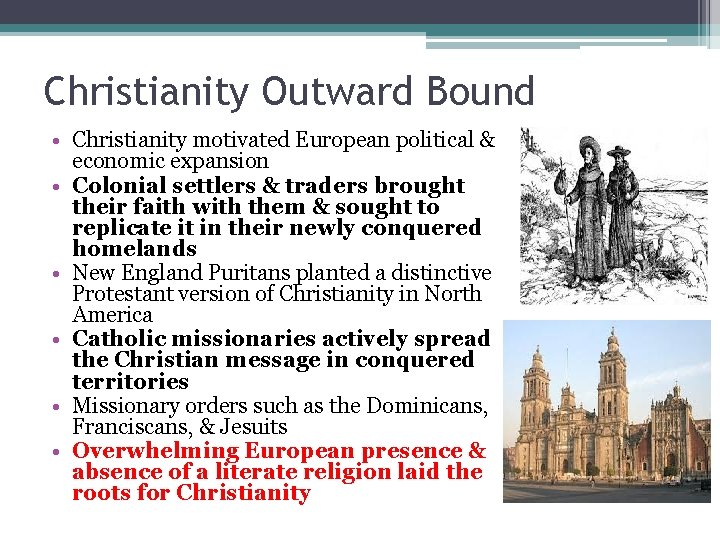
Christianity Outward Bound • Christianity motivated European political & economic expansion • Colonial settlers & traders brought their faith with them & sought to replicate it in their newly conquered homelands • New England Puritans planted a distinctive Protestant version of Christianity in North America • Catholic missionaries actively spread the Christian message in conquered territories • Missionary orders such as the Dominicans, Franciscans, & Jesuits • Overwhelming European presence & absence of a literate religion laid the roots for Christianity
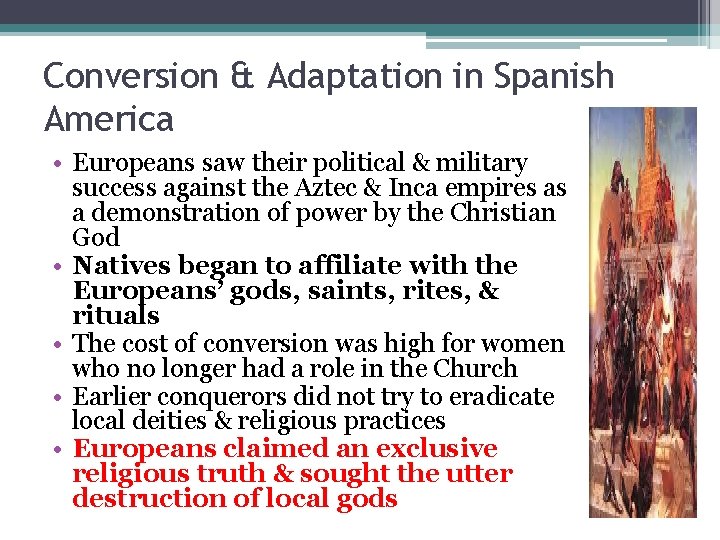
Conversion & Adaptation in Spanish America • Europeans saw their political & military success against the Aztec & Inca empires as a demonstration of power by the Christian God • Natives began to affiliate with the Europeans’ gods, saints, rites, & rituals • The cost of conversion was high for women who no longer had a role in the Church • Earlier conquerors did not try to eradicate local deities & religious practices • Europeans claimed an exclusive religious truth & sought the utter destruction of local gods
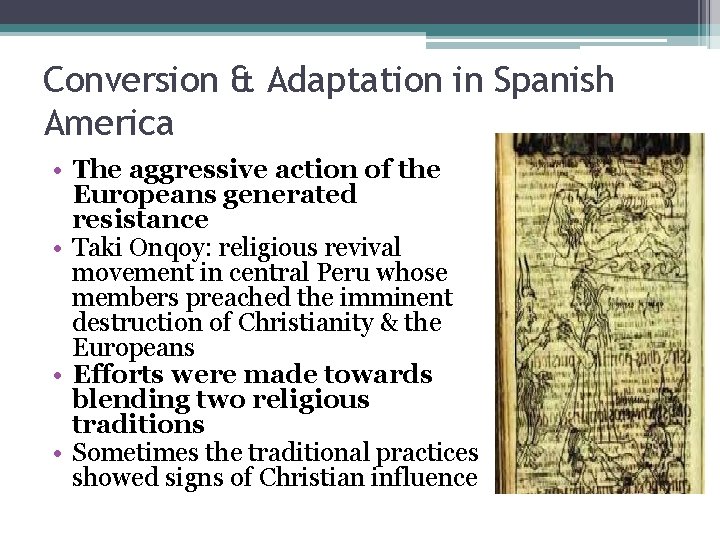
Conversion & Adaptation in Spanish America • The aggressive action of the Europeans generated resistance • Taki Onqoy: religious revival movement in central Peru whose members preached the imminent destruction of Christianity & the Europeans • Efforts were made towards blending two religious traditions • Sometimes the traditional practices showed signs of Christian influence
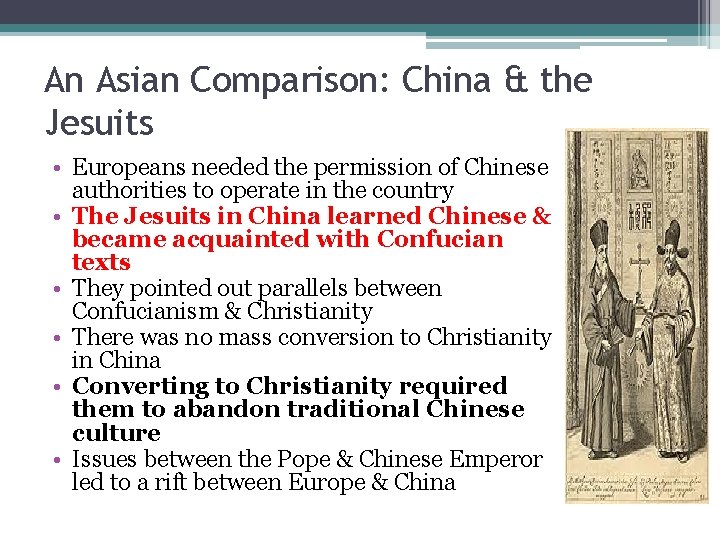
An Asian Comparison: China & the Jesuits • Europeans needed the permission of Chinese authorities to operate in the country • The Jesuits in China learned Chinese & became acquainted with Confucian texts • They pointed out parallels between Confucianism & Christianity • There was no mass conversion to Christianity in China • Converting to Christianity required them to abandon traditional Chinese culture • Issues between the Pope & Chinese Emperor led to a rift between Europe & China
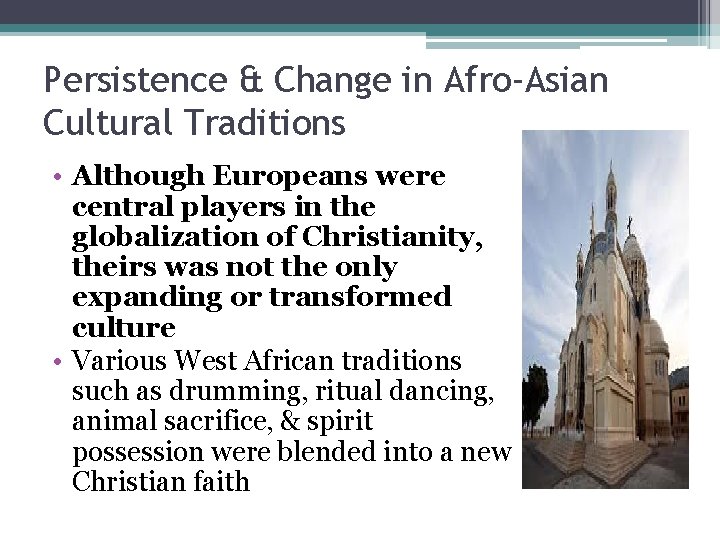
Persistence & Change in Afro-Asian Cultural Traditions • Although Europeans were central players in the globalization of Christianity, theirs was not the only expanding or transformed culture • Various West African traditions such as drumming, ritual dancing, animal sacrifice, & spirit possession were blended into a new Christian faith
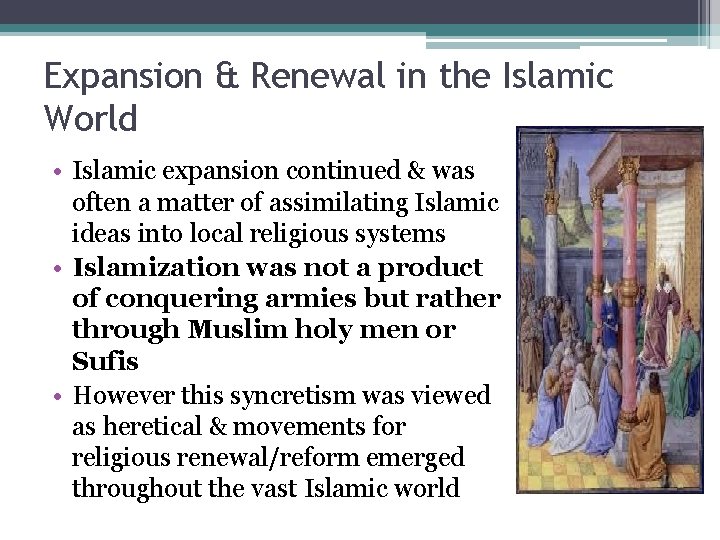
Expansion & Renewal in the Islamic World • Islamic expansion continued & was often a matter of assimilating Islamic ideas into local religious systems • Islamization was not a product of conquering armies but rather through Muslim holy men or Sufis • However this syncretism was viewed as heretical & movements for religious renewal/reform emerged throughout the vast Islamic world
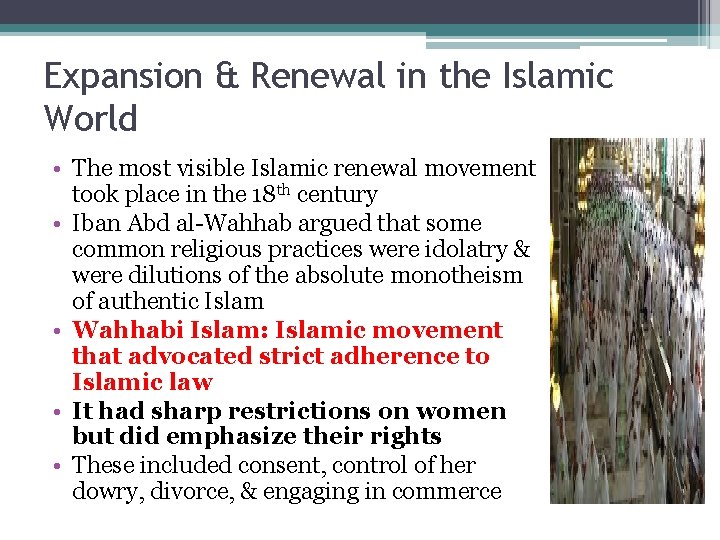
Expansion & Renewal in the Islamic World • The most visible Islamic renewal movement took place in the 18 th century • Iban Abd al-Wahhab argued that some common religious practices were idolatry & were dilutions of the absolute monotheism of authentic Islam • Wahhabi Islam: Islamic movement that advocated strict adherence to Islamic law • It had sharp restrictions on women but did emphasize their rights • These included consent, control of her dowry, divorce, & engaging in commerce
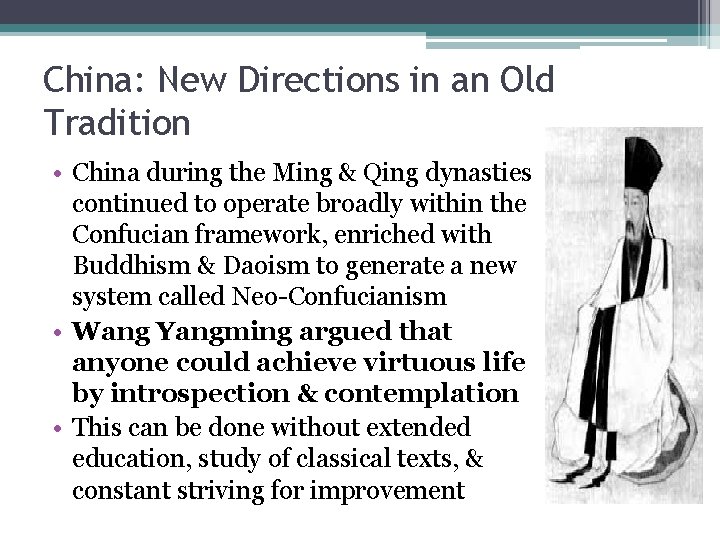
China: New Directions in an Old Tradition • China during the Ming & Qing dynasties continued to operate broadly within the Confucian framework, enriched with Buddhism & Daoism to generate a new system called Neo-Confucianism • Wang Yangming argued that anyone could achieve virtuous life by introspection & contemplation • This can be done without extended education, study of classical texts, & constant striving for improvement
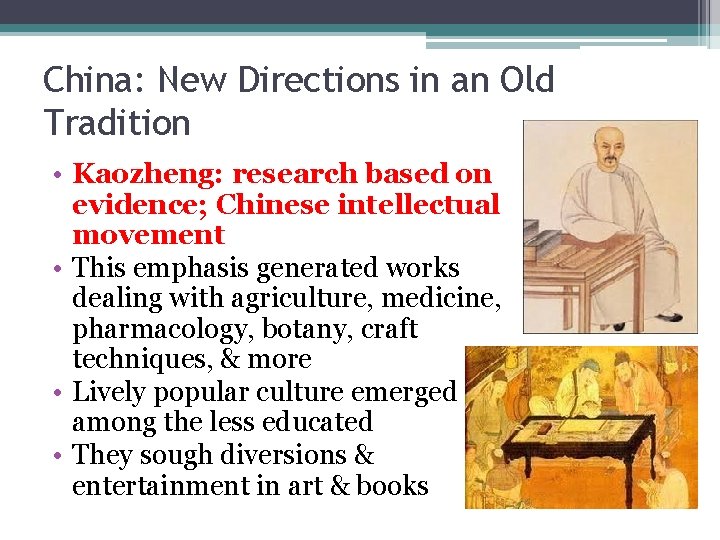
China: New Directions in an Old Tradition • Kaozheng: research based on evidence; Chinese intellectual movement • This emphasis generated works dealing with agriculture, medicine, pharmacology, botany, craft techniques, & more • Lively popular culture emerged among the less educated • They sough diversions & entertainment in art & books
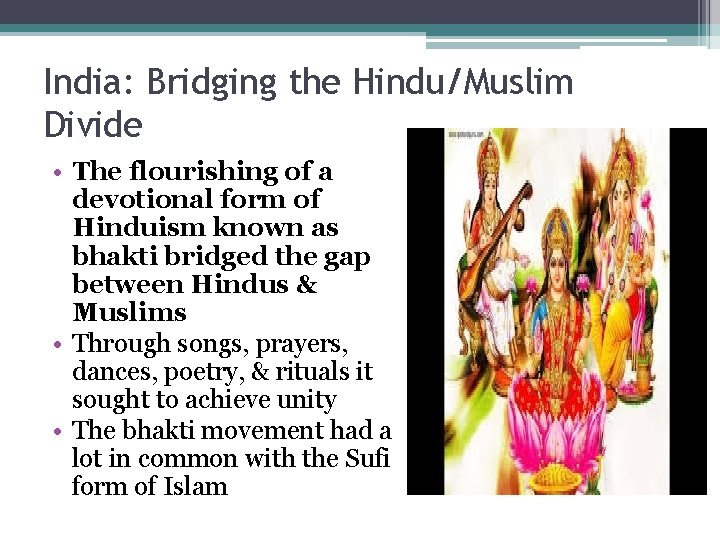
India: Bridging the Hindu/Muslim Divide • The flourishing of a devotional form of Hinduism known as bhakti bridged the gap between Hindus & Muslims • Through songs, prayers, dances, poetry, & rituals it sought to achieve unity • The bhakti movement had a lot in common with the Sufi form of Islam
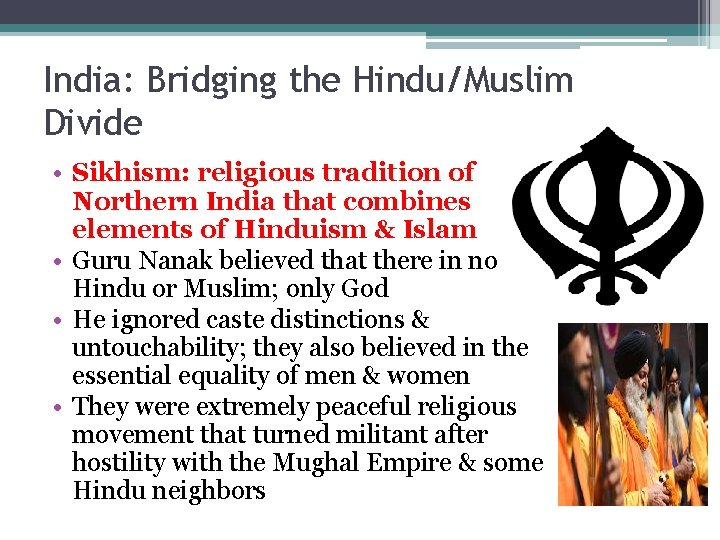
India: Bridging the Hindu/Muslim Divide • Sikhism: religious tradition of Northern India that combines elements of Hinduism & Islam • Guru Nanak believed that there in no Hindu or Muslim; only God • He ignored caste distinctions & untouchability; they also believed in the essential equality of men & women • They were extremely peaceful religious movement that turned militant after hostility with the Mughal Empire & some Hindu neighbors
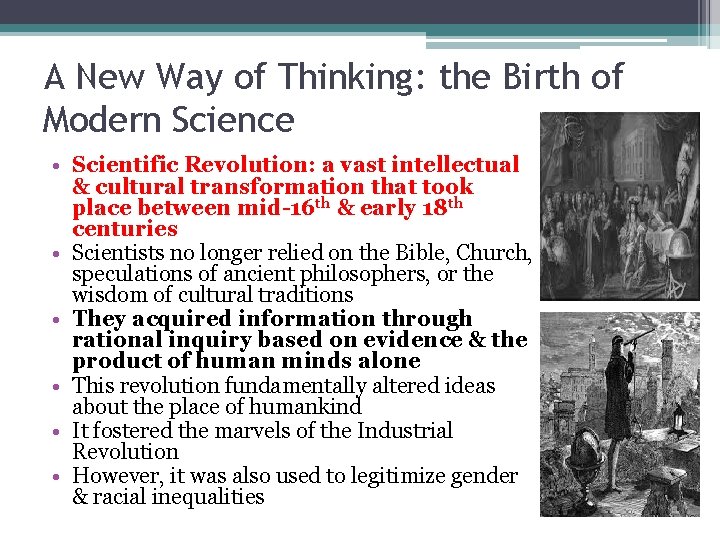
A New Way of Thinking: the Birth of Modern Science • Scientific Revolution: a vast intellectual & cultural transformation that took place between mid-16 th & early 18 th centuries • Scientists no longer relied on the Bible, Church, speculations of ancient philosophers, or the wisdom of cultural traditions • They acquired information through rational inquiry based on evidence & the product of human minds alone • This revolution fundamentally altered ideas about the place of humankind • It fostered the marvels of the Industrial Revolution • However, it was also used to legitimize gender & racial inequalities
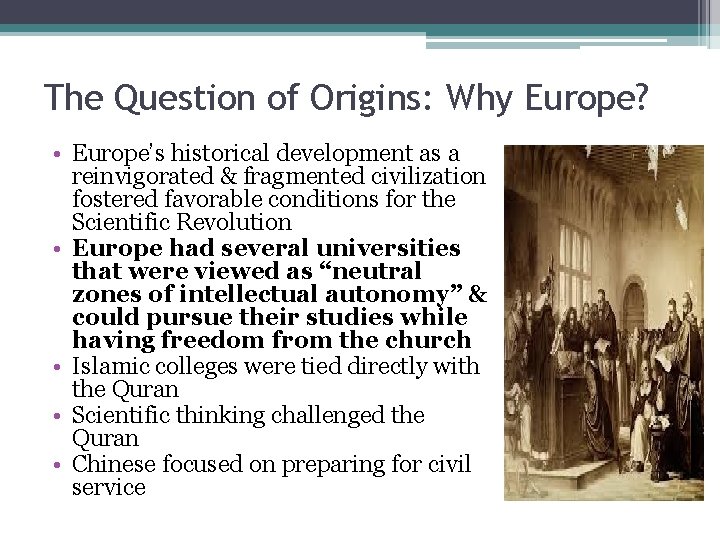
The Question of Origins: Why Europe? • Europe’s historical development as a reinvigorated & fragmented civilization fostered favorable conditions for the Scientific Revolution • Europe had several universities that were viewed as “neutral zones of intellectual autonomy” & could pursue their studies while having freedom from the church • Islamic colleges were tied directly with the Quran • Scientific thinking challenged the Quran • Chinese focused on preparing for civil service
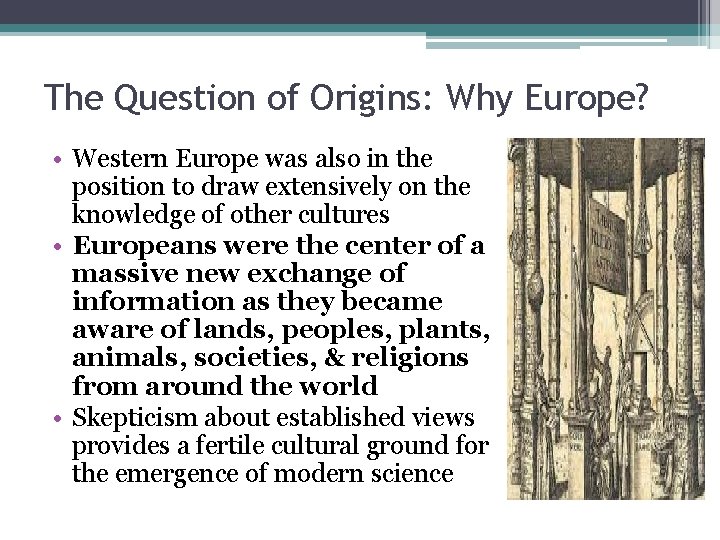
The Question of Origins: Why Europe? • Western Europe was also in the position to draw extensively on the knowledge of other cultures • Europeans were the center of a massive new exchange of information as they became aware of lands, peoples, plants, animals, societies, & religions from around the world • Skepticism about established views provides a fertile cultural ground for the emergence of modern science
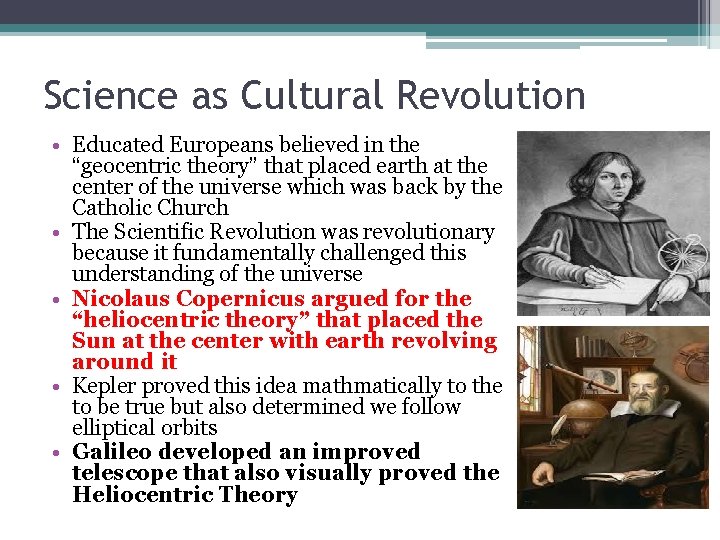
Science as Cultural Revolution • Educated Europeans believed in the “geocentric theory” that placed earth at the center of the universe which was back by the Catholic Church • The Scientific Revolution was revolutionary because it fundamentally challenged this understanding of the universe • Nicolaus Copernicus argued for the “heliocentric theory” that placed the Sun at the center with earth revolving around it • Kepler proved this idea mathmatically to the to be true but also determined we follow elliptical orbits • Galileo developed an improved telescope that also visually proved the Heliocentric Theory
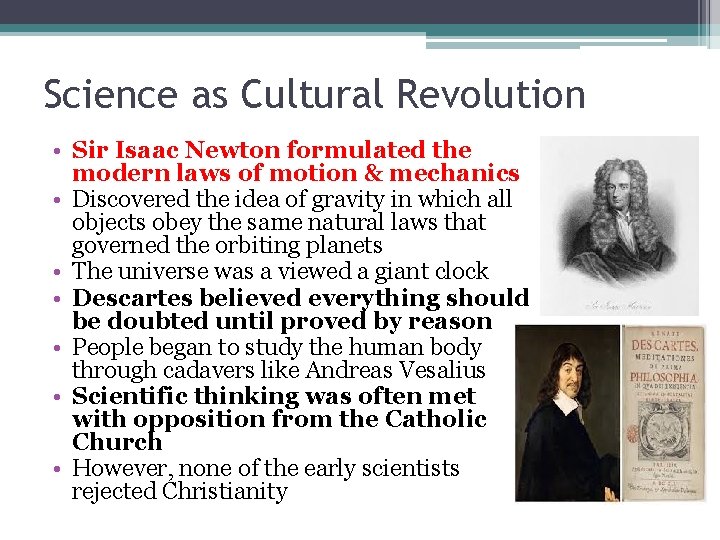
Science as Cultural Revolution • Sir Isaac Newton formulated the modern laws of motion & mechanics • Discovered the idea of gravity in which all objects obey the same natural laws that governed the orbiting planets • The universe was a viewed a giant clock • Descartes believed everything should be doubted until proved by reason • People began to study the human body through cadavers like Andreas Vesalius • Scientific thinking was often met with opposition from the Catholic Church • However, none of the early scientists rejected Christianity
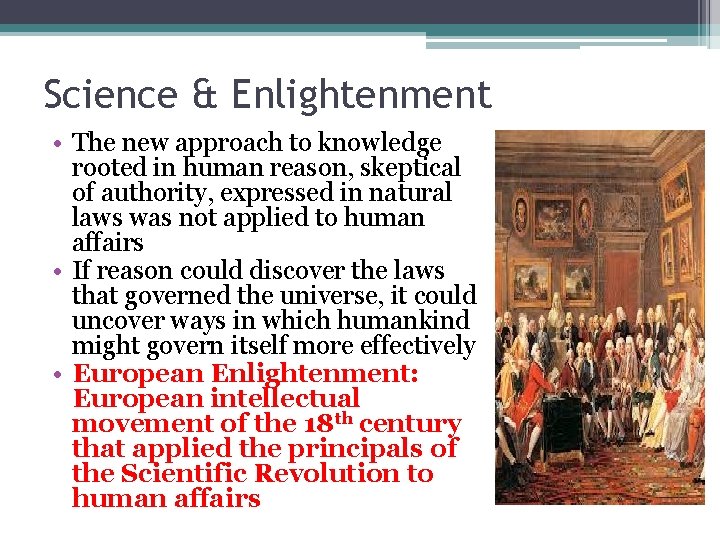
Science & Enlightenment • The new approach to knowledge rooted in human reason, skeptical of authority, expressed in natural laws was not applied to human affairs • If reason could discover the laws that governed the universe, it could uncover ways in which humankind might govern itself more effectively • European Enlightenment: European intellectual movement of the 18 th century that applied the principals of the Scientific Revolution to human affairs
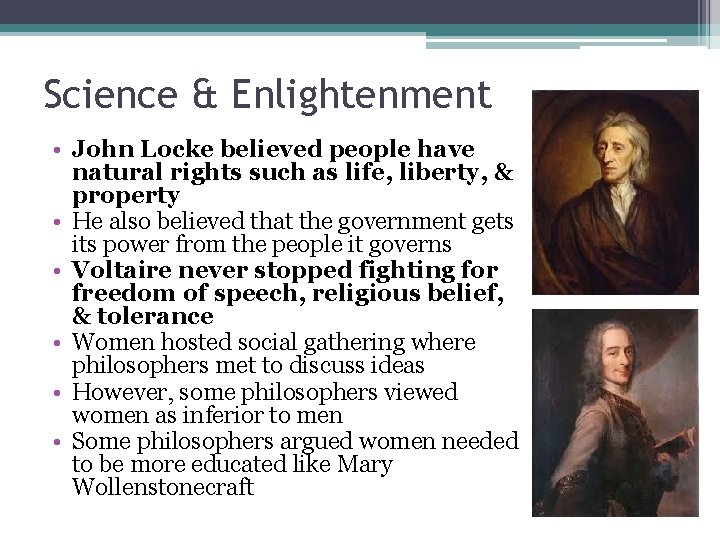
Science & Enlightenment • John Locke believed people have natural rights such as life, liberty, & property • He also believed that the government gets its power from the people it governs • Voltaire never stopped fighting for freedom of speech, religious belief, & tolerance • Women hosted social gathering where philosophers met to discuss ideas • However, some philosophers viewed women as inferior to men • Some philosophers argued women needed to be more educated like Mary Wollenstonecraft
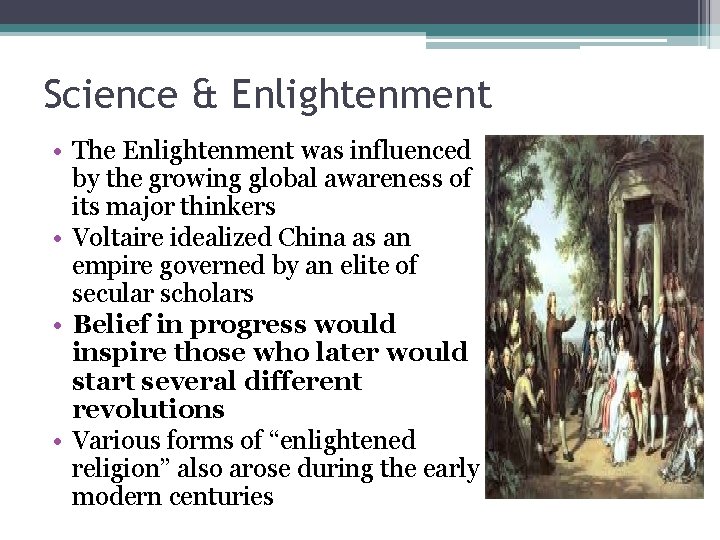
Science & Enlightenment • The Enlightenment was influenced by the growing global awareness of its major thinkers • Voltaire idealized China as an empire governed by an elite of secular scholars • Belief in progress would inspire those who later would start several different revolutions • Various forms of “enlightened religion” also arose during the early modern centuries
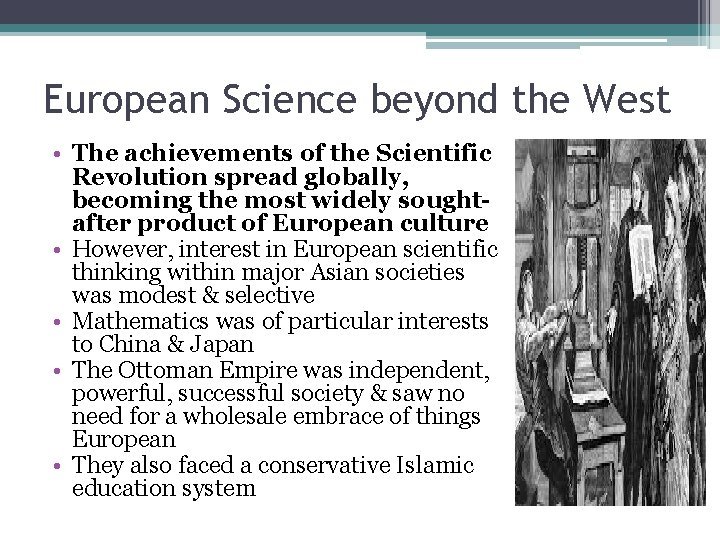
European Science beyond the West • The achievements of the Scientific Revolution spread globally, becoming the most widely soughtafter product of European culture • However, interest in European scientific thinking within major Asian societies was modest & selective • Mathematics was of particular interests to China & Japan • The Ottoman Empire was independent, powerful, successful society & saw no need for a wholesale embrace of things European • They also faced a conservative Islamic education system
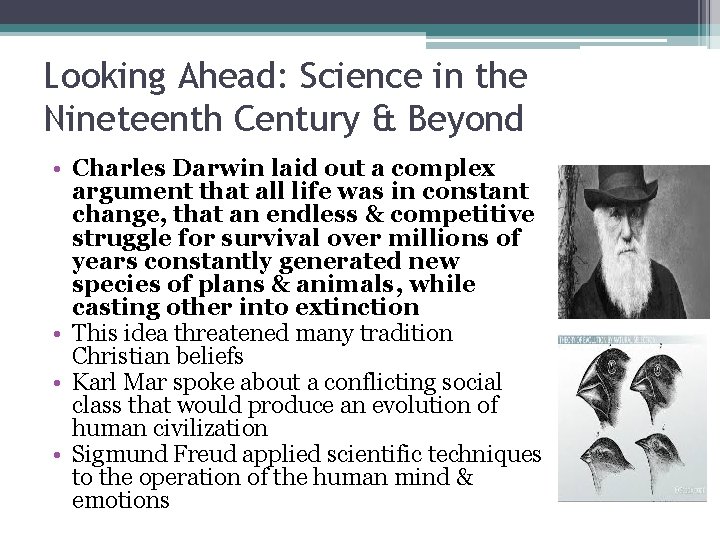
Looking Ahead: Science in the Nineteenth Century & Beyond • Charles Darwin laid out a complex argument that all life was in constant change, that an endless & competitive struggle for survival over millions of years constantly generated new species of plans & animals, while casting other into extinction • This idea threatened many tradition Christian beliefs • Karl Mar spoke about a conflicting social class that would produce an evolution of human civilization • Sigmund Freud applied scientific techniques to the operation of the human mind & emotions
- Slides: 26