
Cultural Synergy What is Cultural Synergy How Can
- Slides: 13
Cultural Synergy What is Cultural Synergy? How Can it be Achieved? How Can it be Used as a Competitive Advantage?
Cultural Invisibility • Cultural Blindness: – Choosing not to see cultural differences – Others become a projection of yourself – American’s are taught to blind themselves to gender, racial and ethnic differences.
Cultural Diversity can cause Problems • Most global managers can articulate the disadvantages of cultural divesity… few can articulate the advantages. • Cultural diversity can cause problems during convergent process (everyone needs to think/act the same). • Cultural diversity can cause problems when overgeneralizations occur of practices and processes from one culture to another (e. g. what works in one culture may not work in another) • Cultural diversity increases the complexity of companywide policies (e. g. definition of “family” in one culture versus another).
Advantages of Cultural Diversity • In divergent process where expanded perspectives, strategies, tactics and ideas are needed. • Reduces the risk of Group. Think
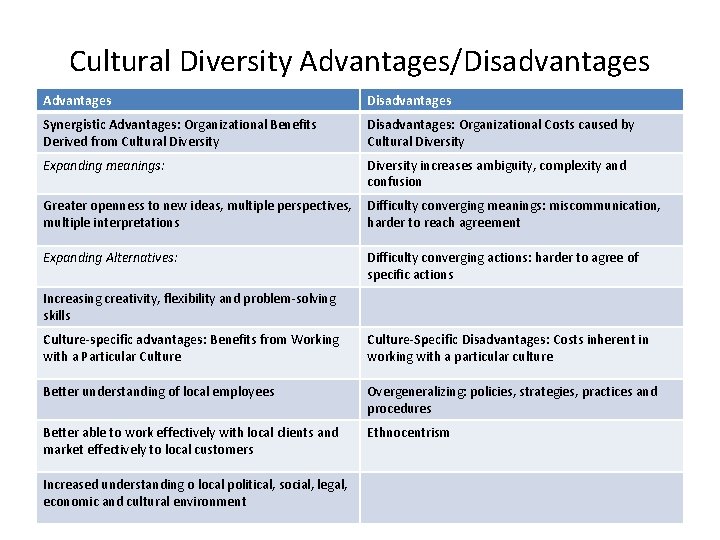
Cultural Diversity Advantages/Disadvantages Advantages Disadvantages Synergistic Advantages: Organizational Benefits Derived from Cultural Diversity Disadvantages: Organizational Costs caused by Cultural Diversity Expanding meanings: Diversity increases ambiguity, complexity and confusion Greater openness to new ideas, multiple perspectives, multiple interpretations Difficulty converging meanings: miscommunication, harder to reach agreement Expanding Alternatives: Difficulty converging actions: harder to agree of specific actions Increasing creativity, flexibility and problem-solving skills Culture-specific advantages: Benefits from Working with a Particular Culture-Specific Disadvantages: Costs inherent in working with a particular culture Better understanding of local employees Overgeneralizing: policies, strategies, practices and procedures Better able to work effectively with local clients and market effectively to local customers Ethnocentrism Increased understanding o local political, social, legal, economic and cultural environment
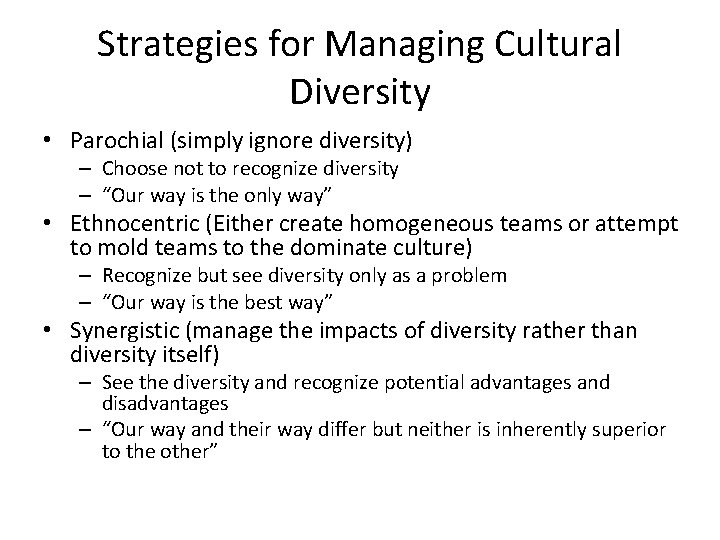
Strategies for Managing Cultural Diversity • Parochial (simply ignore diversity) – Choose not to recognize diversity – “Our way is the only way” • Ethnocentric (Either create homogeneous teams or attempt to mold teams to the dominate culture) – Recognize but see diversity only as a problem – “Our way is the best way” • Synergistic (manage the impacts of diversity rather than diversity itself) – See the diversity and recognize potential advantages and disadvantages – “Our way and their way differ but neither is inherently superior to the other”
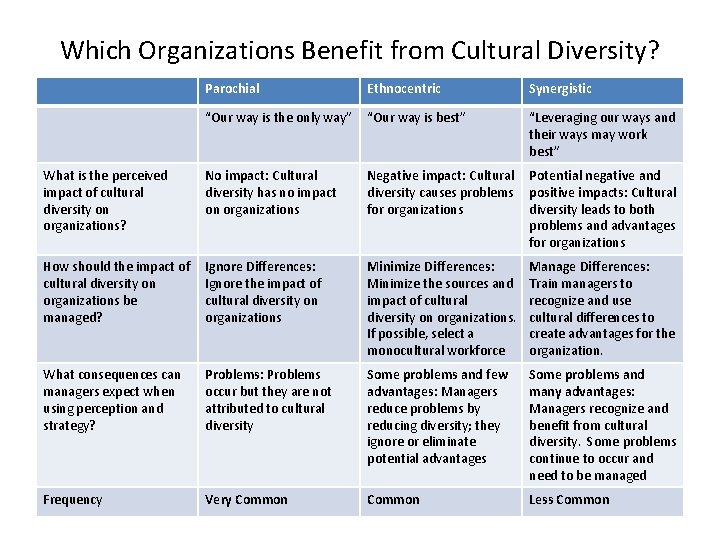
Which Organizations Benefit from Cultural Diversity? Parochial Ethnocentric Synergistic “Our way is the only way” “Our way is best” “Leveraging our ways and their ways may work best” What is the perceived impact of cultural diversity on organizations? No impact: Cultural diversity has no impact on organizations Negative impact: Cultural diversity causes problems for organizations Potential negative and positive impacts: Cultural diversity leads to both problems and advantages for organizations How should the impact of cultural diversity on organizations be managed? Ignore Differences: Ignore the impact of cultural diversity on organizations Minimize Differences: Minimize the sources and impact of cultural diversity on organizations. If possible, select a monocultural workforce Manage Differences: Train managers to recognize and use cultural differences to create advantages for the organization. What consequences can managers expect when using perception and strategy? Problems: Problems occur but they are not attributed to cultural diversity Some problems and few advantages: Managers reduce problems by reducing diversity; they ignore or eliminate potential advantages Some problems and many advantages: Managers recognize and benefit from cultural diversity. Some problems continue to occur and need to be managed Frequency Very Common Less Common
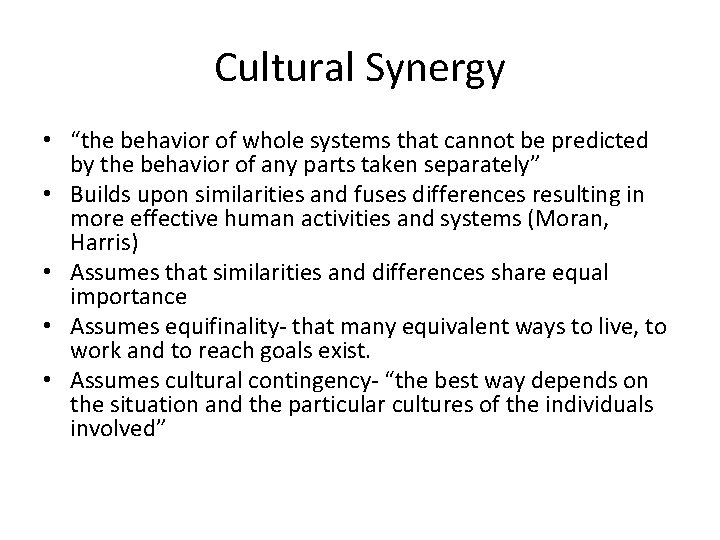
Cultural Synergy • “the behavior of whole systems that cannot be predicted by the behavior of any parts taken separately” • Builds upon similarities and fuses differences resulting in more effective human activities and systems (Moran, Harris) • Assumes that similarities and differences share equal importance • Assumes equifinality- that many equivalent ways to live, to work and to reach goals exist. • Assumes cultural contingency- “the best way depends on the situation and the particular cultures of the individuals involved”
Misleading Assumptions • Homogeneity – All people are basically the same • Heterogeneity – The cultural mosaic
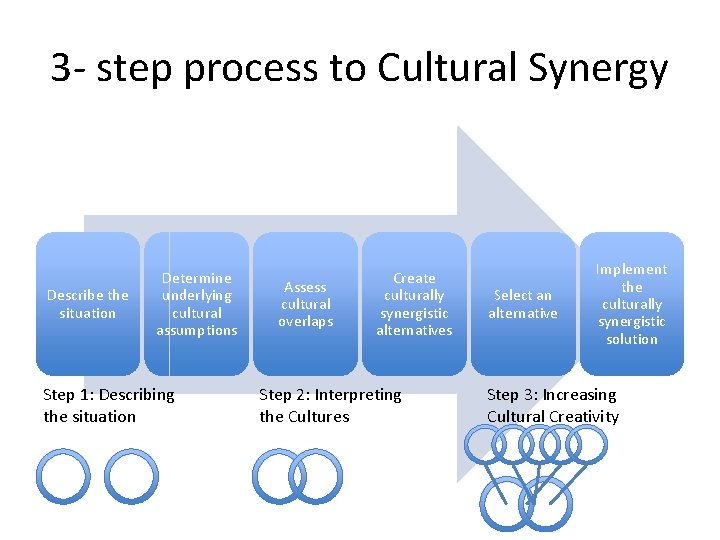
3 - step process to Cultural Synergy Describe the situation Determine underlying cultural assumptions Step 1: Describing the situation Assess cultural overlaps Create culturally synergistic alternatives Step 2: Interpreting the Cultures Select an alternative Implement the culturally synergistic solution Step 3: Increasing Cultural Creativity
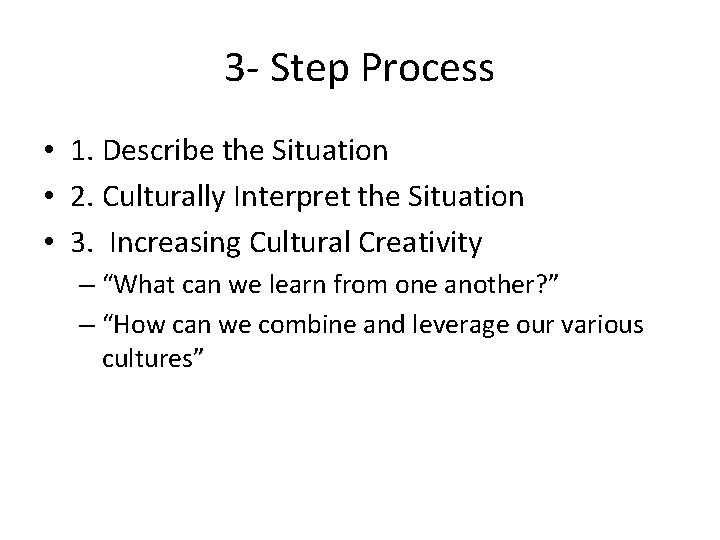
3 - Step Process • 1. Describe the Situation • 2. Culturally Interpret the Situation • 3. Increasing Cultural Creativity – “What can we learn from one another? ” – “How can we combine and leverage our various cultures”
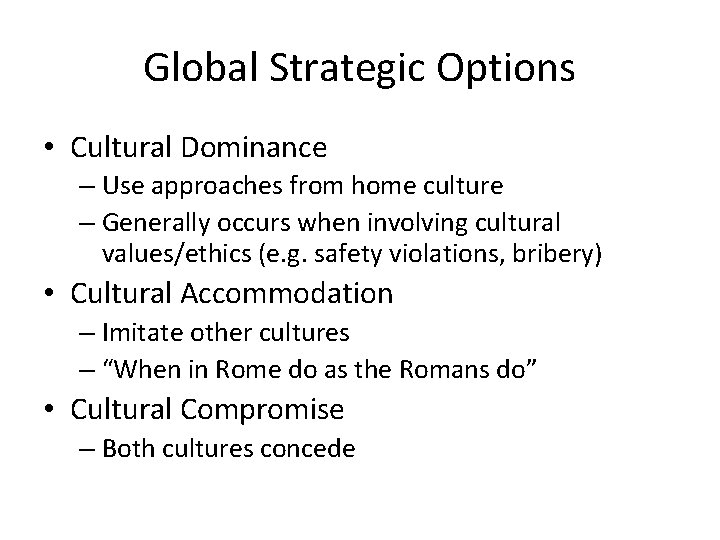
Global Strategic Options • Cultural Dominance – Use approaches from home culture – Generally occurs when involving cultural values/ethics (e. g. safety violations, bribery) • Cultural Accommodation – Imitate other cultures – “When in Rome do as the Romans do” • Cultural Compromise – Both cultures concede
Global Strategic Options (cont) • Cultural Avoidance – Cultural Blindness- Ignore difference – Used when the issue is less important that the long-term business relationship • Cultural Synergy – Leverage the cultural differences • Cultural Synergy is an approach, not the approach