
Cultural patterns I Edward T Hall 4 distinguishing
- Slides: 9
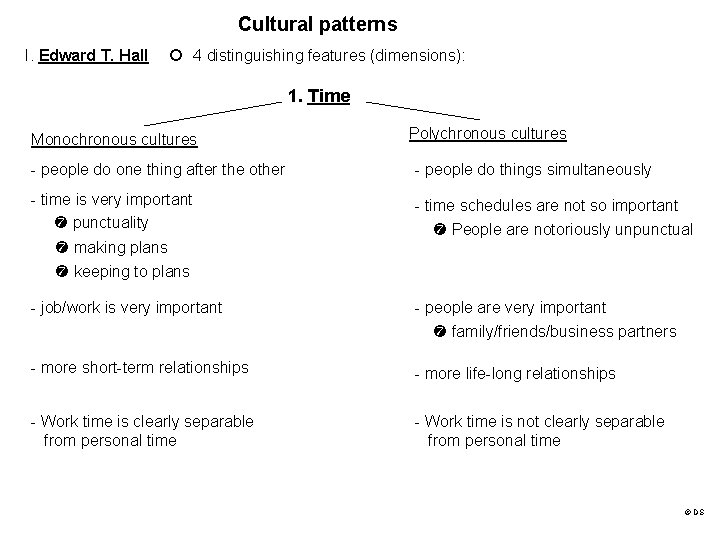
Cultural patterns I. Edward T. Hall 4 distinguishing features (dimensions): 1. Time Monochronous cultures Polychronous cultures - people do one thing after the other - people do things simultaneously - time is very important punctuality - time schedules are not so important People are notoriously unpunctual making plans keeping to plans - job/work is very important - people are very important family/friends/business partners - more short-term relationships - more life-long relationships - Work time is clearly separable from personal time - Work time is not clearly separable from personal time © DS
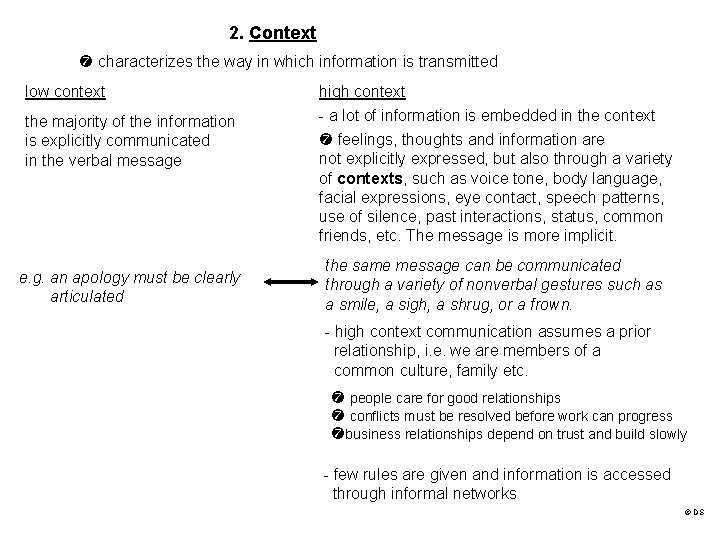
2. Context characterizes the way in which information is transmitted low context the majority of the information is explicitly communicated in the verbal message e. g. an apology must be clearly articulated high context - a lot of information is embedded in the context feelings, thoughts and information are not explicitly expressed, but also through a variety of contexts, such as voice tone, body language, facial expressions, eye contact, speech patterns, use of silence, past interactions, status, common friends, etc. The message is more implicit. the same message can be communicated through a variety of nonverbal gestures such as a smile, a sigh, a shrug, or a frown. - high context communication assumes a prior relationship, i. e. we are members of a common culture, family etc. people care for good relationships conflicts must be resolved before work can progress business relationships depend on trust and build slowly - few rules are given and information is accessed through informal networks © DS
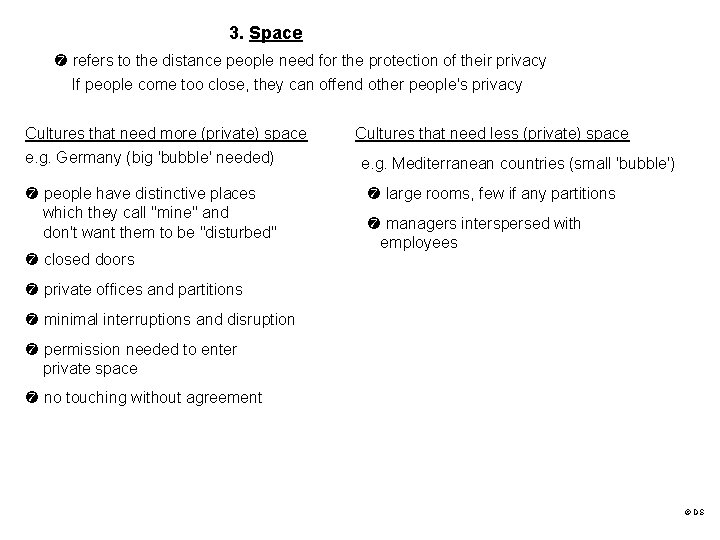
3. Space refers to the distance people need for the protection of their privacy If people come too close, they can offend other people's privacy Cultures that need more (private) space e. g. Germany (big 'bubble' needed) people have distinctive places which they call "mine" and don't want them to be "disturbed" closed doors Cultures that need less (private) space e. g. Mediterranean countries (small 'bubble') large rooms, few if any partitions managers interspersed with employees private offices and partitions minimal interruptions and disruption permission needed to enter private space no touching without agreement © DS
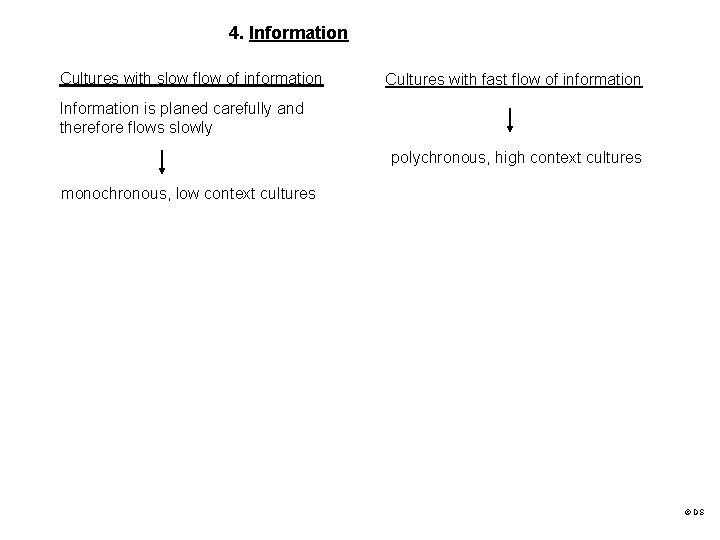
4. Information Cultures with slow flow of information Cultures with fast flow of information Information is planed carefully and therefore flows slowly polychronous, high context cultures monochronous, low context cultures © DS
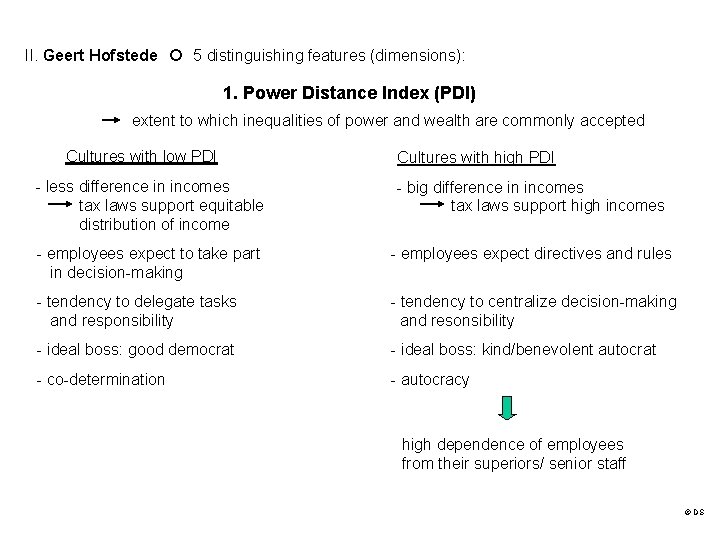
II. Geert Hofstede 5 distinguishing features (dimensions): 1. Power Distance Index (PDI) extent to which inequalities of power and wealth are commonly accepted Cultures with low PDI Cultures with high PDI - less difference in incomes tax laws support equitable distribution of income - big difference in incomes tax laws support high incomes - employees expect to take part in decision-making - employees expect directives and rules - tendency to delegate tasks and responsibility - tendency to centralize decision-making and resonsibility - ideal boss: good democrat - ideal boss: kind/benevolent autocrat - co-determination - autocracy high dependence of employees from their superiors/ senior staff © DS
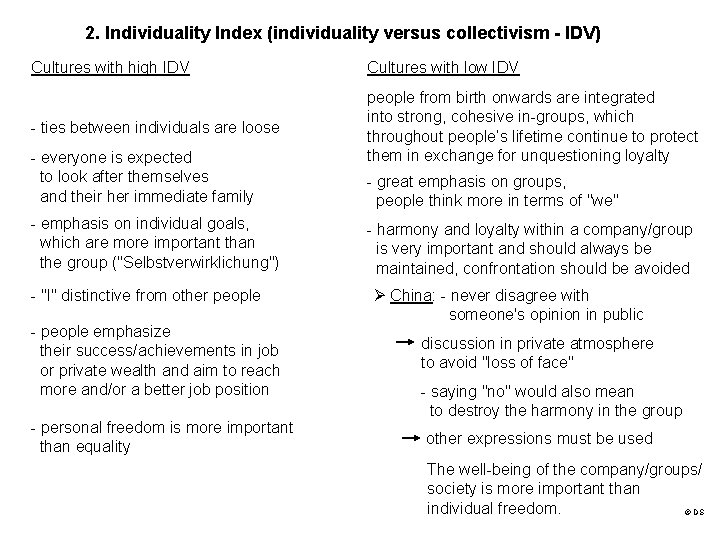
2. Individuality Index (individuality versus collectivism - IDV) Cultures with high IDV Cultures with low IDV - ties between individuals are loose people from birth onwards are integrated into strong, cohesive in-groups, which throughout people’s lifetime continue to protect them in exchange for unquestioning loyalty - everyone is expected to look after themselves and their her immediate family - emphasis on individual goals, which are more important than the group ("Selbstverwirklichung") - "I" distinctive from other people - people emphasize their success/achievements in job or private wealth and aim to reach more and/or a better job position - personal freedom is more important than equality - great emphasis on groups, people think more in terms of "we" - harmony and loyalty within a company/group is very important and should always be maintained, confrontation should be avoided China: - never disagree with someone's opinion in public discussion in private atmosphere to avoid "loss of face" - saying "no" would also mean to destroy the harmony in the group other expressions must be used The well-being of the company/groups/ society is more important than individual freedom. © DS
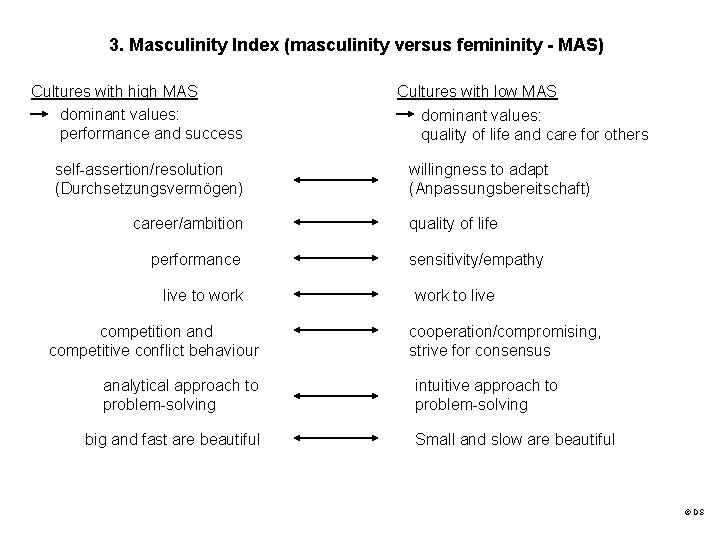
3. Masculinity Index (masculinity versus femininity - MAS) Cultures with high MAS dominant values: performance and success self-assertion/resolution (Durchsetzungsvermögen) career/ambition performance live to work competition and competitive conflict behaviour analytical approach to problem-solving big and fast are beautiful Cultures with low MAS dominant values: quality of life and care for others willingness to adapt (Anpassungsbereitschaft) quality of life sensitivity/empathy work to live cooperation/compromising, strive for consensus intuitive approach to problem-solving Small and slow are beautiful © DS
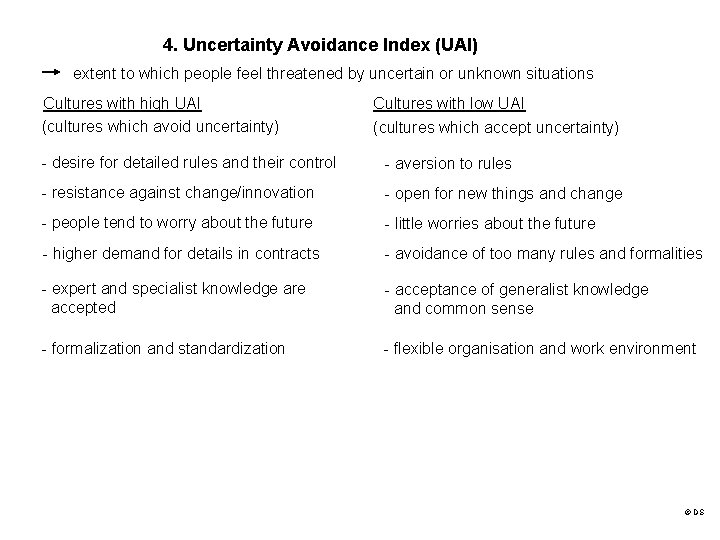
4. Uncertainty Avoidance Index (UAI) extent to which people feel threatened by uncertain or unknown situations Cultures with high UAI (cultures which avoid uncertainty) Cultures with low UAI (cultures which accept uncertainty) - desire for detailed rules and their control - aversion to rules - resistance against change/innovation - open for new things and change - people tend to worry about the future - little worries about the future - higher demand for details in contracts - avoidance of too many rules and formalities - expert and specialist knowledge are accepted - acceptance of generalist knowledge and common sense - formalization and standardization - flexible organisation and work environment © DS
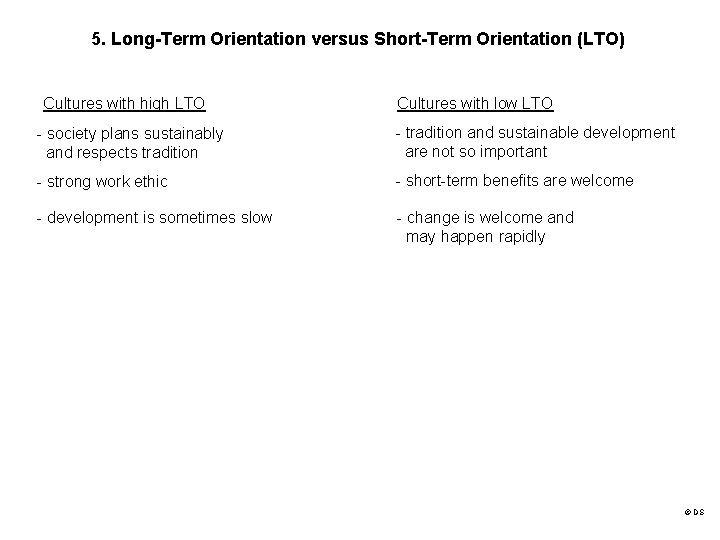
5. Long-Term Orientation versus Short-Term Orientation (LTO) Cultures with high LTO Cultures with low LTO - society plans sustainably and respects tradition - tradition and sustainable development are not so important - strong work ethic - short-term benefits are welcome - development is sometimes slow - change is welcome and may happen rapidly © DS