
Cultural Patterns Edward T Hall Distinguishing Features dimensions
- Slides: 5
Cultural Patterns Edward T. Hall Distinguishing Features (dimensions):
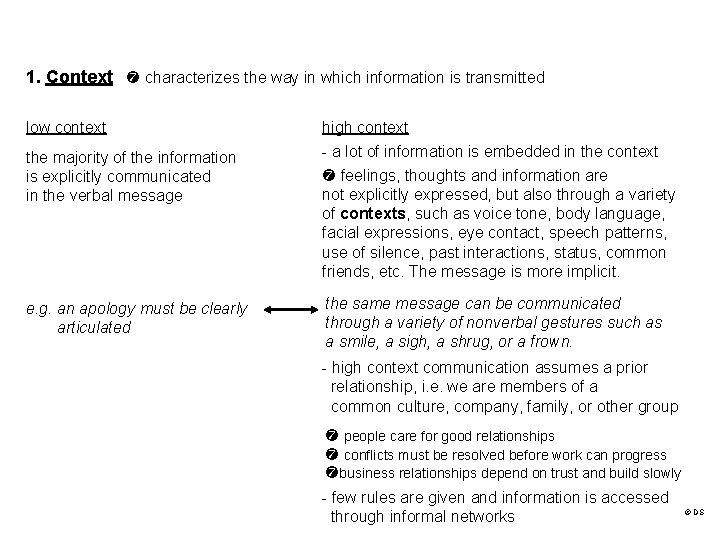
1. Context characterizes the way in which information is transmitted low context high context the majority of the information is explicitly communicated in the verbal message - a lot of information is embedded in the context feelings, thoughts and information are not explicitly expressed, but also through a variety of contexts, such as voice tone, body language, facial expressions, eye contact, speech patterns, use of silence, past interactions, status, common friends, etc. The message is more implicit. e. g. an apology must be clearly articulated the same message can be communicated through a variety of nonverbal gestures such as a smile, a sigh, a shrug, or a frown. - high context communication assumes a prior relationship, i. e. we are members of a common culture, company, family, or other group people care for good relationships conflicts must be resolved before work can progress business relationships depend on trust and build slowly - few rules are given and information is accessed through informal networks © DS
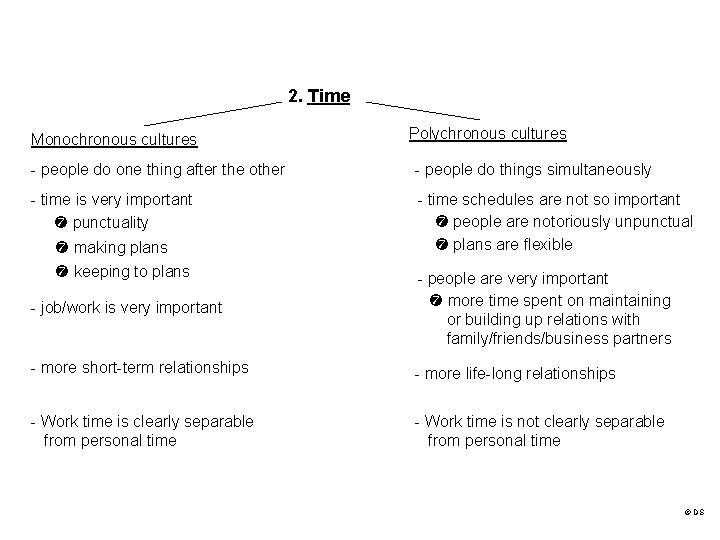
2. Time Monochronous cultures Polychronous cultures - people do one thing after the other - people do things simultaneously - time is very important punctuality - time schedules are not so important people are notoriously unpunctual plans are flexible making plans keeping to plans - job/work is very important - people are very important more time spent on maintaining or building up relations with family/friends/business partners - more short-term relationships - more life-long relationships - Work time is clearly separable from personal time - Work time is not clearly separable from personal time © DS
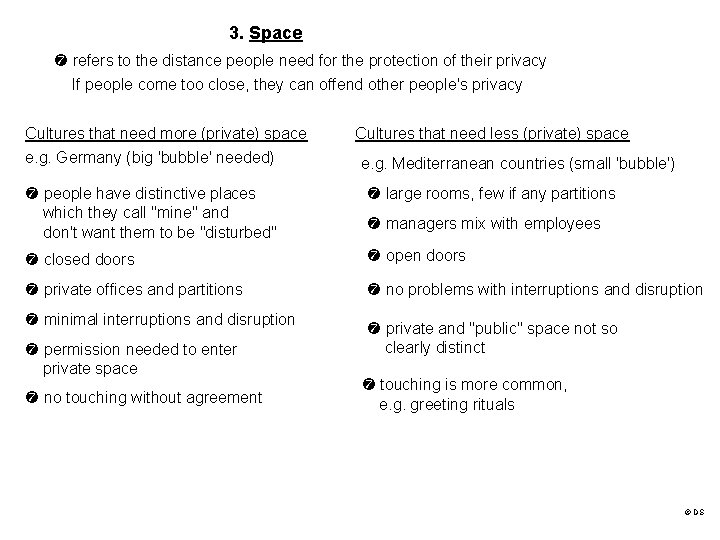
3. Space refers to the distance people need for the protection of their privacy If people come too close, they can offend other people's privacy Cultures that need more (private) space e. g. Germany (big 'bubble' needed) Cultures that need less (private) space e. g. Mediterranean countries (small 'bubble') people have distinctive places which they call "mine" and don't want them to be "disturbed" large rooms, few if any partitions closed doors open doors private offices and partitions no problems with interruptions and disruption minimal interruptions and disruption permission needed to enter private space no touching without agreement managers mix with employees private and "public" space not so clearly distinct touching is more common, e. g. greeting rituals © DS
4. Information Communication Cultures with slow flow of information Cultures with fast flow of information Information is planed carefully and therefore flows slowly polychronous, high context cultures monochronous, low context cultures © DS