
Cultural Media Imperialism Globalization is a process of
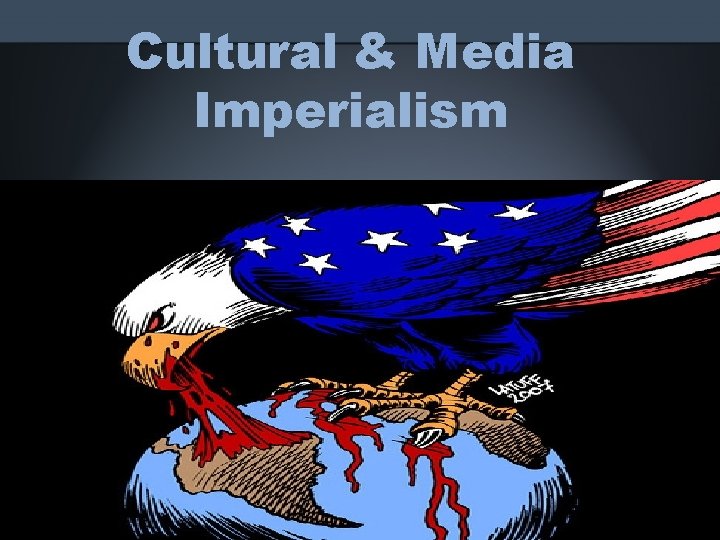
Cultural & Media Imperialism
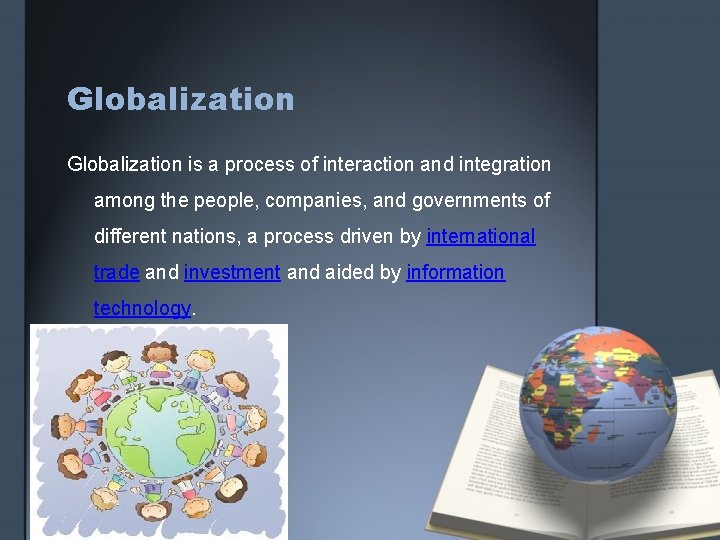
Globalization is a process of interaction and integration among the people, companies, and governments of different nations, a process driven by international trade and investment and aided by information technology.
Globalization Policy and technological developments of the past few decades have spurred increases in cross-border trade, investment, and migration so large that many observers believe the world has entered a qualitatively new phase in its economic development.
Globalization Since 1950, for example, the volume of world trade has increased by 20 times, and from just 1997 to 1999 flows of foreign investment nearly doubled, from $468 billion to $827 billion. Distinguishing this current wave of globalization from earlier ones, author Thomas Friedman has said that today globalization is “farther, faster, cheaper, and deeper. ”
Globalization Since the Second World War, and especially during the past two decades, many governments have adopted free-market economic systems, vastly increasing their own productive potential and creating numerous new opportunities for international trade and investment.
Effects of globalization • • • • Improving living standards of people in developing countries Industrialization Financial economic Political Informational Cultural Ecological Travel and tourism Immigration Global telecommunications Legal and ethical laws Crime importation
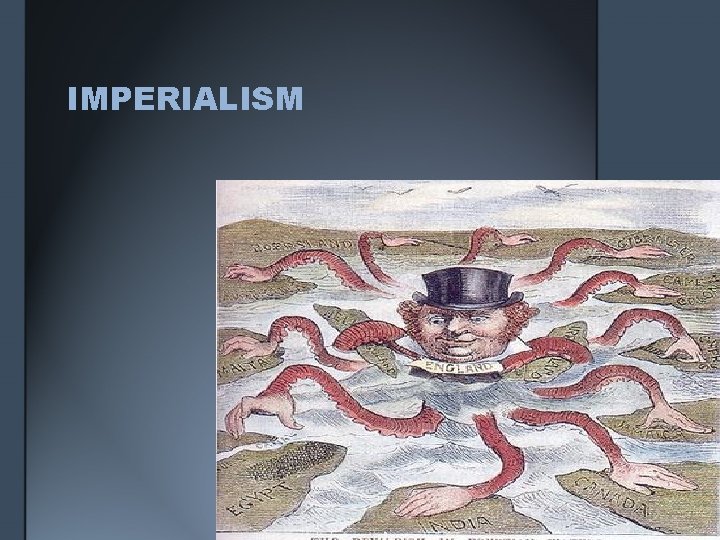
IMPERIALISM
Imperialism A process whereby powerful groups try to extend their power and increase their wealth by bringing over more of the world under their domination.
Age of Imperialism • The Age of Imperialism was a time period beginning around 1870 when modern, relatively developed nations were taking over less developed areas, colonizing them, or influencing them in order to expand their own power. • the term "Age of Imperialism" generally refers to the activities of nations such as the United Kingdom, France, Germany, Italy, Japan and the United States in the early 18 th through the middle 20 th centuries.
Types of Imperialism • Military Imperialism • Political Imperialism • Economical Imperialism • Cultural Imperialism • Communication Imperialism
Military Imperialism Developed countries are interrupting in developing countries by use of military power. U. S. Invasion and Occupation of countries like Iraq
Political Imperialism This could go a couple of different ways, depending on the time and region. For example, England put white English people in-charge of regions of India and changed the existing political structure to benefit the dominant culture (typically the ethnic minority) and keep things running smoothly.
Economic Imperialism • Mc. Donalds and other originally American/Western businesses moving across the world into other economies and pulling resources from that region and back into the U. S. /West. Also, you could call the corporate purchase of lands and resources in large areas of land (like Shell buying them up in Nigeria and elsewhere) a form of economic imperialism, since they are using the power of money to influence the area and ultimately benefit the dominant country.
Communication imperialism Communications imperialism has to do with the domination of a country's media activities by another. The ownership, structure, distribution or content of the media in one country are affected by pressures from media interests of another country or group out of proportion with those of that country.
Communication imperialism The four aspects of international media in this situation are • Television program exportation • Foreign ownership and control of media distribution • The infringement of capital opinions on other societies • The transfer of commercialism and broadcasting norms.
Media Imperialism • Media imperialism is a theory based upon an overconcentration of mass media from larger nations as a significant variable in negatively affecting smaller nations, in which the national identity of smaller nations is lessened or lost due to media homogeneity inherent in mass media from the larger countries.

Media Imperialism
Media Imperialism • The Media Imperialism debate started in the early 1970 s when developing countries began to criticize the control developed countries held over the media. The site for this conflict was UNESCO where the NWICO movement developed. Supported by the Mac. Bride report, "Many Voices, One World", countries such as India, Indonesia, and Egypt argued that the large media companies should have limited access to developing countries.
Cultural Imperialism
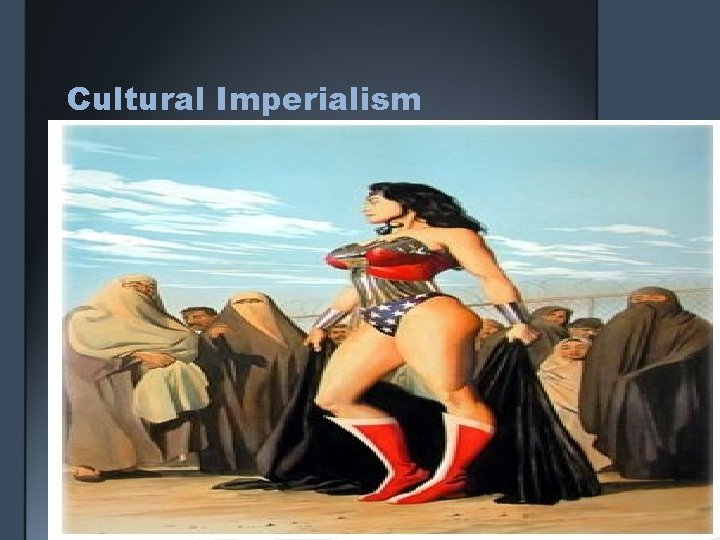
Cultural Imperialism • The Issue of cultural imperialism has been in the center of controversy for quite a long time. One group maintains that cultural imperialism is one way flow of cultural domination from west to east or from center to periphery or even from global to local. • Countries may have their own language and culture, but cultural imperialism pushes them to adopt cultural attitudes and values from somewhere else.
Cultural Imperialism • Cultural contacts among different societies are happening through worlds market, global migration or commodity and labor. Products are flowing from one corner to another along with intercultural communication. • The prevalence of plastic surgery in China to create more Western looking features (thinner/longer nose, bigger breasts, and even longer legs) has devalued traditionally Chinese characteristics for something they consider more powerful and desirable.
Effects of Cultural and media Imperialism Pakistan is one of those developing countries which are suffering from Americanization and cultural invasion due to the foreign channels on satellite transmission and cable TV network. It has affected their • life styles • food habits • dressing • Language • media content • festivals
Life style It is a known fact that Hollywood is a much more advanced industry, their moral slandered are different from eastern moral values. Now despite the counter flow of cultural products by eastern media, US-led western media domination has not diminished. Actually it is a channel of influence that flows from Hollywood to Bollywood and then to our Pakistani media. In this perspective the protection of cultural identity became a particularly hot issue since 1970's debates on cultural imperialism through media globalization
Life style • Lifestyle of people in developing countries has totally changed now. • They have adopted western lifestyle. • People get up late in morning and go to bed late at night. • Friends are preferred upon family. • Social gathering like youth parties, concerts, night parties and bone-fires are arranged for entertainment and to enhance social interaction.
Food habits • Media has a direct impact on cultures by mesmerizing viewers with entertainment cultural products, fast music, popularizing fast food points such as KFC, Mc. Donald, and Pizza Hut etc. introducing the Mcworld culture. • Junk food, fast food, outside dining is preferred on traditional desi regional food.
Dressing • Modern media technology has now created the possibility and even the Likelihood of a global culture. The satellites and cable TV are sweeping away cultural boundaries. Global entertainment industries shape the perceptions and dreams of ordinary citizens, wherever they live. • The concept of global village has changed the outlook of future society. Western dresses like jeans, long coats, skirts, pants, tea shirts are preferred in developing countries
Language • Culture exists in the mind or habit patterns of the members of a society. It is visible in the behavior of individuals, as they engage in various forms of learned behavior. • A nation possessing a specific culture has its own discrete identity which we can say the national cultural identity and every culture have its own language but now English language is mostly preferred in every institution either business firm or education institution.
Media programs • Pakistani Independent drama channels such as Indus Vision, ARY digital, Geo entertainment etc, are trying to compete with this Indian and western channels. • The co-productions have changed the face of today media industry. . Our independent media channels are not confined to the combine productions, they have taken the rights from (PEMRA) Pakistan Electronic Media Regulatory Authority to broadcast pure Indian productions from their own channels
Media programs Thus our media channels being influenced form foreign Indian channels serve as the trendsetter for our Pakistani viewers and society. When the viewers observe that our media is absorbing the change whether it is in the form of dresses, Jewelry, language or other cultural values such as male actors hugging and handshaking with female actresses then the viewers are easily persuaded to adopt these changes or at least they become mentally liberal which is an initial step towards change
Festivals • Showing ‘local culture’ in the global media, making folk song global, cannot take place without global local interaction. • Simply, if we take example such as Valentine‘s Day or Mother or Father Day; these are recently imported Western celebrations to be involved with global economic dimension in the name of cultural assimilation or homogenization.
Conclusion • In conclusion, it can be reiterated that given the diversity of political, socio-economic context, cultural issues have always been treated as the moot point of global debate. • the debate continues raising queries; will there be one culture all over the world? Will the world be homogenized or fragmented through cultural communication? • Arguments and counter arguments are persistent and never-ending. And that is why the concept of cultural Imperialism is indeed a useful concept to describe global communication.
REFERENCES • Rahman M. H, Cultural Imperialism and Its Possible Effects on Global Communication, Retrieved fromhttp: //www. academia. edu/981258/Cultural_Imper ialismand_Its_Possible_Effects_on_Global_Communi cation Khan M. A. (2009) Media imperialism and its effects on culture of pakistan a case study of youth of multan, global media journal Retrieved from http: //www. aiou. edu. pk/gmj/artical 3%28 Aut 08%29. asp •
• American cultural imperialism: gift or threat Retrieved from • http: //gsevenier. free. fr/cultural. Imperialism. html • Lee PS (1988). Communication imperialism and dependency: a conceptual clarification. • Retrieved from http: //www. ncbi. nlm. nih. gov/pubmed/12283101 •
- Slides: 33