
CULTURAL INTELLIGENCE IN A VUCA WORLD Lesson 5

- Slides: 14
CULTURAL INTELLIGENCE IN A VUCA WORLD
Lesson 5: World View LEARNING OBJECTIVE Everyone has a motivation for living, whether aware of it or not. This motivation – whether religious, secular, philosophical, or something else, helps us to get up each morning, go to work, and then guides us throughout the day. This is called a world view, which asks basic questions about life in terms of reality, human nature, truth, and values. KEY TAKEAWAY • • Define world view. Articulate your personal world view and how this affects our outlook on life and how you approach business problems. Describe the role of perception in our intercultural interactions. Differentiate between a stereotype and a generalization. LEADERSHIP APPLICATIONS Worldviews can be invisible forces that impact our lives and professions, and culture influences the way individuals view the world. We need to be aware of this.
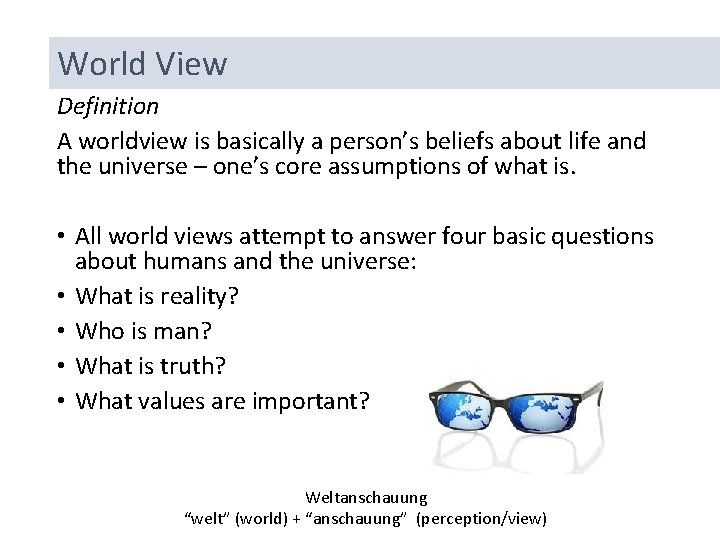
World View Definition A worldview is basically a person’s beliefs about life and the universe – one’s core assumptions of what is. • All world views attempt to answer four basic questions about humans and the universe: • What is reality? • Who is man? • What is truth? • What values are important? Weltanschauung “welt” (world) + “anschauung” (perception/view)
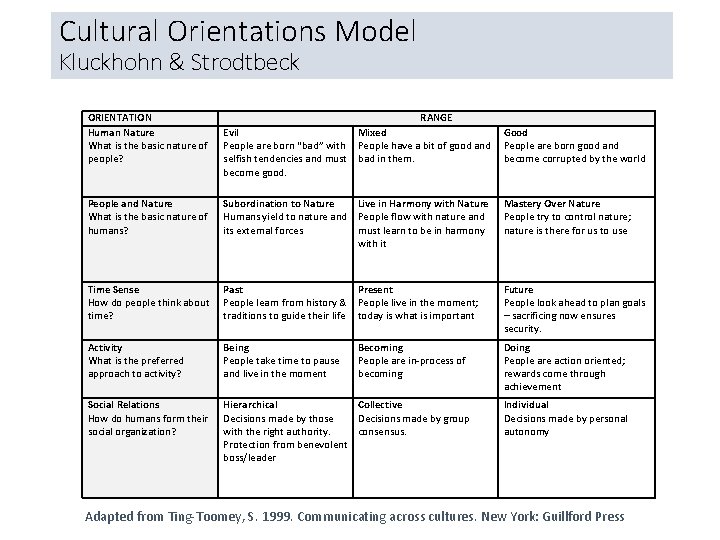
Cultural Orientations Model Kluckhohn & Strodtbeck ORIENTATION Human Nature What is the basic nature of people? RANGE Evil Mixed Good People are born “bad” with People have a bit of good and People are born good and selfish tendencies and must bad in them. become corrupted by the world become good. People and Nature What is the basic nature of humans? Subordination to Nature Live in Harmony with Nature Humans yield to nature and People flow with nature and its external forces must learn to be in harmony with it Mastery Over Nature People try to control nature; nature is there for us to use Time Sense How do people think about time? Past Present People learn from history & People live in the moment; traditions to guide their life today is what is important Future People look ahead to plan goals – sacrificing now ensures security. Activity What is the preferred approach to activity? Being People take time to pause and live in the moment Becoming People are in-process of becoming Doing People are action oriented; rewards come through achievement Social Relations How do humans form their social organization? Hierarchical Decisions made by those with the right authority. Protection from benevolent boss/leader Collective Decisions made by group consensus. Individual Decisions made by personal autonomy Adapted from Ting-Toomey, S. 1999. Communicating across cultures. New York: Guillford Press
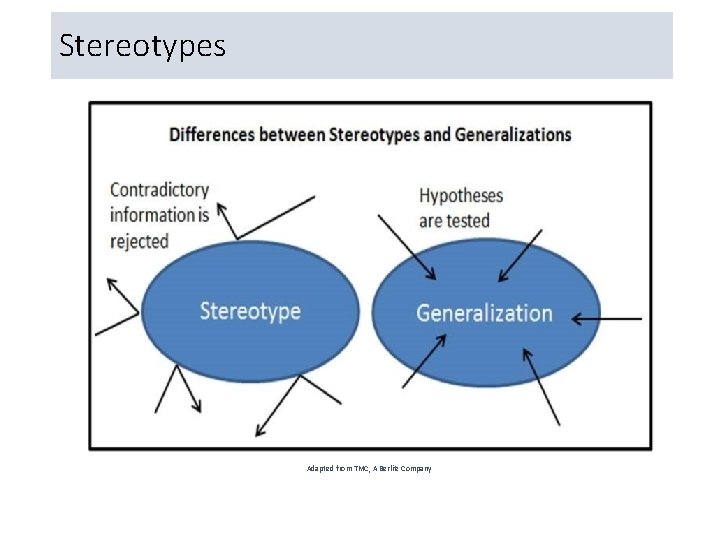
Stereotypes Adapted from TMC, A Berlitz Company
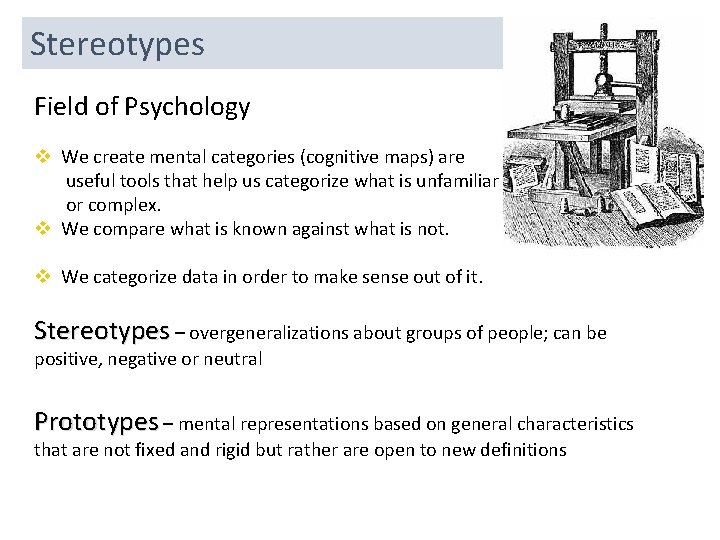
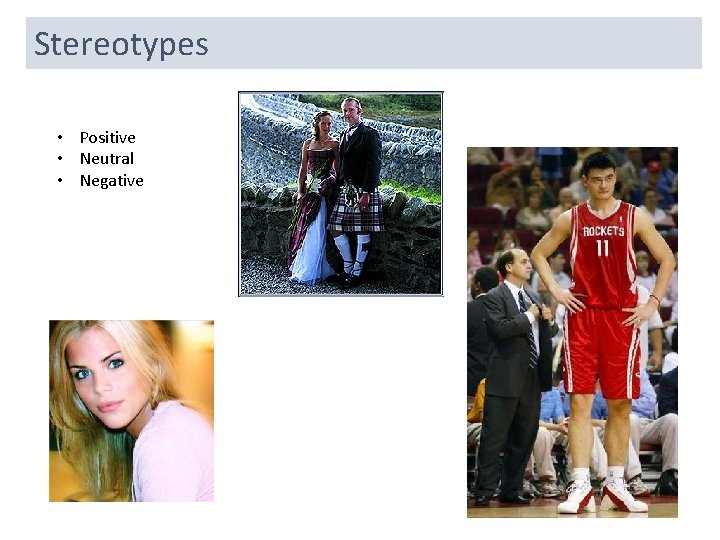
Stereotypes Field of Psychology v We create mental categories (cognitive maps) are useful tools that help us categorize what is unfamiliar or complex. v We compare what is known against what is not. v We categorize data in order to make sense out of it. Stereotypes – overgeneralizations about groups of people; can be positive, negative or neutral Prototypes – mental representations based on general characteristics that are not fixed and rigid but rather are open to new definitions
Stereotypes • Positive • Neutral • Negative
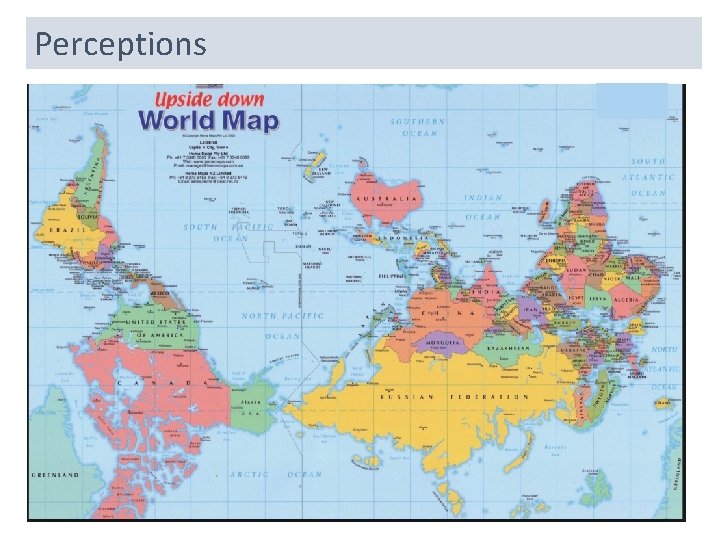
Perceptions
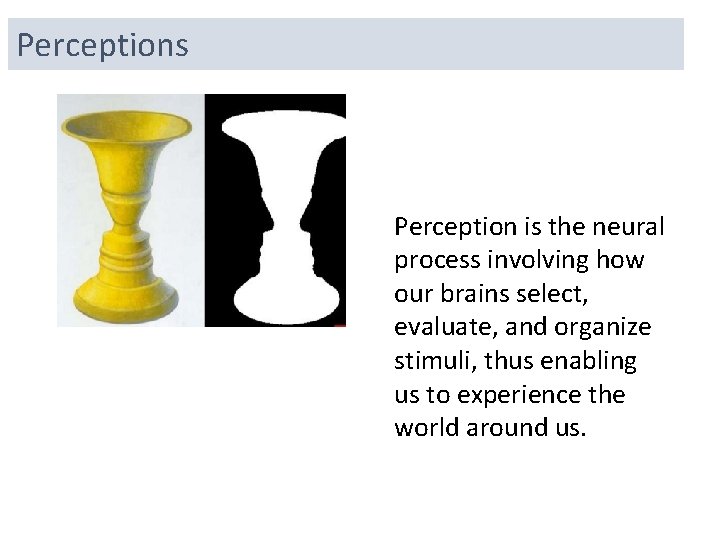
Perceptions Perception is the neural process involving how our brains select, evaluate, and organize stimuli, thus enabling us to experience the world around us.
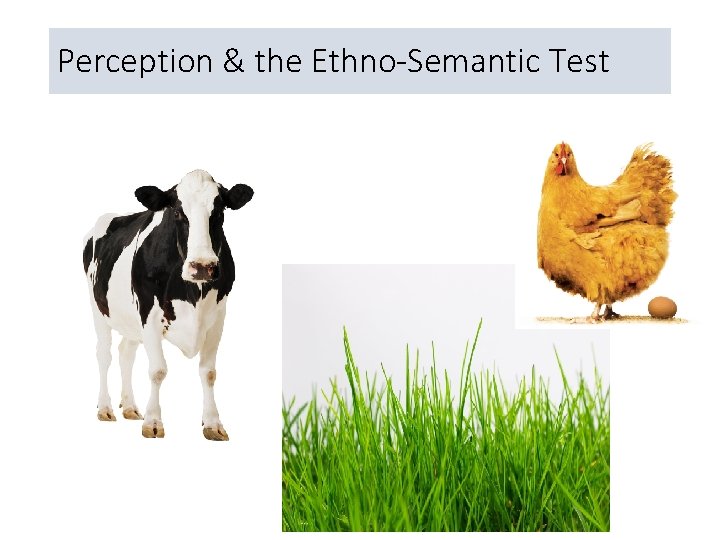
Perception & the Ethno-Semantic Test
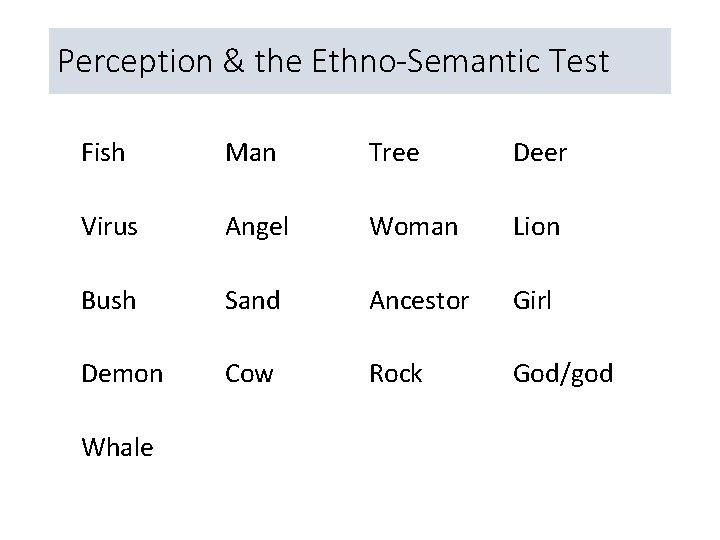
Perception & the Ethno-Semantic Test Fish Man Tree Deer Virus Angel Woman Lion Bush Sand Ancestor Girl Demon Cow Rock God/god Whale
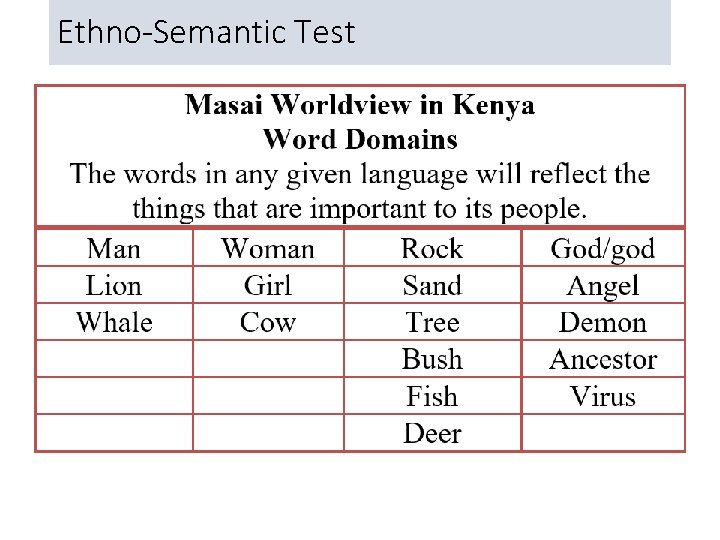
Ethno-Semantic Test
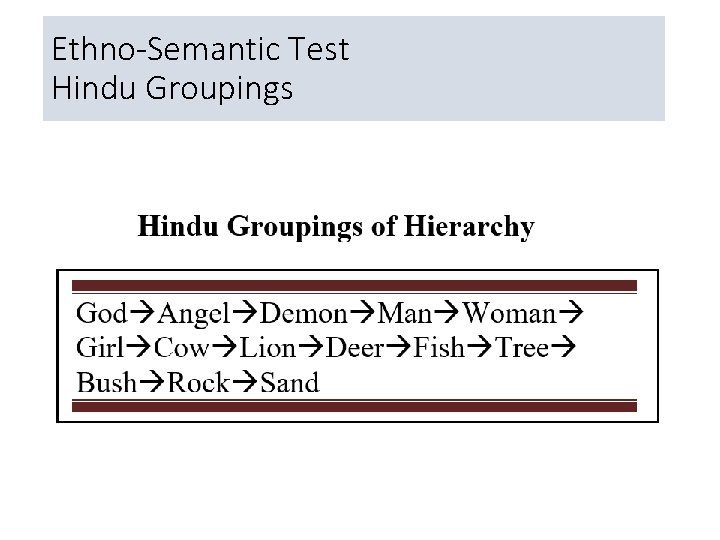
Ethno-Semantic Test Hindu Groupings
Summary Culture influences the way people view the world. As leaders we need to remember that tacit worldviews can be invisible forces that impact our lives, professions, and the people with whom we interact. • Everyone has a world view or the vantage point to survey her or his world. • As we try to make sense of the world, each of us uses the process of perception to make sense of the external stimuli coming at all five senses. Such generalizations are all right as long as we view them as hypotheses to be tested rather than rigid judgments that define all people. • A stereotype is a belief about a person or group that puts everyone into a category. When you make a stereotype you tend to reject contradictory information by using selective perception and refusing to change your attitude. • A prototype is a mental representation based on general characteristics that are not fixed and rigid but rather are open to new definitions • A generalization is an idea that has a general rather than specific application that is a hypothesis to be tested and observed. You analyze the data and constantly test your ideas by being open, curious, and willing to learn.