
Cultural Input in Oral English Teaching in Call




- Slides: 41
Cultural Input in Oral English Teaching in Call Environments Zhihong Lu (卢志鸿), Shenghua Huang, Xiaoyan Li Zhihong Lu (email: zhihonglu 2002@yahoo. com. cn) Beijing University of Posts and Telecommunications 1
Cultural Input in Oral English Teaching in Call Environments 1. Importance of Cultural Input (in an audio -video speaking class (AVSC) based on the perspective 2. Features in CALL Environments of social identity and cultural code) 3. Conducting Cultural Input in AVSC 4. Limitations 2
Background College English teaching reform in China (since 2004) College English Curriculum Requirements (2007) comprehensive communicative language abilities The extensive use of modern information technology Changes in college English teaching: Emphasis: language knowledge (past) communicative language ability and autonomous learning ability teaching focuses on the learners teaching mode shifts from teacher-centered to student-centered 3
Background College English teaching reform in China (since 2004) ● teacher-centered pattern: Foreign language education has limited the teaching of culture to the transmission of information about the people of the target country, and about their general attitudes and world views (Kramsch, 1999). In a traditional teaching environment, the teacher focuses more on explaining grammar and linguistic knowledge, whereas ignoring the cultural input. 4
Background College English teaching reform in China (since 2004) ● student-centered teaching: multi-dimensional models Put culture teaching as the fifth dimension, which is closely related to listening, reading, writing and speaking (Damen, 2004). Communicative language teaching & interactive teaching model 5
The Importance of Cultural Input in an (AVSC) 1. Needs to Stimulate the Awareness of Culture Code culture code: The unconscious meaning we apply to any given thing —— a car, a type of food, a relationship, even a country —— via the culture in which we are raised (Rapaille, C. 2007). key to improving learners’ awareness of culture code: necessary cultural information awareness of cultural differences 6
The Importance of Cultural Input in an (AVSC) 2. Needs to Raise the Awareness of Social Identity is generated, confirmed, and transformed in the process of interactions between groups and individuals (Stempleski & Tomalin: 1990)& Barth(1969) Cultural Input necessary to raise the learners’ awareness of social identity effective in breaking the boundaries resulted from different social identities 7
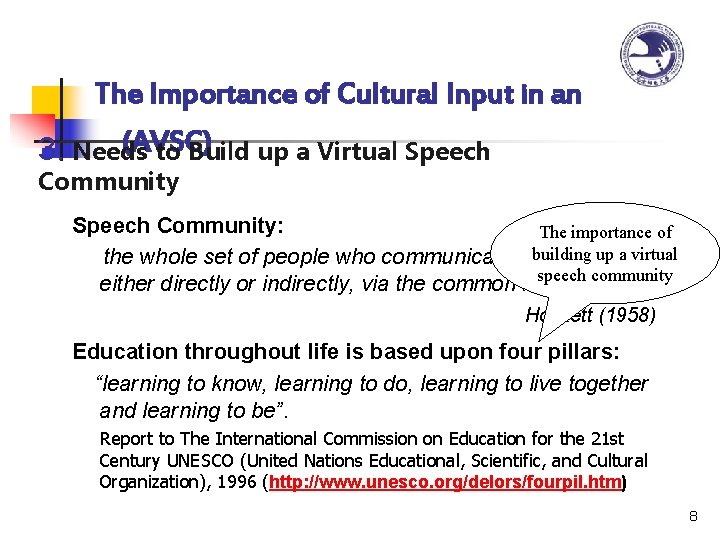
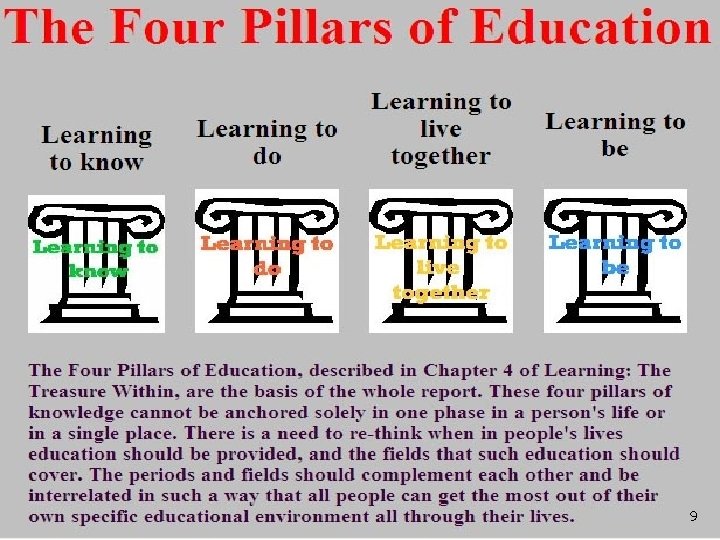
The Importance of Cultural Input in an (AVSC) 3. Needs to Build up a Virtual Speech Community: The importance of building up other, a virtual the whole set of people who communicate with each speech community either directly or indirectly, via the common language. Hockett (1958) Education throughout life is based upon four pillars: “learning to know, learning to do, learning to live together and learning to be”. Report to The International Commission on Education for the 21 st Century UNESCO (United Nations Educational, Scientific, and Cultural Organization), 1996 (http: //www. unesco. org/delors/fourpil. htm) 8
9
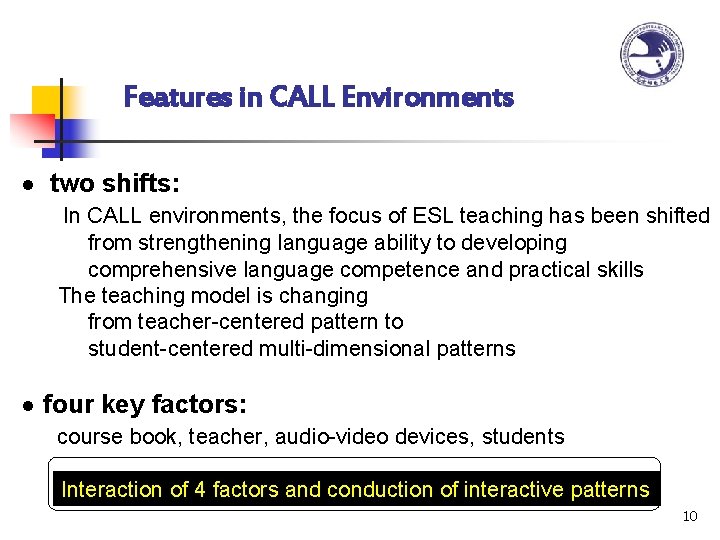
Features in CALL Environments ● two shifts: In CALL environments, the focus of ESL teaching has been shifted from strengthening language ability to developing comprehensive language competence and practical skills The teaching model is changing from teacher-centered pattern to student-centered multi-dimensional patterns ● four key factors: course book, teacher, audio-video devices, students Interaction of 4 factors and conduction of interactive patterns 10
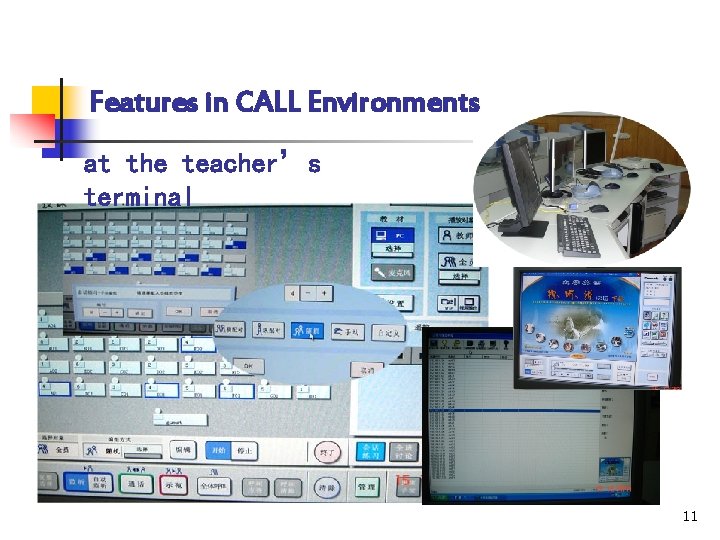
Features in CALL Environments at the teacher’s terminal 11
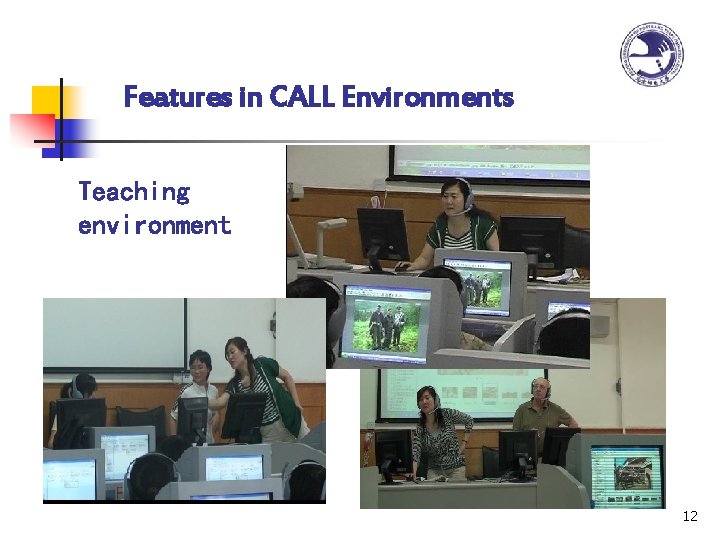
Features in CALL Environments Teaching environment 12
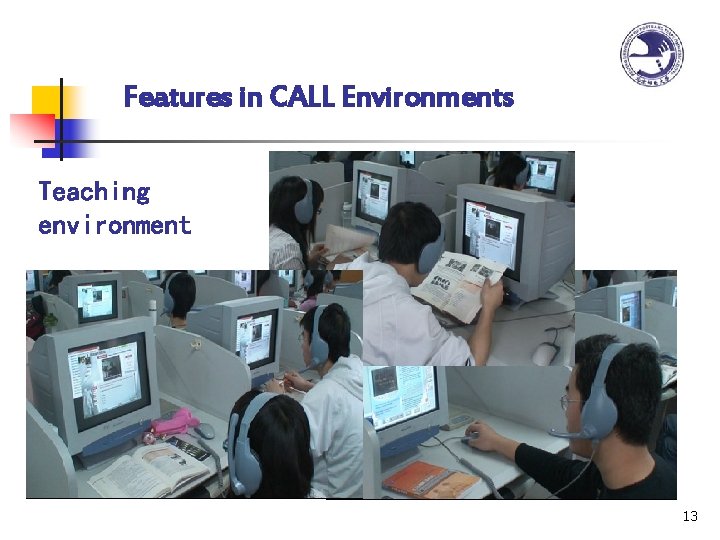
Features in CALL Environments Teaching environment 13
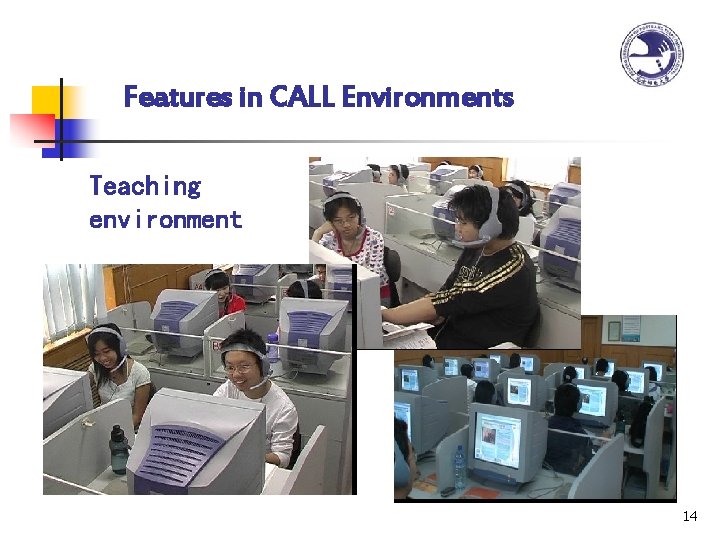
Features in CALL Environments Teaching environment 14
Features in CALL Environments ● Adapt to the need for the interaction among students, or between the teacher and students. ● Provide more functional devices for the teacher in conducting in- class speaking activities. ● Help the teacher build up a vivid learning environment, stimulating students’ interests to speak in the target language. ● Easy access to the Internet, which opens a large knowledge pool for students. ● Resources can be saved either in disks or shown on the computer screen. 15
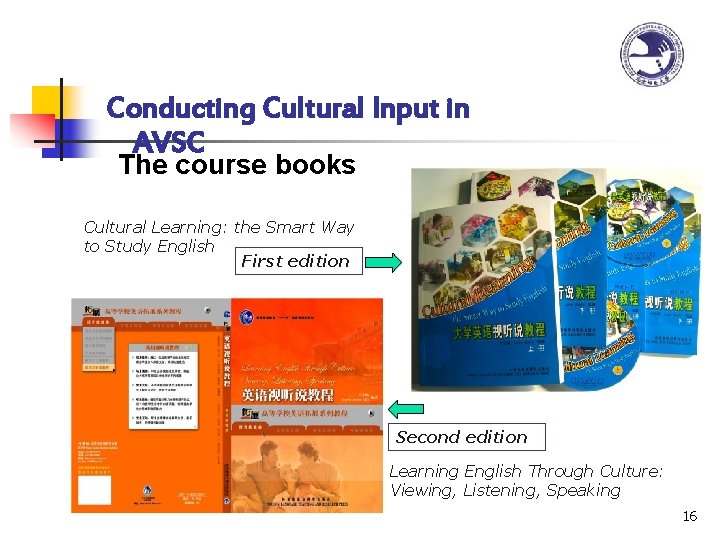
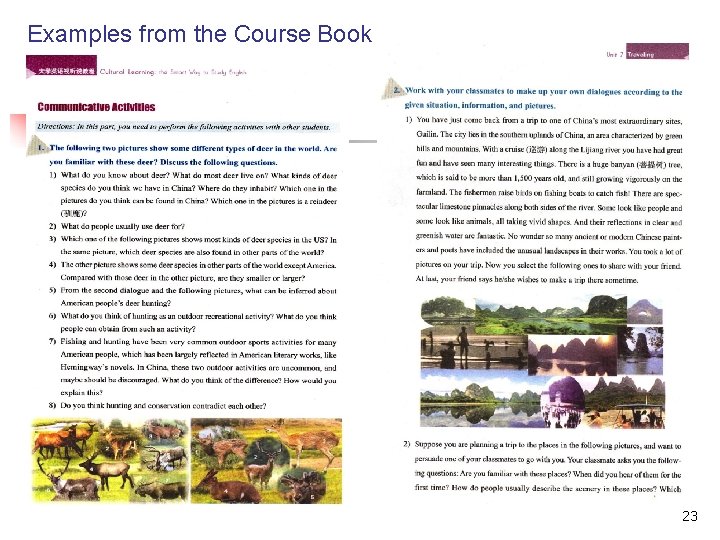
Conducting Cultural Input in AVSC The course books Cultural Learning: the Smart Way to Study English First edition Second edition Learning English Through Culture: Viewing, Listening, Speaking 16
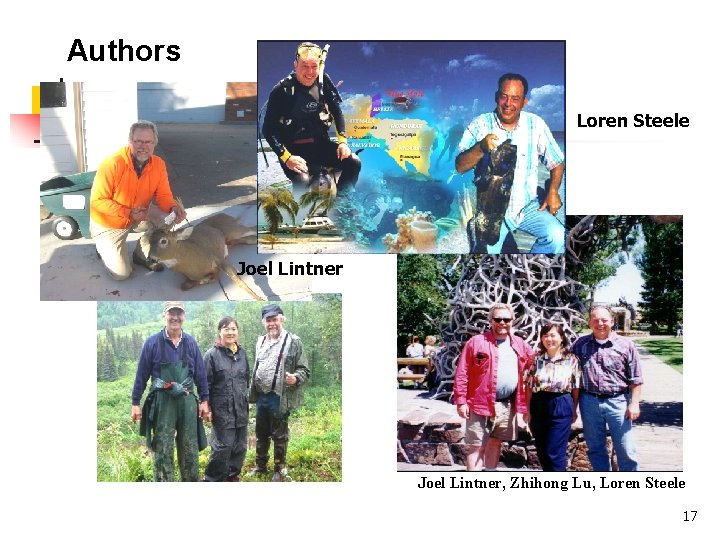
Authors Loren Steele Joel Lintner, Zhihong Lu, Loren Steele 17
Conducting Cultural Input in AVSC The course books stressed on: • • “Student-centered” autonomous Learning Individualized teaching Learners’ cultural input Awareness of cultural differences and the importance of cultural learning 18
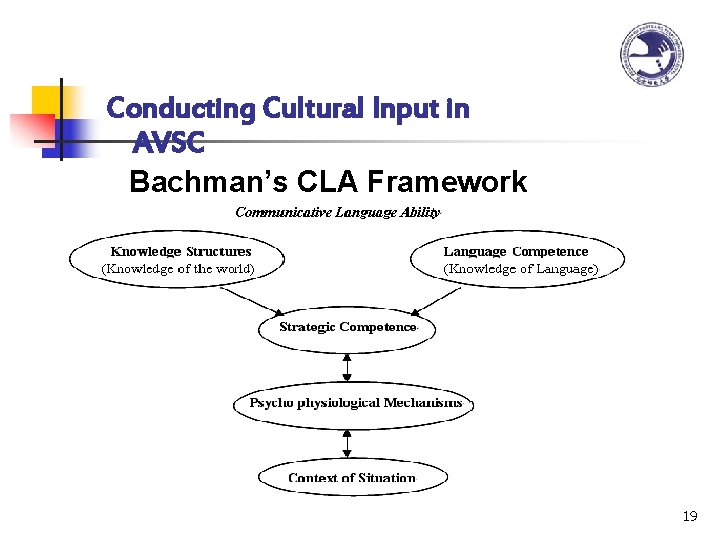
Conducting Cultural Input in AVSC Bachman’s CLA Framework 19
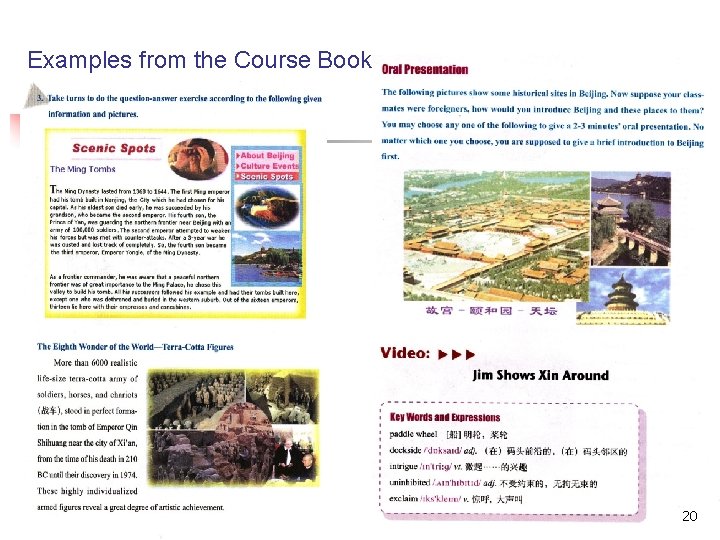
Examples from the Course Book 20
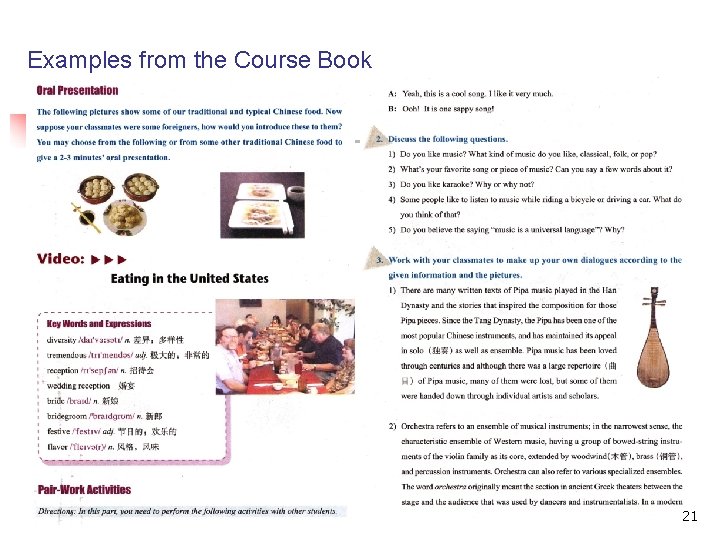
Examples from the Course Book 21
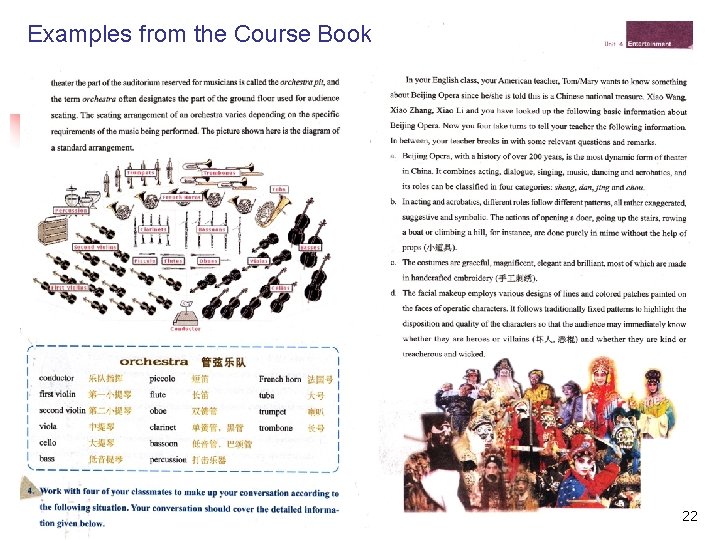
Examples from the Course Book 22
Examples from the Course Book 23
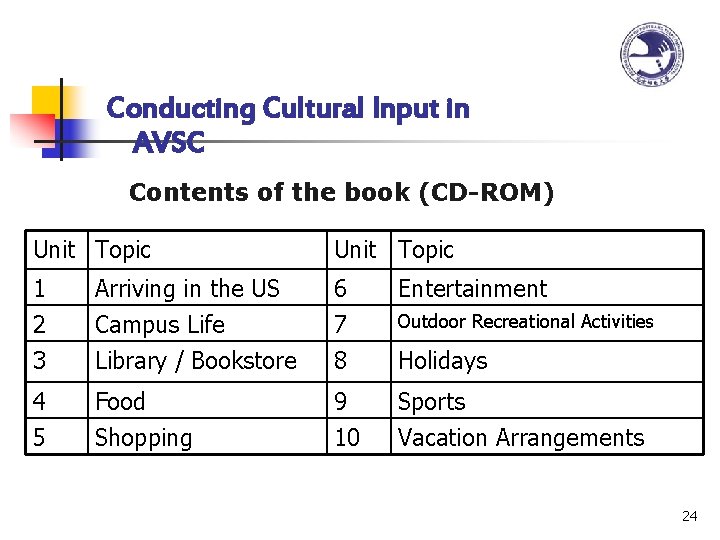
Conducting Cultural Input in AVSC Contents of the book (CD-ROM) Unit Topic 1 2 3 Arriving in the US Campus Life Library / Bookstore 6 7 8 Entertainment 4 5 Food Shopping 9 10 Sports Vacation Arrangements Outdoor Recreational Activities Holidays 24
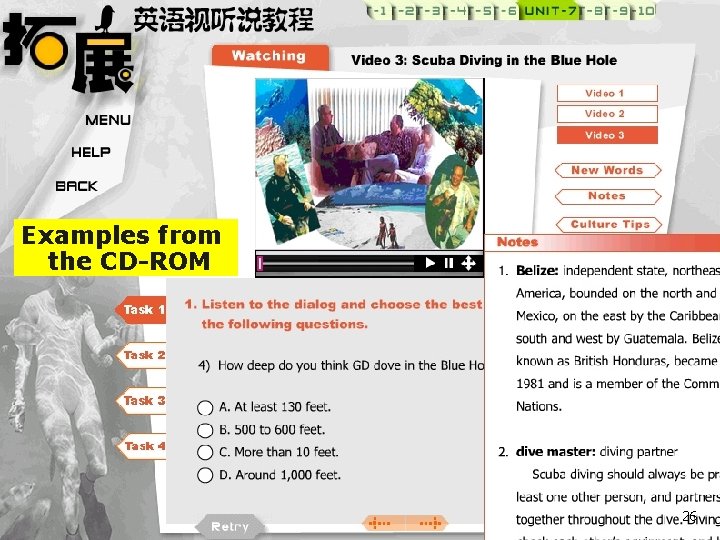
Conducting Cultural Input in AVSC Examples from the CD-ROM 25
Conducting Cultural Input in AVSC Examples from the CD-ROM 26
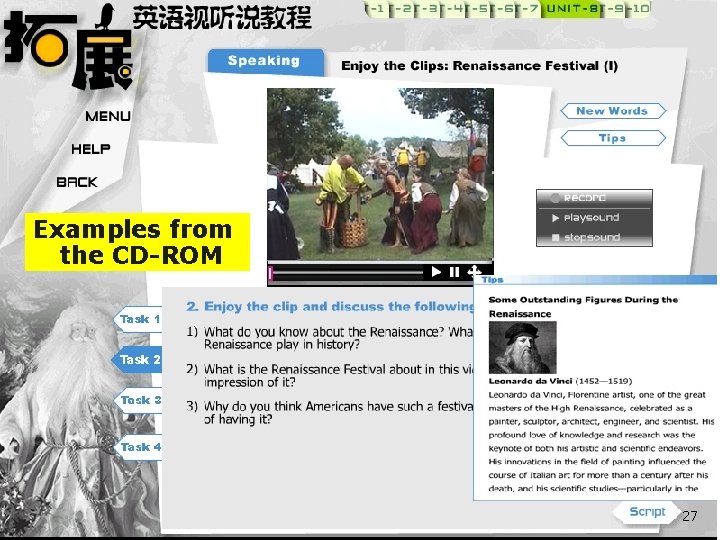
Examples from the CD-ROM 27
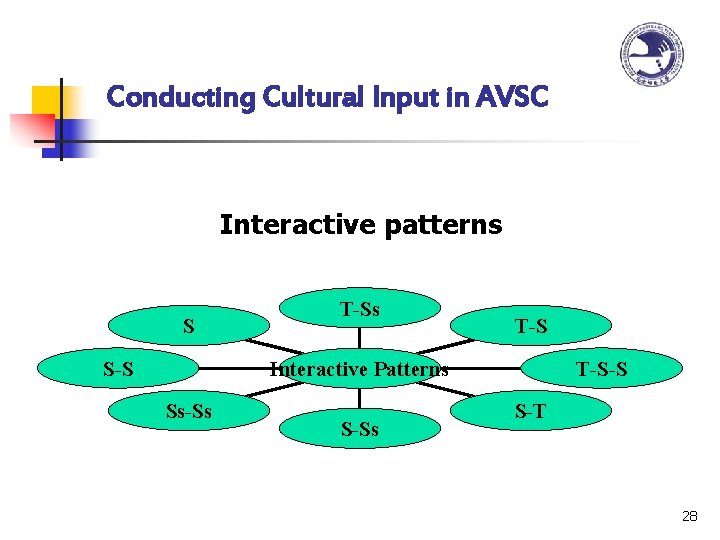
Conducting Cultural Input in AVSC Interactive patterns S S-S T-Ss T-S-S Interactive Patterns Ss-Ss S-T 28
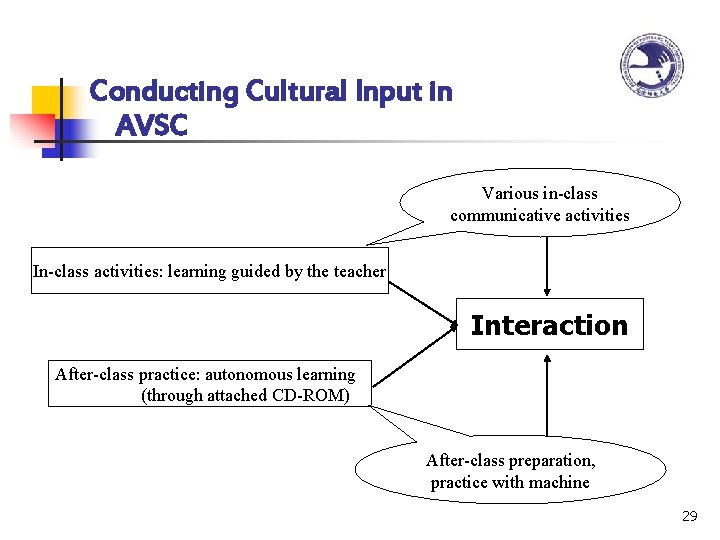
Conducting Cultural Input in AVSC Various in-class communicative activities In-class activities: learning guided by the teacher Interaction After-class practice: autonomous learning (through attached CD-ROM) After-class preparation, practice with machine 29
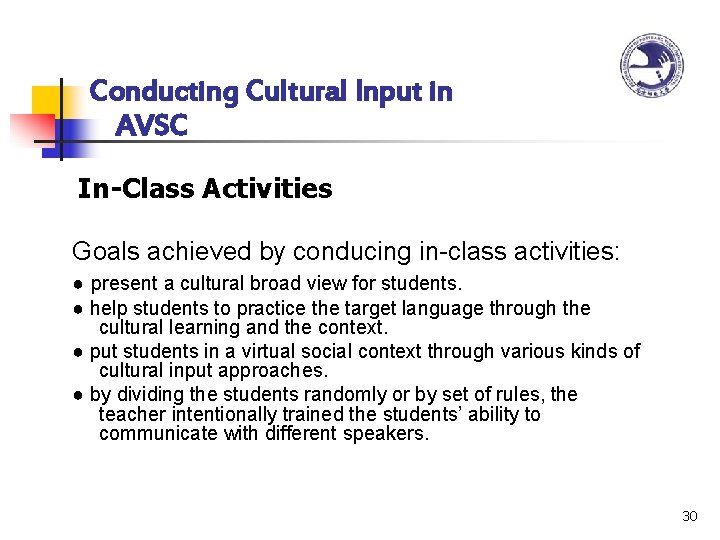
Conducting Cultural Input in AVSC In-Class Activities Goals achieved by conducing in-class activities: ● present a cultural broad view for students. ● help students to practice the target language through the cultural learning and the context. ● put students in a virtual social context through various kinds of cultural input approaches. ● by dividing the students randomly or by set of rules, the teacher intentionally trained the students’ ability to communicate with different speakers. 30
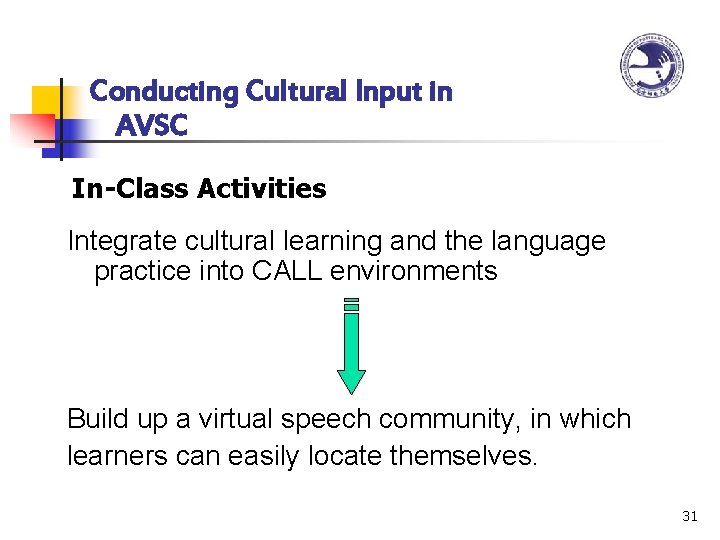
Conducting Cultural Input in AVSC In-Class Activities Integrate cultural learning and the language practice into CALL environments Build up a virtual speech community, in which learners can easily locate themselves. 31
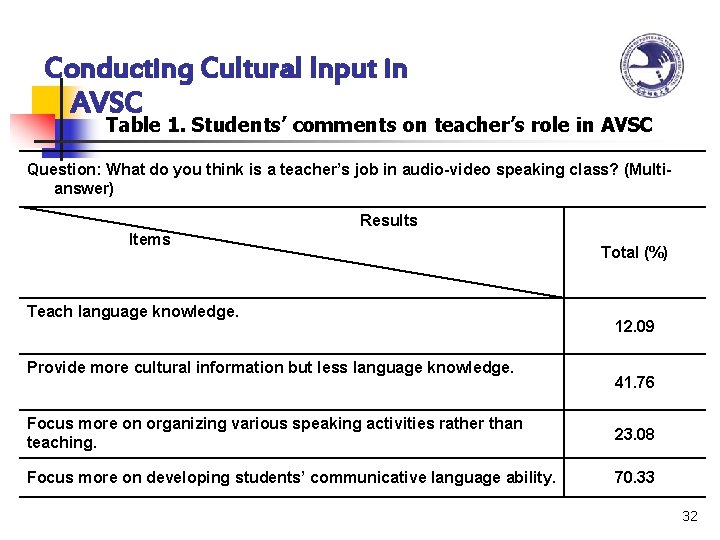
Conducting Cultural Input in AVSC Table 1. Students’ comments on teacher’s role in AVSC Question: What do you think is a teacher’s job in audio-video speaking class? (Multianswer) Results Items Teach language knowledge. Provide more cultural information but less language knowledge. Total (%) 12. 09 41. 76 Focus more on organizing various speaking activities rather than teaching. 23. 08 Focus more on developing students’ communicative language ability. 70. 33 32
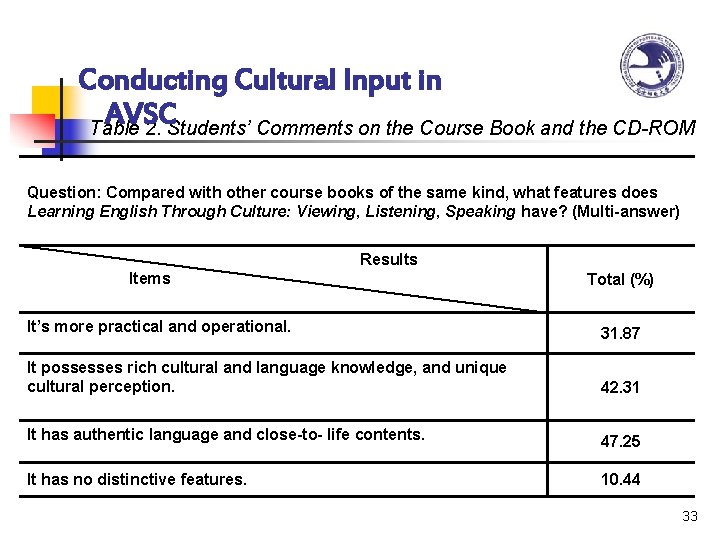
Conducting Cultural Input in AVSC Table 2. Students’ Comments on the Course Book and the CD-ROM Question: Compared with other course books of the same kind, what features does Learning English Through Culture: Viewing, Listening, Speaking have? (Multi-answer) Results Items Total (%) It’s more practical and operational. 31. 87 It possesses rich cultural and language knowledge, and unique cultural perception. 42. 31 It has authentic language and close-to- life contents. 47. 25 It has no distinctive features. 10. 44 33
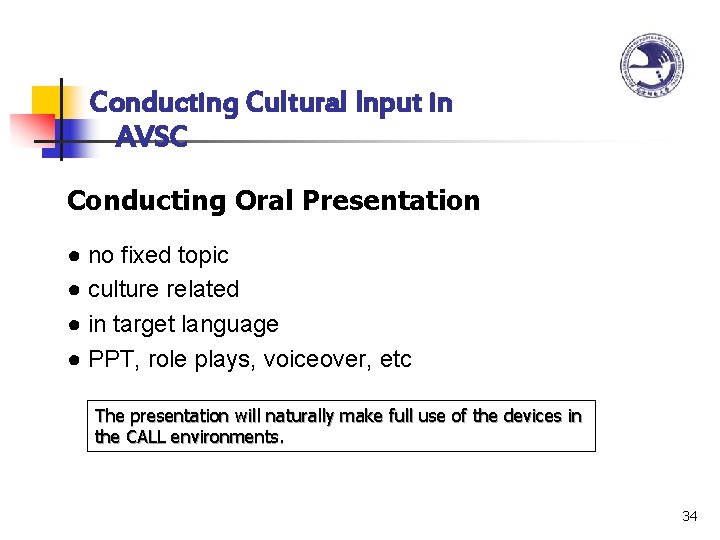
Conducting Cultural Input in AVSC Conducting Oral Presentation ● no fixed topic ● culture related ● in target language ● PPT, role plays, voiceover, etc The presentation will naturally make full use of the devices in the CALL environments. 34
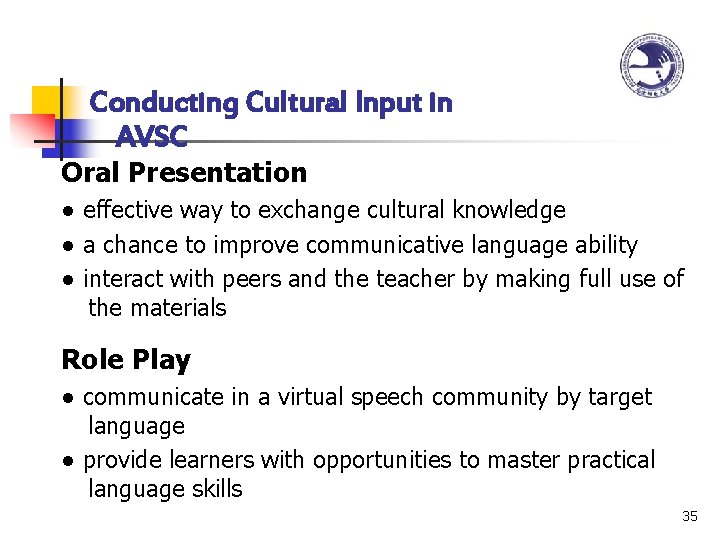
Conducting Cultural Input in AVSC Oral Presentation ● effective way to exchange cultural knowledge ● a chance to improve communicative language ability ● interact with peers and the teacher by making full use of the materials Role Play ● communicate in a virtual speech community by target language ● provide learners with opportunities to master practical language skills 35
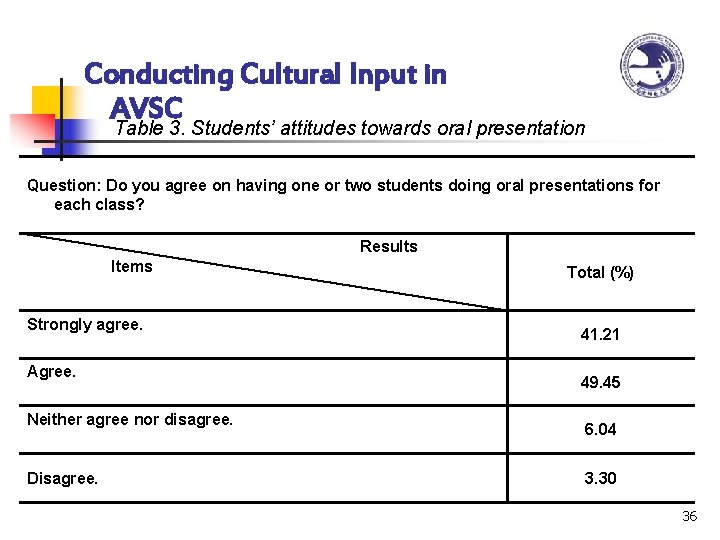
Conducting Cultural Input in AVSC Table 3. Students’ attitudes towards oral presentation Question: Do you agree on having one or two students doing oral presentations for each class? Results Items Strongly agree. Agree. Neither agree nor disagree. Disagree. Total (%) 41. 21 49. 45 6. 04 3. 30 36
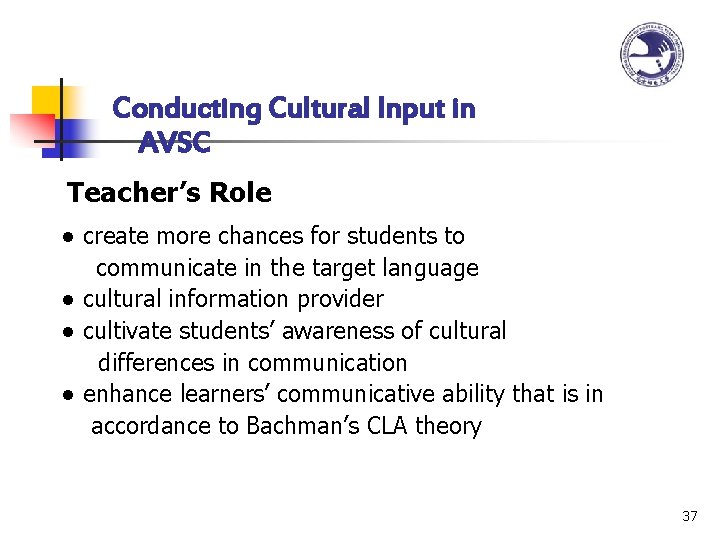
Conducting Cultural Input in AVSC Teacher’s Role ● create more chances for students to communicate in the target language ● cultural information provider ● cultivate students’ awareness of cultural differences in communication ● enhance learners’ communicative ability that is in accordance to Bachman’s CLA theory 37
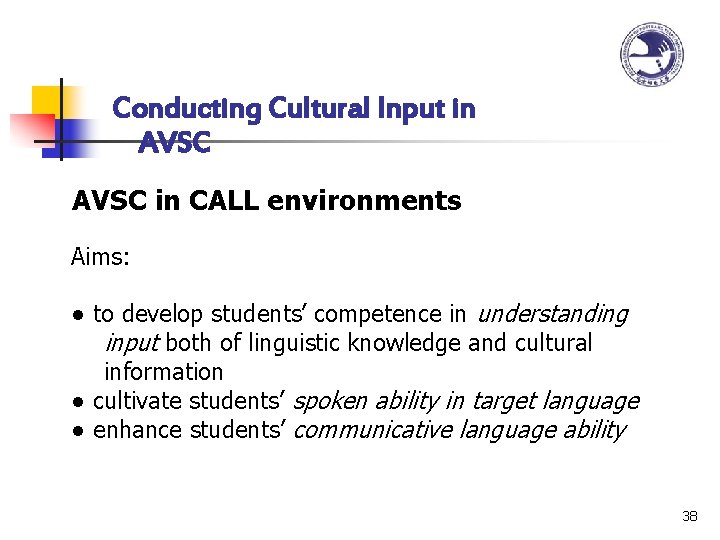
Conducting Cultural Input in AVSC in CALL environments Aims: ● to develop students’ competence in understanding input both of linguistic knowledge and cultural information ● cultivate students’ spoken ability in target language ● enhance students’ communicative language ability 38
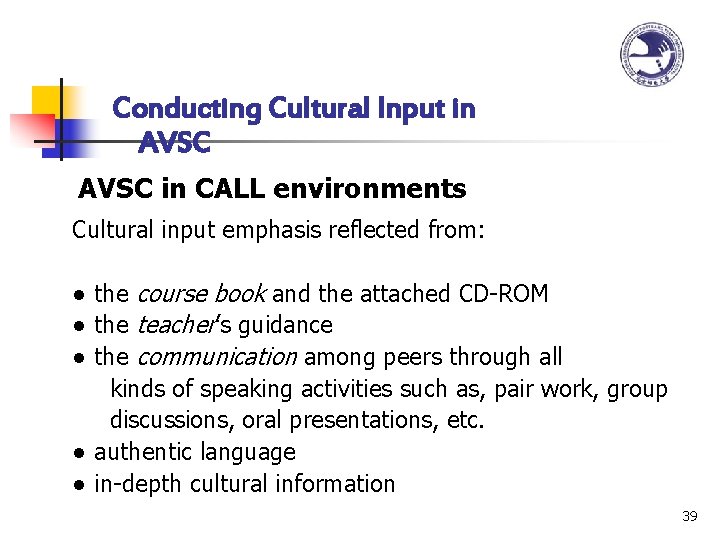
Conducting Cultural Input in AVSC in CALL environments Cultural input emphasis reflected from: ● the course book and the attached CD-ROM ● the teacher’s guidance ● the communication among peers through all kinds of speaking activities such as, pair work, group discussions, oral presentations, etc. ● authentic language ● in-depth cultural information 39
Limitations ● proper selection of the cultural input for easy learning environment ● information redundancy due to learning facilities 40
41