
Cultural Geography of Russia Chapter 15 Section 1
- Slides: 40
Cultural Geography of Russia Chapter 15, Section 1: Population and Culture
Important Vocabulary • Ethnic Group: a group sharing a common ancestry, language, religion, customs, or a combination of these. • Soviet era: a period from 1922 to 1991 in which Russia was part of the Soviet Union (U. S. S. R. ): Union of Soviet Socialist Republics. • Nationality: a location of major ethnic groups. The former U. S. S. R. contained many nationalities within its borders.
Vocabulary (Cont’d) • Sovereignty: meaning self-rule. • Atheism: belief that God does not exist. It was heavily promoted by the Soviet gov’t until the 1980 s. • Pogrom: an organized persecution and massacre of a group of people. Ex: Jews during Czarist and Soviet Russia.
Vocabulary (Cont’d) • Intelligentsia: the intellectual elite. Ex: prominent educators, writers, and artists during Soviet era. • Socialist realism: an artist’s duty to promote/glorify the Soviet gov’t’s achievements through their works. Artists were punished for not following these rules. They were limited in expressing their individual expressions.
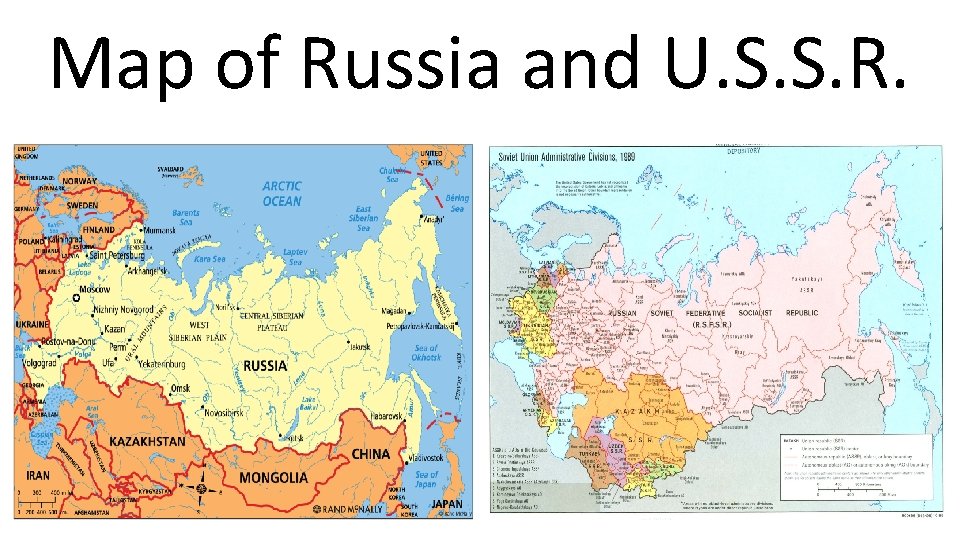
Map of Russia and U. S. S. R.
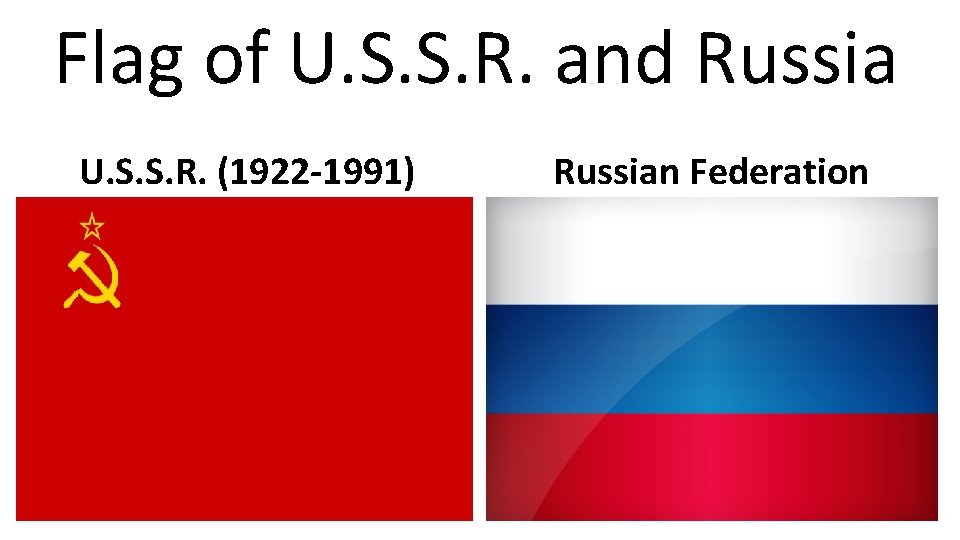
Flag of U. S. S. R. and Russia U. S. S. R. (1922 -1991) Russian Federation
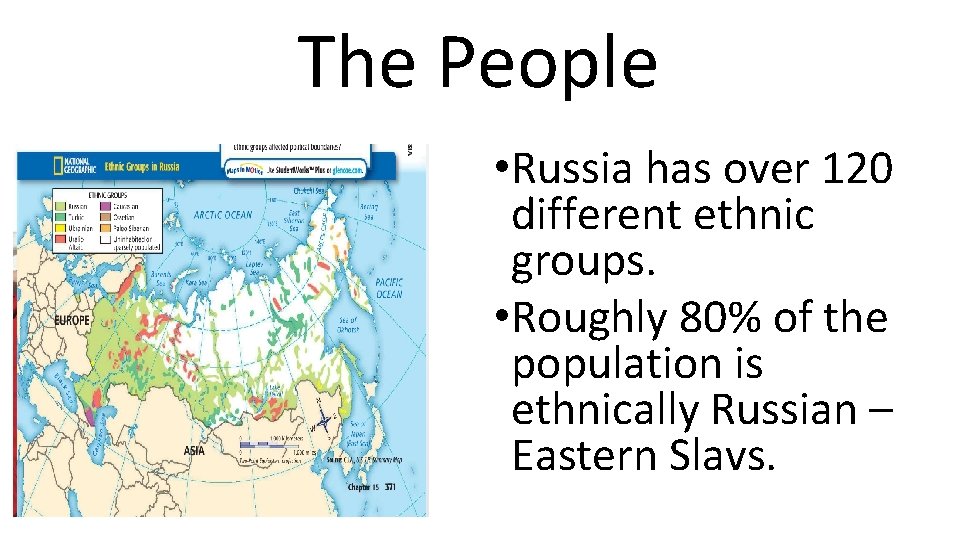
The People • Russia has over 120 different ethnic groups. • Roughly 80% of the population is ethnically Russian – Eastern Slavs.
Density & Distribution • 80% live in western Russia, other 20% live in Siberia. • Moscow: Russia’s capital and major industrial center. • Since 1990, urban population has leveled off or decreased. • Various migration patterns during and post. Soviet era.
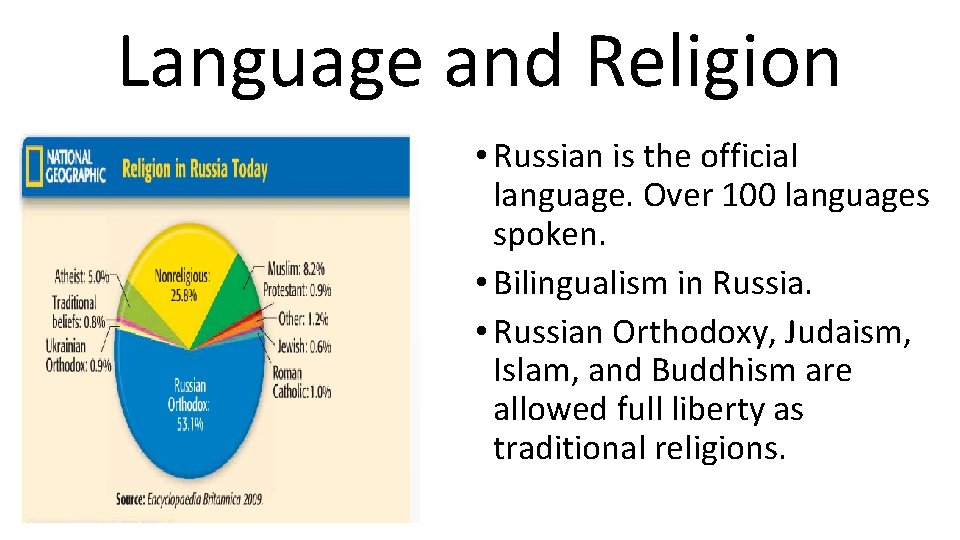
Language and Religion • Russian is the official language. Over 100 languages spoken. • Bilingualism in Russia. • Russian Orthodoxy, Judaism, Islam, and Buddhism are allowed full liberty as traditional religions.
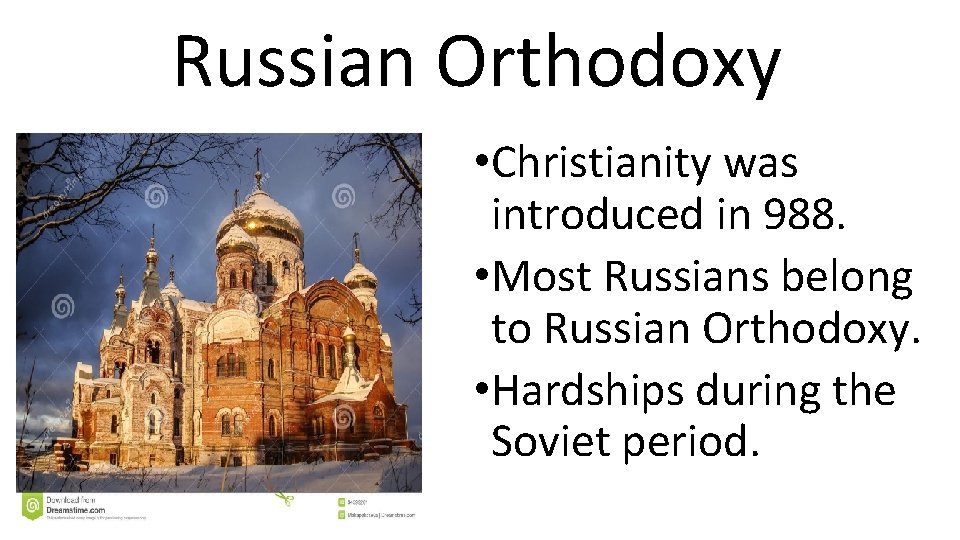
Russian Orthodoxy • Christianity was introduced in 988. • Most Russians belong to Russian Orthodoxy. • Hardships during the Soviet period.
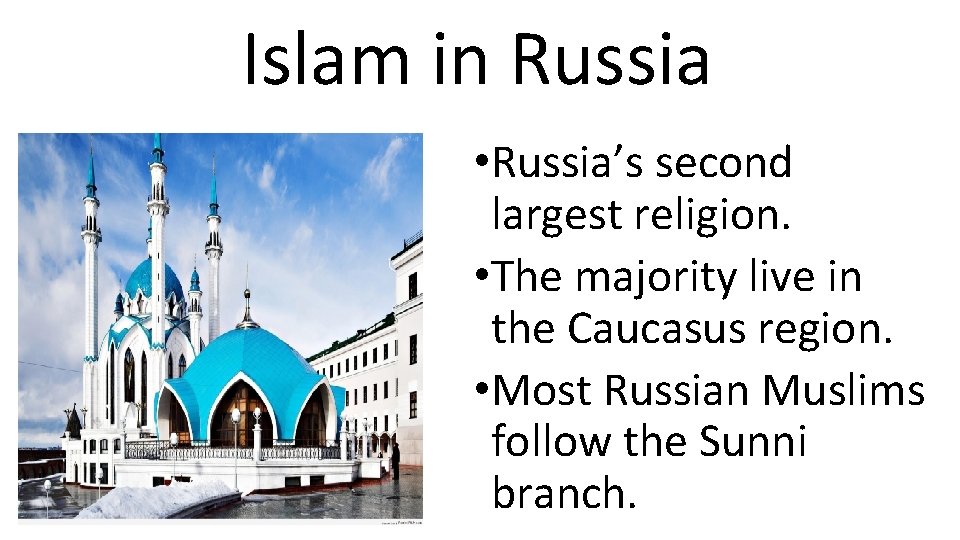
Islam in Russia • Russia’s second largest religion. • The majority live in the Caucasus region. • Most Russian Muslims follow the Sunni branch.
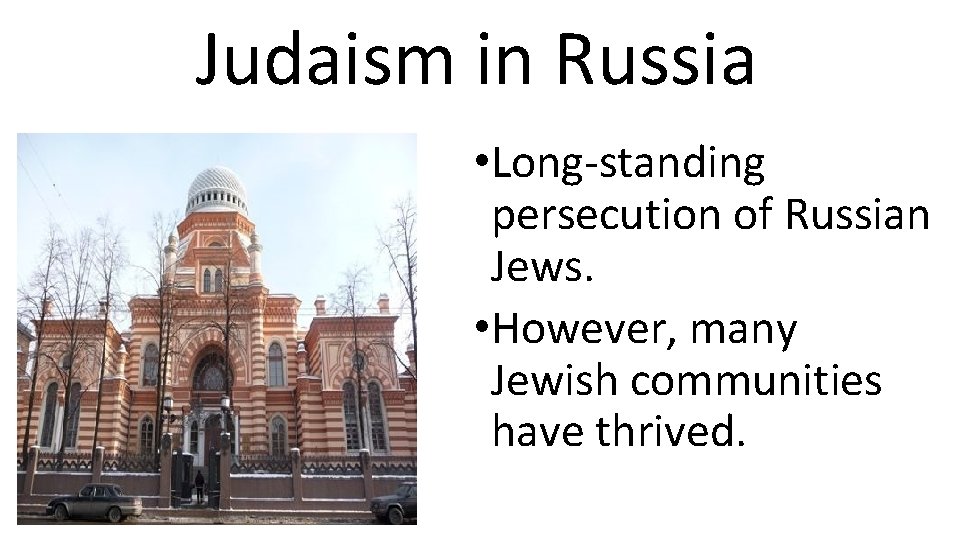
Judaism in Russia • Long-standing persecution of Russian Jews. • However, many Jewish communities have thrived.
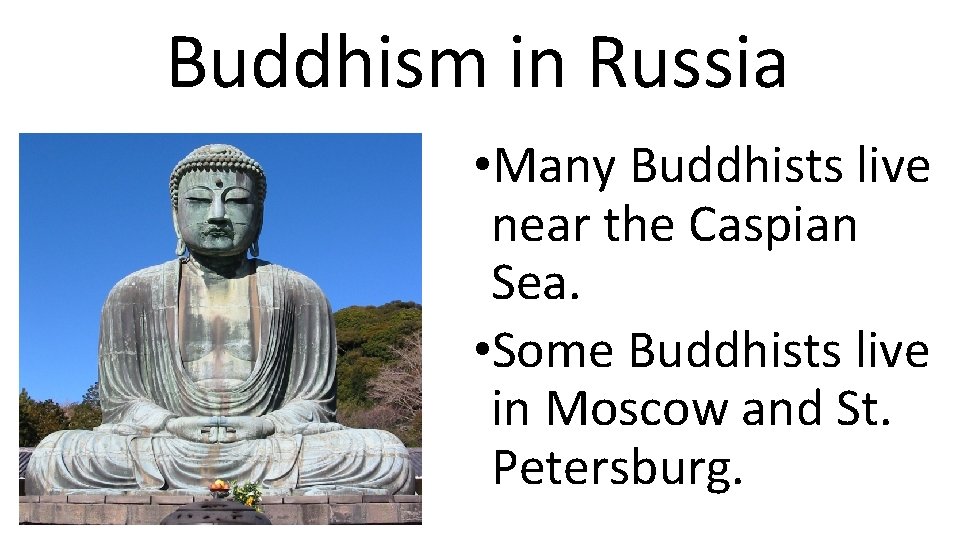
Buddhism in Russia • Many Buddhists live near the Caspian Sea. • Some Buddhists live in Moscow and St. Petersburg.
Education • Free, mandatory education during Soviet era. • Emphasis on math, science, and engineering. • Post-Soviet era – more balanced education. • Russia has school choice, but lack of funds and teachers. • Many students are not focused on education.
Healthcare • Poor healthcare in Russia. • Average life expectancy is 68 years. • High infant mortality rates. • Negative population growth since 1992. • Hospitals are still gov’t-run and inefficient.
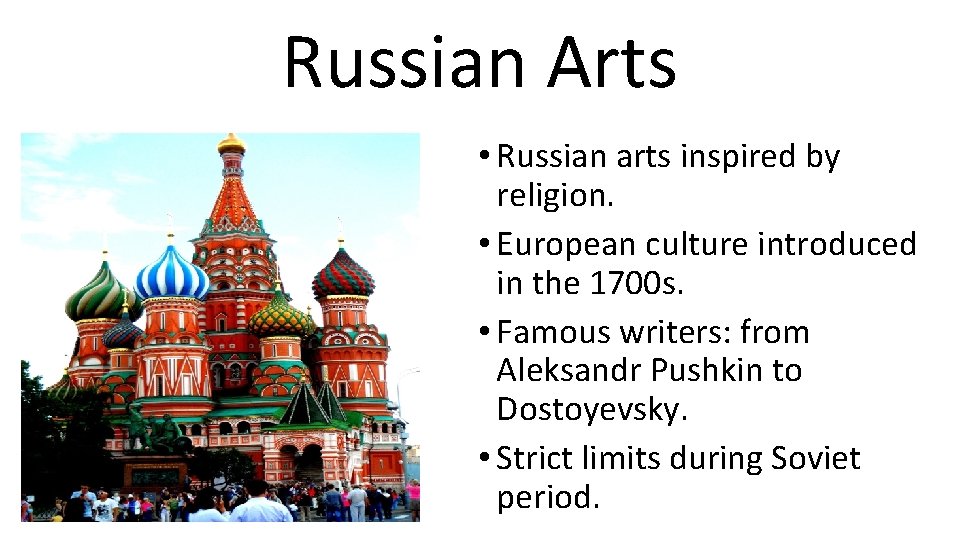
Russian Arts • Russian arts inspired by religion. • European culture introduced in the 1700 s. • Famous writers: from Aleksandr Pushkin to Dostoyevsky. • Strict limits during Soviet period.
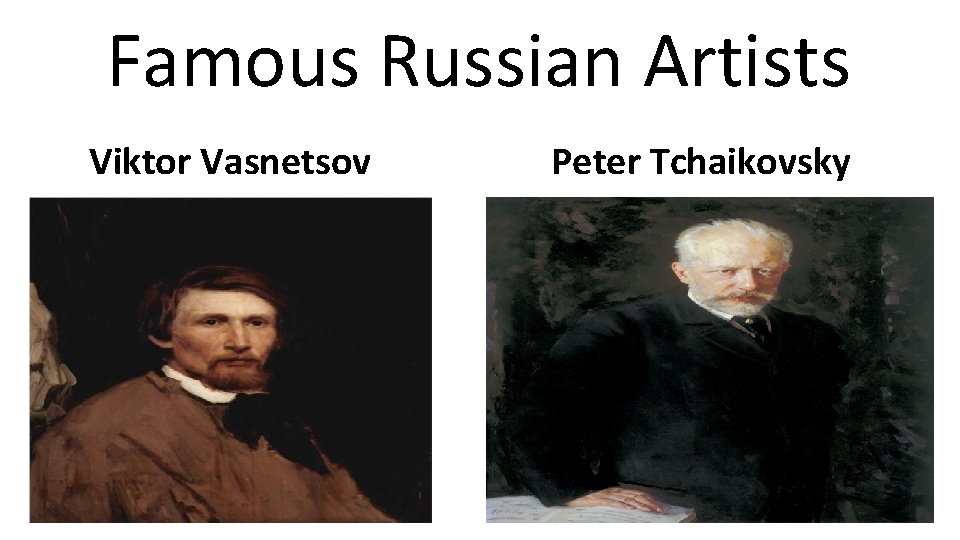
Famous Russian Artists Viktor Vasnetsov Peter Tchaikovsky
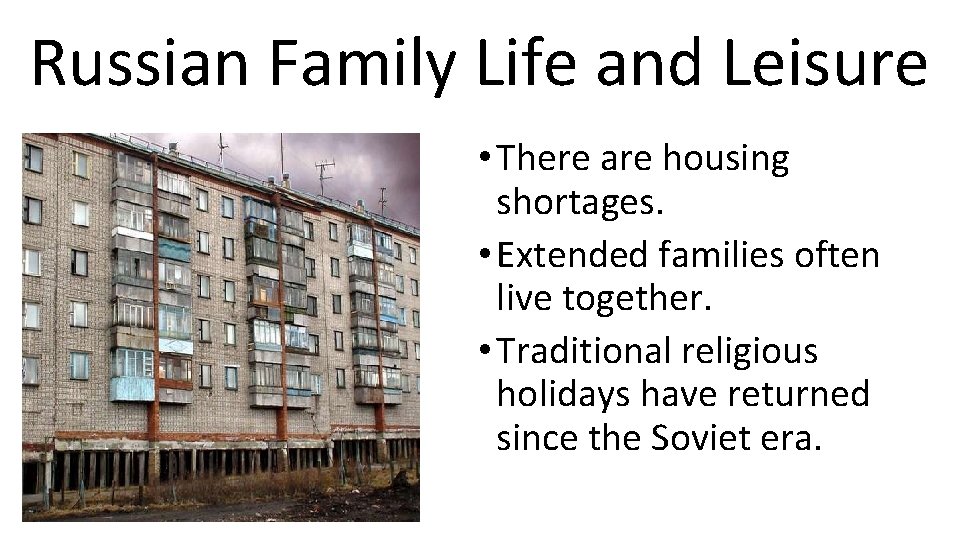
Russian Family Life and Leisure • There are housing shortages. • Extended families often live together. • Traditional religious holidays have returned since the Soviet era.
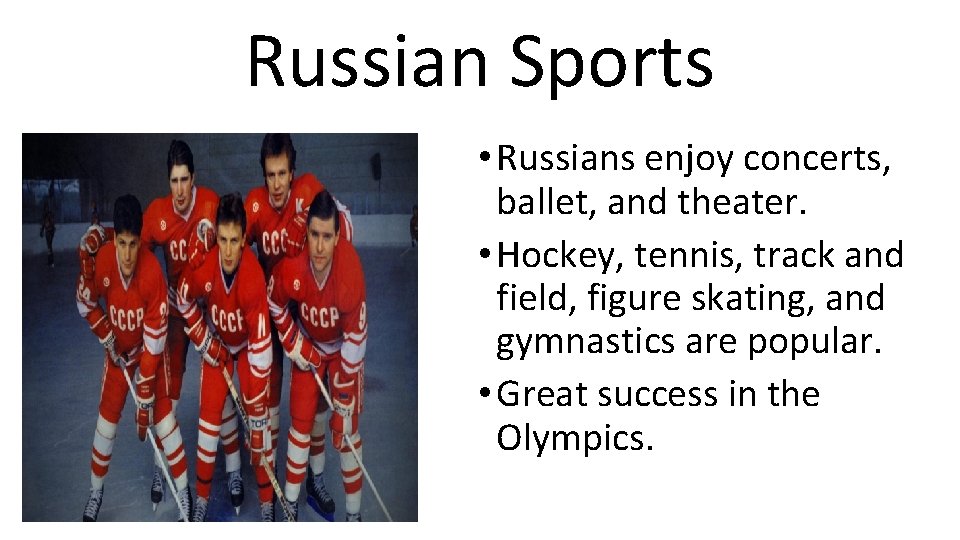
Russian Sports • Russians enjoy concerts, ballet, and theater. • Hockey, tennis, track and field, figure skating, and gymnastics are popular. • Great success in the Olympics.
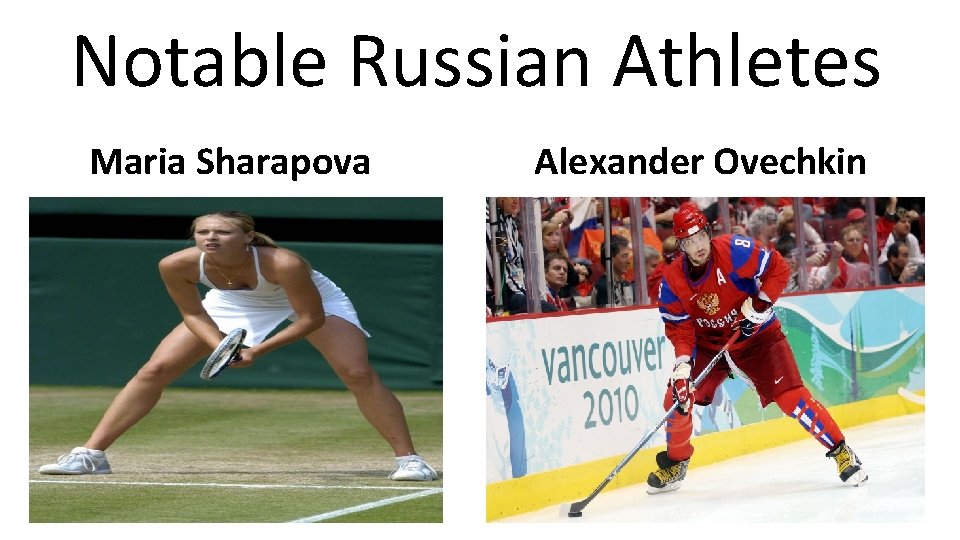
Notable Russian Athletes Maria Sharapova Alexander Ovechkin
Cultural Geography of Russia Chapter 15, Section 2: History and Government
Important Vocabulary • Czar: supreme ruler in Russia. • Serf: an enslaved workforce of peasants that were bound to the land under the nobility’s control. • Russification: a gov’t policy, under Czar Alexander II, which encouraged people to speak Russian and follow Russian Orthodox Christianity. • Socialism: a belief in greater economic equality in society.
Vocabulary (Cont’d) • Bolshevik: a communist revolutionary group led by Vladimir Ulyich Lenin. • Communism: a philosophy based on Karl Marx’s ideas (Communist Manifesto) that called for the violent overthrow of gov’t and the creation of a workers’ led society. • Satellite: countries controlled by the Soviet Union after WWII. Ex: Eastern Europe.
Vocabulary (Cont’d) • Cold War: the struggle between two competing systems (communist vs. capitalist) for world influence and power. The U. S. A. vs. the U. S. S. R. from 1945 -1991. • Perestroika: a policy of economic restructuring. • Glasnost: a policy of greater political openness.
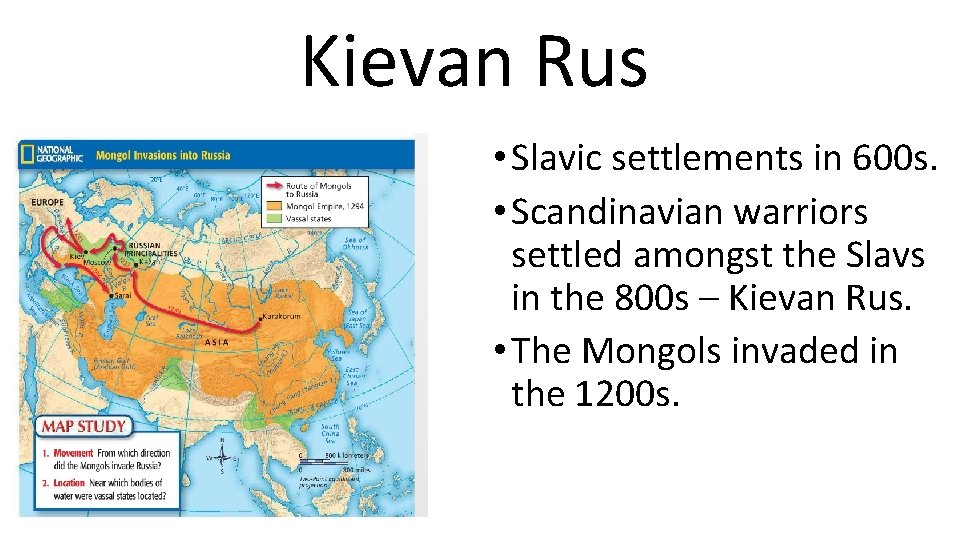
Kievan Rus • Slavic settlements in 600 s. • Scandinavian warriors settled amongst the Slavs in the 800 s – Kievan Rus. • The Mongols invaded in the 1200 s.
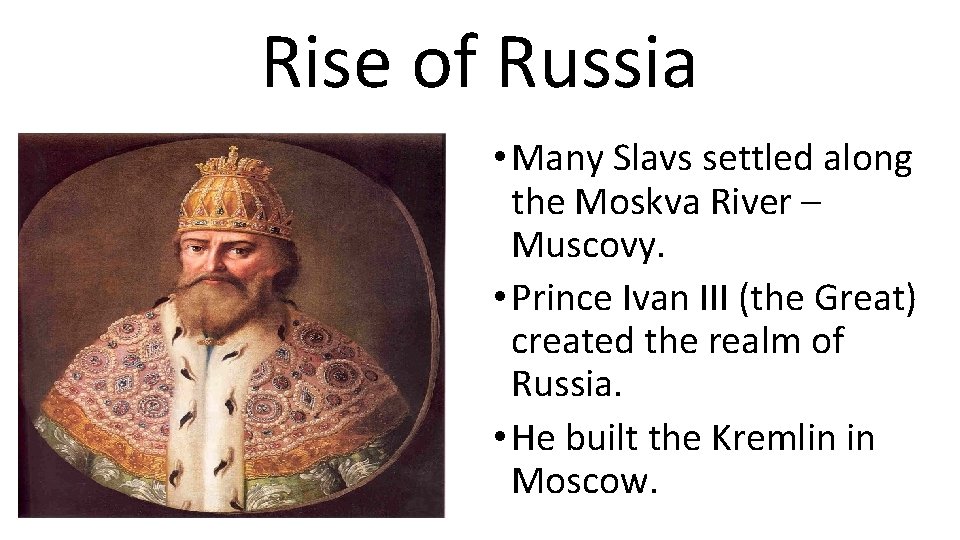
Rise of Russia • Many Slavs settled along the Moskva River – Muscovy. • Prince Ivan III (the Great) created the realm of Russia. • He built the Kremlin in Moscow.
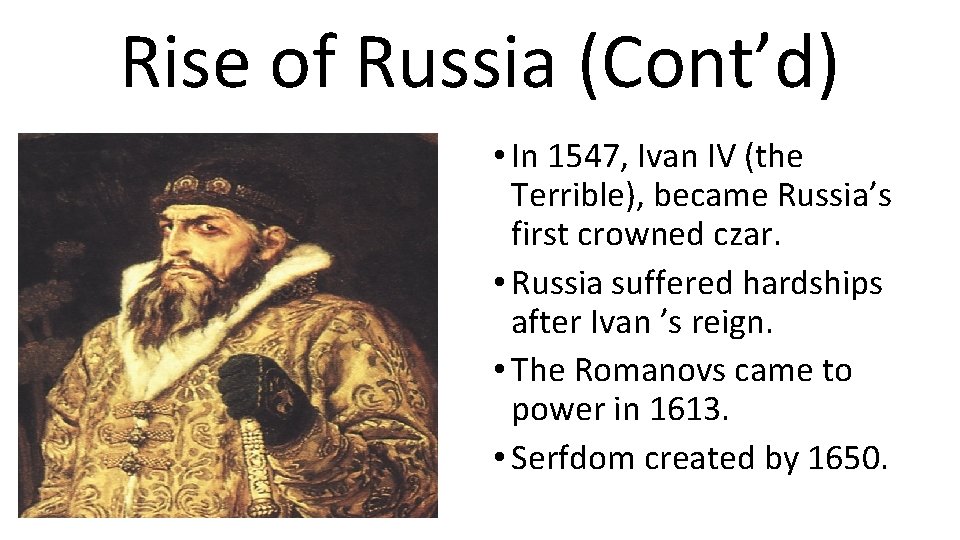
Rise of Russia (Cont’d) • In 1547, Ivan IV (the Terrible), became Russia’s first crowned czar. • Russia suffered hardships after Ivan ’s reign. • The Romanovs came to power in 1613. • Serfdom created by 1650.
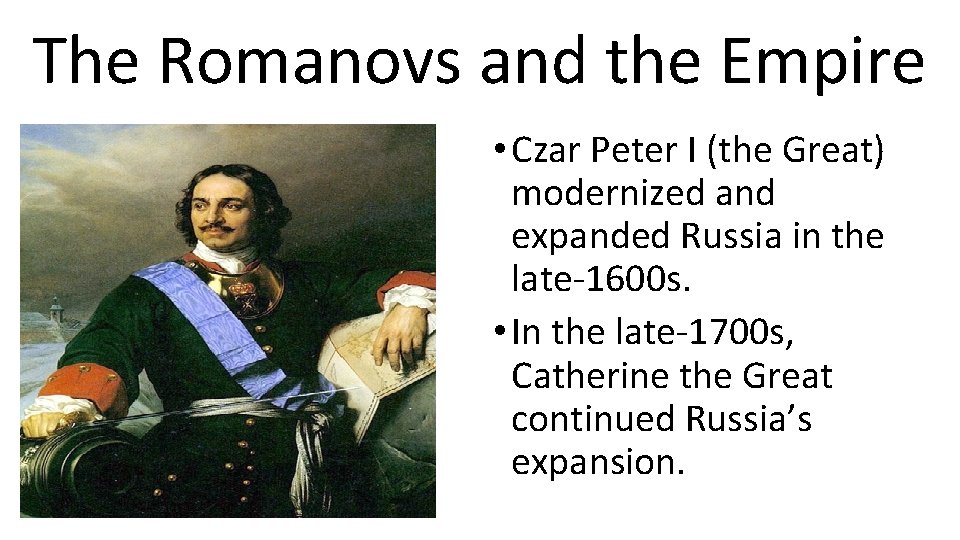
The Romanovs and the Empire • Czar Peter I (the Great) modernized and expanded Russia in the late-1600 s. • In the late-1700 s, Catherine the Great continued Russia’s expansion.
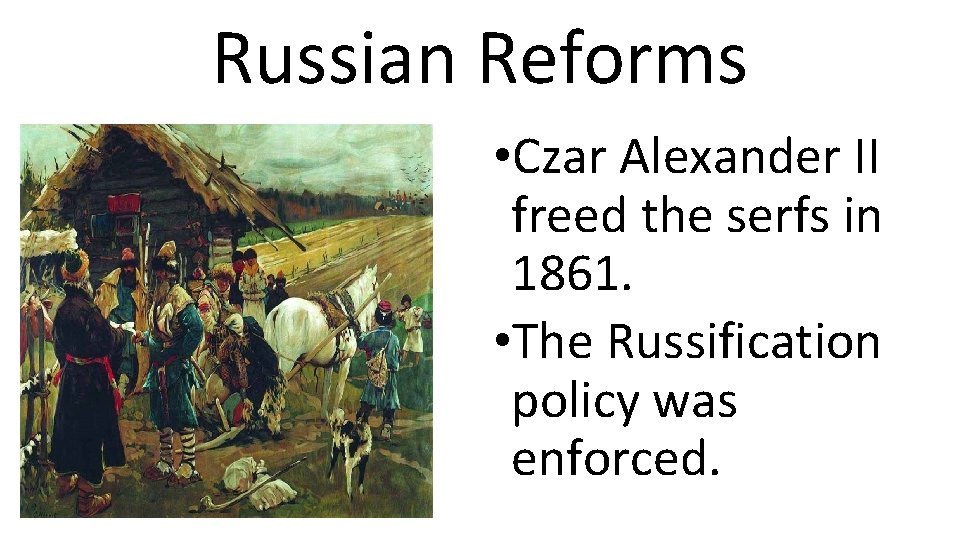
Russian Reforms • Czar Alexander II freed the serfs in 1861. • The Russification policy was enforced.
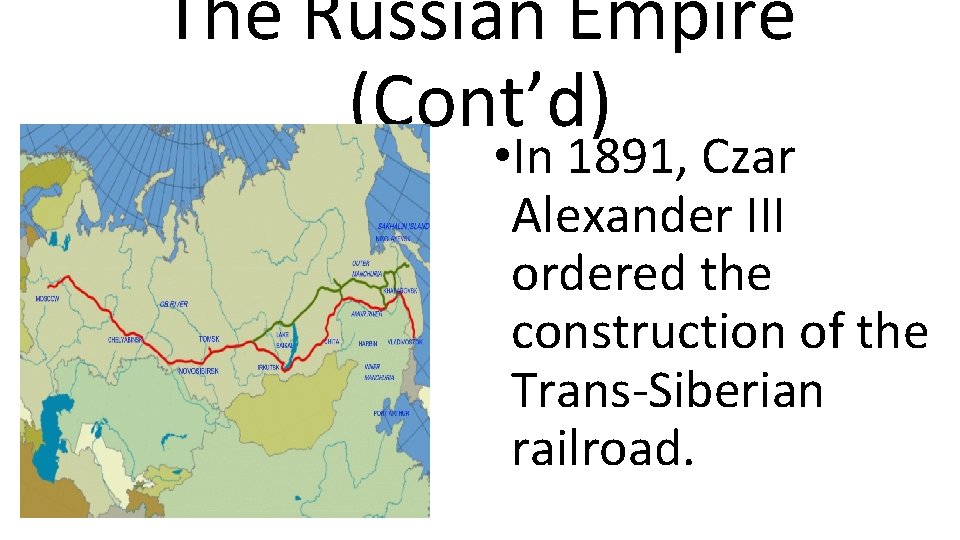
The Russian Empire (Cont’d) • In 1891, Czar Alexander III ordered the construction of the Trans-Siberian railroad.
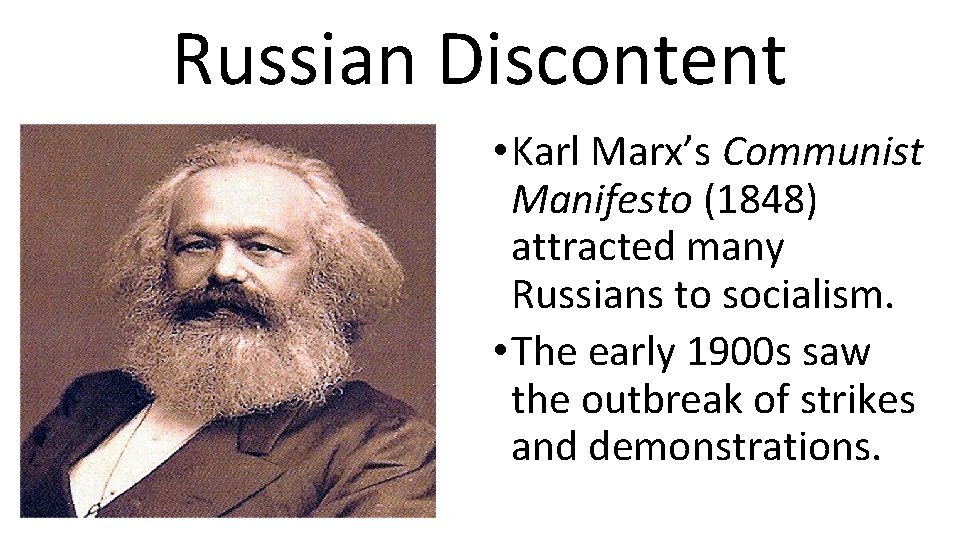
Russian Discontent • Karl Marx’s Communist Manifesto (1848) attracted many Russians to socialism. • The early 1900 s saw the outbreak of strikes and demonstrations.
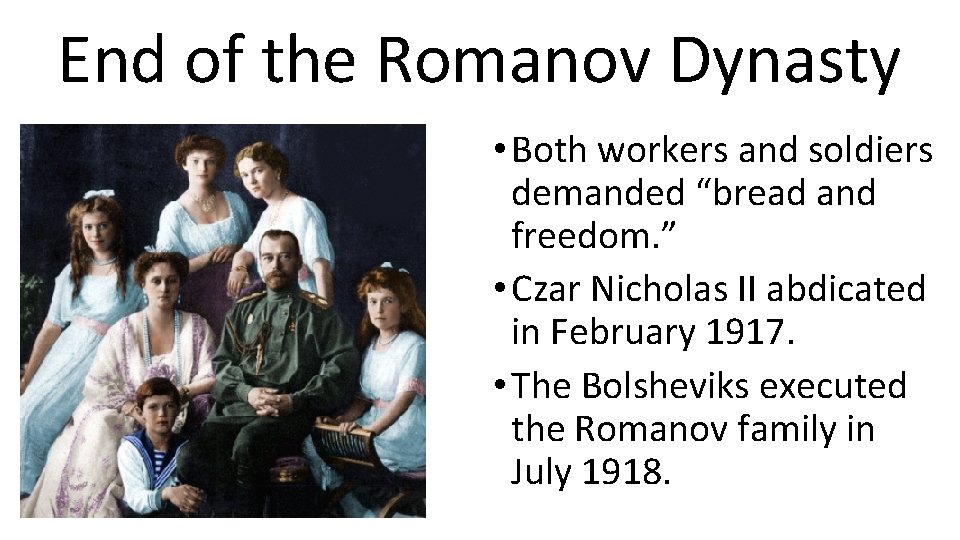
End of the Romanov Dynasty • Both workers and soldiers demanded “bread and freedom. ” • Czar Nicholas II abdicated in February 1917. • The Bolsheviks executed the Romanov family in July 1918.
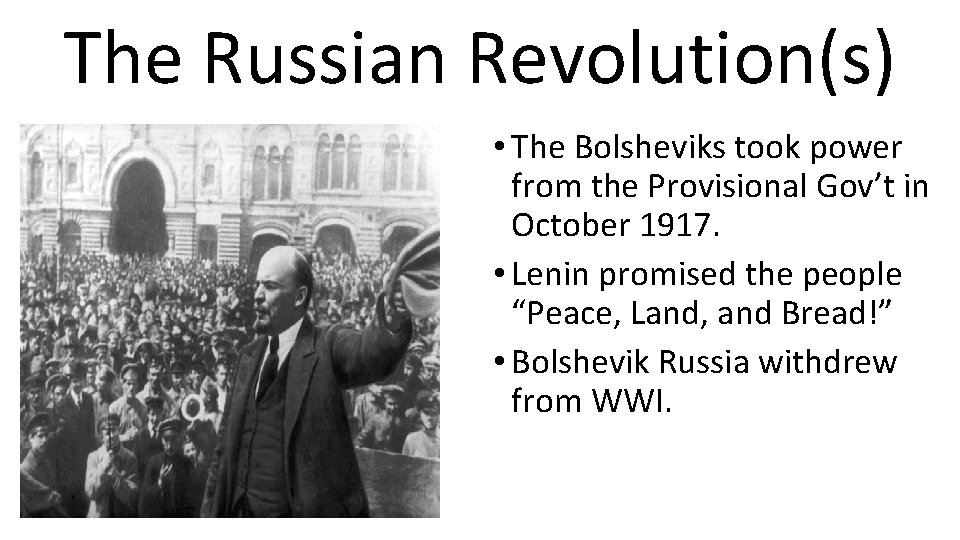
The Russian Revolution(s) • The Bolsheviks took power from the Provisional Gov’t in October 1917. • Lenin promised the people “Peace, Land, and Bread!” • Bolshevik Russia withdrew from WWI.
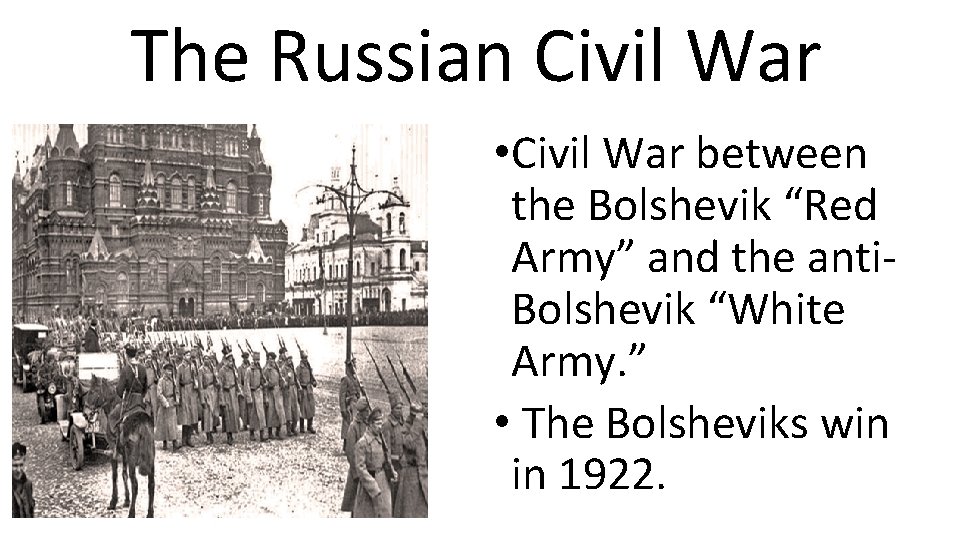
The Russian Civil War • Civil War between the Bolshevik “Red Army” and the anti. Bolshevik “White Army. ” • The Bolsheviks win in 1922.
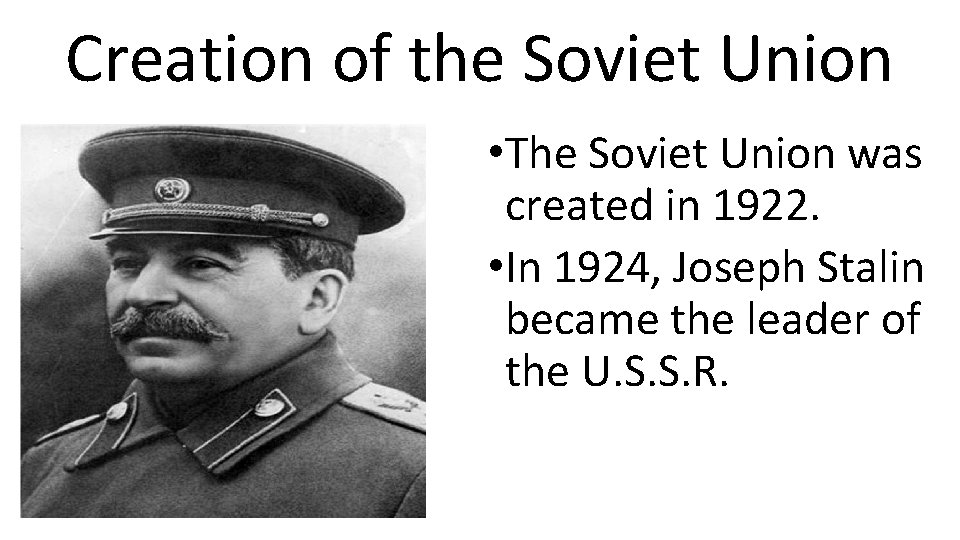
Creation of the Soviet Union • The Soviet Union was created in 1922. • In 1924, Joseph Stalin became the leader of the U. S. S. R.
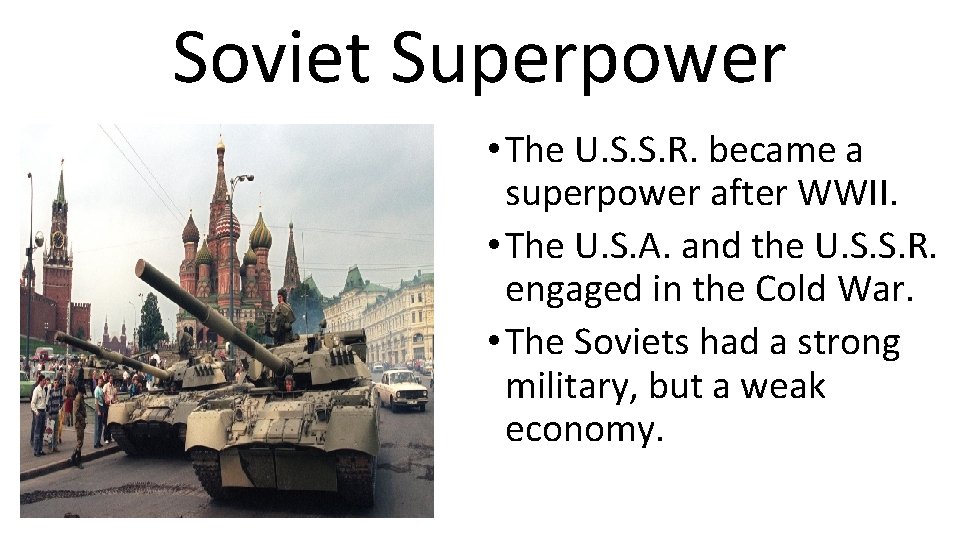
Soviet Superpower • The U. S. S. R. became a superpower after WWII. • The U. S. A. and the U. S. S. R. engaged in the Cold War. • The Soviets had a strong military, but a weak economy.
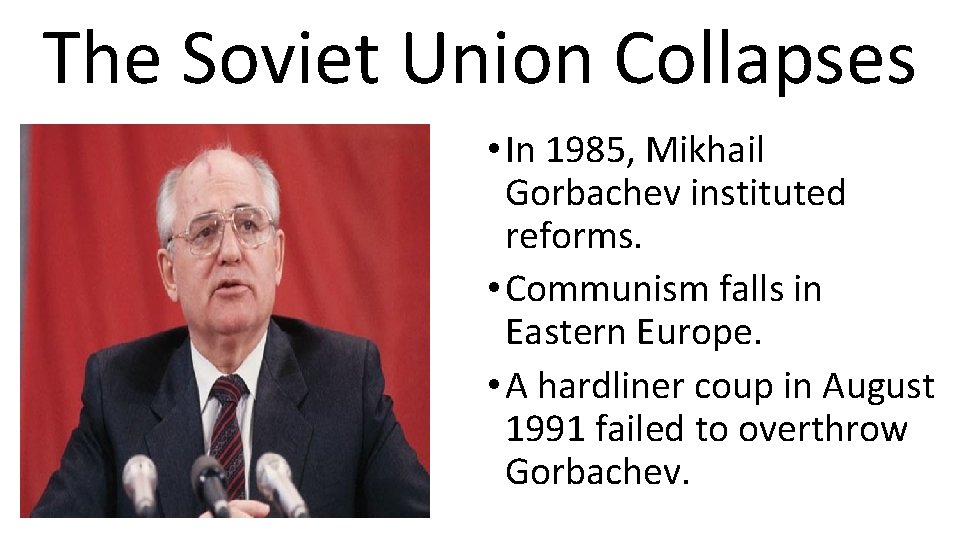
The Soviet Union Collapses • In 1985, Mikhail Gorbachev instituted reforms. • Communism falls in Eastern Europe. • A hardliner coup in August 1991 failed to overthrow Gorbachev.
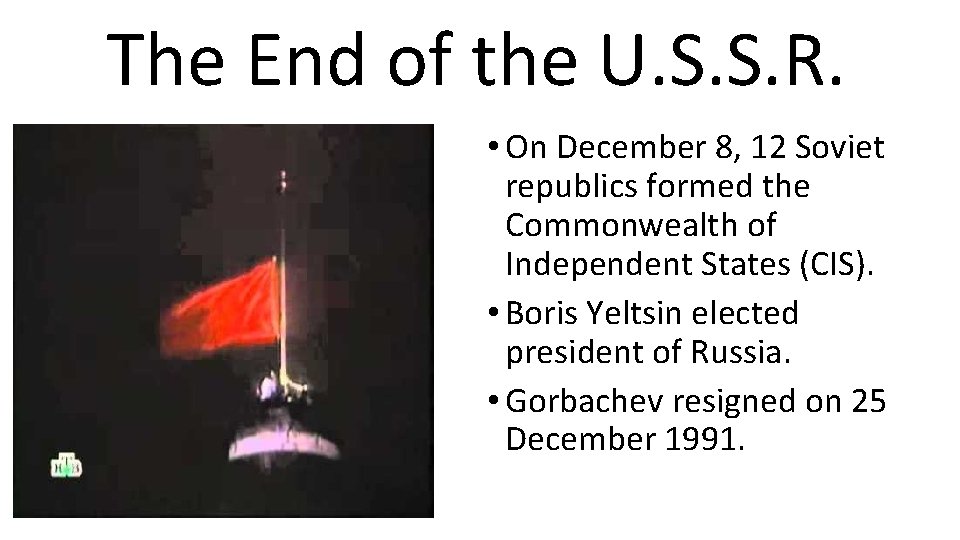
The End of the U. S. S. R. • On December 8, 12 Soviet republics formed the Commonwealth of Independent States (CIS). • Boris Yeltsin elected president of Russia. • Gorbachev resigned on 25 December 1991.
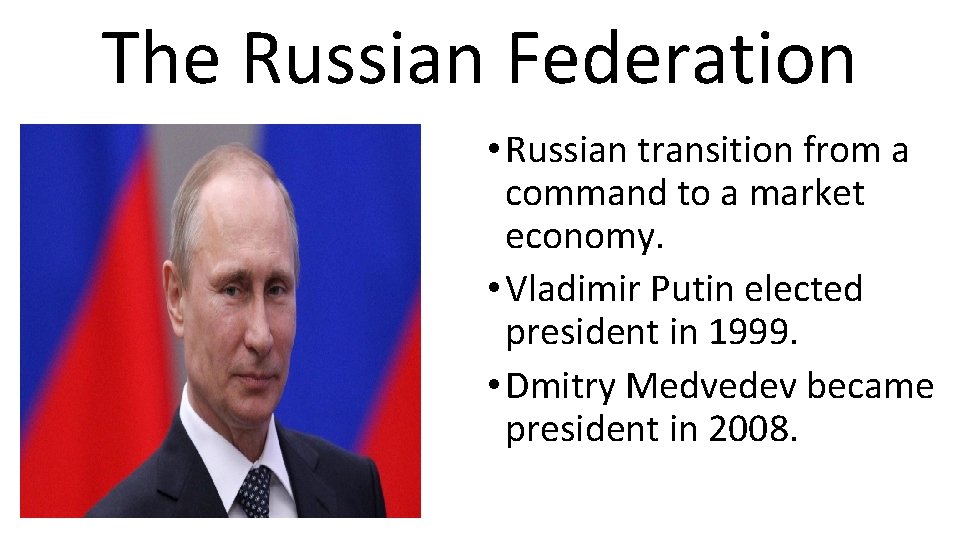
The Russian Federation • Russian transition from a command to a market economy. • Vladimir Putin elected president in 1999. • Dmitry Medvedev became president in 2008.
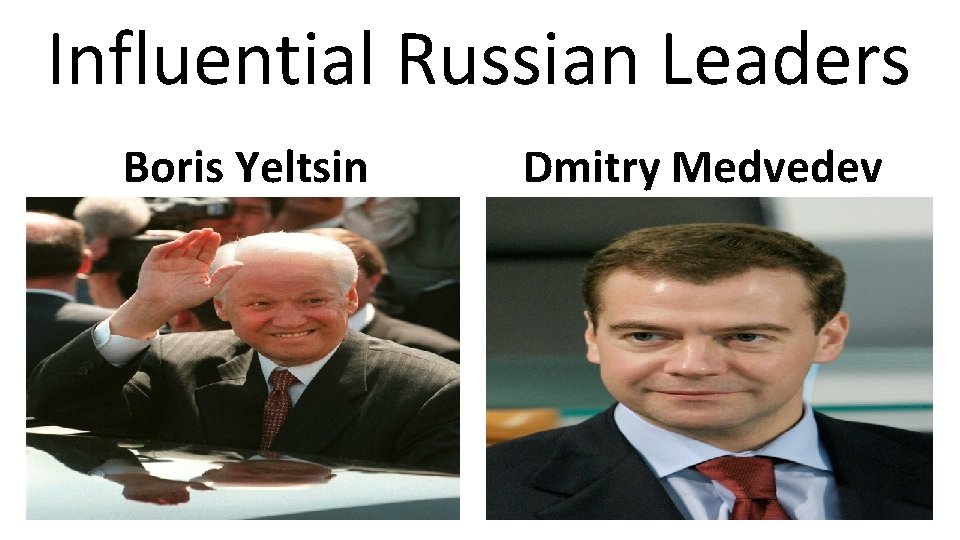
Influential Russian Leaders Boris Yeltsin Dmitry Medvedev