
Cultural Diversity Literacy Lesson Plans File 2 Engagement
- Slides: 15
Cultural Diversity - Literacy Lesson Plans File 2
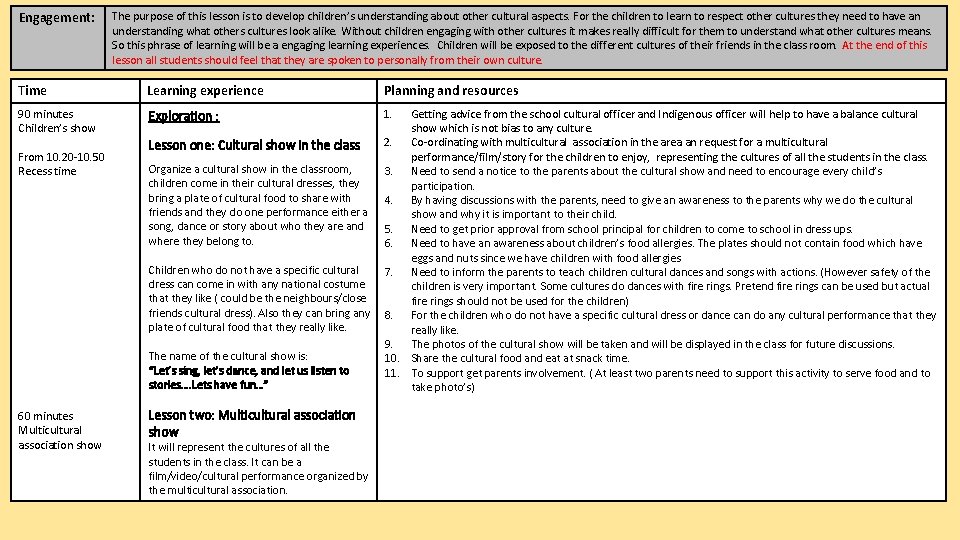
Engagement: The purpose of this lesson is to develop children’s understanding about other cultural aspects. For the children to learn to respect other cultures they need to have an understanding what others cultures look alike. Without children engaging with other cultures it makes really difficult for them to understand what other cultures means. So this phrase of learning will be a engaging learning experiences. Children will be exposed to the different cultures of their friends in the class room. At the end of this lesson all students should feel that they are spoken to personally from their own culture. Time Learning experience 90 minutes Children’s show Exploration : From 10. 20 -10. 50 Recess time 60 minutes Multicultural association show Planning and resources 1. Getting advice from the school cultural officer and Indigenous officer will help to have a balance cultural show which is not bias to any culture. 2. Co-ordinating with multicultural association in the area an request for a multicultural Lesson one: Cultural show in the class performance/film/story for the children to enjoy, representing the cultures of all the students in the class. Organize a cultural show in the classroom, 3. Need to send a notice to the parents about the cultural show and need to encourage every child’s children come in their cultural dresses, they participation. bring a plate of cultural food to share with 4. By having discussions with the parents, need to give an awareness to the parents why we do the cultural friends and they do one performance either a show and why it is important to their child. song, dance or story about who they are and 5. Need to get prior approval from school principal for children to come to school in dress ups. where they belong to. 6. Need to have an awareness about children’s food allergies. The plates should not contain food which have eggs and nuts since we have children with food allergies Children who do not have a specific cultural 7. Need to inform the parents to teach children cultural dances and songs with actions. (However safety of the dress can come in with any national costume children is very important. Some cultures do dances with fire rings. Pretend fire rings can be used but actual that they like ( could be the neighbours/close fire rings should not be used for the children) friends cultural dress). Also they can bring any 8. For the children who do not have a specific cultural dress or dance can do any cultural performance that they plate of cultural food that they really like. 9. The photos of the cultural show will be taken and will be displayed in the class for future discussions. The name of the cultural show is: 10. Share the cultural food and eat at snack time. “Let’s sing, let’s dance, and let us listen to 11. To support get parents involvement. ( At least two parents need to support this activity to serve food and to stories…. Lets have fun…” take photo’s) Lesson two: Multicultural association show It will represent the cultures of all the students in the class. It can be a film/video/cultural performance organized by the multicultural association.
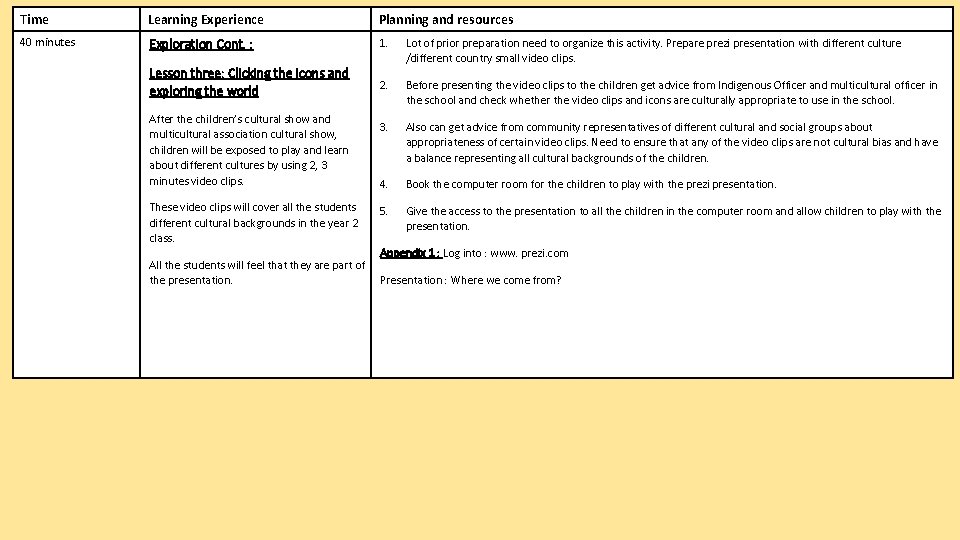
Time Learning Experience Planning and resources 40 minutes Exploration Cont. : 1. Lesson three: Clicking the icons and exploring the world Lot of prior preparation need to organize this activity. Prepare prezi presentation with different culture /different country small video clips. 2. Before presenting the video clips to the children get advice from Indigenous Officer and multicultural officer in the school and check whether the video clips and icons are culturally appropriate to use in the school. 3. Also can get advice from community representatives of different cultural and social groups about appropriateness of certain video clips. Need to ensure that any of the video clips are not cultural bias and have a balance representing all cultural backgrounds of the children. 4. Book the computer room for the children to play with the prezi presentation. 5. Give the access to the presentation to all the children in the computer room and allow children to play with the presentation. After the children’s cultural show and multicultural association cultural show, children will be exposed to play and learn about different cultures by using 2, 3 minutes video clips. These video clips will cover all the students different cultural backgrounds in the year 2 class. All the students will feel that they are part of the presentation. Appendix 1 : Log into : www. prezi. com Presentation : Where we come from?
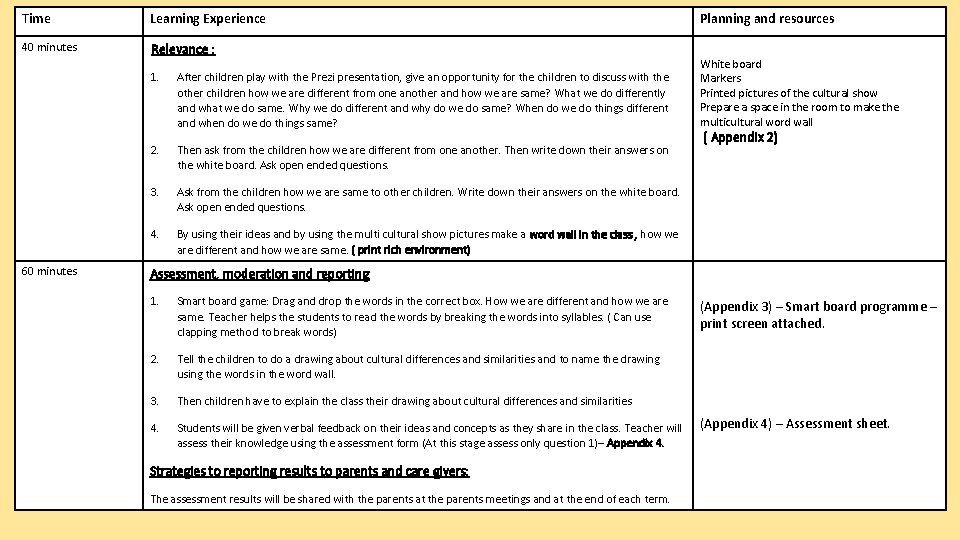
Time Learning Experience 40 minutes Relevance : 60 minutes 1. After children play with the Prezi presentation, give an opportunity for the children to discuss with the other children how we are different from one another and how we are same? What we do differently and what we do same. Why we do different and why do we do same? When do we do things different and when do we do things same? 2. Then ask from the children how we are different from one another. Then write down their answers on the white board. Ask open ended questions. 3. Ask from the children how we are same to other children. Write down their answers on the white board. Ask open ended questions. 4. By using their ideas and by using the multi cultural show pictures make a word wall in the class , how we are different and how we are same. ( print rich environment) Planning and resources White board Markers Printed pictures of the cultural show Prepare a space in the room to make the multicultural word wall ( Appendix 2) Assessment, moderation and reporting 1. Smart board game: Drag and drop the words in the correct box. How we are different and how we are same. Teacher helps the students to read the words by breaking the words into syllables. ( Can use clapping method to break words) 2. Tell the children to do a drawing about cultural differences and similarities and to name the drawing using the words in the word wall. 3. Then children have to explain the class their drawing about cultural differences and similarities 4. Students will be given verbal feedback on their ideas and concepts as they share in the class. Teacher will assess their knowledge using the assessment form (At this stage assess only question 1)– Appendix 4. Strategies to reporting results to parents and care givers: The assessment results will be shared with the parents at the parents meetings and at the end of each term. (Appendix 3) – Smart board programme – print screen attached. (Appendix 4) – Assessment sheet.
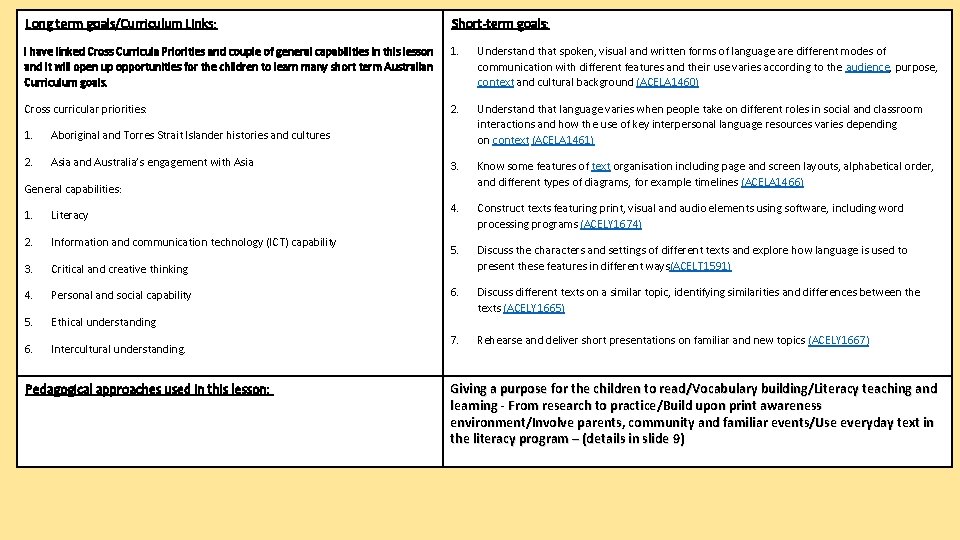
Long term goals/Curriculum Links: Short-term goals: I have linked Cross Curricula Priorities and couple of general capabilities in this lesson and it will open up opportunities for the children to learn many short term Australian Curriculum goals. 1. Understand that spoken, visual and written forms of language are different modes of communication with different features and their use varies according to the audience, purpose, context and cultural background (ACELA 1460) Cross curricular priorities: 2. Understand that language varies when people take on different roles in social and classroom interactions and how the use of key interpersonal language resources varies depending on context (ACELA 1461) 3. Know some features of text organisation including page and screen layouts, alphabetical order, and different types of diagrams, for example timelines (ACELA 1466) 4. Construct texts featuring print, visual and audio elements using software, including word processing programs (ACELY 1674) 5. Discuss the characters and settings of different texts and explore how language is used to present these features in different ways(ACELT 1591) 6. Discuss different texts on a similar topic, identifying similarities and differences between the texts (ACELY 1665) 7. Rehearse and deliver short presentations on familiar and new topics (ACELY 1667)/ 1. Aboriginal and Torres Strait Islander histories and cultures 2. Asia and Australia’s engagement with Asia General capabilities: 1. Literacy 2. Information and communication technology (ICT) capability 3. Critical and creative thinking 4. Personal and social capability 5. Ethical understanding 6. Intercultural understanding. Pedagogical approaches used in this lesson: Language variation and change / ACELA 1443 Giving a purpose for the children to read/Vocabulary building/Literacy teaching and learning - From research to practice/Build upon print awareness environment/Involve parents, community and familiar events/Use everyday text in the literacy program – (details in slide 9)
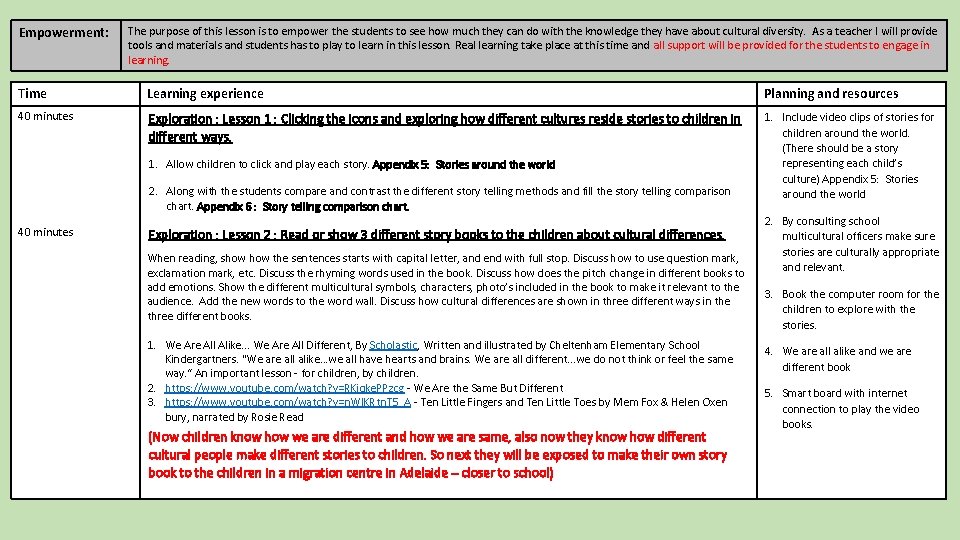
Empowerment: The purpose of this lesson is to empower the students to see how much they can do with the knowledge they have about cultural diversity. As a teacher I will provide tools and materials and students has to play to learn in this lesson. Real learning take place at this time and all support will be provided for the students to engage in learning. Time Learning experience Planning and resources 40 minutes Exploration : Lesson 1 : Clicking the icons and exploring how different cultures reside stories to children in different ways. 1. Include video clips of stories for children around the world. (There should be a story representing each child’s culture) Appendix 5: Stories around the world 1. Allow children to click and play each story. Appendix 5: Stories around the world 2. Along with the students compare and contrast the different story telling methods and fill the story telling comparison chart. Appendix 6 : Story telling comparison chart. 40 minutes Exploration : Lesson 2 : Read or show 3 different story books to the children about cultural differences. When reading, show the sentences starts with capital letter, and end with full stop. Discuss how to use question mark, exclamation mark, etc. Discuss the rhyming words used in the book. Discuss how does the pitch change in different books to add emotions. Show the different multicultural symbols, characters, photo’s included in the book to make it relevant to the audience. Add the new words to the word wall. Discuss how cultural differences are shown in three different ways in the three different books. 1. We Are All Alike. . . We Are All Different, By Scholastic, Written and illustrated by Cheltenham Elementary School Kindergartners. "We are all alike. . . we all have hearts and brains. We are all different. . . we do not think or feel the same way. “ An important lesson - for children, by children. 2. https: //www. youtube. com/watch? v=RKiqke. PPzcg - We Are the Same But Different 3. https: //www. youtube. com/watch? v=n. Wl. KRtn. T 5_A - Ten Little Fingers and Ten Little Toes by Mem Fox & Helen Oxen bury, narrated by Rosie Read (Now children know how we are different and how we are same, also now they know how different cultural people make different stories to children. So next they will be exposed to make their own story book to the children in a migration centre in Adelaide – closer to school) 2. By consulting school multicultural officers make sure stories are culturally appropriate and relevant. 3. Book the computer room for the children to explore with the stories. 4. We are all alike and we are different book 5. Smart board with internet connection to play the video books.
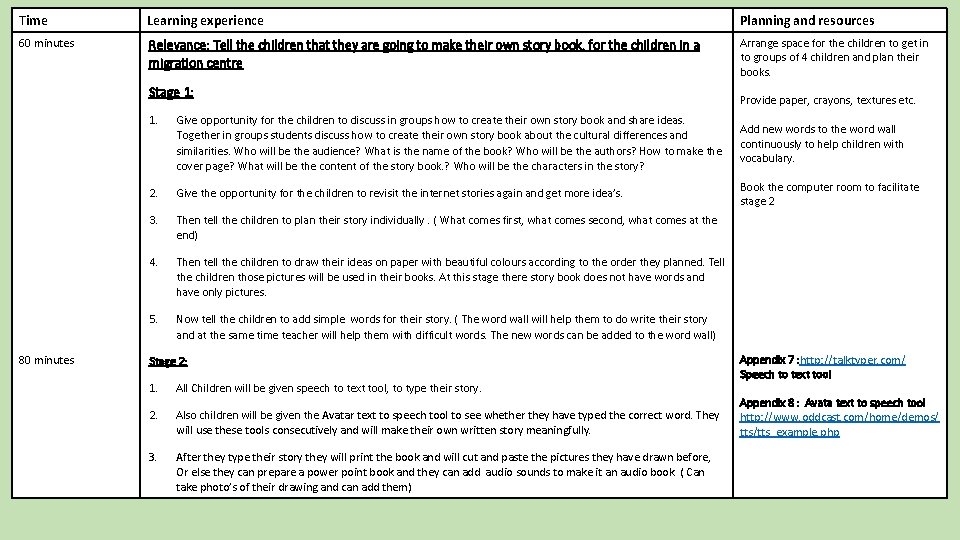
Time Learning experience Planning and resources 60 minutes Relevance: Tell the children that they are going to make their own story book, for the children in a migration centre Arrange space for the children to get in to groups of 4 children and plan their books. Stage 1: 80 minutes Provide paper, crayons, textures etc. 1. Give opportunity for the children to discuss in groups how to create their own story book and share ideas. Together in groups students discuss how to create their own story book about the cultural differences and similarities. Who will be the audience? What is the name of the book? Who will be the authors? How to make the cover page? What will be the content of the story book. ? Who will be the characters in the story? Add new words to the word wall continuously to help children with vocabulary. 2. Give the opportunity for the children to revisit the internet stories again and get more idea’s. Book the computer room to facilitate stage 2 3. Then tell the children to plan their story individually. ( What comes first, what comes second, what comes at the end) 4. Then tell the children to draw their ideas on paper with beautiful colours according to the order they planned. Tell the children those pictures will be used in their books. At this stage there story book does not have words and have only pictures. 5. Now tell the children to add simple words for their story. ( The word wall will help them to do write their story and at the same time teacher will help them with difficult words. The new words can be added to the word wall) Stage 2: 1. All Children will be given speech to text tool, to type their story. 2. Also children will be given the Avatar text to speech tool to see whether they have typed the correct word. They will use these tools consecutively and will make their own written story meaningfully. 3. After they type their story they will print the book and will cut and paste the pictures they have drawn before, Or else they can prepare a power point book and they can add audio sounds to make it an audio book. ( Can take photo’s of their drawing and can add them) Appendix 7 : http: //talktyper. com/ Speech to text tool Appendix 8 : Avata text to speech tool http: //www. oddcast. com/home/demos/ tts/tts_example. php
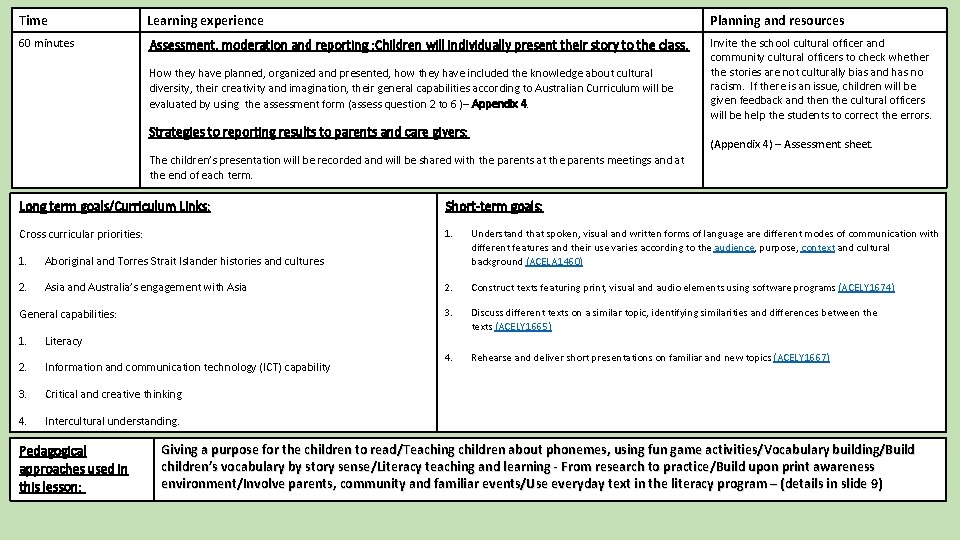
Time Learning experience Planning and resources 60 minutes Assessment, moderation and reporting : Children will individually present their story to the class. Invite the school cultural officer and community cultural officers to check whether the stories are not culturally bias and has no racism. If there is an issue, children will be given feedback and then the cultural officers will be help the students to correct the errors. How they have planned, organized and presented, how they have included the knowledge about cultural diversity, their creativity and imagination, their general capabilities according to Australian Curriculum will be evaluated by using the assessment form (assess question 2 to 6 )– Appendix 4. Strategies to reporting results to parents and care givers: (Appendix 4) – Assessment sheet. The children’s presentation will be recorded and will be shared with the parents at the parents meetings and at the end of each term. Long term goals/Curriculum Links: Short-term goals: Cross curricular priorities: 1. Understand that spoken, visual and written forms of language are different modes of communication with different features and their use varies according to the audience, purpose, context and cultural background (ACELA 1460) 2. Construct texts featuring print, visual and audio elements using software programs (ACELY 1674) 3. Discuss different texts on a similar topic, identifying similarities and differences between the texts (ACELY 1665) 4. Rehearse and deliver short presentations on familiar and new topics (ACELY 1667)/ 1. Aboriginal and Torres Strait Islander histories and cultures 2. Asia and Australia’s engagement with Asia General capabilities: 1. Literacy 2. Information and communication technology (ICT) capability 3. Critical and creative thinking 4. Intercultural understanding. Pedagogical approaches used in this lesson: and change / ACELA 1443 Giving a purpose for the children to read/Teaching children about phonemes, using fun game activities/Vocabulary building/Build children’s vocabulary by story sense/Literacy teaching and learning - From research to practice/Build upon print awareness environment/Involve parents, community and familiar events/Use everyday text in the literacy program – (details in slide 9)
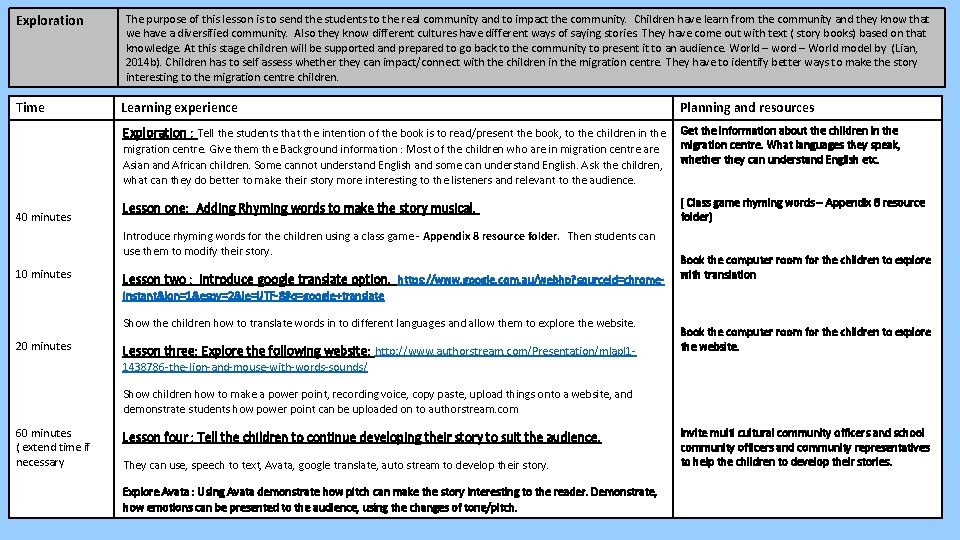
Exploration Time The purpose of this lesson is to send the students to the real community and to impact the community. Children have learn from the community and they know that we have a diversified community. Also they know different cultures have different ways of saying stories. They have come out with text ( story books) based on that knowledge. At this stage children will be supported and prepared to go back to the community to present it to an audience. World – word – World model by (Lian, 2014 b). Children has to self assess whether they can impact/connect with the children in the migration centre. They have to identify better ways to make the story interesting to the migration centre children. Learning experience Planning and resources Exploration : Tell the students that the intention of the book is to read/present the book, to the children in the Get the information about the children in the 40 minutes migration centre. Give them the Background information : Most of the children who are in migration centre are Asian and African children. Some cannot understand English and some can understand English. Ask the children, what can they do better to make their story more interesting to the listeners and relevant to the audience. migration centre. What languages they speak, whether they can understand English etc. Lesson one: Adding Rhyming words to make the story musical. ( Class game rhyming words – Appendix 8 resource folder) Introduce rhyming words for the children using a class game - Appendix 8 resource folder. Then students can use them to modify their story. 10 minutes Lesson two : Introduce google translate option. https: //www. google. com. au/webhp? sourceid=chrome- Book the computer room for the children to explore with translation instant&ion=1&espv=2&ie=UTF-8#q=google+translate Show the children how to translate words in to different languages and allow them to explore the website. 20 minutes Lesson three: Explore the following website: http: //www. authorstream. com/Presentation/mlapl 1 - Book the computer room for the children to explore the website. 1438786 -the-lion-and-mouse-with-words-sounds/ Show children how to make a power point, recording voice, copy paste, upload things onto a website, and demonstrate students how power point can be uploaded on to authorstream. com 60 minutes. ( extend time if necessary Lesson four : Tell the children to continue developing their story to suit the audience. They can use, speech to text, Avata, google translate, auto stream to develop their story. Explore Avata : Using Avata demonstrate how pitch can make the story interesting to the reader. Demonstrate, how emotions can be presented to the audience, using the changes of tone/pitch. Invite multi cultural community officers and school community officers and community representatives to help the children to develop their stories.
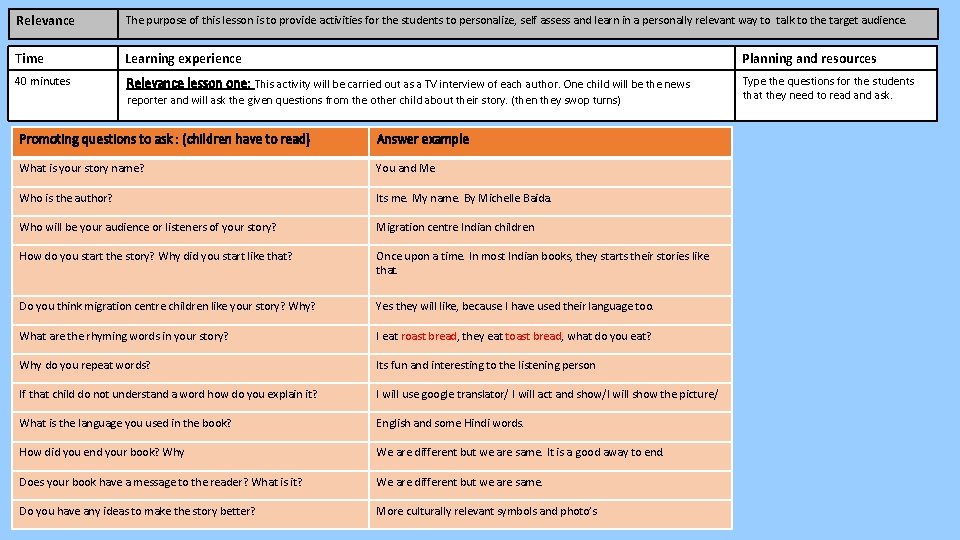
Relevance The purpose of this lesson is to provide activities for the students to personalize, self assess and learn in a personally relevant way to talk to the target audience. Time Learning experience Planning and resources 40 minutes Relevance lesson one: This activity will be carried out as a TV interview of each author. One child will be the news Type the questions for the students that they need to read and ask. reporter and will ask the given questions from the other child about their story. (then they swop turns) Promoting questions to ask : (children have to read) Answer example What is your story name? You and Me Who is the author? Its me. My name. By Michelle Baida. Who will be your audience or listeners of your story? Migration centre Indian children How do you start the story? Why did you start like that? Once upon a time. In most Indian books, they starts their stories like that. Do you think migration centre children like your story? Why? Yes they will like, because I have used their language too. What are the rhyming words in your story? I eat roast bread, they eat toast bread, what do you eat? Why do you repeat words? Its fun and interesting to the listening person If that child do not understand a word how do you explain it? I will use google translator/ I will act and show/I will show the picture/ What is the language you used in the book? English and some Hindi words. How did you end your book? Why We are different but we are same. It is a good away to end. Does your book have a message to the reader? What is it? We are different but we are same. Do you have any ideas to make the story better? More culturally relevant symbols and photo’s
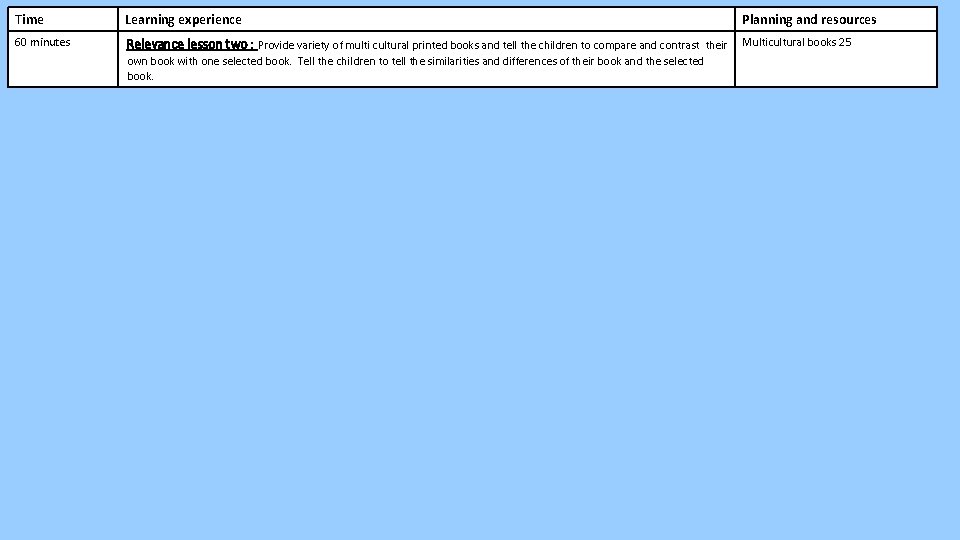
Time Learning experience 60 minutes Relevance lesson two : Provide variety of multi cultural printed books and tell the children to compare and contrast their Multicultural books 25 own book with one selected book. Tell the children to tell the similarities and differences of their book and the selected book. Planning and resources
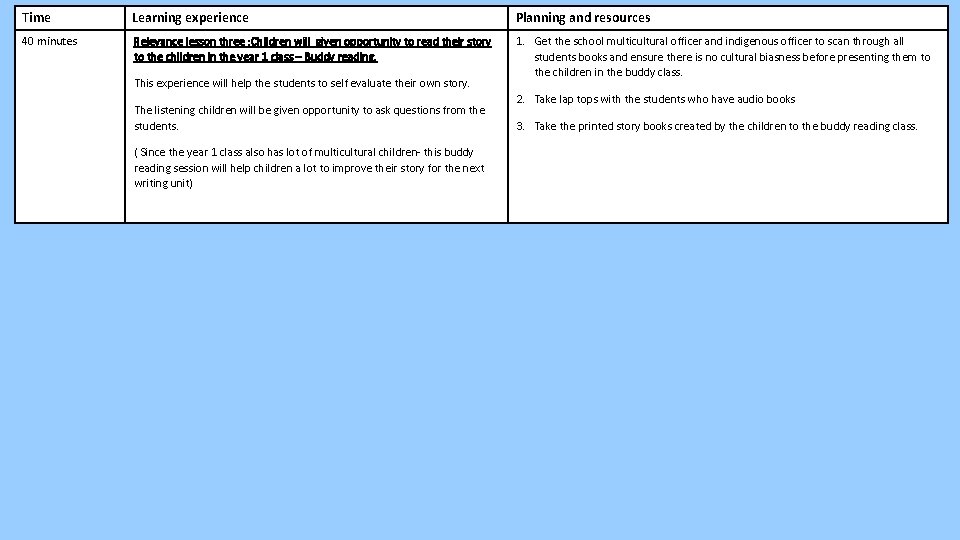
Time Learning experience Planning and resources 40 minutes Relevance lesson three : Children will given opportunity to read their story to the children in the year 1 class – Buddy reading. 1. Get the school multicultural officer and indigenous officer to scan through all students books and ensure there is no cultural biasness before presenting them to the children in the buddy class. This experience will help the students to self evaluate their own story. The listening children will be given opportunity to ask questions from the students. ( Since the year 1 class also has lot of multicultural children- this buddy reading session will help children a lot to improve their story for the next writing unit) 2. Take lap tops with the students who have audio books 3. Take the printed story books created by the children to the buddy reading class.
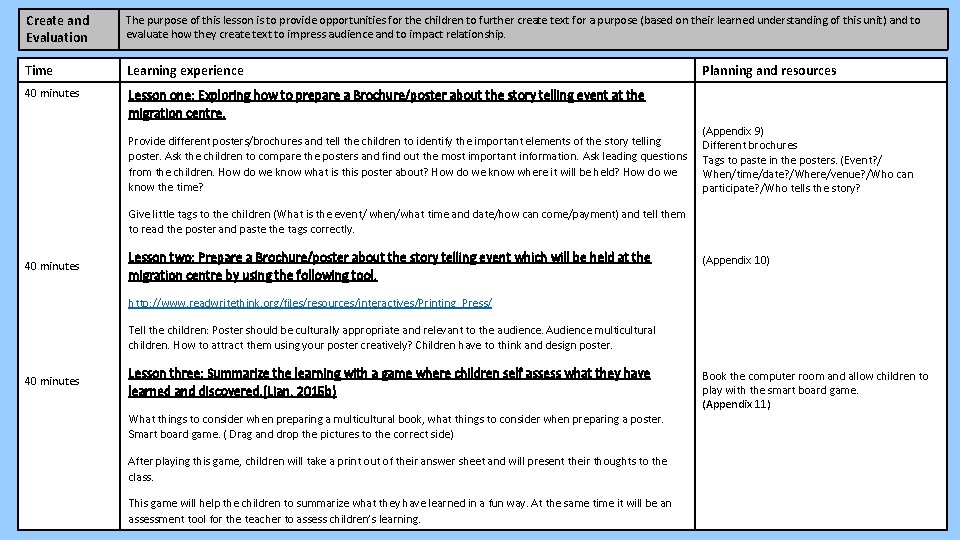
Create and Evaluation The purpose of this lesson is to provide opportunities for the children to further create text for a purpose (based on their learned understanding of this unit) and to evaluate how they create text to impress audience and to impact relationship. Time Learning experience 40 minutes Lesson one: Exploring how to prepare a Brochure/poster about the story telling event at the migration centre. Provide different posters/brochures and tell the children to identify the important elements of the story telling poster. Ask the children to compare the posters and find out the most important information. Ask leading questions from the children. How do we know what is this poster about? How do we know where it will be held? How do we know the time? Planning and resources (Appendix 9) Different brochures Tags to paste in the posters. (Event? / When/time/date? /Where/venue? /Who can participate? /Who tells the story? Give little tags to the children (What is the event/ when/what time and date/how can come/payment) and tell them to read the poster and paste the tags correctly. 40 minutes Lesson two: Prepare a Brochure/poster about the story telling event which will be held at the migration centre by using the following tool. (Appendix 10) http: //www. readwritethink. org/files/resources/interactives/Printing_Press/ Tell the children: Poster should be culturally appropriate and relevant to the audience. Audience multicultural children. How to attract them using your poster creatively? Children have to think and design poster. 40 minutes Lesson three: Summarize the learning with a game where children self assess what they have learned and discovered. (Lian, 2015 b) What things to consider when preparing a multicultural book, what things to consider when preparing a poster. Smart board game. ( Drag and drop the pictures to the correct side) After playing this game, children will take a print out of their answer sheet and will present their thoughts to the class. This game will help the children to summarize what they have learned in a fun way. At the same time it will be an assessment tool for the teacher to assess children’s learning. Book the computer room and allow children to play with the smart board game. (Appendix 11)
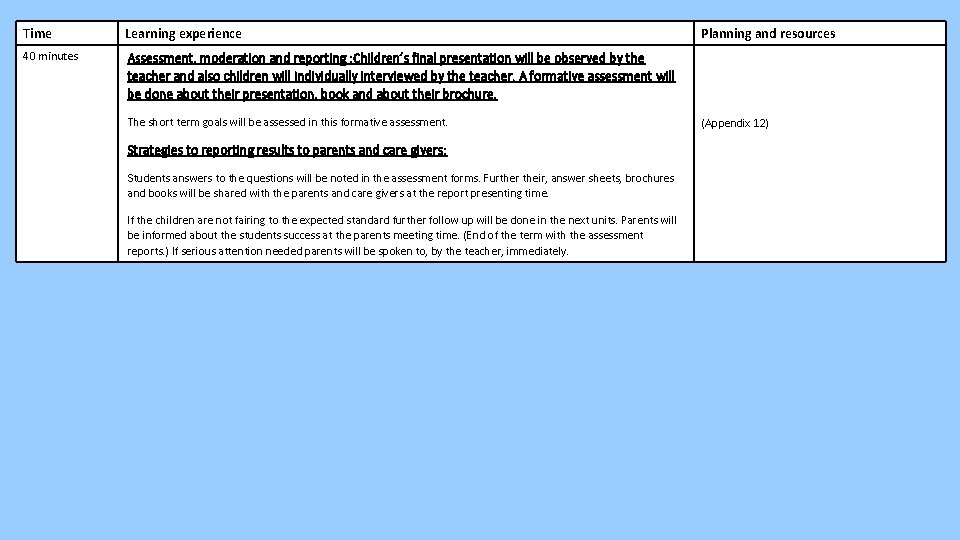
Time Learning experience 40 minutes Assessment, moderation and reporting : Children’s final presentation will be observed by the teacher and also children will individually interviewed by the teacher. A formative assessment will be done about their presentation, book and about their brochure. The short term goals will be assessed in this formative assessment. Strategies to reporting results to parents and care givers: Students answers to the questions will be noted in the assessment forms. Further their, answer sheets, brochures and books will be shared with the parents and care givers at the report presenting time. If the children are not fairing to the expected standard further follow up will be done in the next units. Parents will be informed about the students success at the parents meeting time. (End of the term with the assessment reports. ) If serious attention needed parents will be spoken to, by the teacher, immediately. Planning and resources (Appendix 12)
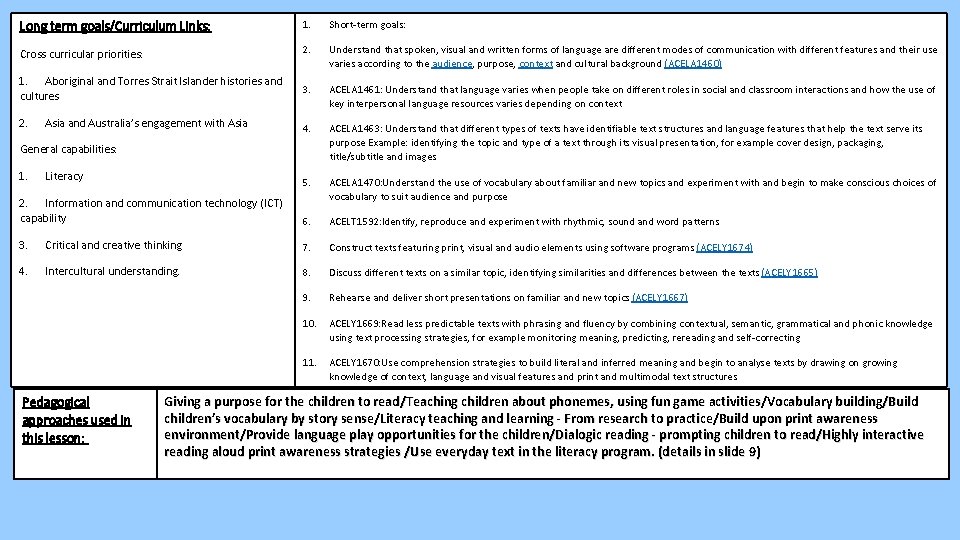
Long term goals/Curriculum Links: 1. Short-term goals: Cross curricular priorities: 2. Understand that spoken, visual and written forms of language are different modes of communication with different features and their use varies according to the audience, purpose, context and cultural background (ACELA 1460) 1. Aboriginal and Torres Strait Islander histories and cultures 3. ACELA 1461: Understand that language varies when people take on different roles in social and classroom interactions and how the use of key interpersonal language resources varies depending on context 4. ACELA 1463: Understand that different types of texts have identifiable text structures and language features that help the text serve its purpose Example: identifying the topic and type of a text through its visual presentation, for example cover design, packaging, title/subtitle and images 5. 2. Information and communication technology (ICT) capability ACELA 1470: Understand the use of vocabulary about familiar and new topics and experiment with and begin to make conscious choices of vocabulary to suit audience and purpose 6. ACELT 1592: Identify, reproduce and experiment with rhythmic, sound and word patterns 3. Critical and creative thinking 7. Construct texts featuring print, visual and audio elements using software programs (ACELY 1674) 4. Intercultural understanding. 8. Discuss different texts on a similar topic, identifying similarities and differences between the texts (ACELY 1665) 9. Rehearse and deliver short presentations on familiar and new topics (ACELY 1667) 10. ACELY 1669: Read less predictable texts with phrasing and fluency by combining contextual, semantic, grammatical and phonic knowledge using text processing strategies, for example monitoring meaning, predicting, rereading and self-correcting 11. ACELY 1670: Use comprehension strategies to build literal and inferred meaning and begin to analyse texts by drawing on growing knowledge of context, language and visual features and print and multimodal text structures 2. Asia and Australia’s engagement with Asia General capabilities: 1. Literacy Pedagogical approaches used in this lesson: Giving a purpose for the children to read/Teaching children about phonemes, using fun game activities/Vocabulary building/Build children’s vocabulary by story sense/Literacy teaching and learning - From research to practice/Build upon print awareness environment/Provide language play opportunities for the children/Dialogic reading - prompting children to read/Highly interactive reading aloud print awareness strategies /Use everyday text in the literacy program. (details in slide 9)