
Cultural diffusion the spread of cultural characteristics from
- Slides: 15
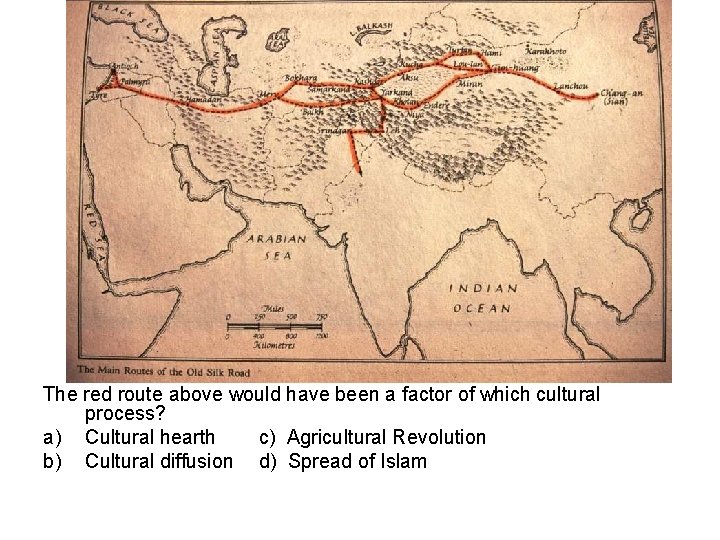
Cultural diffusion • the spread of cultural characteristics from one culture to another • concerns the spread of culture and the factors that account for it, such as migration, communications, trade, and commerce. Because culture moves over space, the geography of culture is constantly changing. Generally, culture traits originate in a particular area and spread outward, ultimately to characterize a larger expanse of territory. Culture region describes the location of culture traits or cultural communities; cultural diffusion helps explain how they got there.
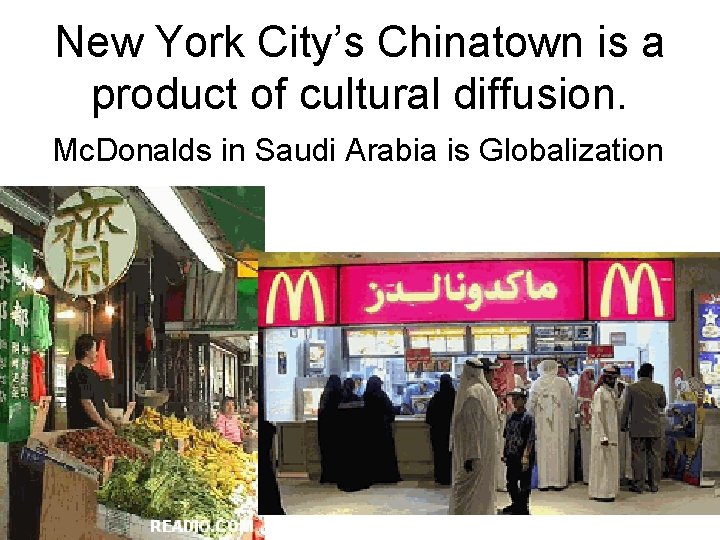
New York City’s Chinatown is a product of cultural diffusion. Mc. Donalds in Saudi Arabia is Globalization
Spatial diffusion • is the geographic spread of ideas, innovations, or phenomena (such as disease changing time AND changing places • transfer or movement of things, ideas, people from place to place • a main mechanism in the process of cultural change. Technology, for example, is produced through innovation (internal) and spread through diffusion (external) • processes of diffusion : - the origin in time and place of the feature • the routes, chronology, and manner of the spread • any "regionalization" of features • resultant geographies • globalization is essentially a process of diffusion, note the labels in your household: • • • Korea - computer Japan - stereo Germany - car Brazil - shoes India - shirts and blouses
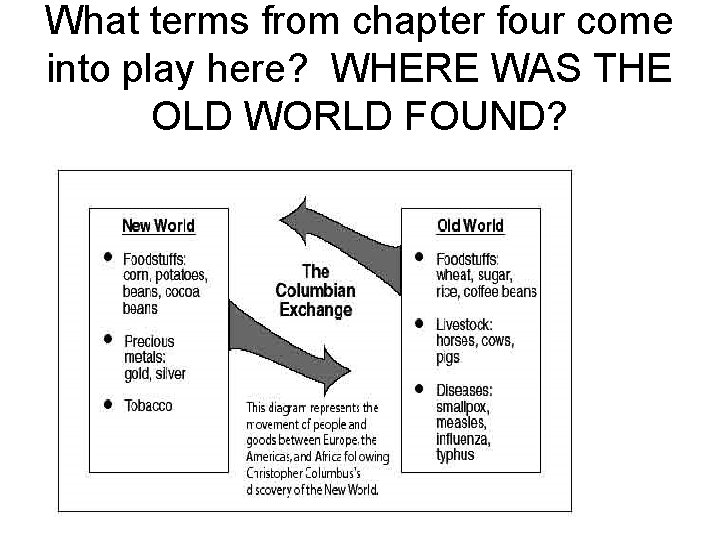
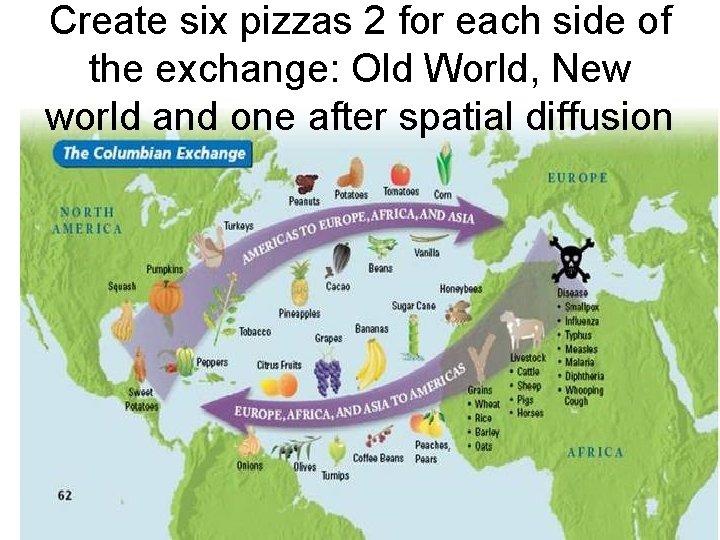
Columbian Exchange NEGATIVE EFFECTS OF: Some were diseases, which included smallpox, influenza, malaria, measles, typhus and syphilis. Also, African slavery was introduced by the Spanish because many Native Americans were killed by these diseases. Positive effects. New food supplies, better livestock, and improved diets, population increase in Europe due to new food supplies
What terms from chapter four come into play here? WHERE WAS THE OLD WORLD FOUND?
Create six pizzas 2 for each side of the exchange: Old World, New world and one after spatial diffusion
LET’S PRACTICE • A major impact of the Columbian exchange on western Europe was the introduction of • (A) Christianity that led to the rise of the Catholic Church (B) new food crops that improved the European diet (C) new military technology that weakened local rulers (D) diseases that drastically reduced the population of Europe
QUESTION 2 • Which statement describes an impact of the Columbian exchange on the lives of Europeans? (A) The combination of new products and ideas promoted economic growth. (B) Native Americans immigrated to Europe and competed with Europeans for jobs. (C) Millions of Europeans were killed by new American diseases. (D) Introduction of the Native American religions resulted in the decline of the Roman Catholic Church
QUESTION What was one effect of the Columbian exchange? (A) rapid decline in European population (B) economic instability in China and Japan (C) introduction of new foods to both Europe and the Americas (D) spread of Hinduism into Latin America
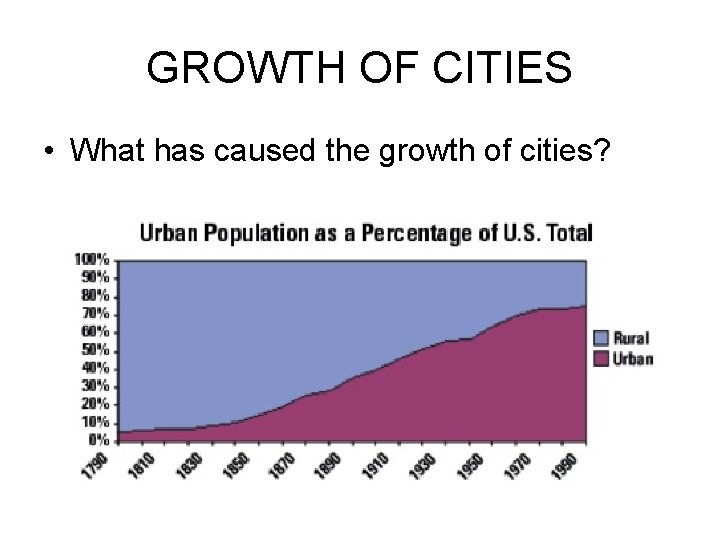
GROWTH OF CITIES • What has caused the growth of cities?
Read the statement and answer the question below • "Within the span of a few decades from the late 19 th to the early 20 th century, the United States was transformed from a predominately rural agrarian society to an industrial economy centered in large metropolitan cities … The decades surrounding 1900 were not only the age of industrialization in the United States, but were also the age of urbanization and immigration. The 1880 s were the first decade in American history, with the exception of the Civil War decade, when the urban population increased more than the rural population (in absolute numbers). " Charles Hirschman and Elizabeth Mogford (2009) “Immigration and the American industrial revolution from 1880 to 1920” Social Science Research 38: 897 -920. 1. What major event could have caused the shifting in American Society from rural to urban areas and growth of cities a. World War II c. Industrial Revolution b. Agricultural Revolution d. Green Revolution
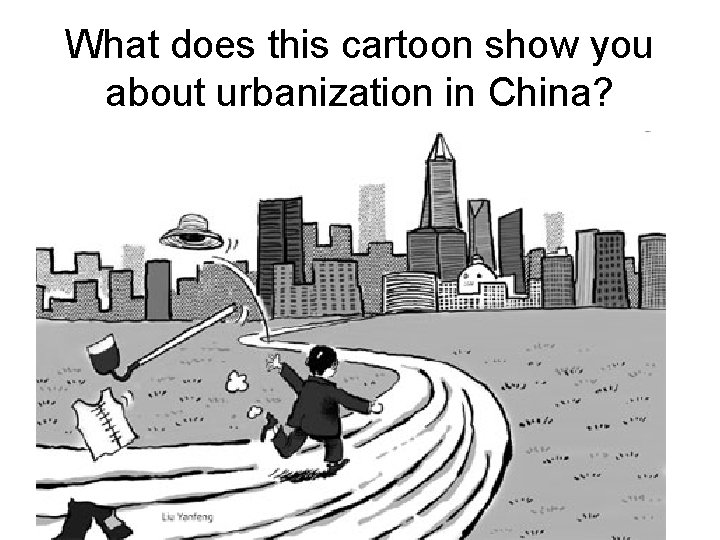
What does this cartoon show you about urbanization in China?
Growth of cities • Causes – Industrial revolution – Immigration – Pull factors of migration into the city • Effects – Think of the problems found in the cities – Overcrowding – Lack of jobs, housing – Poor sanitation
Cultural change
The red route above would have been a factor of which cultural process? a) Cultural hearth c) Agricultural Revolution b) Cultural diffusion d) Spread of Islam