
Cultural Diffusion and the Columbian Exchange Patterns of
Cultural Diffusion and the Columbian Exchange Patterns of Trade From medieval - 1750 C. E. What are the benefits of studying the past regarding this subject today?

Patterns of Trade and how they led to Cultural Diffusion Welcome to our world We will be looking at the exchange of ideas & goods from 300 CE to 1750 CE. 900 CE – 1750 CE MODERN BCE 1 -300 CE

North and South America Afroeurasia Many connections were established among regions that formed interregional patterns of unity.
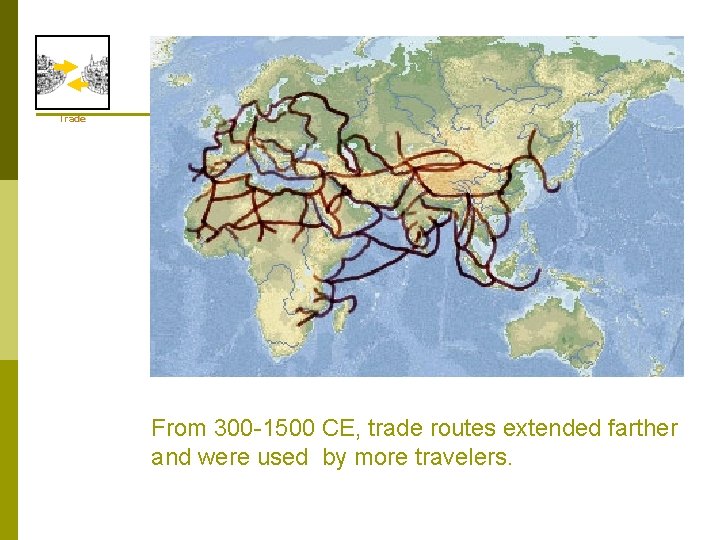
Trade From 300 -1500 CE, trade routes extended farther and were used by more travelers.
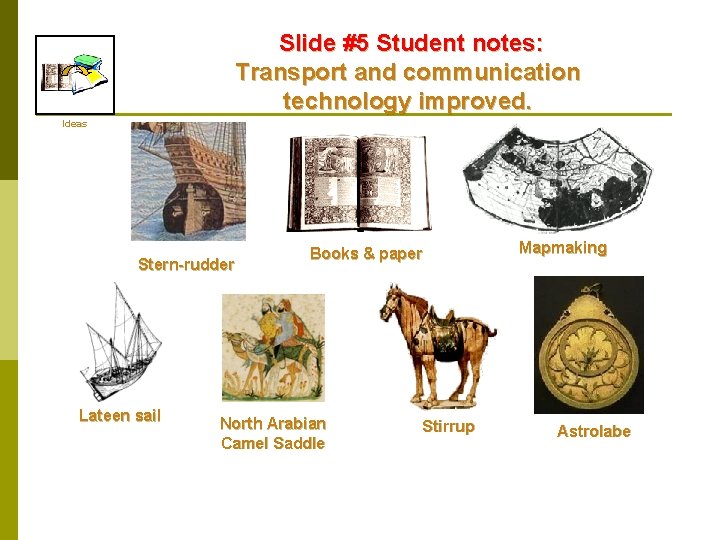
Slide #5 Student notes: Transport and communication technology improved. Ideas Stern-rudder Lateen sail Books & paper North Arabian Camel Saddle Stirrup Mapmaking Astrolabe
Slide #6 Student notes: Ideas • The pace of innovation increased • Knowledge accumulated more quickly • Manufacturing and farming productivity increased • People’s diets and health improved • Sea travel and transport increased How did transfers of technology and products change people’s lives in Afroeurasia?
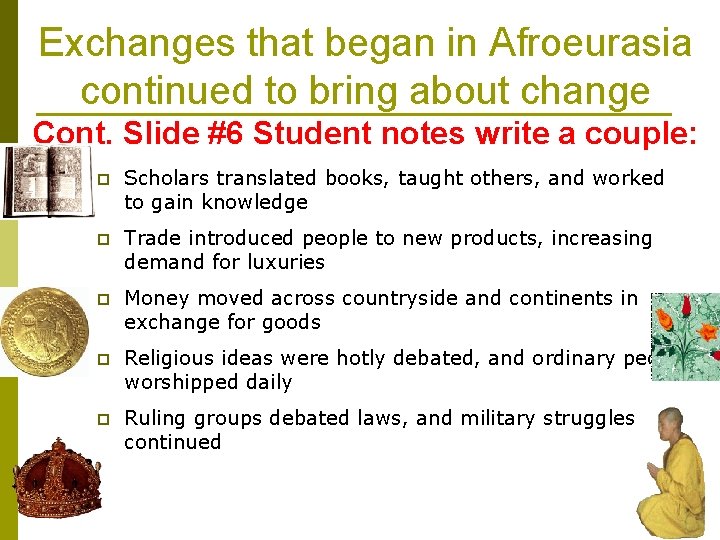
Exchanges that began in Afroeurasia continued to bring about change Cont. Slide #6 Student notes write a couple: p Scholars translated books, taught others, and worked to gain knowledge p Trade introduced people to new products, increasing demand for luxuries p Money moved across countryside and continents in exchange for goods p Religious ideas were hotly debated, and ordinary people worshipped daily p Ruling groups debated laws, and military struggles continued

Columbus 1492 Vasco Da Gama 1498 Magellan 1519 Slide #8 Student notes: After 1415, European mariners made voyages across the seas toward east and west. By 1519, Magellan had circumnavigated the globe. Others set out in search of wealth, adventure and fame.
If you had to put all of these changes into one sentence, what would it be? You might say, by 1500 CE, the world was connected, right? But wait! You still haven’t said much about the Americas!
Well…the Americas and Afroeurasia were not yet permanently linked together. …not until 1492… When Columbus sailed the ocean blue…
Slide #11 Student notes: So, by 1492, European mariners set out on trans-oceanic voyages to the Americas. Those voyages linked the Americas with Afroeurasia for the first time since the migrations of people over 13, 000 years earlier! It had to happen sooner or later!
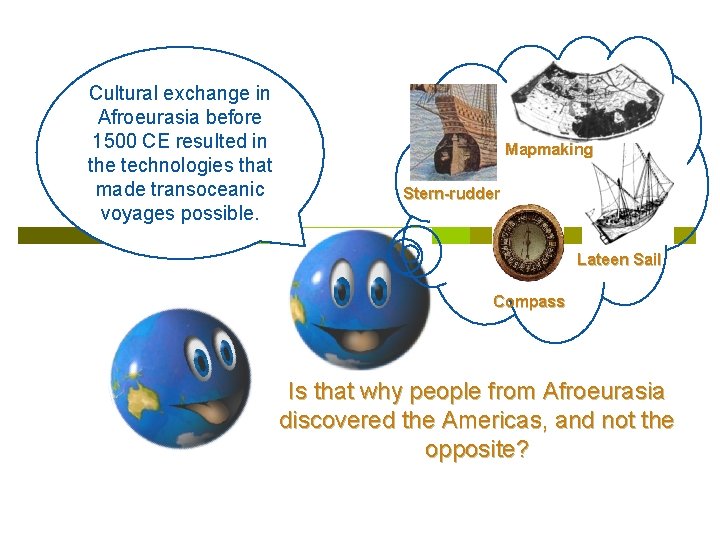
Cultural exchange in Afroeurasia before 1500 CE resulted in the technologies that made transoceanic voyages possible. Mapmaking Stern-rudder Lateen Sail Compass Is that why people from Afroeurasia discovered the Americas, and not the opposite?
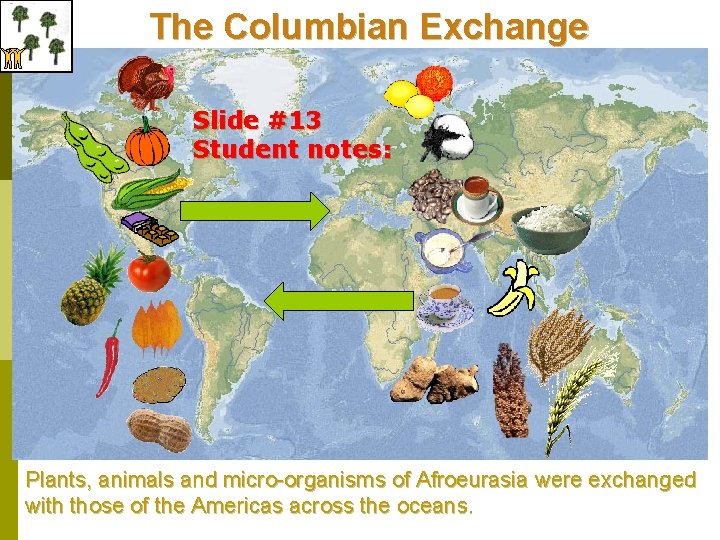
The Columbian Exchange Slide #13 Student notes: Plants, animals and micro-organisms of Afroeurasia were exchanged with those of the Americas across the oceans.
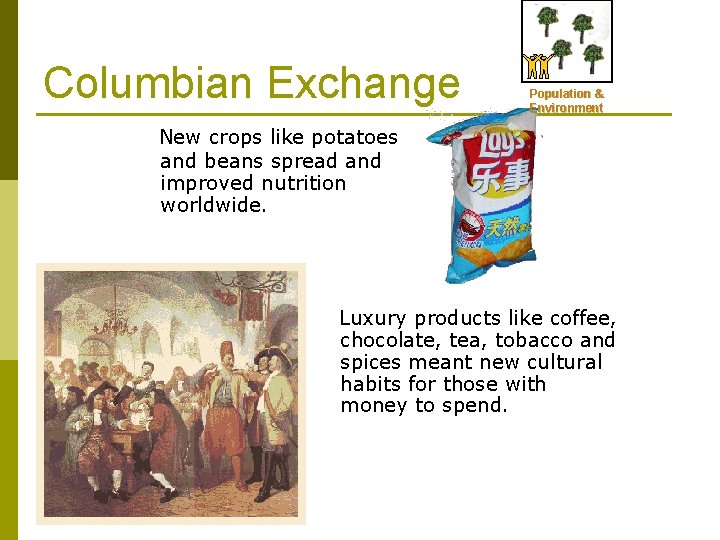
Columbian Exchange Population & Environment New crops like potatoes and beans spread and improved nutrition worldwide. Luxury products like coffee, chocolate, tea, tobacco and spices meant new cultural habits for those with money to spend.
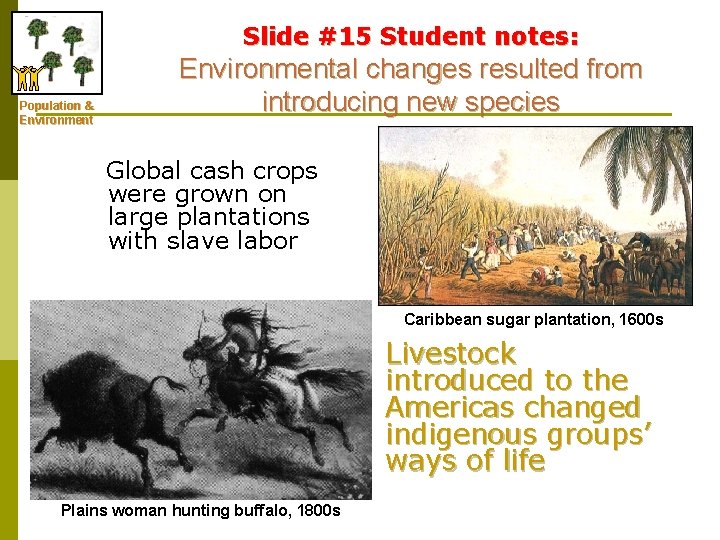
Slide #15 Student notes: Population & Environmental changes resulted from introducing new species Global cash crops were grown on large plantations with slave labor Caribbean sugar plantation, 1600 s Livestock introduced to the Americas changed indigenous groups’ ways of life Plains woman hunting buffalo, 1800 s
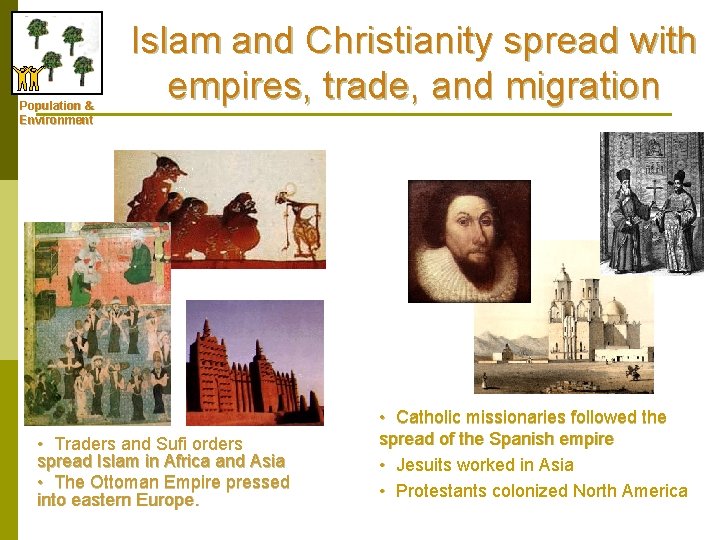
Population & Environment Islam and Christianity spread with empires, trade, and migration • Traders and Sufi orders spread Islam in Africa and Asia • The Ottoman Empire pressed into eastern Europe. • Catholic missionaries followed the spread of the Spanish empire • Jesuits worked in Asia • Protestants colonized North America
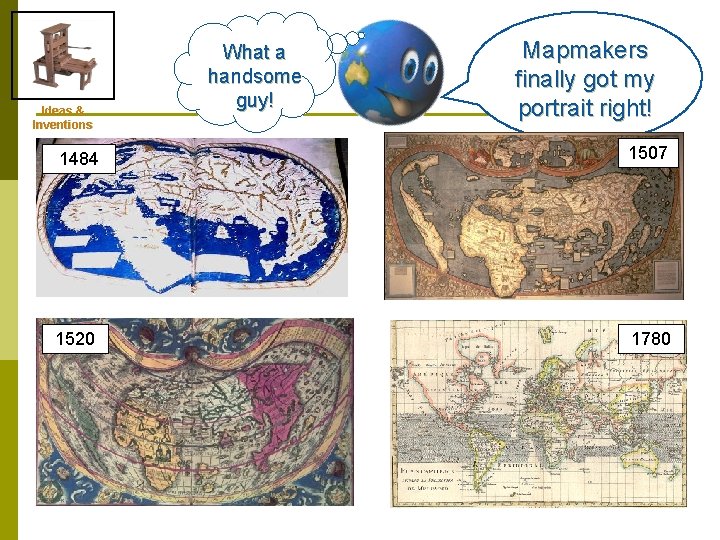
Ideas & Inventions What a handsome guy! Mapmakers finally got my portrait right! 1484 1507 1520 1780
GOODS, IDEAS AND PEOPLE ARE NOW MOVING AROUND THE WORLD CONTINUING CROSS CULTURALIZATION AND…. . Slide #18 Student notes: Define: CULTURAL DIFFUSION Cultural diffusion is the spreading of ideas or products from one culture to another.

Slide # 19 Student notes: Trade & Manufacturing Trade encircled the globe: The Columbian Exchange was a dramatically widespread exchange of animals, plants, culture and human populations (including slaves), communicable diseases, and ideas between the Eastern and Western hemispheres.

Let us draw conclusions: Explain 7 benefits of global trade on civilization, list examples for each benefit. Formulate your ideas then write & explain 7 examples that you learned from this presentation. (Use the graphic organizer)
- Slides: 20