
Cultural Criticism A Quick Introduction COMM 142 John
- Slides: 20
Cultural Criticism A Quick Introduction COMM 142 John A. Cagle
Assumptions of Narrative Analysis Walter Fisher Humans make sense of their world by the stories they tell about it n Beliefs and behaviors are based on good reasons n Narrative is a persuasive and vital form of interpretive discourse n Stories are symbolic actions that create social reality n
Nature of Stories n n Stories are linked to experience Stories are linked to values Narratives are based on experience, is a product of the memory, has a sense of chronology, is coherent, defines a central subject, and has closure. Narratives advance persuasion by disarming listeners, awakening dormant experiences and feelings, and exposing some sort of propositional argument.
Characteristics of Narrative Theme n Plot n Structure n Characters n Narrator n Setting n Time and Causality n
Criticism of Narratives Mythic n Narrative paradigm n Dramatistic n Fantasy theme analysis n Fictitious n Archetypal n ETC. n
Narrative Critical Probes Does the narrative spring from a Master Narrative (older narratives)? n What propositional content is the narrative designed to reveal? n What propositional content is the narrative designed to mask? n How effectively and how faithfully does the narrative deal with its subject matter? n
Dramatism: Kenneth Burke The range of rhetoric is wide. n All life is drama. n Drama features human motives. n Hierarchy is fundamental to human symbolism. n Rhetoric promises transcendence. n Rhetoric is fueled by the negative. n
Rhetorical Analysis of Narrative Kenneth Burke’s Pentad: act, scene, agent, agency, and purpose n Pentadic ratios can be used to define the central relationship of any story: scene-act, scene-agency, scene-purpose, act-agent, act-agency, agent-purpose, agentagency, and agency-purpose. n
Burkean Critical Probes Can principles of hierarchy be found in discourse? n What is rhetor’s vocabulary of motives? n Who or what is being scapegoated? n Are strategies of transcendence in evidence? n
Myth: the Substance of Culture n Myths are master stories that describe exceptional people doing exceptional things and that serve as moral guides to proper action.
Types of Myth Cosmological myths: why we are here. n Societal myths: the proper way to live. n Identity myths: what makes one cultural grouping different from another. n Eschatological myths: quo vadis? n
Why use myth? Heightened sense of authority n Sense of continuity n Sense of coherence n Sense of community n Sense of choice n Sense of agreement n
Structuralism: Claude Levi-Strauss Critic should track the source of the myth n Effectiveness is tied to how mythic elements are combined n Task is to discover the unique harmony (of emotions, images, ideas, etc. ) myth provides n
Structuralism continued Standard chronology vs. synchronic time n Narrative elements that share same context lead to myth’s basic argument n Dialectical forces in myth to discover its motivational base n
Fantasy themes: Ernest Bormann Fantasy themes are mythic shorthand n Fantasy themes are local variations on mythic themes, prized tales of mankind in general n Purpose is to dramatize ideas for listeners n Listeners or readers lack the imagination needed to see what the world will be like if they accept new beliefs n
Fantasy Themes Critical Probes n n n n What are people like? What are possibilities for group action? On what people can you most depend? What is mankind’s purpose on earth? What are measures of right and wrong? How can success be measured? What information is most valuable? Why do things happen as they do?
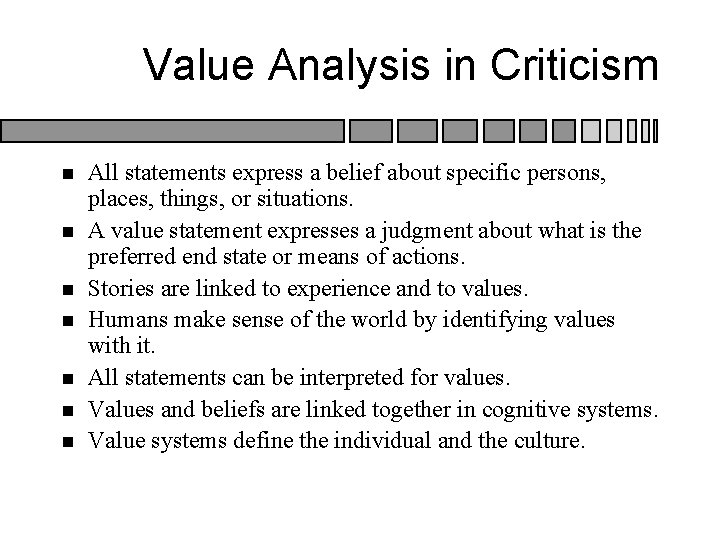
Value Analysis in Criticism n n n n All statements express a belief about specific persons, places, things, or situations. A value statement expresses a judgment about what is the preferred end state or means of actions. Stories are linked to experience and to values. Humans make sense of the world by identifying values with it. All statements can be interpreted for values. Values and beliefs are linked together in cognitive systems. Value systems define the individual and the culture.
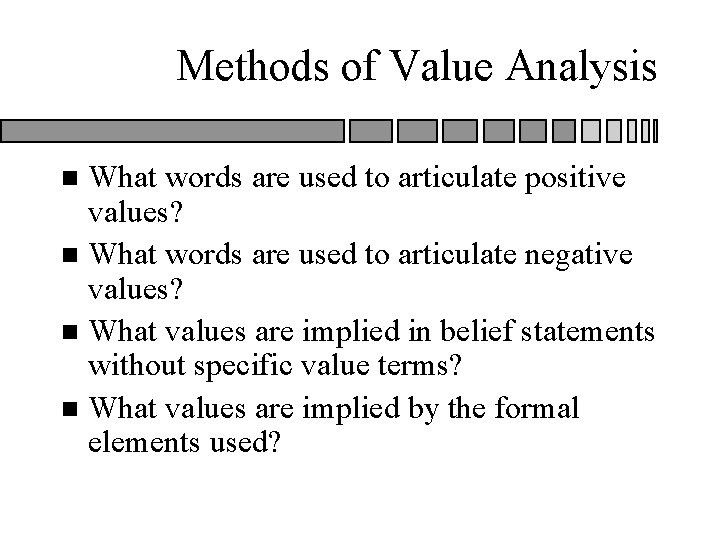
Methods of Value Analysis What words are used to articulate positive values? n What words are used to articulate negative values? n What values are implied in belief statements without specific value terms? n What values are implied by the formal elements used? n
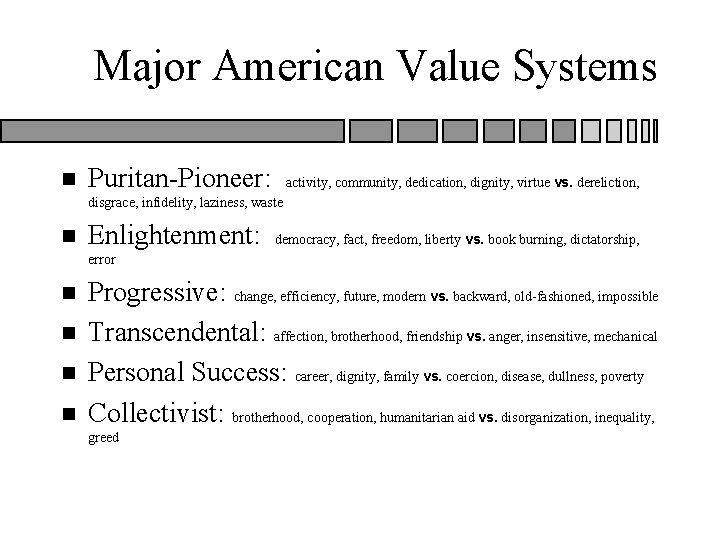
Major American Value Systems n Puritan-Pioneer: activity, community, dedication, dignity, virtue vs. dereliction, disgrace, infidelity, laziness, waste n Enlightenment: democracy, fact, freedom, liberty vs. book burning, dictatorship, error n n Progressive: change, efficiency, future, modern vs. backward, old-fashioned, impossible Transcendental: affection, brotherhood, friendship vs. anger, insensitive, mechanical Personal Success: career, dignity, family vs. coercion, disease, dullness, poverty Collectivist: brotherhood, cooperation, humanitarian aid vs. disorganization, inequality, greed
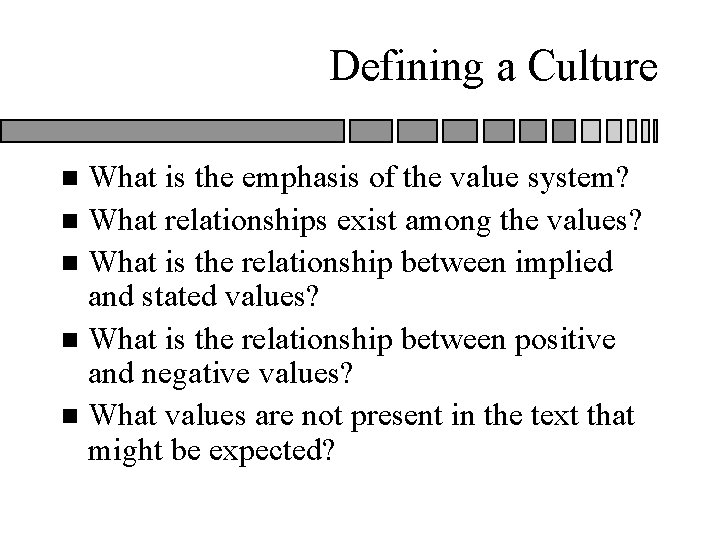
Defining a Culture What is the emphasis of the value system? n What relationships exist among the values? n What is the relationship between implied and stated values? n What is the relationship between positive and negative values? n What values are not present in the text that might be expected? n