
CULTURAL CONFORMITY AND ADAPTATION CHAPTER 3 THE AMERICAN
- Slides: 29
CULTURAL CONFORMITY AND ADAPTATION CHAPTER 3
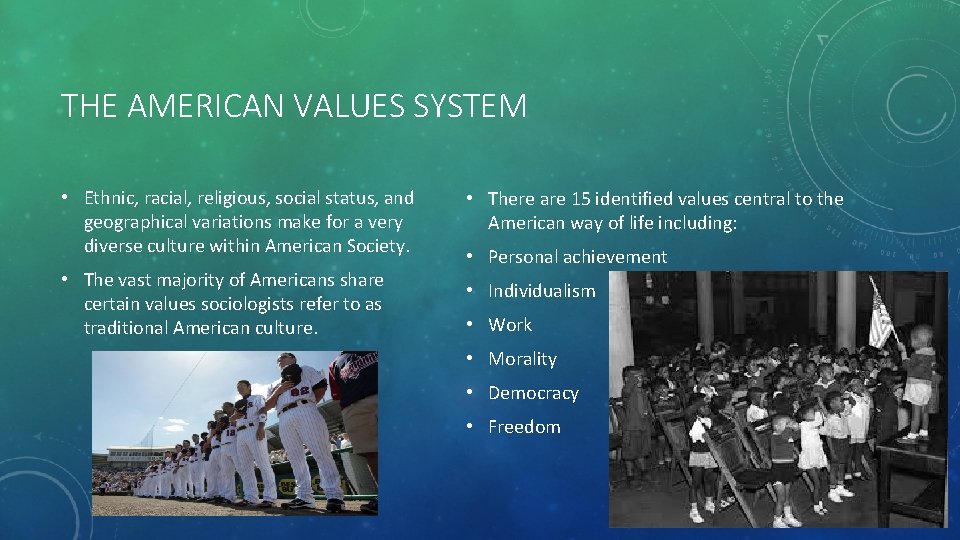
THE AMERICAN VALUES SYSTEM • Ethnic, racial, religious, social status, and geographical variations make for a very diverse culture within American Society. • The vast majority of Americans share certain values sociologists refer to as traditional American culture. • There are 15 identified values central to the American way of life including: • Personal achievement • Individualism • Work • Morality • Democracy • Freedom
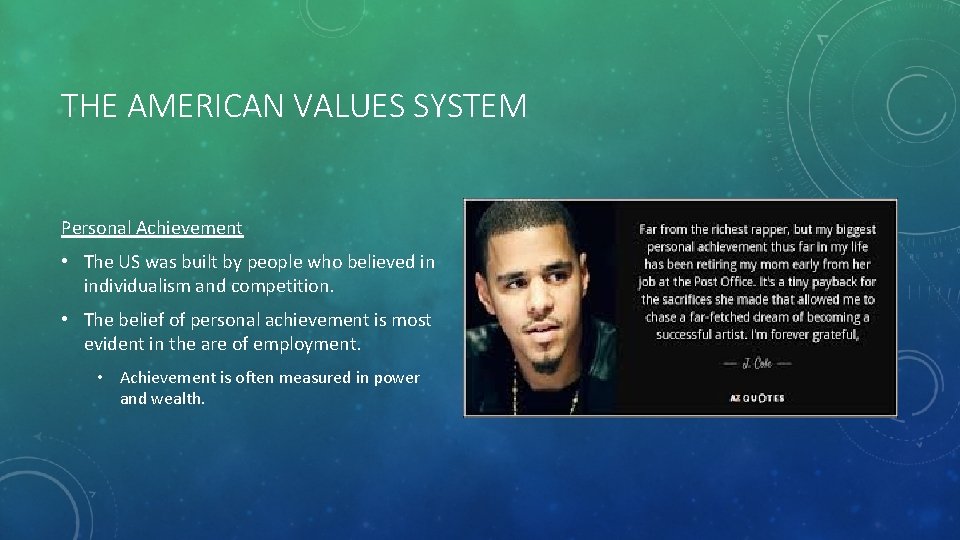
THE AMERICAN VALUES SYSTEM Personal Achievement • The US was built by people who believed in individualism and competition. • The belief of personal achievement is most evident in the are of employment. • Achievement is often measured in power and wealth.
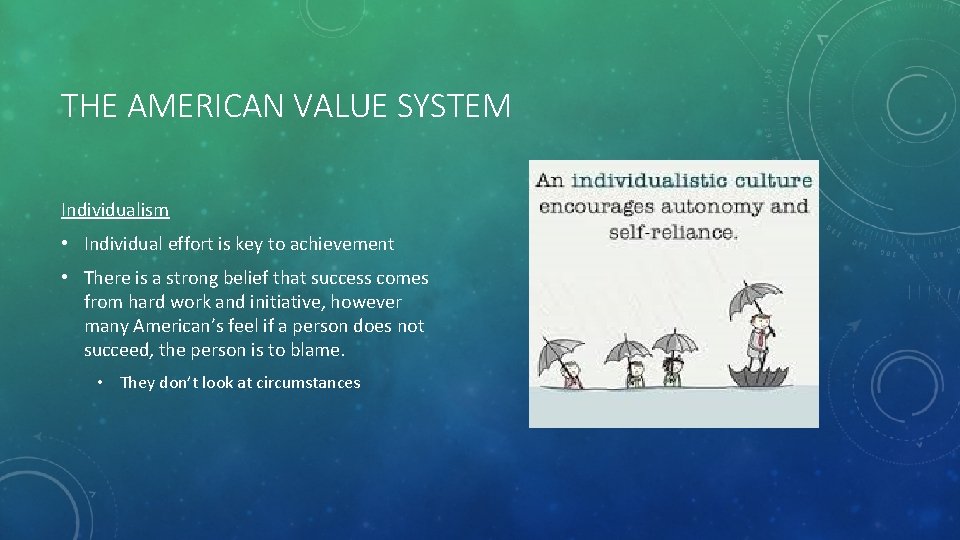
THE AMERICAN VALUE SYSTEM Individualism • Individual effort is key to achievement • There is a strong belief that success comes from hard work and initiative, however many American’s feel if a person does not succeed, the person is to blame. • They don’t look at circumstances
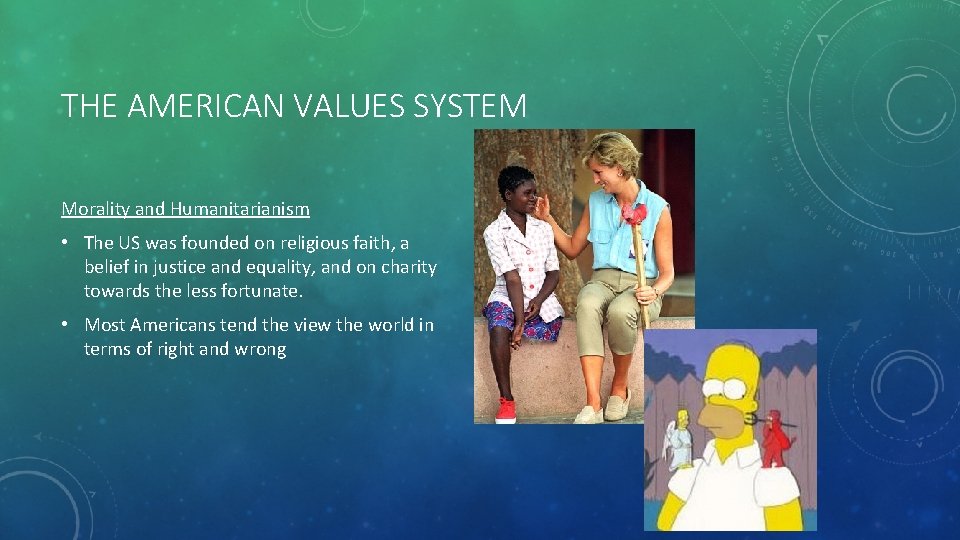
THE AMERICAN VALUES SYSTEM Morality and Humanitarianism • The US was founded on religious faith, a belief in justice and equality, and on charity towards the less fortunate. • Most Americans tend the view the world in terms of right and wrong
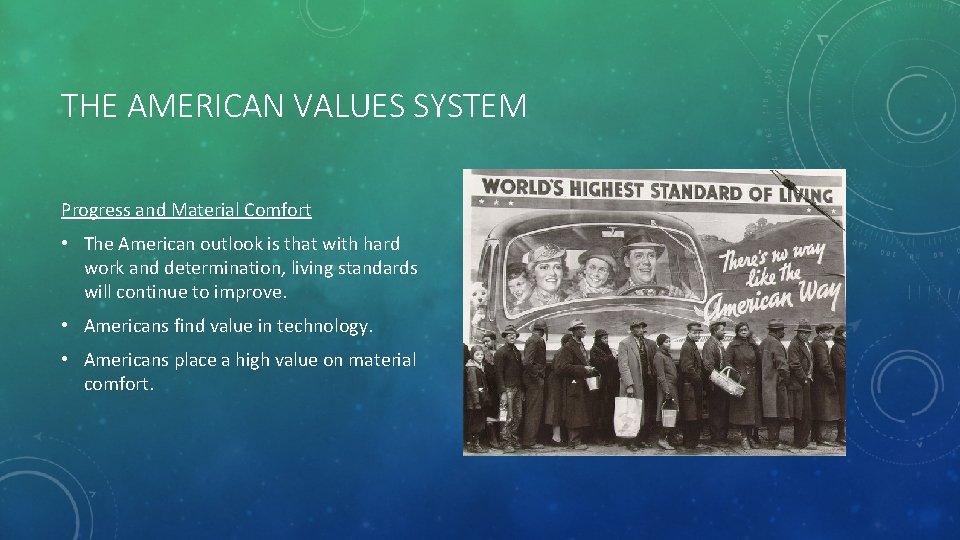
THE AMERICAN VALUES SYSTEM Progress and Material Comfort • The American outlook is that with hard work and determination, living standards will continue to improve. • Americans find value in technology. • Americans place a high value on material comfort.
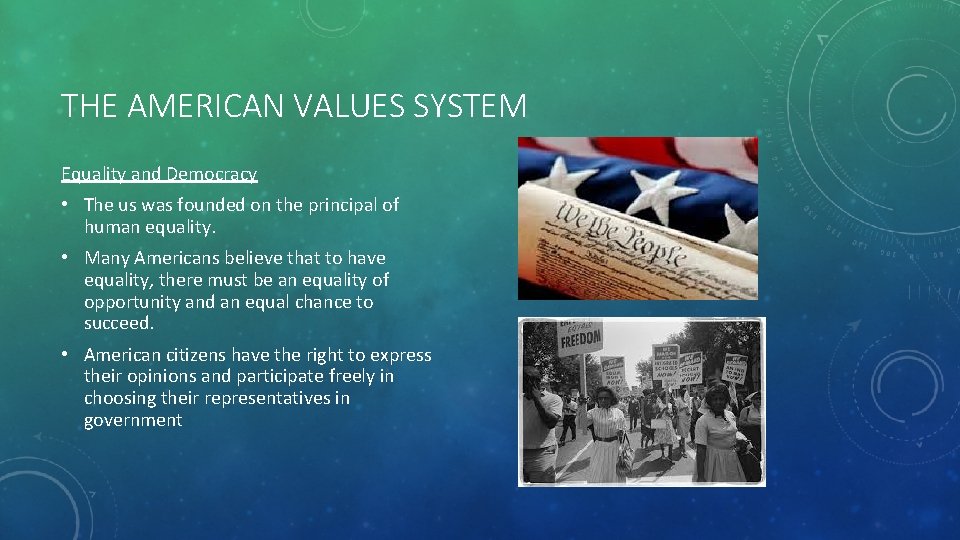
THE AMERICAN VALUES SYSTEM Equality and Democracy • The us was founded on the principal of human equality. • Many Americans believe that to have equality, there must be an equality of opportunity and an equal chance to succeed. • American citizens have the right to express their opinions and participate freely in choosing their representatives in government
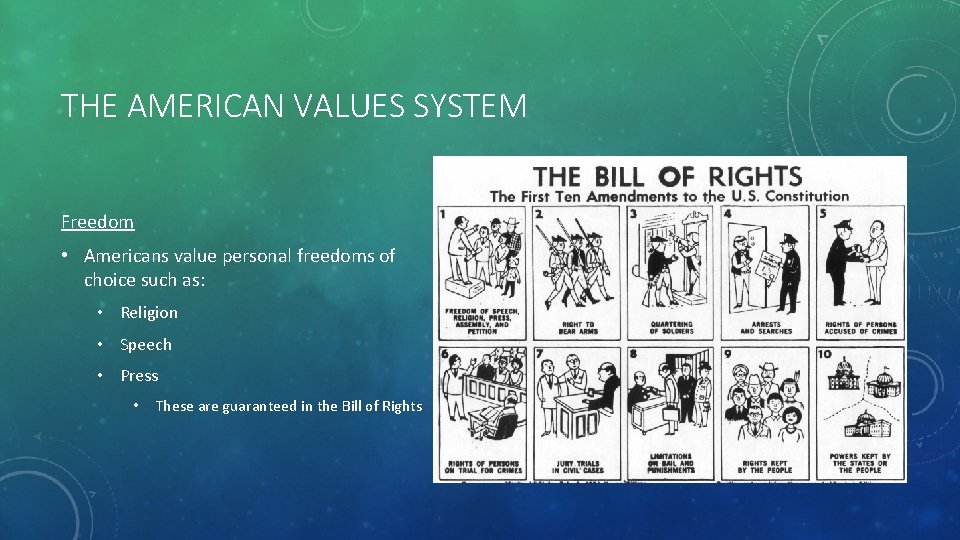
THE AMERICAN VALUES SYSTEM Freedom • Americans value personal freedoms of choice such as: • Religion • Speech • Press • These are guaranteed in the Bill of Rights
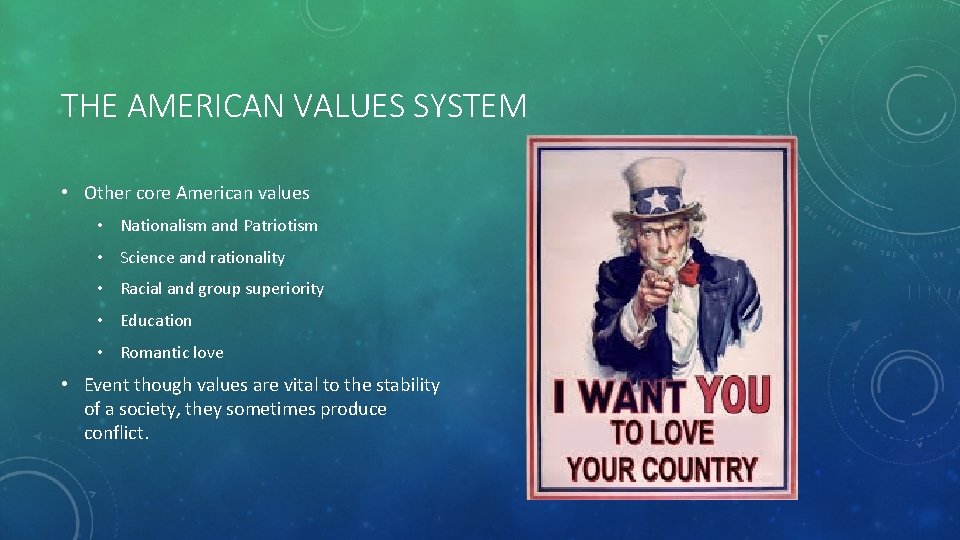
THE AMERICAN VALUES SYSTEM • Other core American values • Nationalism and Patriotism • Science and rationality • Racial and group superiority • Education • Romantic love • Event though values are vital to the stability of a society, they sometimes produce conflict.
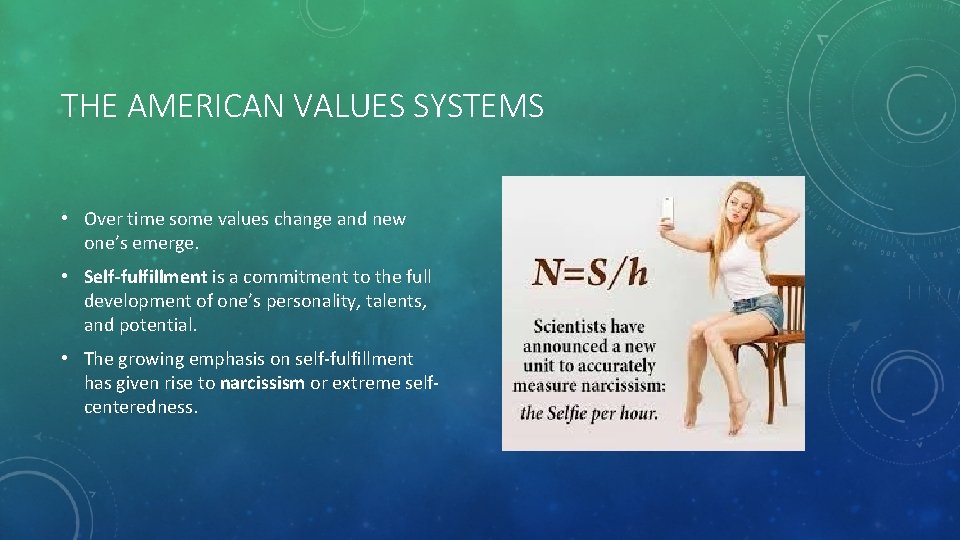
THE AMERICAN VALUES SYSTEMS • Over time some values change and new one’s emerge. • Self-fulfillment is a commitment to the full development of one’s personality, talents, and potential. • The growing emphasis on self-fulfillment has given rise to narcissism or extreme selfcenteredness.
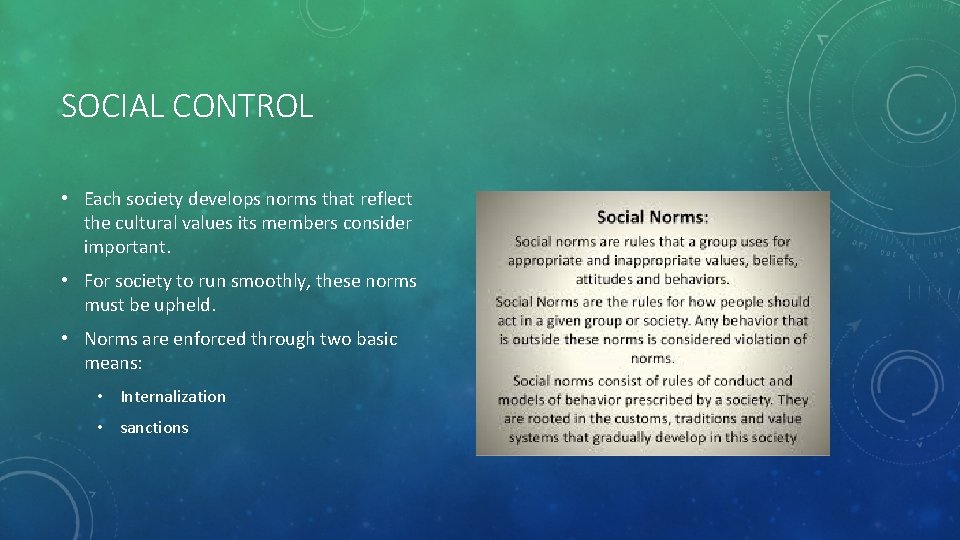
SOCIAL CONTROL • Each society develops norms that reflect the cultural values its members consider important. • For society to run smoothly, these norms must be upheld. • Norms are enforced through two basic means: • Internalization • sanctions
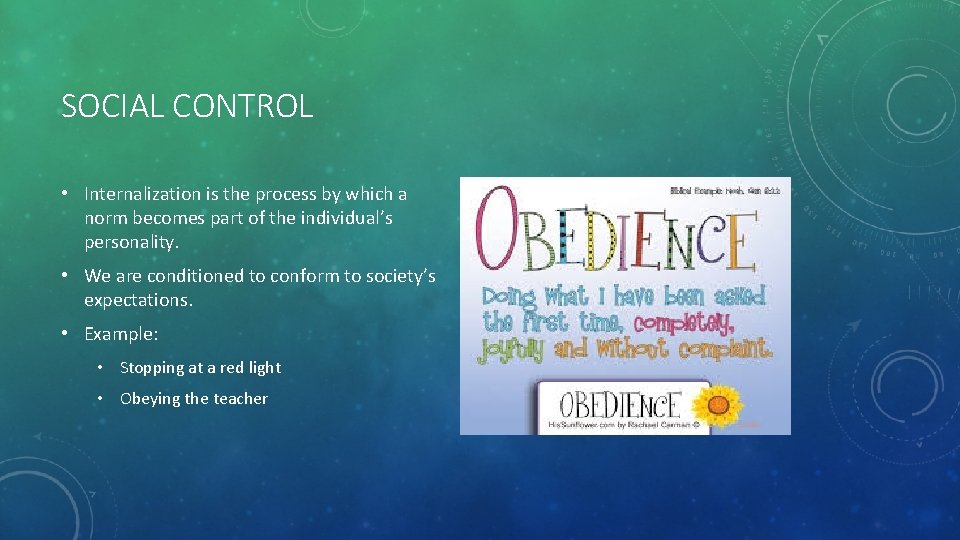
SOCIAL CONTROL • Internalization is the process by which a norm becomes part of the individual’s personality. • We are conditioned to conform to society’s expectations. • Example: • Stopping at a red light • Obeying the teacher
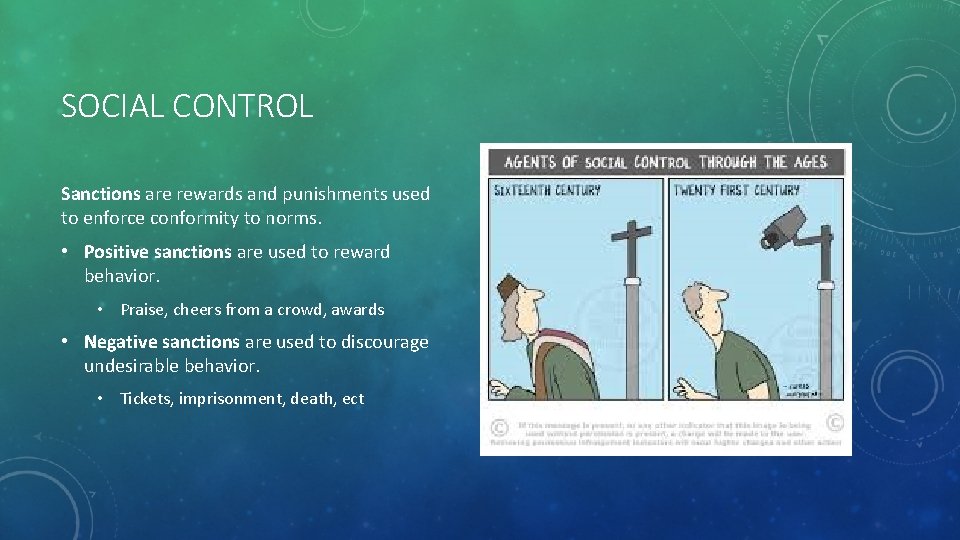
SOCIAL CONTROL Sanctions are rewards and punishments used to enforce conformity to norms. • Positive sanctions are used to reward behavior. • Praise, cheers from a crowd, awards • Negative sanctions are used to discourage undesirable behavior. • Tickets, imprisonment, death, ect
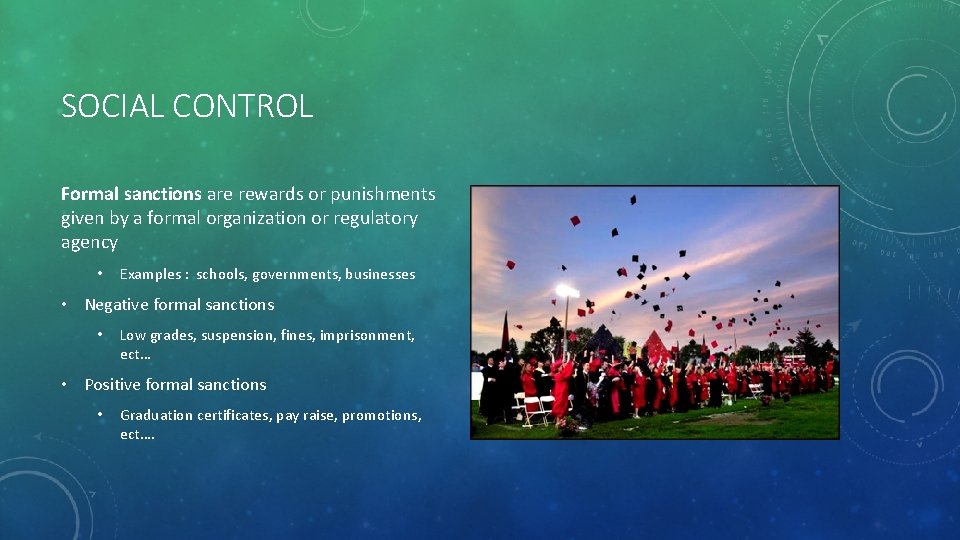
SOCIAL CONTROL Formal sanctions are rewards or punishments given by a formal organization or regulatory agency • Examples : schools, governments, businesses • Negative formal sanctions • Low grades, suspension, fines, imprisonment, ect… • Positive formal sanctions • Graduation certificates, pay raise, promotions, ect….
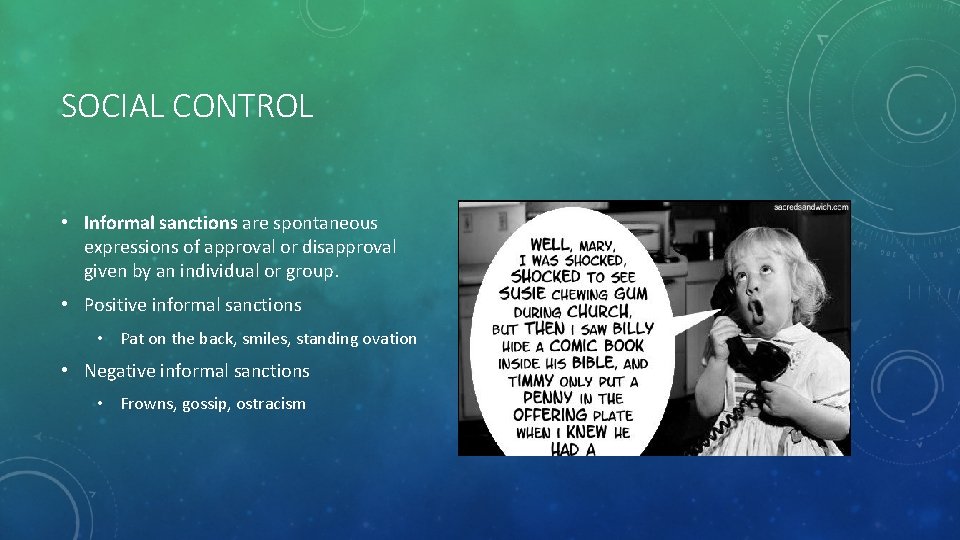
SOCIAL CONTROL • Informal sanctions are spontaneous expressions of approval or disapproval given by an individual or group. • Positive informal sanctions • Pat on the back, smiles, standing ovation • Negative informal sanctions • Frowns, gossip, ostracism
SOCIAL CONTROL Social control is the enforcing norms through either internal or external means. • The principal means of social control in all societies is self control, which is learned through the internalization of norms. • Various agents of social control perform external control using sanctions. • Agents of social control include: • Authority figures, the police, courts, religion, family, and public opinion
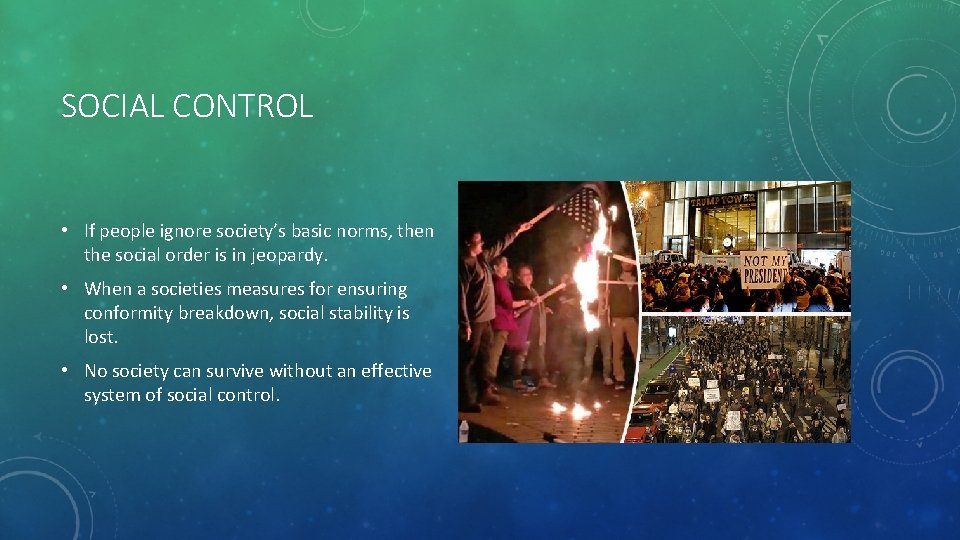
SOCIAL CONTROL • If people ignore society’s basic norms, then the social order is in jeopardy. • When a societies measures for ensuring conformity breakdown, social stability is lost. • No society can survive without an effective system of social control.
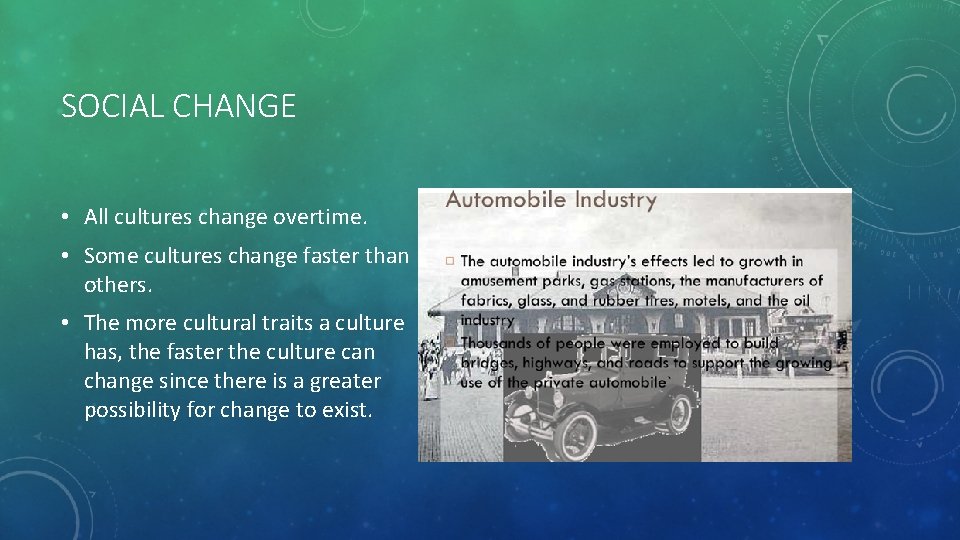
SOCIAL CHANGE • All cultures change overtime. • Some cultures change faster than others. • The more cultural traits a culture has, the faster the culture can change since there is a greater possibility for change to exist.
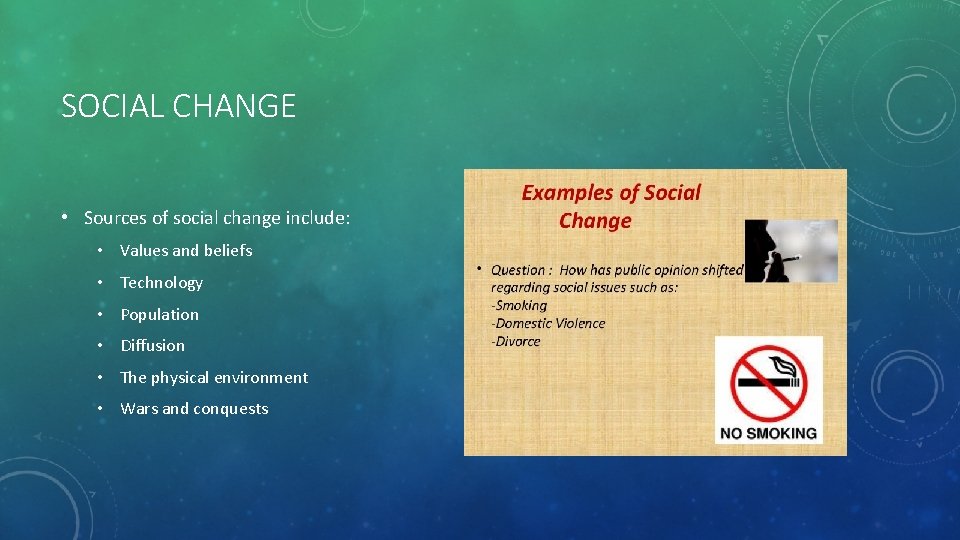
SOCIAL CHANGE • Sources of social change include: • Values and beliefs • Technology • Population • Diffusion • The physical environment • Wars and conquests
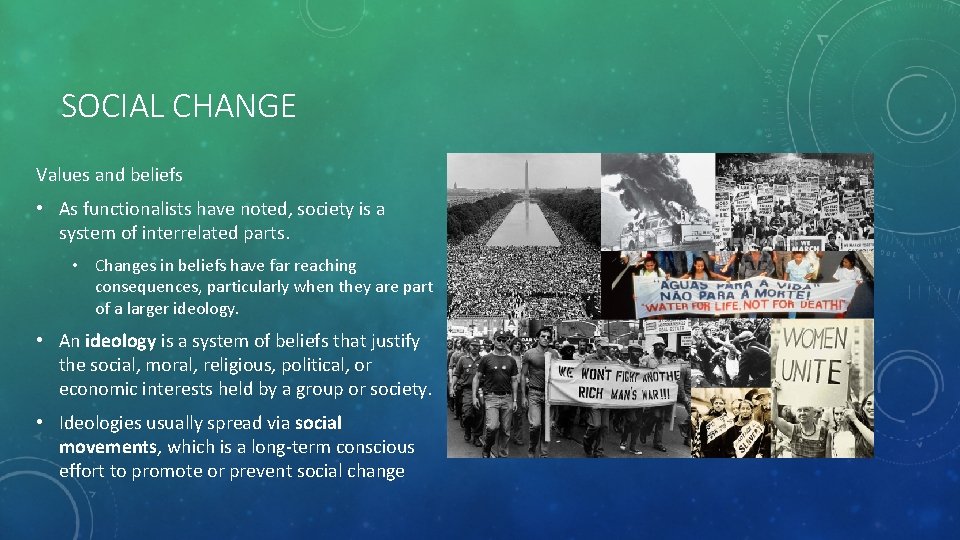
SOCIAL CHANGE Values and beliefs • As functionalists have noted, society is a system of interrelated parts. • Changes in beliefs have far reaching consequences, particularly when they are part of a larger ideology. • An ideology is a system of beliefs that justify the social, moral, religious, political, or economic interests held by a group or society. • Ideologies usually spread via social movements, which is a long-term conscious effort to promote or prevent social change
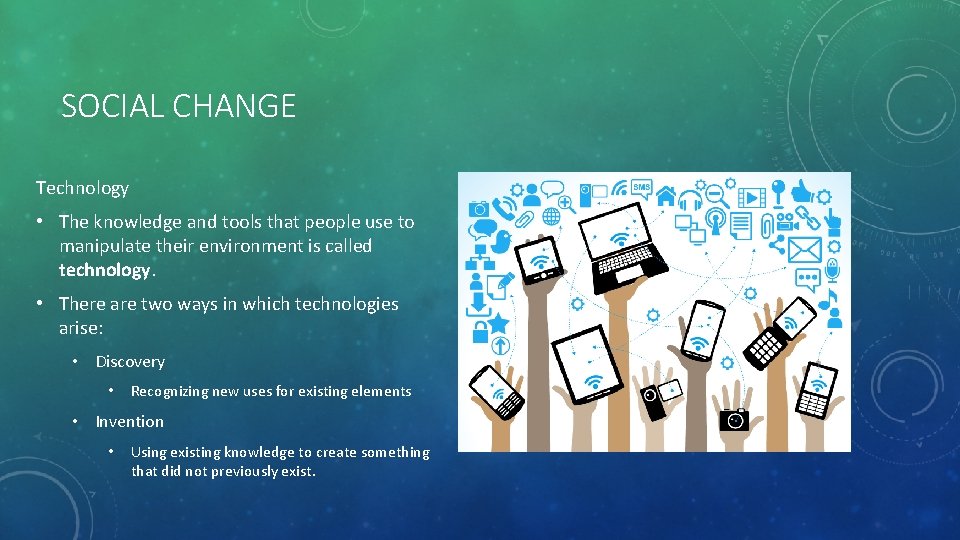
SOCIAL CHANGE Technology • The knowledge and tools that people use to manipulate their environment is called technology. • There are two ways in which technologies arise: • Discovery • Recognizing new uses for existing elements • Invention • Using existing knowledge to create something that did not previously exist.
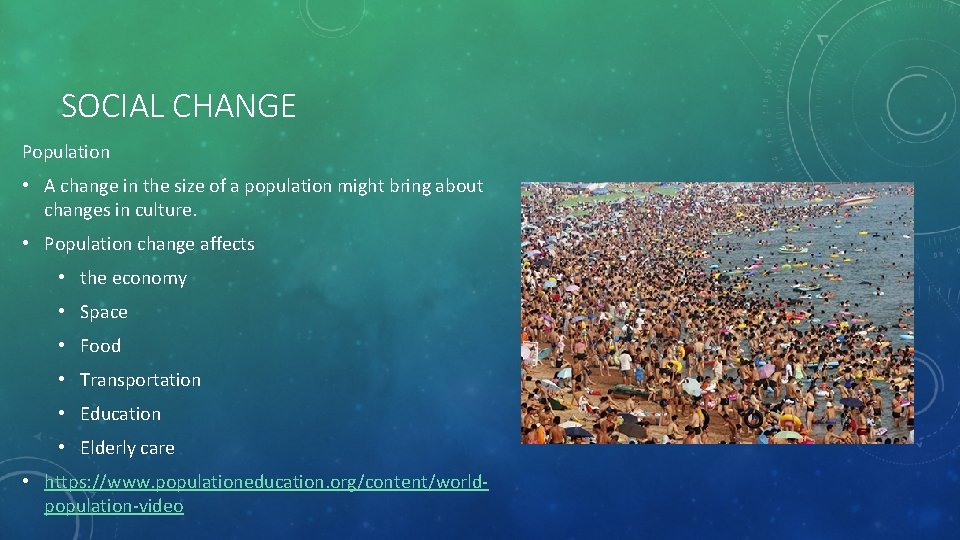
SOCIAL CHANGE Population • A change in the size of a population might bring about changes in culture. • Population change affects • the economy • Space • Food • Transportation • Education • Elderly care • https: //www. populationeducation. org/content/worldpopulation-video
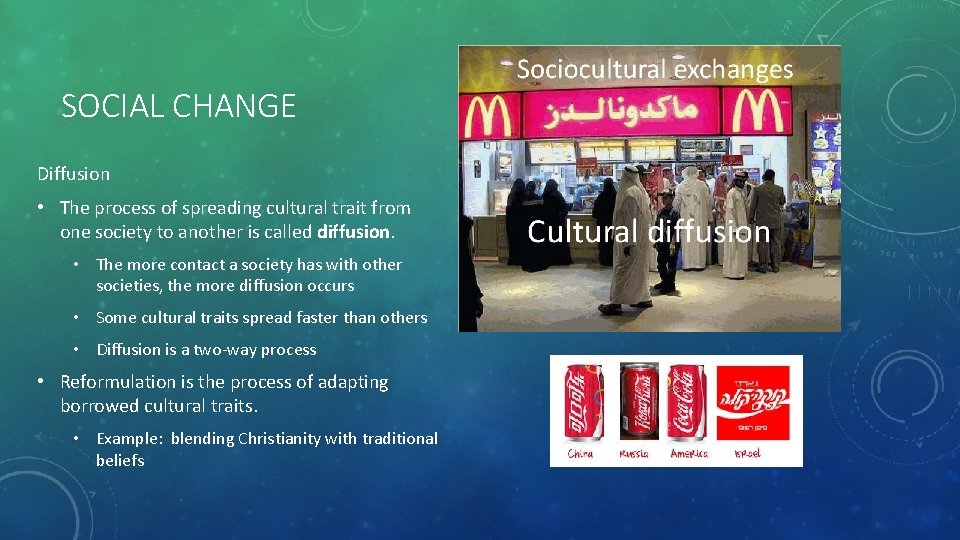
SOCIAL CHANGE Diffusion • The process of spreading cultural trait from one society to another is called diffusion. • The more contact a society has with other societies, the more diffusion occurs • Some cultural traits spread faster than others • Diffusion is a two-way process • Reformulation is the process of adapting borrowed cultural traits. • Example: blending Christianity with traditional beliefs
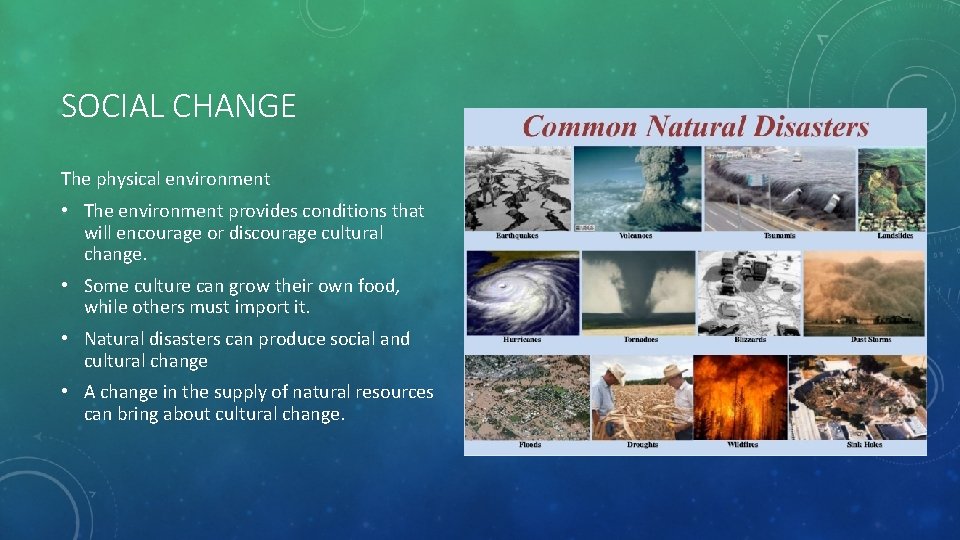
SOCIAL CHANGE The physical environment • The environment provides conditions that will encourage or discourage cultural change. • Some culture can grow their own food, while others must import it. • Natural disasters can produce social and cultural change • A change in the supply of natural resources can bring about cultural change.
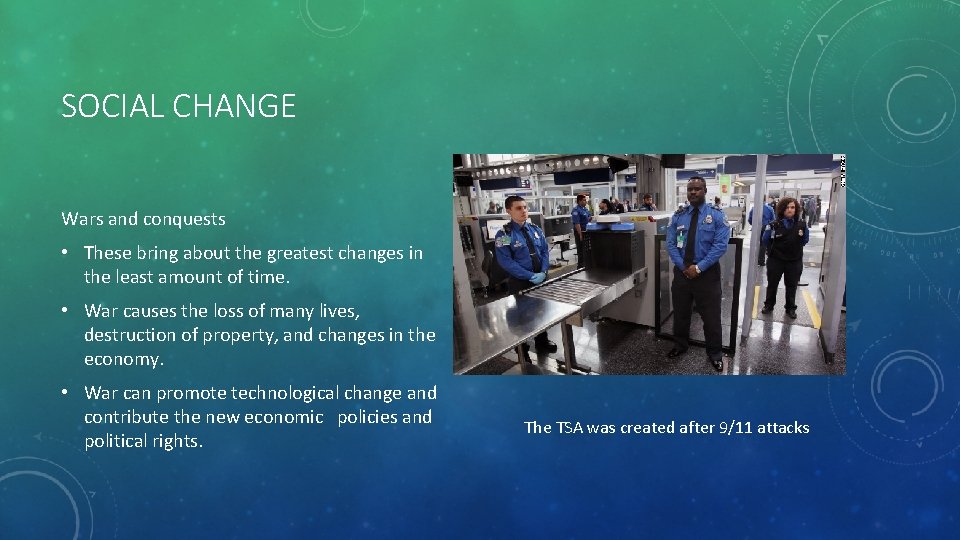
SOCIAL CHANGE Wars and conquests • These bring about the greatest changes in the least amount of time. • War causes the loss of many lives, destruction of property, and changes in the economy. • War can promote technological change and contribute the new economic policies and political rights. The TSA was created after 9/11 attacks
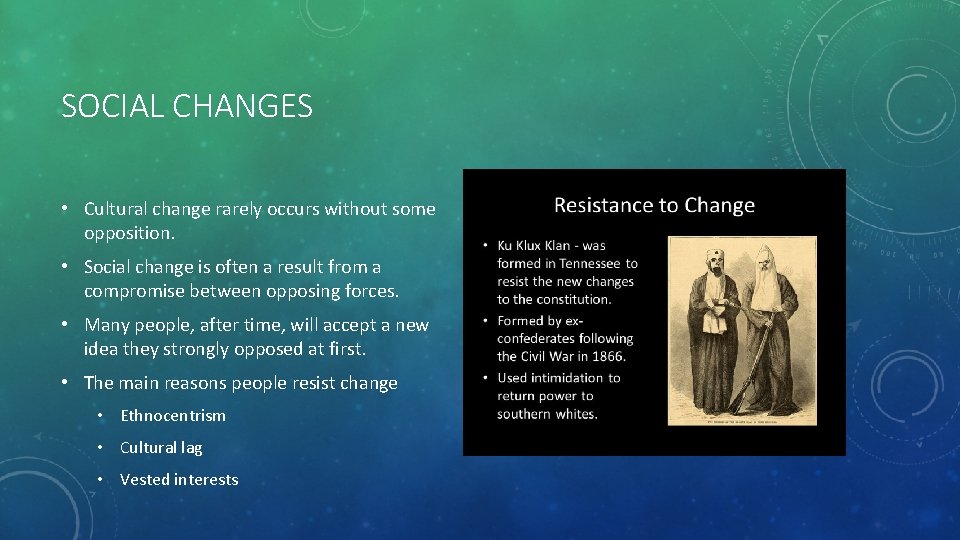
SOCIAL CHANGES • Cultural change rarely occurs without some opposition. • Social change is often a result from a compromise between opposing forces. • Many people, after time, will accept a new idea they strongly opposed at first. • The main reasons people resist change • Ethnocentrism • Cultural lag • Vested interests
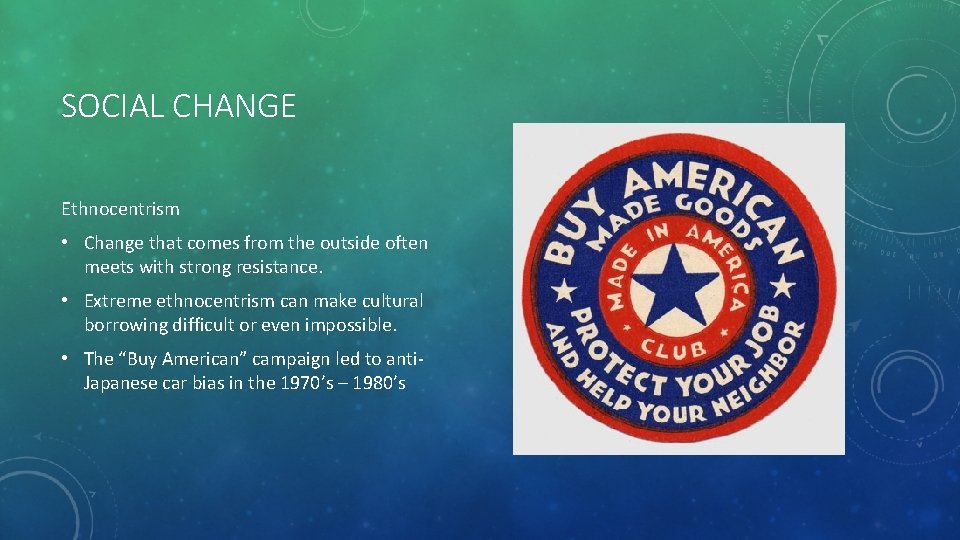
SOCIAL CHANGE Ethnocentrism • Change that comes from the outside often meets with strong resistance. • Extreme ethnocentrism can make cultural borrowing difficult or even impossible. • The “Buy American” campaign led to anti. Japanese car bias in the 1970’s – 1980’s
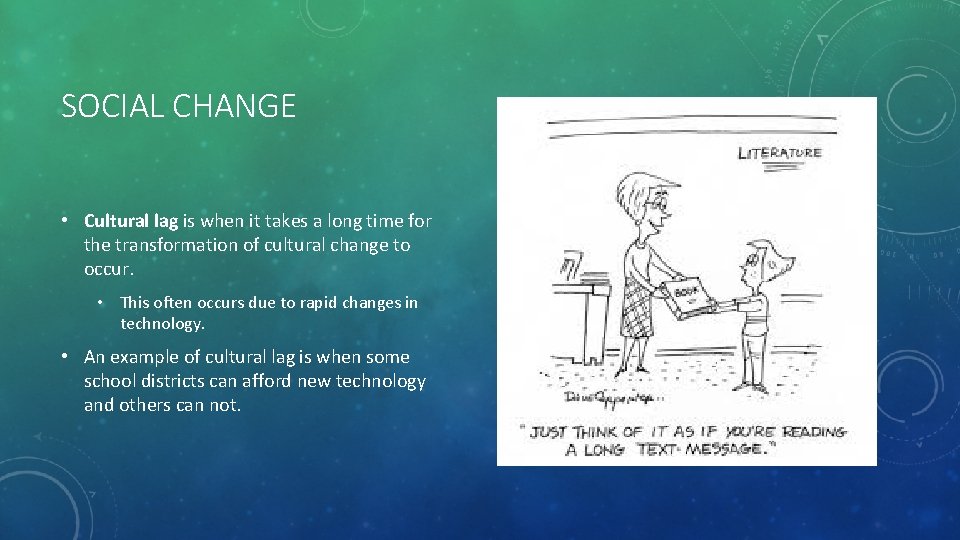
SOCIAL CHANGE • Cultural lag is when it takes a long time for the transformation of cultural change to occur. • This often occurs due to rapid changes in technology. • An example of cultural lag is when some school districts can afford new technology and others can not.
SOCIAL CHANGE Vested interests • A person who is satisfied with the status quo will likely resist change. • People will resist change if it will threaten their own security/standard of living. • In other words they have a vested interest to protect. • Example: • Resisting technology because it may reduce jobs