
Cultural Conflict Ethnicities and Religion A World Divided
- Slides: 11
Cultural Conflict Ethnicities and Religion
A World Divided By Culture? • We have already identified the division of the world into: • • More and less developed nations Physical regions (climate, relief, vegetation, water) Settlements (populations and distribution) Nations (languages, ethnic groups, politics, boundaries) • Our concern is that now, human divisions derive from cultural differences. • These are often more difficult to address than any physical barrier
Diversity and Conflict • The world we live in today is one of tremendous cultural diversity – But, it is also one of increasing interaction between cultures • As a result, many traditional groups are struggling to protect their established ways of life* against foreign influences (nativism) – *Language, religion, ethnicity, traditions etc. • Often this “protection” leads to conflict - Examples?
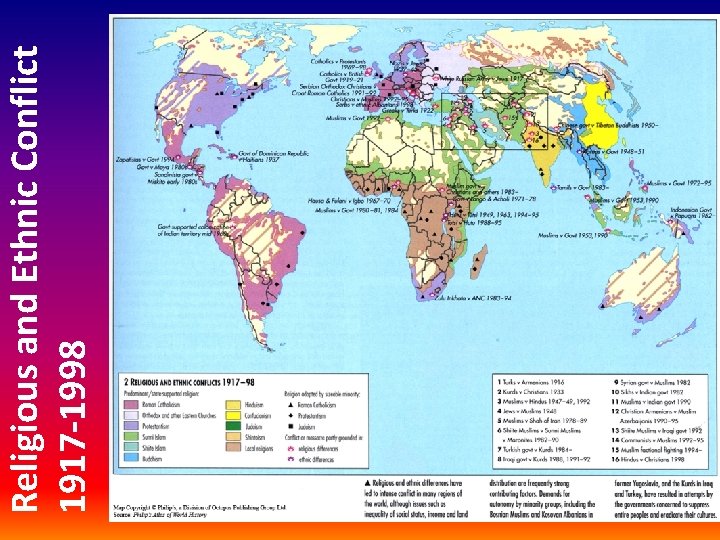
Religious and Ethnic Conflict 1917 -1998
Religion and Cultural Identity • Religion is a key culture trait that binds many societies together and gives meaning to people’s lives • It provides identity and connection to both people and a particular place • Religious differences are a key component of many conflicts around the world
3 Main Types of Religions • Ethnic Religions – One ethnic group – Have not spread into other cultures – Beliefs, legends, and customs shape these religions – Do not seek people to convert to their beliefs – Practice as a part of their ethnic heritage – Hinduism (India) – largest ethnic religion – Others – Confucianism, Judaism, Shintoism, Taoism
3 Main Types of Religions • Animist Religions – Believe in the presence of spirits and forces of nature – Essential part of these religions is Polytheism (belief in many gods) – Common in many traditional societies
3 Main Types of Religions • Universalizing Religions – Seek followers all over the world (spread/rapid growth) – Half of the world’s people follow these religions – Examples – Christianity, Islam, Roman Catholic, Protestant, Othodox – Places of Worship (Mosques, Hajj/Mecca, Temples, Churches, Synagogues etc. ) – Monotheism (One God) – Missionaries – help to spread religion
Religion and Conflict • Humans tend to identify with a specific religion – This has given rise to many military conflicts: • Medieval Crusades, Religious wars (Pakistan: Muslim-Hindu, Lebanon: Christian-Muslim, N. Ireland: Catholic-Protestant) • Religion is more capable than language of resisting external influences – North American experiences of immigration suggest that religion is often the most lasting feature of a culture • Reasons for global religious decline: – Development of modern technology/science has caused a lot of people to question the beliefs of traditional religions (also leads to conflicts between generations)
Religious Landscapes Religion and landscape are often interwoven for 3 reasons: 1. Beliefs about nature and the human environment are integral parts of many religions - Human use or dominance of the physical landscape - Significant places or physical features e. g. The Vatican, Mount Sinai 2. Religion often influences land use - When different groups value similar places for example, Jerusalem, where sites are regarded as sacred by Judaism, Islam and Christianity, the result is often conflict. - This can not only harm society in general, but can impact the economy 3. Many religious identities are displayed on the landscape - Hindu temples, Islamic mosques, Christian churches, Catholic Cathedrals, Sacred Structures (Tourism), burial sites etc. *sequent occupance
Religious Landscapes: Hutterites and Doukhobors in the Canadian West 1. What features do we find on a Mormon landscape? 2. Why was the Mormon landscape created? 3. Why is the religion of the Hutterites and Doukhobors not very evident? 4. Why did the Hutterites come to North America? 5. What kind of landscape did the Hutterites create? 6. Why did the Doukhobors come to Canada? 7. Describe the landscape the Doukhobors created. 8. Describe the religious landscape of Cambridge, Ontario.