
Cultural Competence Can it be Taught California Cadet
Cultural Competence: Can it be Taught? “California Cadet Corps members have an obligation to set an example of cultural competence in the schools where cadet programs exist. We must be shining examples of cultural competence. ” Lieutenant Colonel Mark Ryan, Ph. D. at the 2002 Commandant’s Conference, Sacramento, CA CACC Training Aid 17 -T-3 Last Modified 6 Jan 06
Overview § What is Cultural Competence? – Culture vs. Race/Ethnicity – Competence vs. Sensitivity – Stages of Cultural Competence 2
Keynote Overview § Why is it Important? – Increased Ethnic Diversity; – Ethnic Disparities in Schools; – Cadets’ Background Different From others 3

Keynote Overview § How to Achieve it? – Organizational Transformation – Personal Transformation 4
What is Cultural Competence? Cultural Competence • A set of congruent practices, skills, attitudes, policies and structures, which come together in a system, agency, or among professionals, which enable that system, agency or professionals to work effectively in cross-cultural situations. Cross, T. L. , Bazron, B. J. , Dennis, K. W. , Isaac, M. R. (1999) 5
What is Cultural Competence? Cultural Competence – Congruence across aspects of school life; – Aspects include: • Practices, skills, attitudes (Individual); • Practices, policies, structures (Organization) 6
Culture vs. Race/Ethnicity Culture –Shared values, beliefs, traditions, norms, customs, folklore, art, history of a group of people –A foundation – “grounds” you –Passed on from generation to generation; 7
Culture vs. Race/Ethnicity Culture –Dynamic & evolving; –Shapes attitudes & values; –Shapes styles and modes of communication; –Shapes notions about education; –Shapes school behavior. 8
Culture vs. Race/Ethnicity Race –Historically ascribed to groups of individuals categorized as biologically distinct. –Modern Times – “race” is a social construction –Physical, behavioral and cultural differences incorrectly ascribed to race; 9

Culture vs. Race/Ethnicity –A subgroup that shares common ancestry, geography, history, language or culture; 10
Sensitivity vs. Competence Cultural Sensitivity – Heightened awareness of cultural differences – Increased ability to interpret and respond to non-verbal or cultural cues – Willingness and ability to adapt behavior 11

Sensitivity vs. Competence Cultural Competence – Incorporate plans, policies & practices to respond to differences – Cultural sensitivity is necessary but insufficient for achieving competence 12

Stages of Cultural Competence Cultural Proficiency Cultural Competence Cultural Pre. Competence Cultural Blindness Cultural Incapacity Cultural Destructiveness 13
Stages of Cultural Competence – Destructiveness -- actively working to destroy or diminish well-being – Incapacity -- not actively seeking to destroy, but not actively working to improve well-being – Blindness -- unbiased treatment is the most effective treatment 14
Stages of Cultural Competence – Pre-Competence -- Belief, desire & commitment, not clear on how to move forward – Competence -- Belief, desire & commitment + structure, systems & policies in place – Proficiency -- Competence + Vocal advocates for societal change 15

Why is Cultural Competence Important? – Ethnic Disparities in Educational access • Dropout and failure rates higher among racial/ethnic subgroups • Some improvements – gains modest and uneven 16
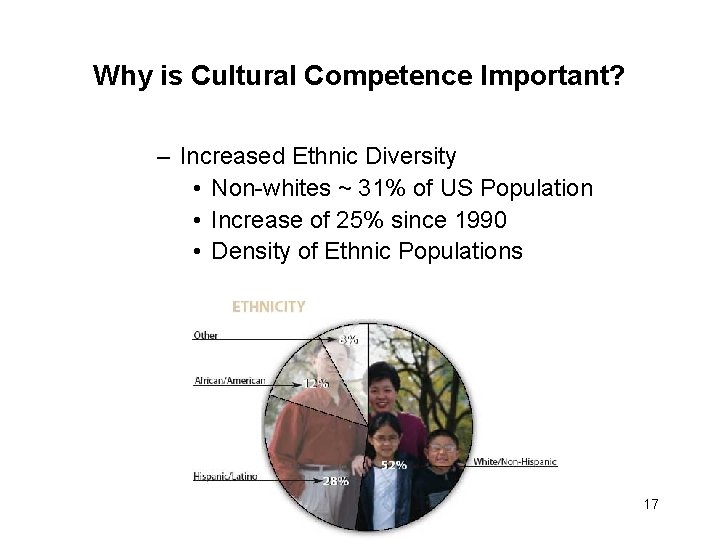
Why is Cultural Competence Important? – Increased Ethnic Diversity • Non-whites ~ 31% of US Population • Increase of 25% since 1990 • Density of Ethnic Populations 17
Achieving Cultural Competence • Practices of Successful Organizations: – Define Culture Broadly • Beyond ethnicity, heritage, language • Shared attributes (gender, sexual orientation) • Shared life experiences (violence, homelessness) 18
Achieving Cultural Competence • Practices of Successful Organizations: – Value cadet’s cultural beliefs • Genuine concern and respect • Ability to learn about needs and challenges of community • Willing to understand cadets’ life experiences 19
Achieving Cultural Competence • Practices of Successful Organizations: – Recognize Communication is Complex • Communication is more than shared language – Language differs across cultures – Linguistic variation within cultures – Cultural variation within language – Variation in literacy for all groups 20
Achieving Cultural Competence § Personal Transformation – Know and Understand Culture (broadly) – Value Diversity – Seek Opportunities to Experience Culture 21
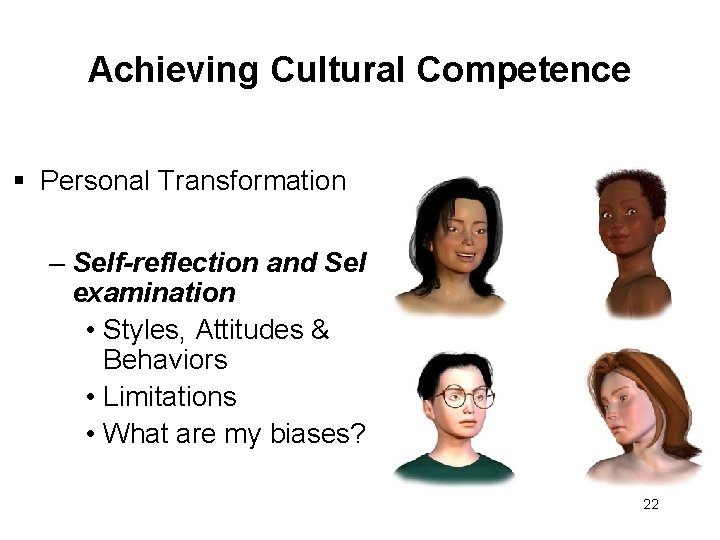
Achieving Cultural Competence § Personal Transformation – Self-reflection and Selfexamination • Styles, Attitudes & Behaviors • Limitations • What are my biases? 22
- Slides: 22