
Cultural and translation challenges in assessing health literacy
- Slides: 15
Cultural and translation challenges in assessing health literacy in four language groups: The Rx. HL study Susan J. Shaw, Molly Totman, Dina Gavrilyuk, Josephine Korchmaros, Cristina Huebner Torres, Jeannie Lee
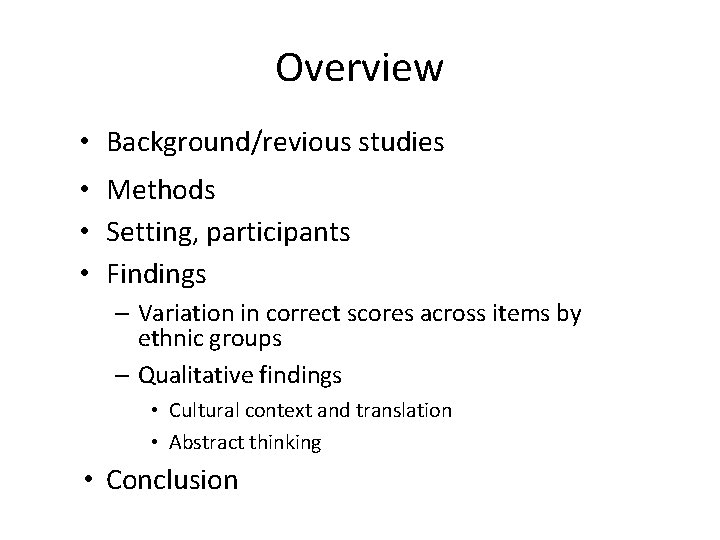
Overview • Background/revious studies • Methods • Setting, participants • Findings – Variation in correct scores across items by ethnic groups – Qualitative findings • Cultural context and translation • Abstract thinking • Conclusion
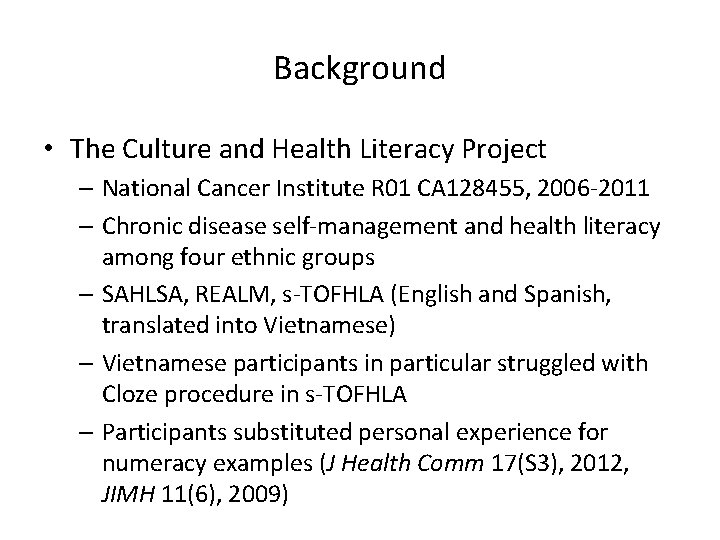
Background • The Culture and Health Literacy Project – National Cancer Institute R 01 CA 128455, 2006 -2011 – Chronic disease self-management and health literacy among four ethnic groups – SAHLSA, REALM, s-TOFHLA (English and Spanish, translated into Vietnamese) – Vietnamese participants in particular struggled with Cloze procedure in s-TOFHLA – Participants substituted personal experience for numeracy examples (J Health Comm 17(S 3), 2012, JIMH 11(6), 2009)
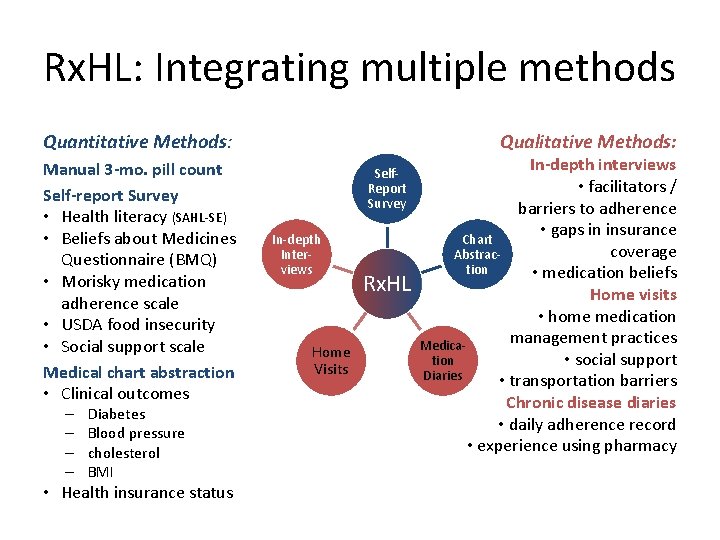
Rx. HL: Integrating multiple methods Quantitative Methods: Manual 3 -mo. pill count Self-report Survey • Health literacy (SAHL-SE) • Beliefs about Medicines Questionnaire (BMQ) • Morisky medication adherence scale • USDA food insecurity • Social support scale Medical chart abstraction • Clinical outcomes – – Diabetes Blood pressure cholesterol BMI • Health insurance status Qualitative Methods: Self. Report Survey In-depth Interviews Home Visits Rx. HL In-depth interviews • facilitators / barriers to adherence • gaps in insurance Chart coverage Abstraction • medication beliefs Home visits • home medication management practices Medica • social support tion Diaries • transportation barriers Chronic disease diaries • daily adherence record • experience using pharmacy
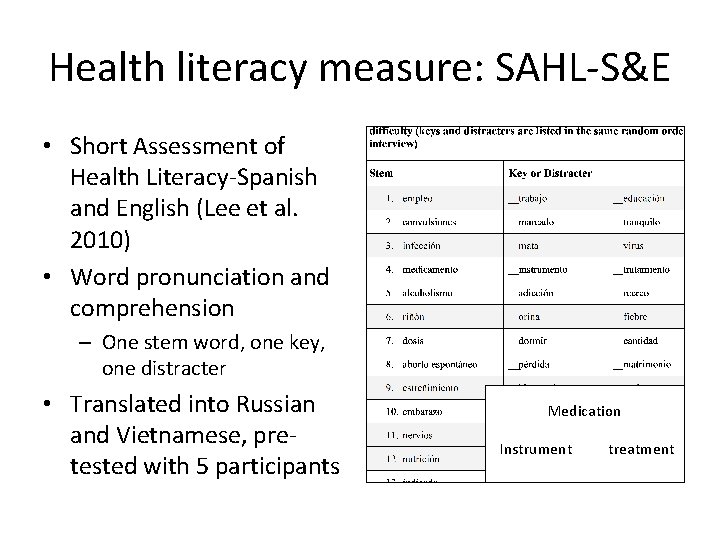
Health literacy measure: SAHL-S&E • Short Assessment of Health Literacy-Spanish and English (Lee et al. 2010) • Word pronunciation and comprehension – One stem word, one key, one distracter • Translated into Russian and Vietnamese, pretested with 5 participants Medication Instrument treatment
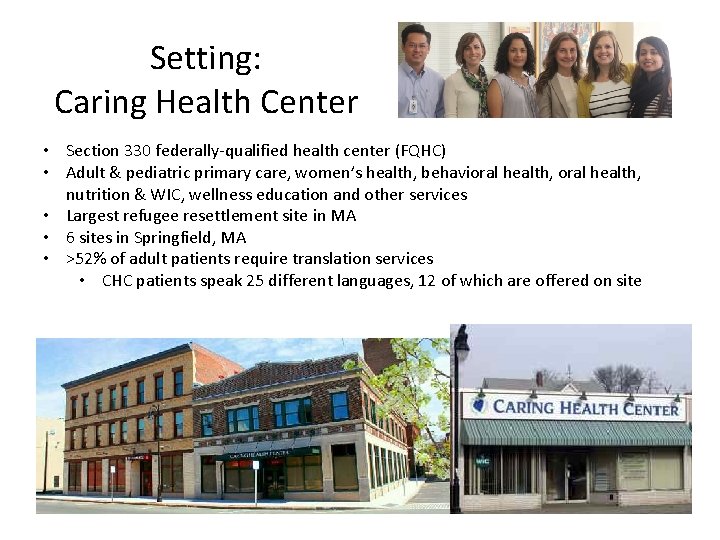
Setting: Caring Health Center • Section 330 federally-qualified health center (FQHC) • Adult & pediatric primary care, women’s health, behavioral health, nutrition & WIC, wellness education and other services • Largest refugee resettlement site in MA • 6 sites in Springfield, MA • >52% of adult patients require translation services • CHC patients speak 25 different languages, 12 of which are offered on site
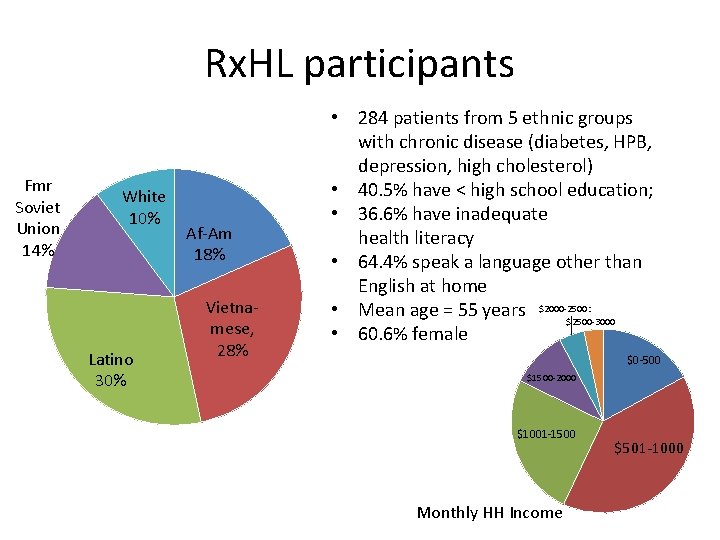
Rx. HL participants Fmr Soviet Union 14% White 10% Latino 30% Af-Am 18% Vietnamese, 28% • 284 patients from 5 ethnic groups with chronic disease (diabetes, HPB, depression, high cholesterol) • 40. 5% have < high school education; • 36. 6% have inadequate health literacy • 64. 4% speak a language other than English at home • Mean age = 55 years $2000 -2500: $2500 -3000 • 60. 6% female $0 -500 $1500 -2000 $1001 -1500 Monthly HH Income $501 -1000
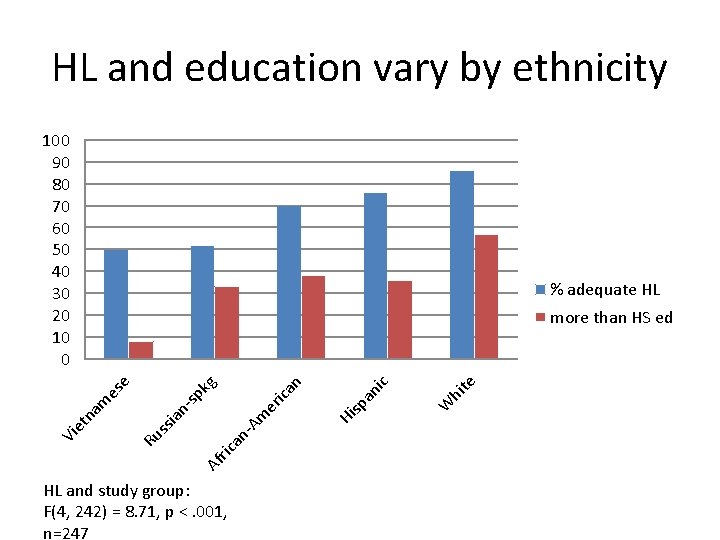
HL and education vary by ethnicity 100 90 80 70 60 50 40 30 20 10 0 % adequate HL te hi W c ni sp a -A m ric an Af HL and study group: F(4, 242) = 8. 71, p <. 001, n=247 Hi n ica er sp nss ia Ru Vi et na m es e kg more than HS ed
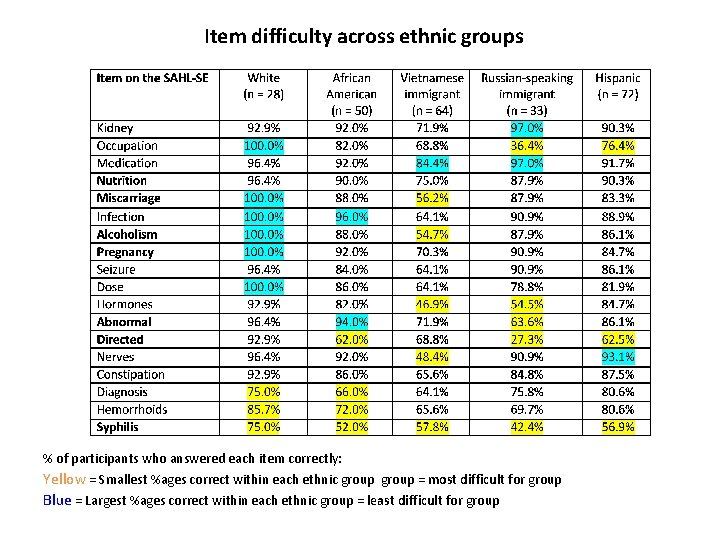
Item difficulty across ethnic groups % of participants who answered each item correctly: Yellow = Smallest %ages correct within each ethnic group = most difficult for group Blue = Largest %ages correct within each ethnic group = least difficult for group
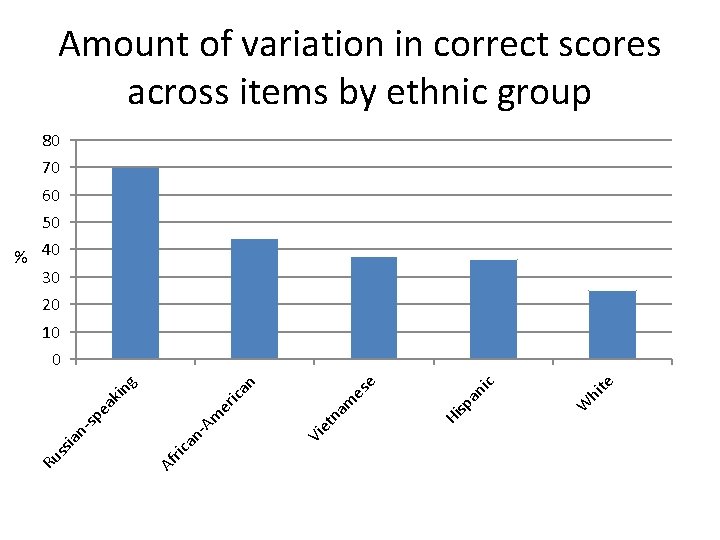
Amount of variation in correct scores across items by ethnic group 80 70 60 50 % 40 30 20 10 te hi W c ni sp a Hi e m es na et Vi -A m ric an Af Ru ss ia n- sp e er ica ak in n g 0
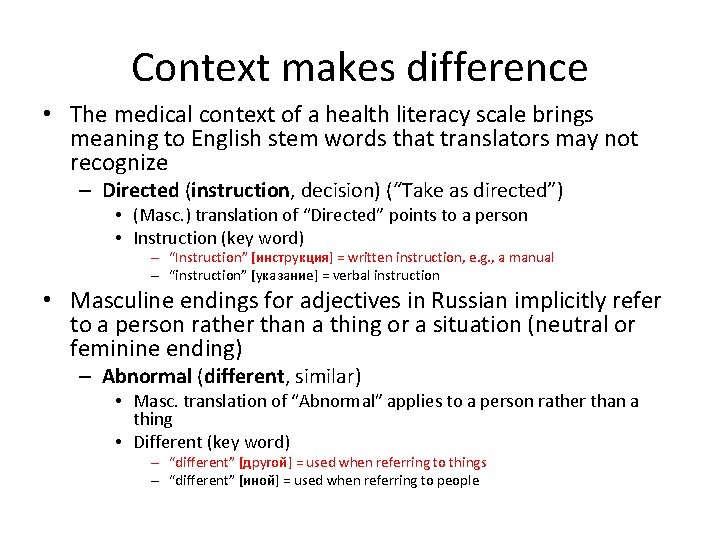
Context makes difference • The medical context of a health literacy scale brings meaning to English stem words that translators may not recognize – Directed (instruction, decision) (“Take as directed”) • (Masc. ) translation of “Directed” points to a person • Instruction (key word) – “Instruction” [инструкция] = written instruction, e. g. , a manual – “instruction” [указание] = verbal instruction • Masculine endings for adjectives in Russian implicitly refer to a person rather than a thing or a situation (neutral or feminine ending) – Abnormal (different, similar) • Masc. translation of “Abnormal” applies to a person rather than a thing • Different (key word) – “different” [другой] = used when referring to things – “different” [иной] = used when referring to people
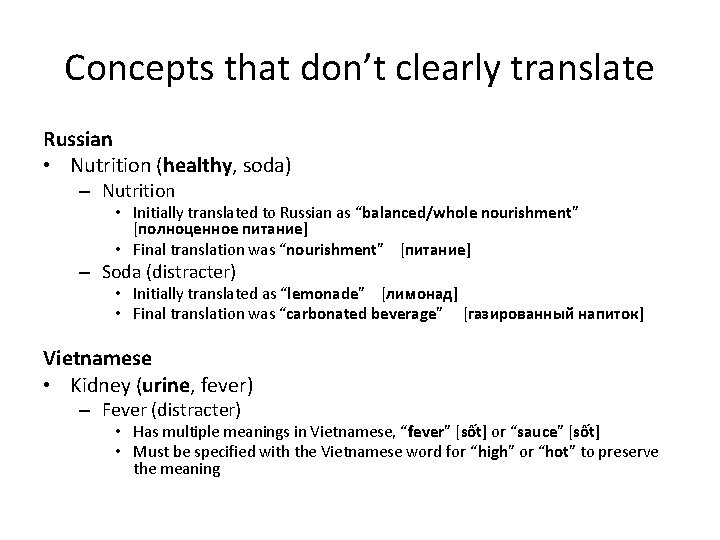
Concepts that don’t clearly translate Russian • Nutrition (healthy, soda) – Nutrition • Initially translated to Russian as “balanced/whole nourishment” [полноценное питание] • Final translation was “nourishment” [питание] – Soda (distracter) • Initially translated as “lemonade” [лимонад] • Final translation was “carbonated beverage” [газированный напиток] Vietnamese • Kidney (urine, fever) – Fever (distracter) • Has multiple meanings in Vietnamese, “fever” [sốt] or “sauce” [sốt] • Must be specified with the Vietnamese word for “high” or “hot” to preserve the meaning
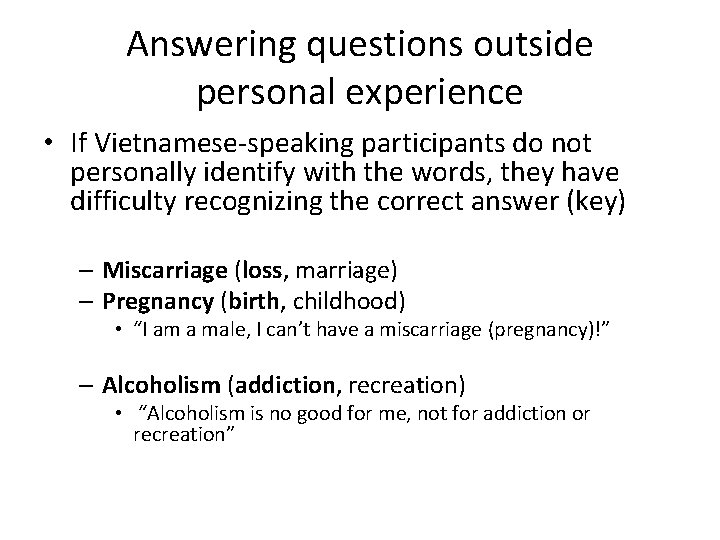
Answering questions outside personal experience • If Vietnamese-speaking participants do not personally identify with the words, they have difficulty recognizing the correct answer (key) – Miscarriage (loss, marriage) – Pregnancy (birth, childhood) • “I am a male, I can’t have a miscarriage (pregnancy)!” – Alcoholism (addiction, recreation) • “Alcoholism is no good for me, not for addiction or recreation”
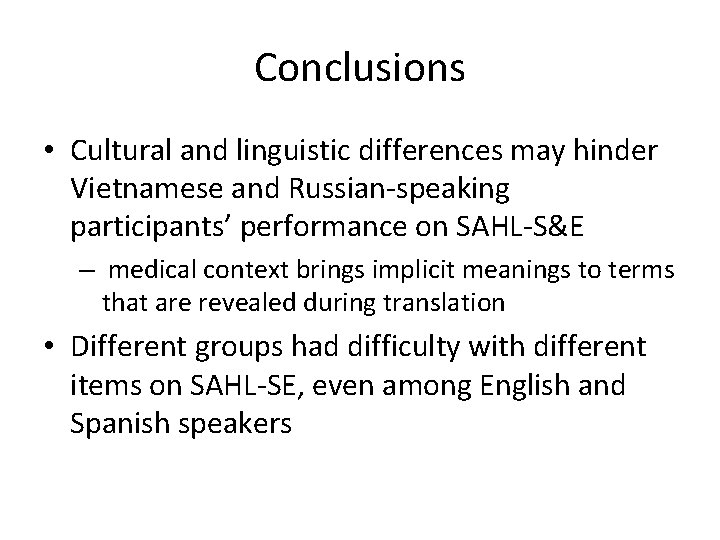
Conclusions • Cultural and linguistic differences may hinder Vietnamese and Russian-speaking participants’ performance on SAHL-S&E – medical context brings implicit meanings to terms that are revealed during translation • Different groups had difficulty with different items on SAHL-SE, even among English and Spanish speakers
Acknowledgements Rx. HL team University of Arizona Caring Health Center • Josephine Korchmaros, Ph. D, Southwest Institute for Research on Women • Jeannie K. Lee, Pharm. D, School of Pharmacy • Amanda Hilton, School of Anthropology • Will Robertson, MA, School of Anthropology • Cristina Huebner Torres, MA, ABD, VP for Research • Molly Totman, MPH, Project Coordinator • Sabina Dakhal, MPH, Ethnographer • Interviewers: Khanh Nguyen, Dina Gavrilyuk, Yoeli Pachecos NHLBI: This research was supported by grant #1 R 01 HL 120907 -01.