
Cultural Agility Global Coops Presenter Jon Andrew Senior
Cultural Agility & Global Co-ops Presenter: Jon Andrew, Senior Co-op Coordinator, International Affairs, CSSH
Agenda for today 1. What is Cultural Agility and why is it important for Co-op? 2. Breaking down our cultural assumptions 3. Cultural Agility Resources: Goin Global & Globe. Smart

Student Co-op Experience This Photo by Unknown Author is licensed under CC BY-SA Sophie’s first co-op with a nonprofit in Buenos Aires, Argentina This Photo by Unknown Author is licensed under CC BY-SA
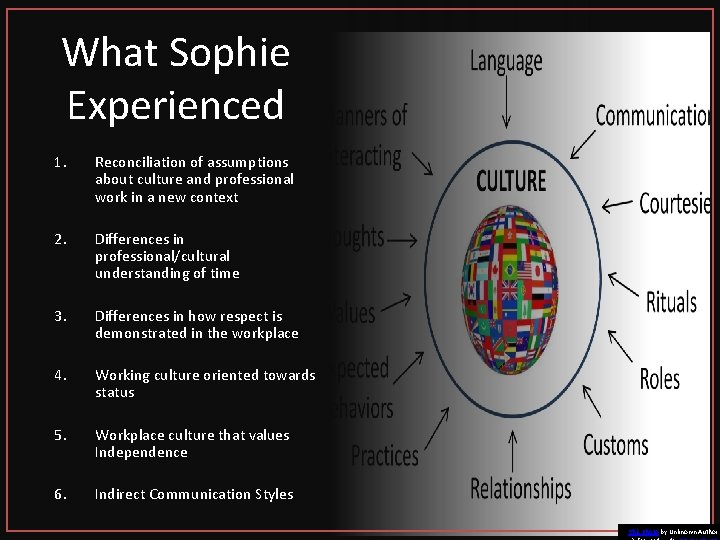
What Sophie Experienced 1. Reconciliation of assumptions about culture and professional work in a new context 2. Differences in professional/cultural understanding of time 3. Differences in how respect is demonstrated in the workplace 4. Working culture oriented towards status 5. Workplace culture that values Independence 6. Indirect Communication Styles This Photo by Unknown Author

Class Poll: What is Cultural Agility? List of attributes:

Cultural Agility-Megacompetency Culturally agile professionals are able to leverage Three Different Cultural Responses: Practicing Cultural Agility: • Read • Assess • Respond Cultural Adaptation When Adapting to norms of context is Cultural Minimization When one’s cultural norms need to supersede others expectations Cultural Integration When finding a compromise is most important Caligiuri, P. (2012). Cultural Agility. San Francisco: Jossey-Bass.
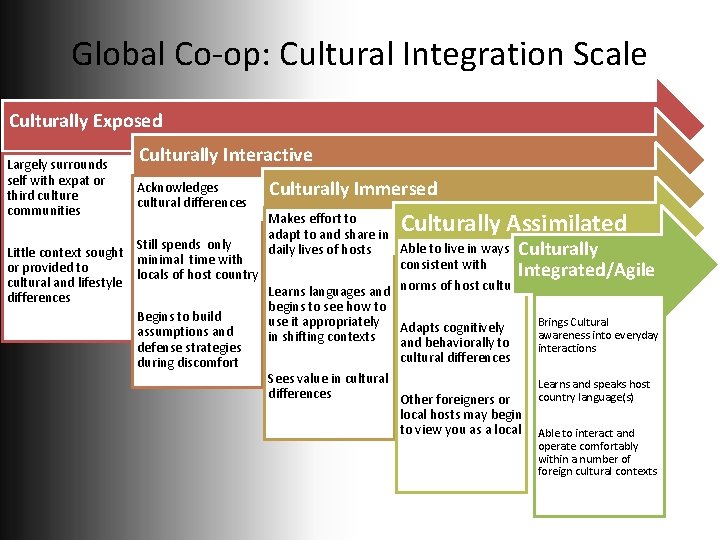
Global Co-op: Cultural Integration Scale Culturally Exposed Largely surrounds self with expat or third culture communities Culturally Interactive Acknowledges cultural differences Still spends only Little context sought minimal time with or provided to locals of host country cultural and lifestyle differences Begins to build assumptions and defense strategies during discomfort Culturally Immersed Culturally Assimilated Makes effort to adapt to and share in Able to live in ways daily lives of hosts consistent with Culturally Integrated/Agile Learns languages and norms of host culture begins to see how to use it appropriately Adapts cognitively in shifting contexts and behaviorally to cultural differences Sees value in cultural differences Other foreigners or local hosts may begin to view you as a local Brings Cultural awareness into everyday interactions Learns and speaks host country language(s) Able to interact and operate comfortably within a number of foreign cultural contexts
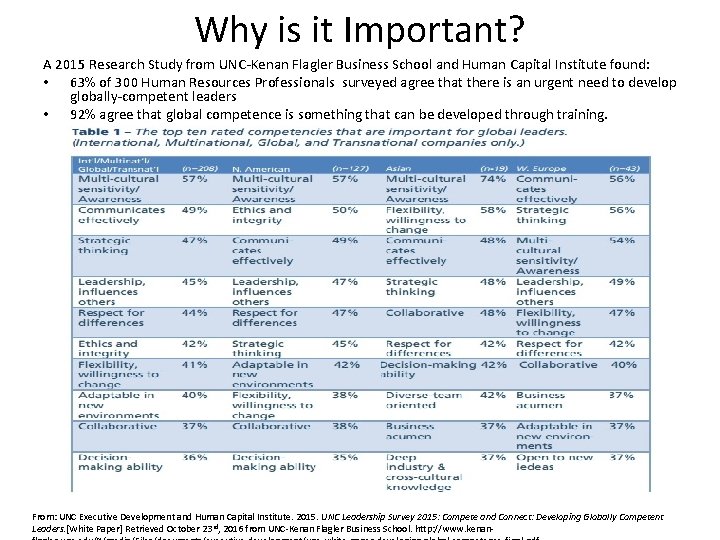
Why is it Important? A 2015 Research Study from UNC-Kenan Flagler Business School and Human Capital Institute found: • 63% of 300 Human Resources Professionals surveyed agree that there is an urgent need to develop globally-competent leaders • 92% agree that global competence is something that can be developed through training. From: UNC Executive Development and Human Capital Institute. 2015. UNC Leadership Survey 2015: Compete and Connect: Developing Globally Competent Leaders. [White Paper] Retrieved October 23 rd, 2016 from UNC-Kenan Flagler Business School. http: //www. kenan-
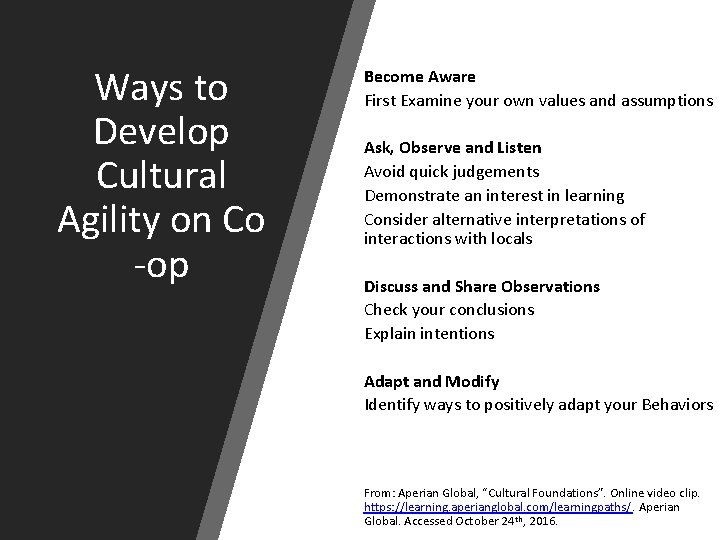
Ways to Develop Cultural Agility on Co -op Become Aware First Examine your own values and assumptions Ask, Observe and Listen Avoid quick judgements Demonstrate an interest in learning Consider alternative interpretations of interactions with locals Discuss and Share Observations Check your conclusions Explain intentions Adapt and Modify Identify ways to positively adapt your Behaviors From: Aperian Global, “Cultural Foundations”. Online video clip. https: //learning. aperianglobal. com/learningpaths/. Aperian Global. Accessed October 24 th, 2016.
Starts with breaking down Assumptions 1. Begin by taking a minute to write down the assumptions you think others may have about you when you are in a different country? 2. How will you overcome these assumptions? What steps can you take to ensure others understand you?
Power of Social Emotional Learning Co-op Employer: Better World Ed Mission: We create Learning Journeys: Kits of videos, short stories, and lesson plans about unique humans from all over Earth. Wordless Videos that hook us on curiosity before judgment. Written Stories that weave empathy building into academics. Lesson Plans that keep learning joyful and inclusive. Social Emotional Learning Journeys help you(th) to become compassionate critical thinkers. To grow awareness. To confront bias. To seek diverse perspectives. To be mindful leaders reweaving a peaceful, equitable, and just world.
Begin by writing down what words come to mind when you think of a banana farmer in Ecuador. What does this person look like, what is their life like? Wordless Video Watch video “I am Norma” and make notes of impressions and feelings/emotions you have when observing this person’s life and community. https: //vimeo. com/betterworlded
Note Changes in understanding and your emotional state (Review the first words you wrote down) What has changed in the last several minutes about your assumptions about this person? What feelings arose for you as you watched this video?
Curiosity: What Do you want to know more about? What lingering questions do you have about this individual? What steps would you take to learn more about them and their cultural perspective? How would you adjust to working professionally with this person?
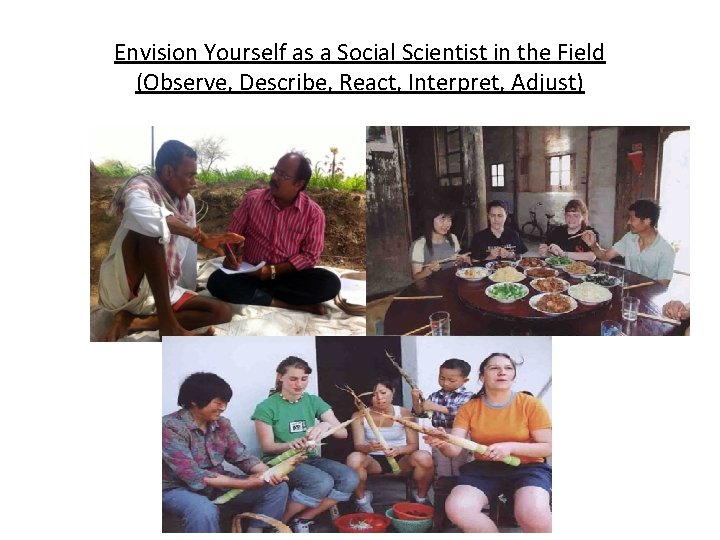
Envision Yourself as a Social Scientist in the Field (Observe, Describe, React, Interpret, Adjust)

General Starting Observations for Cultivating Cultural Awareness • Sample Observation questions to answer Time (fluid or controlled) Dress (Conservative or Liberal) Food and dining etiquette (Social and Nutritional considerations) • Does Public Transportation run on time? • Are public clocks accurate? • How is punctuality treated in the workplace? • How long are the work breaks? • Sample Observation questions to answer • How conservative or liberal is dress on the local citizens in public and workplace versus in private homes? • What differences are observed based on gender norms? • Sample Observation questions to answer • How are utensils used and which hands are used? • How is food presented and what manners do locals show in receiving food? • How much food is polite to consume? • How do locals go about refusing dishes or meals to not seem rude? • Sample Observation questions to answer Personal Space (Close or distanced) • What are the differences between formal and informal interactions? • How is personal space treated between the cultural locals? • How comfortable are you with the space provided during conversations
Goin Global-Online Professional Resources for those interested in international work http: //www. goinglobal. com/ • Globe. Smart- Supports crosscultural understanding between those working across borders with a focus on global learning and inclusivity Sign up using your Northeastern email https: //globesmart. aperianglobal. co m/ • Northeastern Cultural Learning Resources:
Globe. Smart Cultural Dimensions: Professional Strategies for Global Co-op
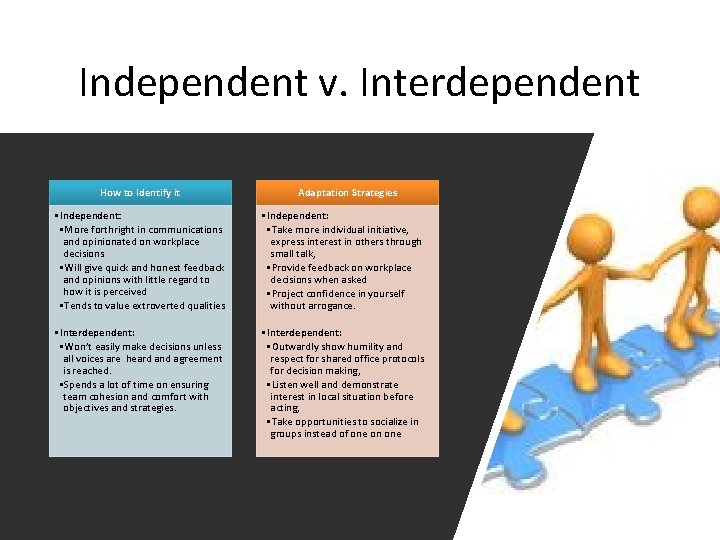
Independent v. Interdependent How to Identify it Adaptation Strategies • Independent: • More forthright in communications and opinionated on workplace decisions • Will give quick and honest feedback and opinions with little regard to how it is perceived • Tends to value extroverted qualities • Independent: • Take more individual initiative, express interest in others through small talk, • Provide feedback on workplace decisions when asked • Project confidence in yourself without arrogance. • Interdependent: • Won’t easily make decisions unless all voices are heard and agreement is reached. • Spends a lot of time on ensuring team cohesion and comfort with objectives and strategies. • Interdependent: • Outwardly show humility and respect for shared office protocols for decision making, • Listen well and demonstrate interest in local situation before acting, • Take opportunities to socialize in groups instead of one on one
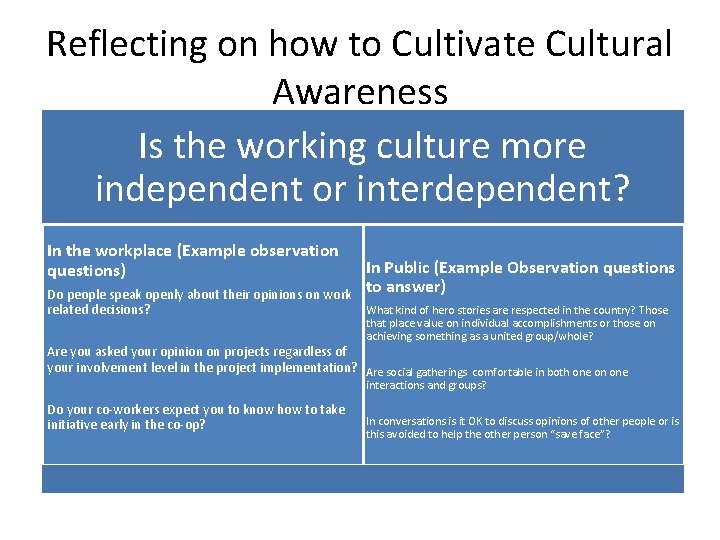
Reflecting on how to Cultivate Cultural Awareness Is the working culture more independent or interdependent? In the workplace (Example observation questions) Do people speak openly about their opinions on work related decisions? In Public (Example Observation questions to answer) What kind of hero stories are respected in the country? Those that place value on individual accomplishments or those on achieving something as a united group/whole? Are you asked your opinion on projects regardless of your involvement level in the project implementation? Are social gatherings comfortable in both one on one interactions and groups? Do your co-workers expect you to know how to take initiative early in the co-op? In conversations is it OK to discuss opinions of other people or is this avoided to help the other person “save face”?
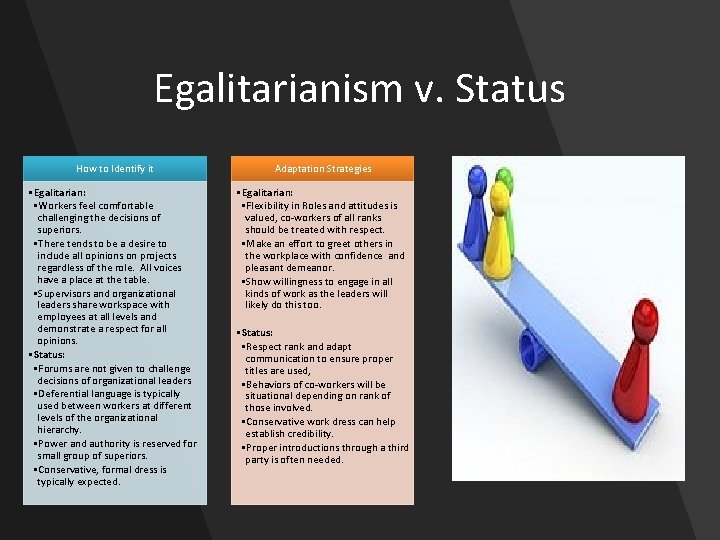
Egalitarianism v. Status How to Identify it Adaptation Strategies • Egalitarian: • Workers feel comfortable challenging the decisions of superiors. • There tends to be a desire to include all opinions on projects regardless of the role. All voices have a place at the table. • Supervisors and organizational leaders share workspace with employees at all levels and demonstrate a respect for all opinions. • Status: • Forums are not given to challenge decisions of organizational leaders • Deferential language is typically used between workers at different levels of the organizational hierarchy. • Power and authority is reserved for small group of superiors. • Conservative, formal dress is typically expected. • Egalitarian: • Flexibility in Roles and attitudes is valued, co-workers of all ranks should be treated with respect. • Make an effort to greet others in the workplace with confidence and pleasant demeanor. • Show willingness to engage in all kinds of work as the leaders will likely do this too. • Status: • Respect rank and adapt communication to ensure proper titles are used, • Behaviors of co-workers will be situational depending on rank of those involved. • Conservative work dress can help establish credibility. • Proper introductions through a third party is often needed.
Reflecting on how to Cultivate Cultural Awareness Is the working culture hierarchical or egalitarian? In the workplace (Example Observation questions) • How are office spaces and nameplates assigned? In Public (Example Observation questions) • How do workers interact with their superiors in public establishments or large events? • How are titles used in the workplace, and how is respect • How do people from different socioeconomic backgrounds interact in public or in different to superiors demonstrated through communication neighborhoods? strategies? • How are meetings arranged? Who has permission to speak at meetings? • Are those dressed more formally afforded more respect? • When introductions are made how much formality is used and how are communication strategies used to demonstrate appropriate respect?
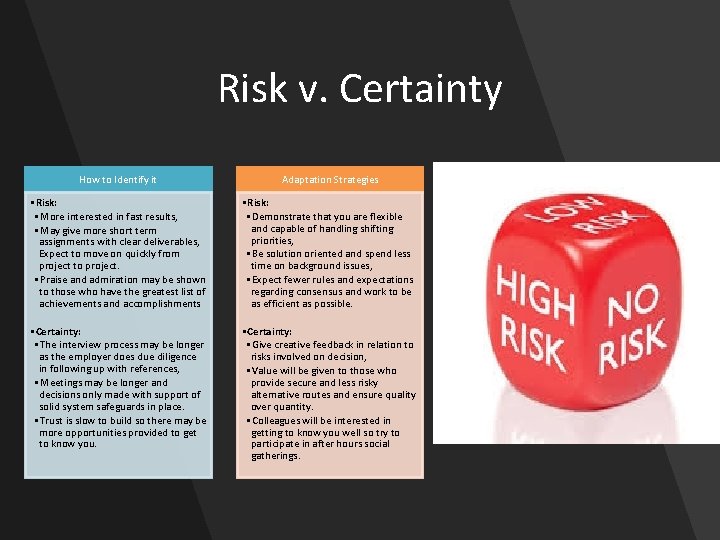
Risk v. Certainty How to Identify it Adaptation Strategies • Risk: • More interested in fast results, • May give more short term assignments with clear deliverables, Expect to move on quickly from project to project. • Praise and admiration may be shown to those who have the greatest list of achievements and accomplishments • Risk: • Demonstrate that you are flexible and capable of handling shifting priorities, • Be solution oriented and spend less time on background issues, • Expect fewer rules and expectations regarding consensus and work to be as efficient as possible. • Certainty: • The interview process may be longer as the employer does due diligence in following up with references, • Meetings may be longer and decisions only made with support of solid system safeguards in place. • Trust is slow to build so there may be more opportunities provided to get to know you. • Certainty: • Give creative feedback in relation to risks involved on decision, • Value will be given to those who provide secure and less risky alternative routes and ensure quality over quantity. • Colleagues will be interested in getting to know you well so try to participate in after hours social gatherings.
Reflecting on how to Cultivate Cultural Awareness Is risk or certainty valued by the working culture? In the workplace (Example Observation questions) • When you are trained is speed and efficiency on goal accomplishment on work tasks valued more heavily than process? • When giving projects do your supervisors spend a lot of time discussing the background and the context or on the deliverables? • What sort of co-workers are given the highest level of praise and what are they praised for? In Public (example observation questions) What kind of stories or myths are important to the society? Or what sort of TV shows are popular? Are the content of these based on morals related to high risk and rewards or on the journey/self discovery process? What qualities are generally valued in the political and business leaders? Is humility a shared value?
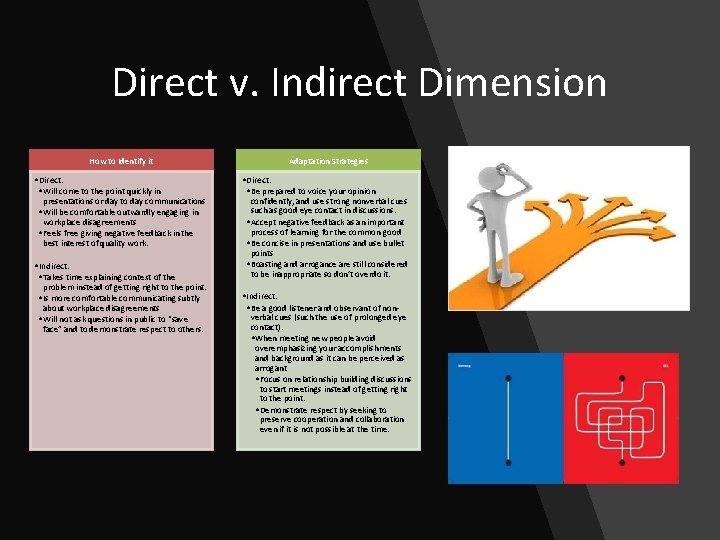
Direct v. Indirect Dimension How to Identify it • Direct: • Will come to the point quickly in presentations or day to day communications • Will be comfortable outwardly engaging in workplace disagreements • Feels free giving negative feedback in the best interest of quality work. • Indirect: • Takes time explaining context of the problem instead of getting right to the point. • Is more comfortable communicating subtly about workplace disagreements • Will not ask questions in public to “save face” and to demonstrate respect to others. Adaptation Strategies • Direct: • Be prepared to voice your opinion confidently, and use strong nonverbal cues such as good eye contact in discussions. • Accept negative feedback as an important process of learning for the common good • Be concise in presentations and use bullet points • Boasting and arrogance are still considered to be inappropriate so don’t overdo it. • Indirect: • Be a good listener and observant of non- verbal cues (such the use of prolonged eye contact). • When meeting new people avoid overemphasizing your accomplishments and background as it can be perceived as arrogant • Focus on relationship building discussions to start meetings instead of getting right to the point. • Demonstrate respect by seeking to preserve cooperation and collaboration even if it is not possible at the time.
Reflecting on how to Cultivate Cultural Awareness Is communication in the work culture more direct or indirect? In the workplace (Example Observation questions) In Public (Example Observation questions) Are presentations by co-workers concise and to the point? How is critical feedback delivered by those around you? Are subtleties used or is negative feedback given as openly as positive feedback. How are workplace disagreements handled? Is a lot of time spent on the context of a problem or is more time spent on ensuring a fast solution? How often do people seek to engage you in political discussions on the actions of the leaders of the country and how open are they with their opinions in these sorts of discussions? When extending or receiving invitations to social events how much context or explanation is expected regarding how to politely decline or accept the invite?
Task v. Relationship How to Identify it Adaptation Strategies • Task • Employer places high value for being on schedule with short term goals • Focus more on employees achievements as opposed to their relationships and contacts • Task • Prioritize your timeline for the accomplishment of short term goals • Get explicit clarification of what is expected for project deliverables • Ensure that work time is spent engaged in work more than socializing • Relationship • Employer places high value on taking time to get to know co-workers and clients • Taking longer to accomplish goals is OK as long as relationships are maintained. • Relationship • Take time to sit down and get to know your colleagues • Try not to get frustrated with the slow pace of progress on work tasks • Expect and learn to enjoy more social conversations at the beginning of work meetings (refreshments can often be included. ).
Reflecting on how to Cultivate Cultural Awareness Is the host culture workplace relationship or task oriented? In the workplace (Example Observation questions) In Public (Observation examples) • Are meetings begun with personal stories or do they jump right into a task? • Ask for a restaurant recommendation from the hotel/hostel employee. • Is the recommendation based on reviews or on personal experience? • Do they recommend things based on family connections? • How much emphasis is placed on ensuring co-workers feel comfortable with decisions?
Questions? This Photo by Unknown Author is licensed under CC BY
Cultural Agility Resources • www. internations. org – Networking club for global professionals • www. tmcorp. com • www. tmaworld. com • www. worldtradepress. com
- Slides: 30