
Cultivating Translation Skills in Intermediate and Advanced Latin
- Slides: 15
Cultivating Translation Skills in Intermediate and Advanced Latin Classes
Translation is a skill… A. separate from and inclusive of knowledge of grammar, forms, and syntax. B. separate from and inclusive of comprehension. C. that can be creative and artistic, but not on standardized tests. Literal translation shows a knowledge of A and B and is therefore a useful exercise.
Is literal translation a major objective for your class?
Caesar BG 4. 30 Quibus rebus cognitis, principes Britanniae, qui post proelium ad Caesarem convenerant, inter se conlocuti, cum et equites et naves et frumentum Romanis deesse intellegerent et paucitatem militum ex castrorum exiguitate cognoscerent, quae hoc erant etiam angustior quod sine impedimentis Caesar legiones transportaverat, optimum factu esse duxerunt rebellione facta frumento commeatuque nostros prohibere et rem in hiemem producere, quod his superatis aut reditu interclusis neminem postea belli inferendi causa in Britanniam transiturum confidebant.
Ablative Absolutes Translation driven by Comprehension
There is NO literal translation of an ablative absolute
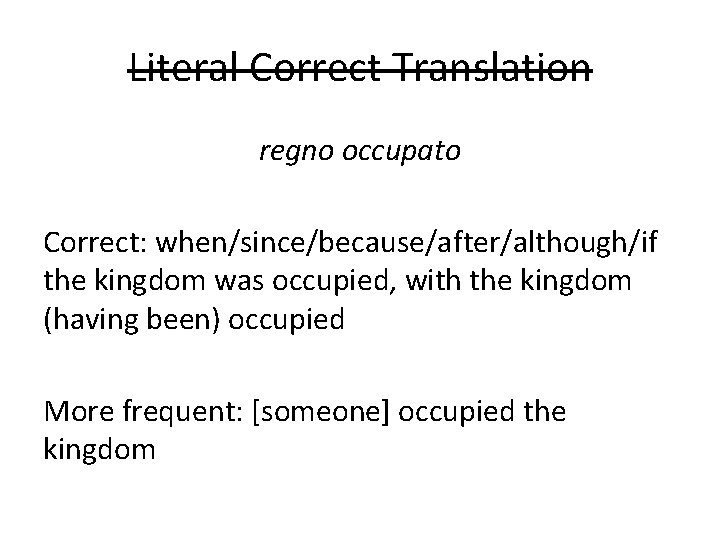
Literal Correct Translation regno occupato Correct: when/since/because/after/although/if the kingdom was occupied, with the kingdom (having been) occupied More frequent: [someone] occupied the kingdom
How We Teach the Ablative Absolute • Usually taught in the chapter on participles • Many possibilities are presented – active or passive participle – noun or pronoun in ablative – absolute without a participle • BUT… – passive participles are far more common – nouns are far more common – most include other words (prep. phrases, adverbs, noun modifiers)
Traditional Tricks • We may say to think of this as a “clause” – the participle is the “verb”, the (pro)noun is the “subject”; translation: “the noun having been verbed” “the x having been yed” • Marking up the text/separation from sentence – Put a box around ablatives absolute – Translate before rest of sentence
Teaching Through Understanding • Students are more likely to be able to translate ablative absolutes when they understand what they are talking about! • They may need to be taught later in the sequence
Stategy #1 English uses absolutes in a limited way That (being) said… God willing… All things considered… That being the case… Weather permitting…
Strategy #2 Explain with pictures
Strategy #3 Show commonality with cum clauses
Your strategies?
Jennifer Sheridan Moss: Jennifer. Sheridan. moss@wayne. edu File containing AP Caesar selections with all ablative absolutes marked: link