
Cultivating Connection by Caring Using Empathetic Marketing to
Cultivating Connection by Caring: Using Empathetic Marketing to Reach Distance Students and Ease Library Anxiety Carrie Girton, Miami University Hamilton girtonc@miamioh. edu
What is Empathy? the action of understanding, being aware of, being sensitive to, and vicariously experiencing the feelings, thoughts, and experience of another of either the past or present without having the feelings, thoughts, and experience fully communicated in an objectively explicit manner; also : the capacity for this 1
What is Empathetic Marketing? • It’s not about getting people to use your product. It’s about seeing a need and then saying “I have a product/service that will meet that need. ” 2 • “Too many companies create corporatecentric, rather than customer-centric, content. The former is about you; the latter is about what you do for your customer—a subtle yet critical shift. ” 3
What is Empathetic Marketing? “First and foremost, you have to reframe the way you see the people you serve—stop calling them your target market—or any name that turns them into a statistic or a bullseye. Instead, consider them to be people: the people you hope to serve, your stakeholders. That reframe alone opens your eyes and leads you into a different type of engagement with them. ” 4
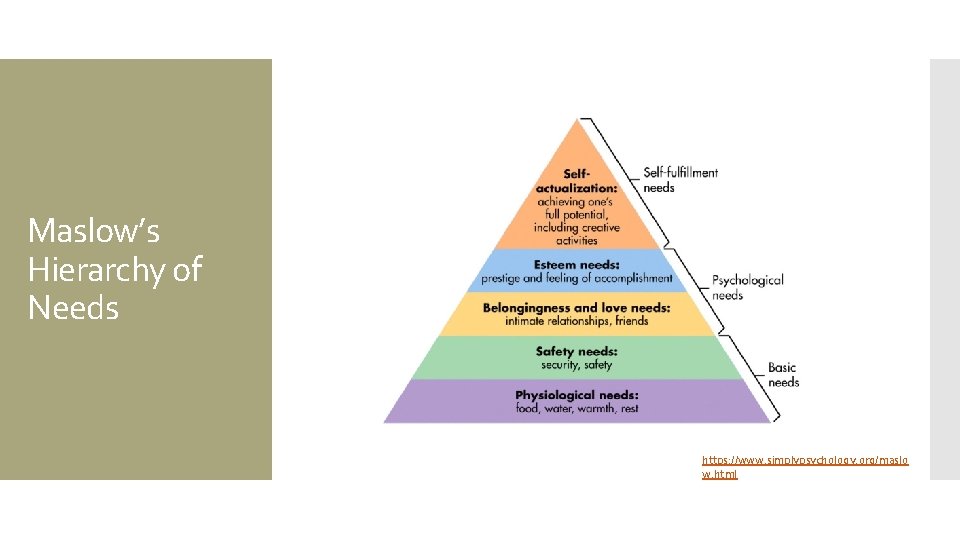
Maslow’s Hierarchy of Needs https: //www. simplypsychology. org/maslo w. html
Examples of Empathetic Marketing https: //www. youtube. com/playlist? list=PLBE Yn 8 q 4 ZI_7 ue. S 8 Z 8 QHB 40 v. F 0 x 6 yuh_c
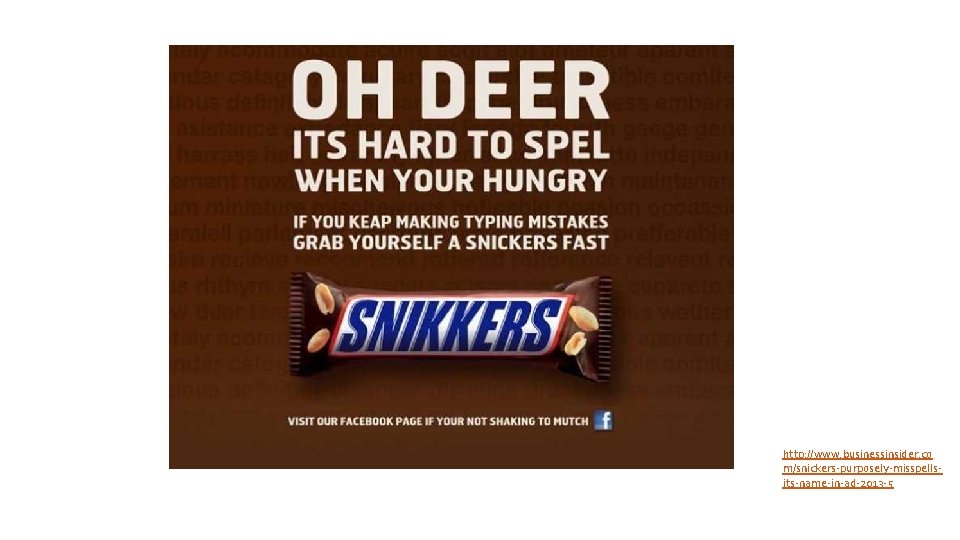
http: //www. businessinsider. co m/snickers-purposely-misspellsits-name-in-ad-2013 -5
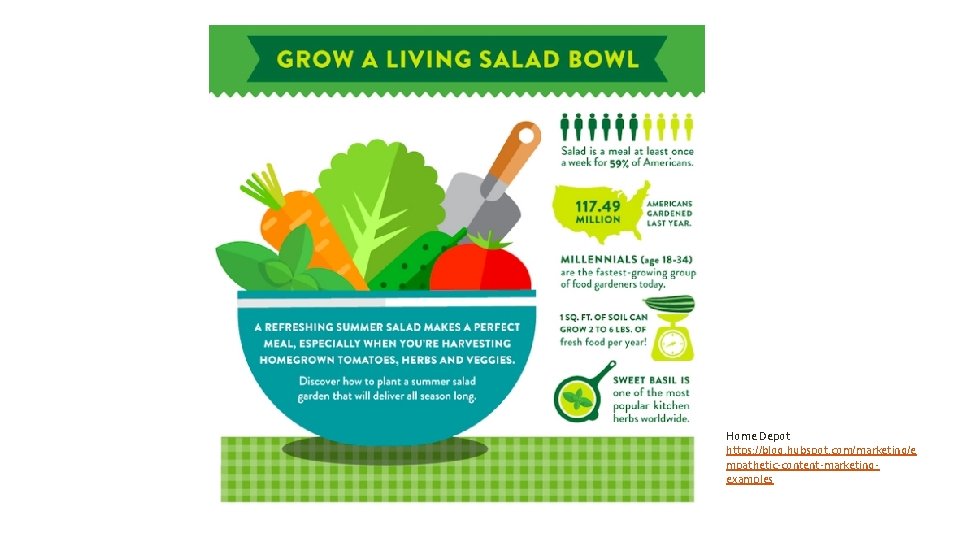
Home Depot https: //blog. hubspot. com/marketing/e mpathetic-content-marketingexamples
https: //www. youtube. com/watch? v=Y Pro. ZYu. MUNk
Meeting the Needs of Distance Students “While the standards of an information literate student can be seen within selfactualization, we must consider the varied and hierarchical needs of students. We cannot address information literacy in isolation. Therefore, in our instruction and daily interaction with students, we must also give attention to their more basic needs, for it is only after the fulfillment of those needs that an individual can focus on those skills required for information literacy. ” 5
• “…we feel some needs the most, such as Meeting the Needs of Distance Students security, when we’re deprived of them. When life is humming by smoothly, we don’t actively pay attention to some of our needs…. The fact that we ignore important needs, such as security, for the sake of other pursuits also creates opportunities for businesses that can anticipate consumers’ dormant needs and head them off before an audience is seriously deprived. ” 2 • “By answering questions, you are addressing specific pain points, demonstrating that you understand customers’ specific issues and concerns. ” 3
Meeting Needs Reduces Library Anxiety • “The literature indicates that acknowledging the anxiety and its legitimacy, and then providing successful experiences to counteract the anxiety is the most effective method for treatment. ” 7 • “…only a good instruction librarian convince them the library isn’t scary. ” 7
Library Anxiety “Students feel their own library-use skills are inadequate while the skills of other students are adequate Students believe the inadequacy is shameful and should be hidden Students think that the inadequacy would be revealed by asking questions so they chose not to ask any questions. ” 5
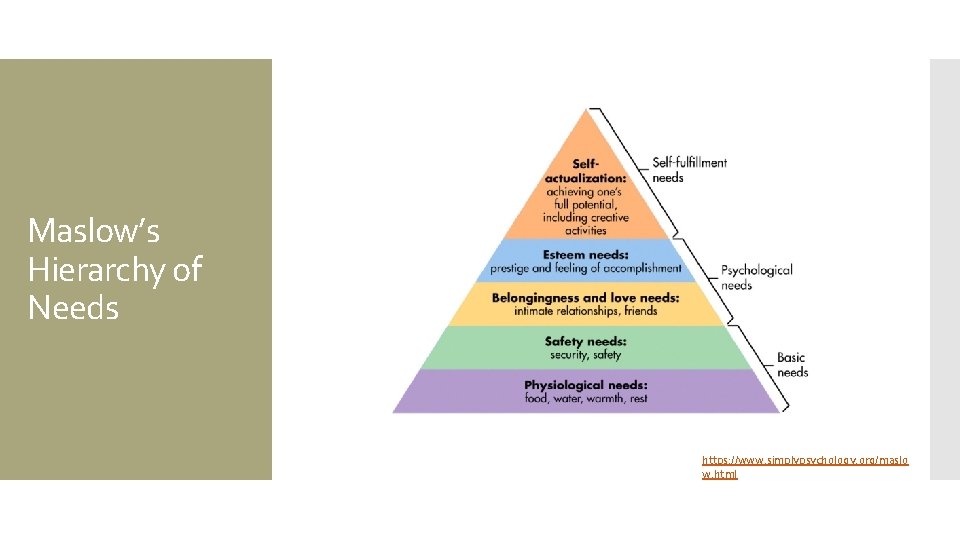
Maslow’s Hierarchy of Needs https: //www. simplypsychology. org/maslo w. html
• Security, safety Safety Needs • “In relation to the library, the need of safety can be seen most clearly in the patron’s level of library anxiety. ” 5 • Some anxiety about “who” they are talking to in online interactions. 6 • Need to feel comfortable to ask questions. 7 (Belonging, Esteem)
Belongingness and Love Needs • Intimate relationships and friends • The sense of having a place and fitting in with others while still being self • This is especially critical and more difficult for distance students • Inform them that they have same access to resources as on-campus students 8
§Prestige and feeling of accomplishment §Self-expression Esteem Needs §Need to feel comfortable/confident to ask questions 7 (Safety, Belonging) §Also addressed through achievement, respect for others, and respect by others 5
• Achieving one’s full potential, including creative activities • Growth period Self. Actualization Needs • “Aspects of [self-actualization] include problem solving, lack of prejudice, acceptance of facts, morality, creativity, and spontaneity. These traits correspond readily to the outcomes set forth within the ACRL Standards. ” 5
“We must focus on the student as a whole individual. This requires time and energy focused on addressing their needs beyond the time we see them during instruction sessions. This places importance on topics such as library anxiety, the library as place, and user experience. By looking to Maslow’s Hierarchy of Needs and working with the whole student, we will be able to reach them and aid their development into information literate individuals. ” 5
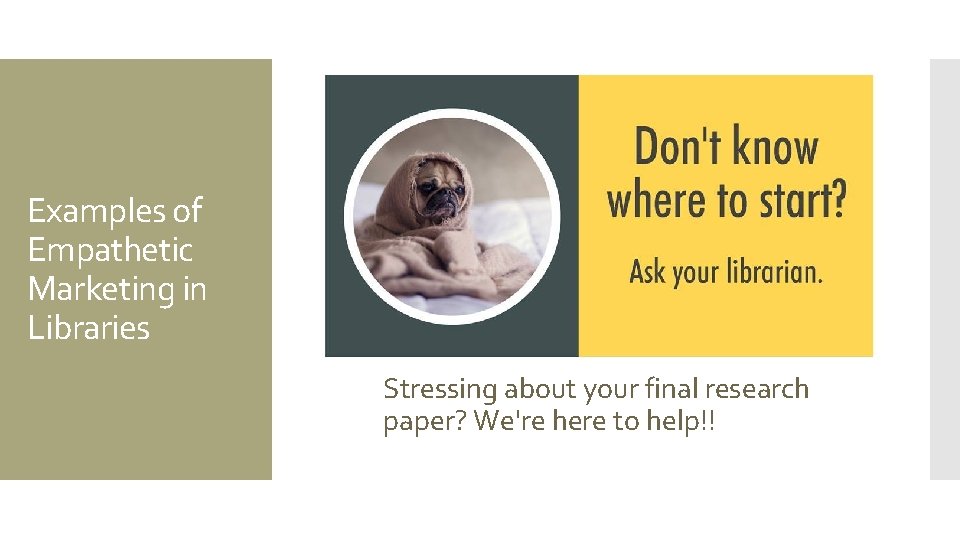
Examples of Empathetic Marketing in Libraries Stressing about your final research paper? We're here to help!!
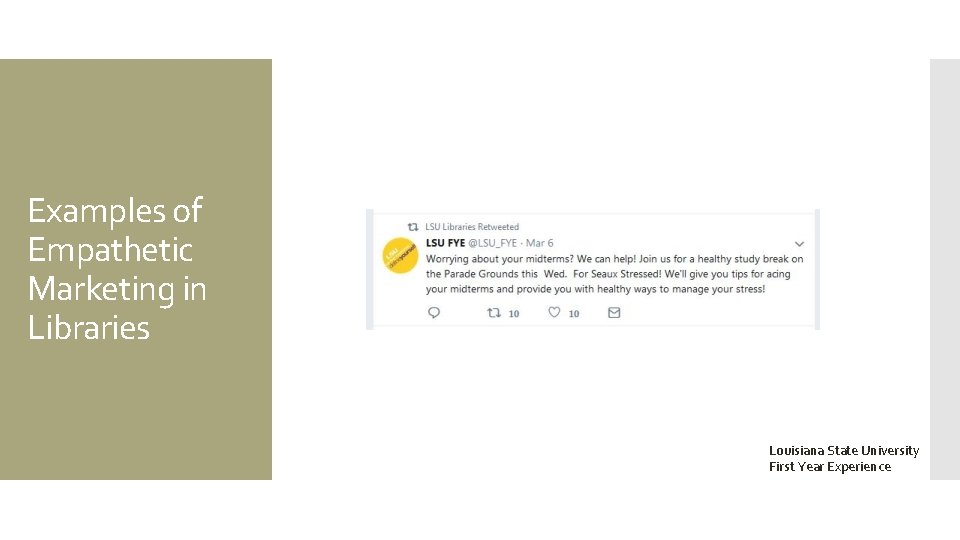
Examples of Empathetic Marketing in Libraries Louisiana State University First Year Experience
Examples of Empathetic Marketing in Libraries • Rod Library at University of Northern Iowa 9 • “by using the Rod Library you will decrease your frustration and increase the quality of your efforts. ” • Looking for answers in all the wrong places? Try the library! • The end is near! – The library is here. • Way too busy – feeling down? Too much homework makes you frown? We turn those frowns – upside down! @ The Rod Library.
• Get into a group of 4 or 5. Activity • Choose one of the Needs (Safety, Belonging, Esteem, or Self-Actualization) and think of a service or product that your library provides that could meet that need. • Create a slogan or marketing idea to promote that service/product to distance students in a way that meets the need.
• 1 Empathy. (n. d. ). https: //www. merriam-webster. com/dictionary/empathy • 2 Ingwer, M. (2012). References Empathetic marketing: how to satisfy the 6 core emotional needs of your customers. New York, NY: Palgrave Macmillan, 2012. • 3 Handley, A. (2013). Empathy pains. Entrepreneur, 41(8), 70. • 4 Tripp, C. (2013). No empathy - no service. Design Management Review, 24(3), 58 -64. doi: 10. 1111/drev. 10253 • 5 Francis, M. (2010). Fulfillment of a higher order: Placing information literacy within Maslow’s hierarchy of needs. College & Research Libraries News, 71(3), 140 -159. • 6 Fagan, J. C. , & Desai, C. M. (2002/2003). Communication strategies for instant messaging and chat reference services. The Reference Librarian, 79/80, 121 -155. • 7 Mellon, C. A. (1986). Library anxiety: a grounded theory and its development. College & Research Libraries, 47, 160 -165. • 8 Bonella, L. , Pitts, J. , & Coleman, J. (2017). How do we market to distance populations, and does it work? : Results from a longitudinal study and a survey of the profession. Journal of Library Administration, 57(1), 69 -86. doi: 10. 1080/01930826. 2016. 1202720 • 9 Neuhaus, C. , & Snowden, K. (2003). Public relations for a university library: A marketing programme is born. Library Management, 24(4 -5), 193 -203. doi: 10. 1108/01435120310475293 • Tremblay, P. , & Wang, Z. (2008). We care—virtually and in person: A user-centered approach to assessment, implementation and promotion of library resources and services to a remote graduate campus. Public Services Quarterly, 4(3), 207 -232. doi: 10. 1080/15228950802100545
- Slides: 24