
Culprit lesion in STEMI missed by angiography and
Culprit lesion in STEMI; missed by angiography and identified by OCT: A case report Mohammed Andaleeb Chowdhury, M. D. , MRCP(UK). Wael Elabbassi, MD. Arif Al Nooryani, FACHARTZ Al Qassimi Hospital, Sharjah, UAE

Case Presentation � 55 yr old male presented with Inferior STEMI. �CAG showed severe distal RCA stenosis �Good flow after stenting. �OCT identified a more proximal site of spontaneous plaque rupture within a highly remodeled artery with no lumen narrowing �Second stent was place covering the true culprit lesion.
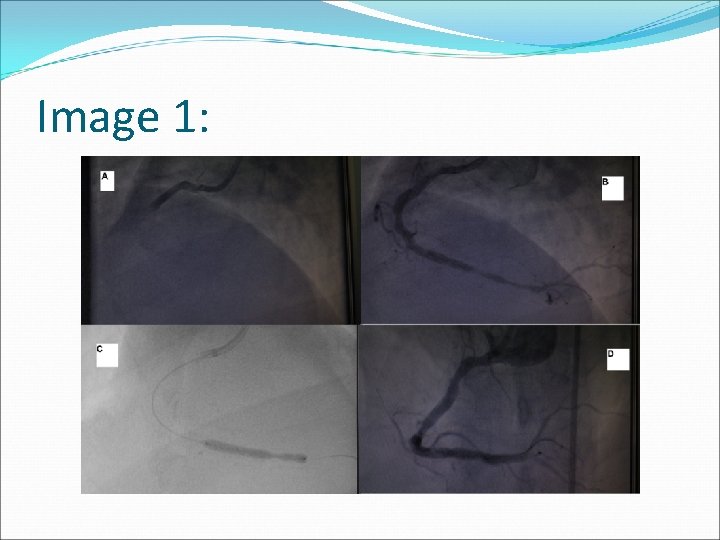
Image 1:
Imaging Findings � 1 A: RCA occluded with thrombus. � 1 B: Initial image after thrombus aspiration. � 1 C: First stent deployment. � 1 D: After first stent deployment, angiogram shows no evidence of proximal plaque rupture
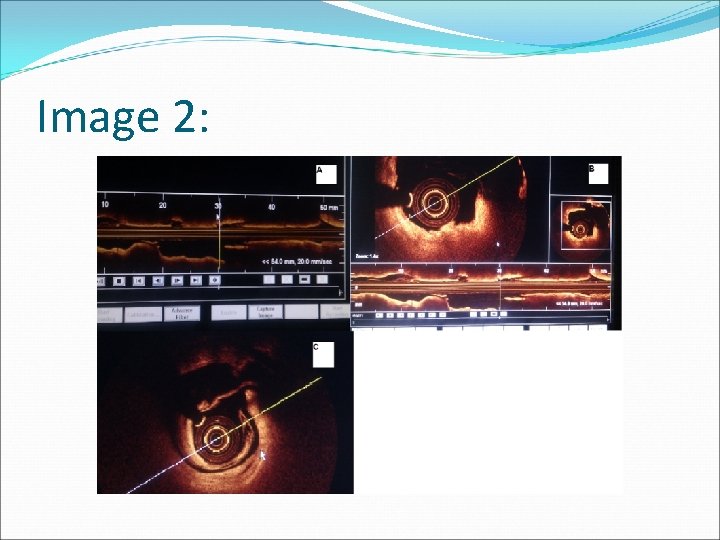
Image 2:
Imaging Findings � 2 A: Remodeled proximal area with spontaneous dissection due to plaque rupture � 2 B: True and false lumen at site of spontaneous dissection due to plaque rupture � 2 C: True and false lumen with a stream of blood crossing over
Image 3:
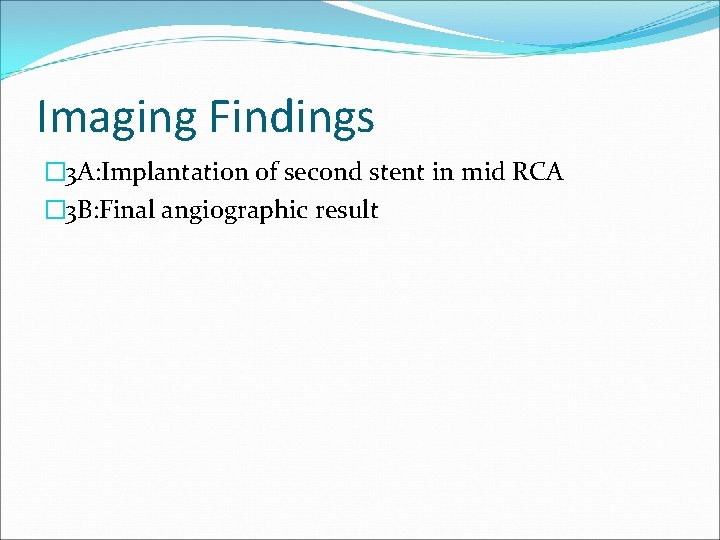
Imaging Findings � 3 A: Implantation of second stent in mid RCA � 3 B: Final angiographic result
Discussion �OCT offers unique possibilities to identify and characterize coronary lesions in acute coronary syndromes and is becoming the new gold standard to detect thrombus 2. Hence, it has the potential of improving outcomes in Primary PCI.
Discussion �Previous IVUS studies in STEMI patients using virtual histology (Dupek et al, presentation during Euro. PCR 2011) have shown that the culprit lesion is only partially covered, especially proximally during primary stenting. �Cervinka et al 3 recently reported on the use of OCT in 20 consecutive primary PCI cases; no adverse effects where noted. In 14 patients, OCT was helpful in avoiding stenting whenever culprit lesion did not show severe stensosis.
Discussion �In our case, the culprit lesion was totally missed as it was non-occlusive with proximal thrombus propagation. �OCT aided in pinpointing the culprit area of plaque rupture and it was subsequently stented.
References � 1. Widimsky P, Wijns W, Fajadet J, et al. Reperfusion therapy for ST elevation acute myocardial infarction in Europe: description of the current situation in 30 countries. Eur Heart J 2010; 31: 943 -957 � 2. Kubo T, Imanishi T, Kashiwagi M, et al. Multiple coronary lesion instability in patients with acute myocardial infarction as determined by optical coherence tomography. Am J Cardiol 2010; 105: 318322*
References � 3. OPTICAL COHERENCE TOMOGRAPHY GUIDED PRIMARY PCI IN STEMI PATIENTS Cervinka et al. J Am Coll Cardiol. 2011; 57: E 1881.
- Slides: 13