
Cuisenaire Rods Mostly everything you wanted to know


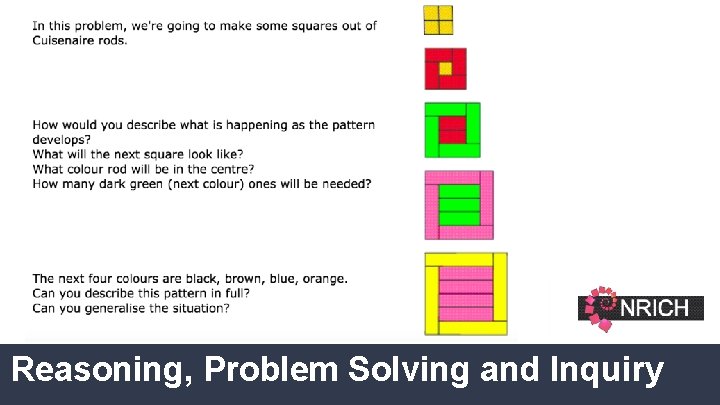
- Slides: 15
Cuisenaire Rods Mostly everything you wanted to know. . .
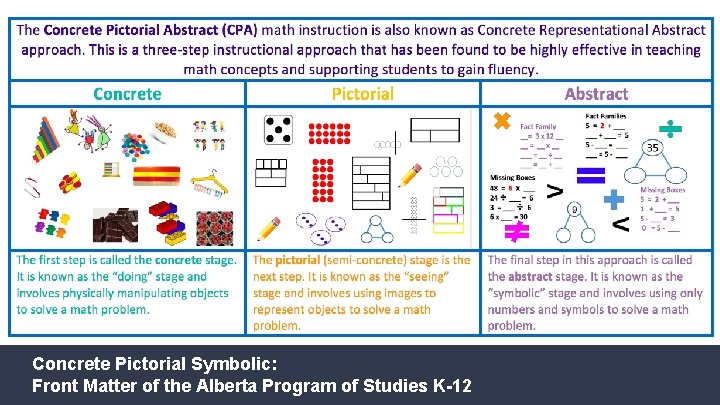
Concrete Pictorial Symbolic: Front Matter of the Alberta Program of Studies K-12
Where are we at. . . Beginning I am new to using manipulatives and representations and want to learn more. Emerging I’ve experimented with manipulatives and representations in my classroom for a few concepts. . Progressing Advancing Mastering I use manipulatives and representations in my practice regularly but want to deepen my understanding. I am confident using manipulatives and representations in my classroom. I use manipulatives and representations confidently in my practice and help others.
Develop conceptual understanding Immediate feedback Connect mathematical ideas Visualization Flexibility with multiple representations Why? Inclusion Make sense of algorithms and procedures Communication
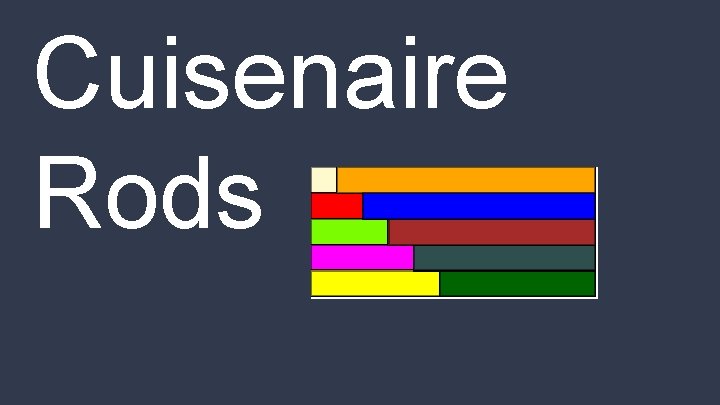
Cuisenaire Rods
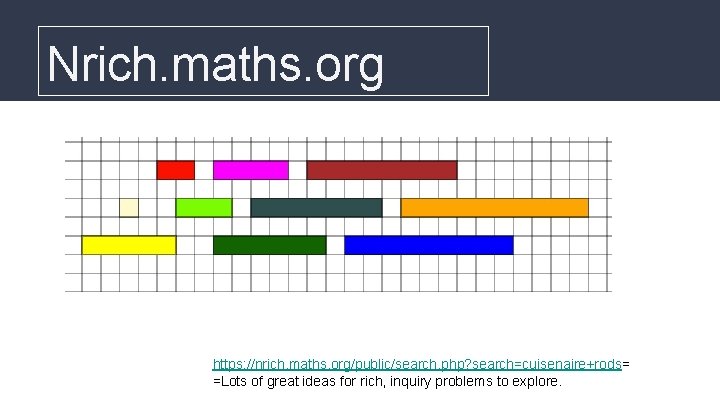
Nrich. maths. org https: //nrich. maths. org/public/search. php? search=cuisenaire+rods= =Lots of great ideas for rich, inquiry problems to explore.
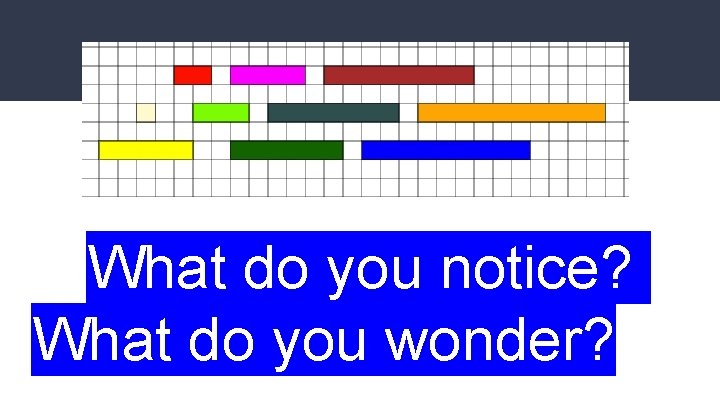
What do you notice? What do you wonder?
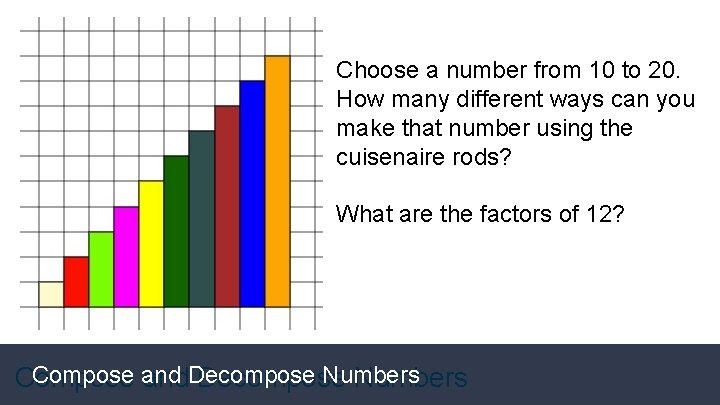
Choose a number from 10 to 20. How many different ways can you make that number using the cuisenaire rods? What are the factors of 12? Compose and Numbers Compose and. Decompose Numbers
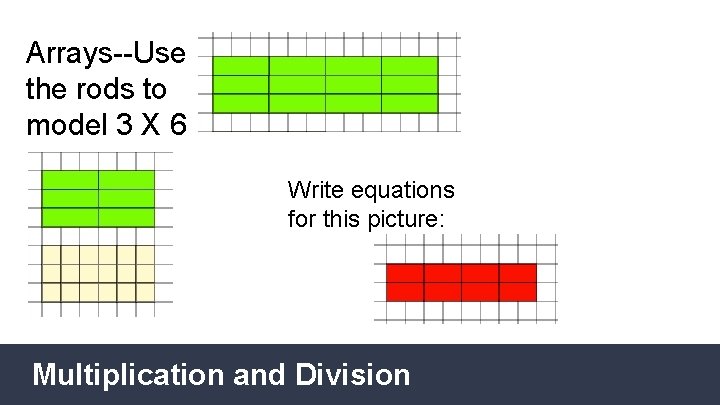
Arrays--Use the rods to model 3 X 6 Write equations for this picture: Multiplication and Division
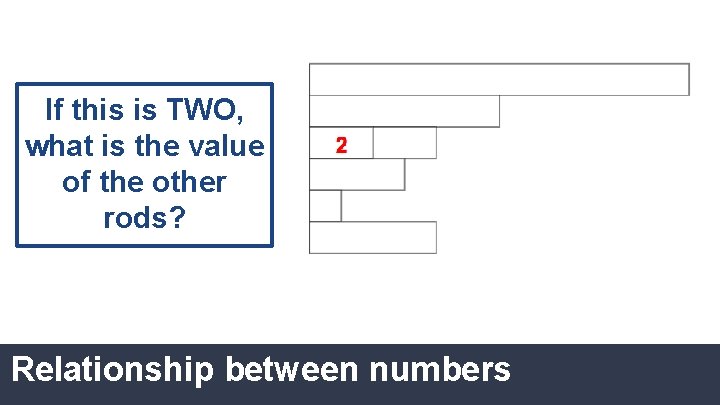
If this is TWO, what is the value of the other rods? Relationship between numbers
Reasoning, Problem Solving and Inquiry
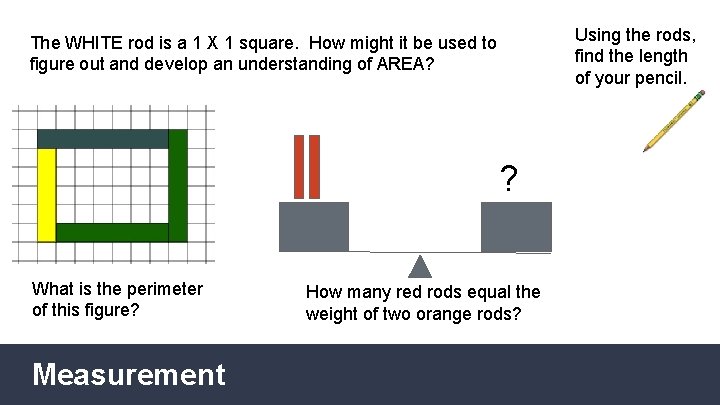
Using the rods, find the length of your pencil. The WHITE rod is a 1 X 1 square. How might it be used to figure out and develop an understanding of AREA? ? What is the perimeter of this figure? Measurement How many red rods equal the weight of two orange rods?
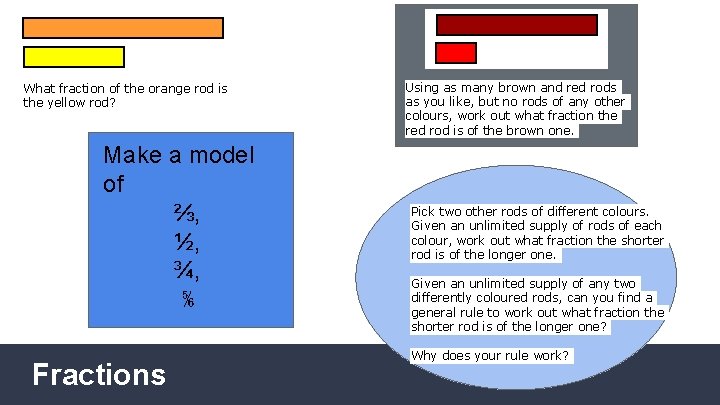
What fraction of the orange rod is the yellow rod? Make a model of ⅔, ½, ¾, ⅚ Fractions Using as many brown and red rods as you like, but no rods of any other colours, work out what fraction the red rod is of the brown one. Pick two other rods of different colours. Given an unlimited supply of rods of each colour, work out what fraction the shorter rod is of the longer one. Given an unlimited supply of any two differently coloured rods, can you find a general rule to work out what fraction the shorter rod is of the longer one? Why does your rule work?
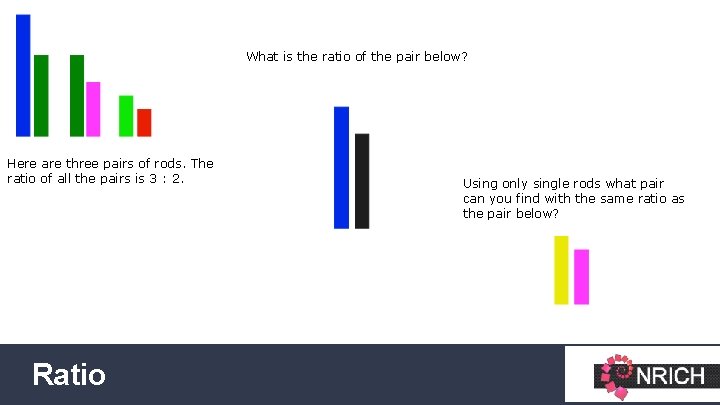
What is the ratio of the pair below? Here are three pairs of rods. The ratio of all the pairs is 3 : 2. Ratio Using only single rods what pair can you find with the same ratio as the pair below?
How do you play? You'll need a grown-up to play with. You'll also need one Cuisenaire rod of each length between 1 (white) and 10 (orange), or you can just write down the numbers on a piece of paper. Decide who is going to go first, and choose a distance between 11 and 55. We'll use 25 as an example. The aim of the game is to make a train of length 25 (exactly). Each player in turn puts down a Cuisenaire rod, putting them end to end so that there is a single train. The person who puts down the last rod to make 25 wins. If one player puts down a rod that makes the train longer than 25, then the other player wins. (If you aren't using rods, then you can use each of the numbers between 1 and 10, but only once. ) Does it make a difference who goes first? Can you work out a winning strategy? Train for Two--Logical Thinking