
Cueing Strategies Use Redirection Strategies to Reengage Students
- Slides: 14
Cueing Strategies: Use Redirection Strategies to Re-engage Students Back into Routine In partnership with NJDOE OSEP funded by IDEA -Part B 2016 -2017
Redirection Strategies “You catch more flies with honey than vinegar” • The ultimate goal of a redirection is to re-engage the student back into routine In partnership with NJDOE OSEP funded by IDEA -Part B 2016 -2017
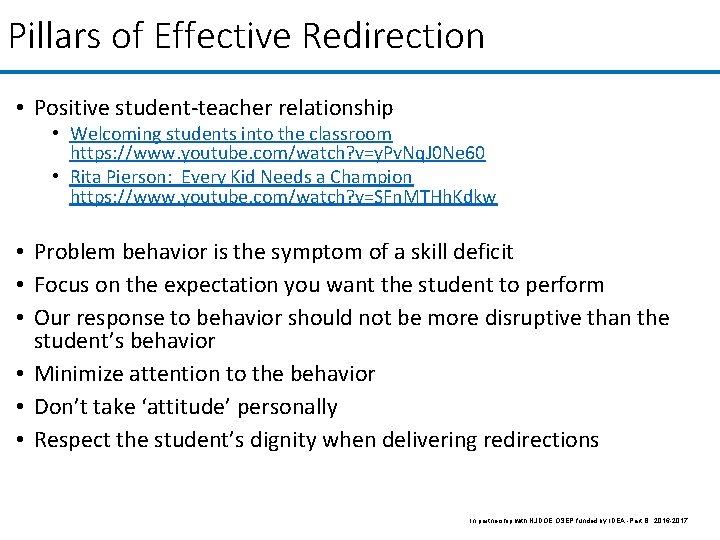
Pillars of Effective Redirection • Positive student-teacher relationship • Welcoming students into the classroom https: //www. youtube. com/watch? v=y. Pv. Nq. J 0 Ne 60 • Rita Pierson: Every Kid Needs a Champion https: //www. youtube. com/watch? v=SFn. MTHh. Kdkw • Problem behavior is the symptom of a skill deficit • Focus on the expectation you want the student to perform • Our response to behavior should not be more disruptive than the student’s behavior • Minimize attention to the behavior • Don’t take ‘attitude’ personally • Respect the student’s dignity when delivering redirections In partnership with NJDOE OSEP funded by IDEA -Part B 2016 -2017
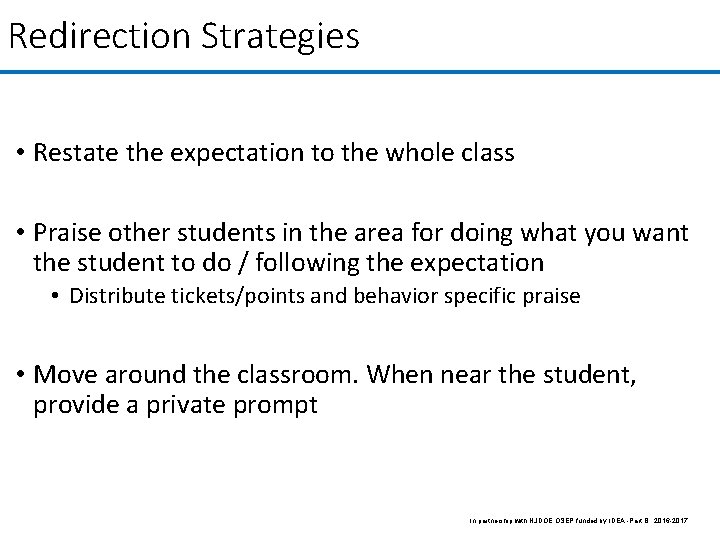
Redirection Strategies • Restate the expectation to the whole class • Praise other students in the area for doing what you want the student to do / following the expectation • Distribute tickets/points and behavior specific praise • Move around the classroom. When near the student, provide a private prompt In partnership with NJDOE OSEP funded by IDEA -Part B 2016 -2017
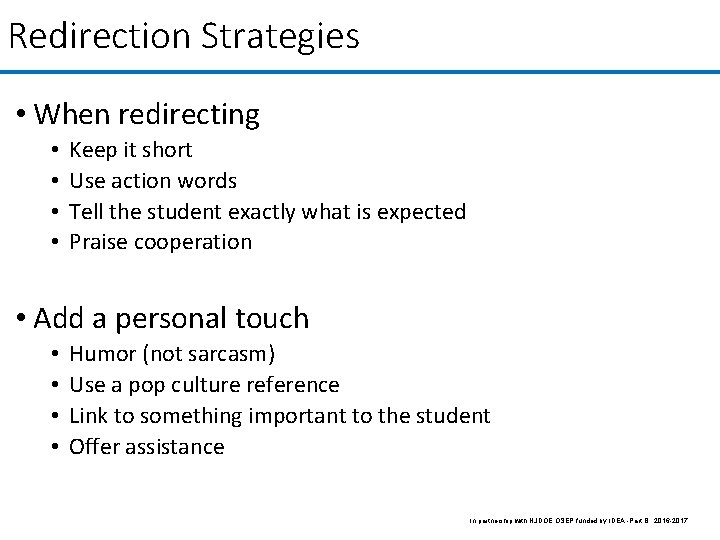
Redirection Strategies • When redirecting • • Keep it short Use action words Tell the student exactly what is expected Praise cooperation • Add a personal touch • • Humor (not sarcasm) Use a pop culture reference Link to something important to the student Offer assistance In partnership with NJDOE OSEP funded by IDEA -Part B 2016 -2017
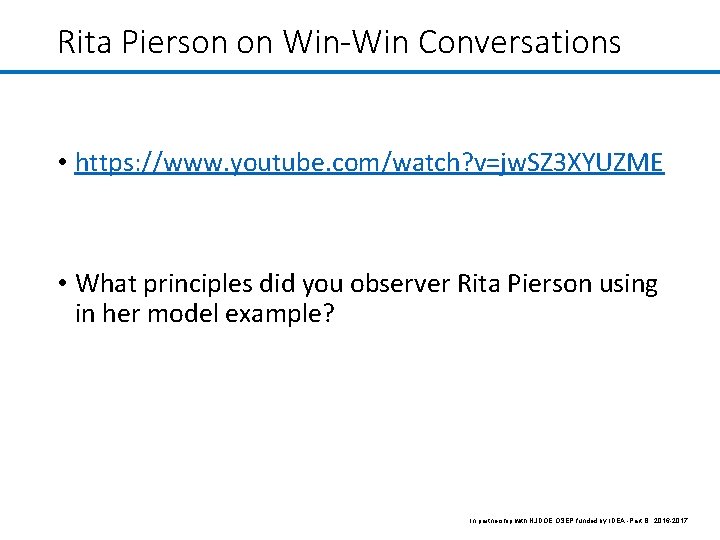
Rita Pierson on Win-Win Conversations • https: //www. youtube. com/watch? v=jw. SZ 3 XYUZME • What principles did you observer Rita Pierson using in her model example? In partnership with NJDOE OSEP funded by IDEA -Part B 2016 -2017
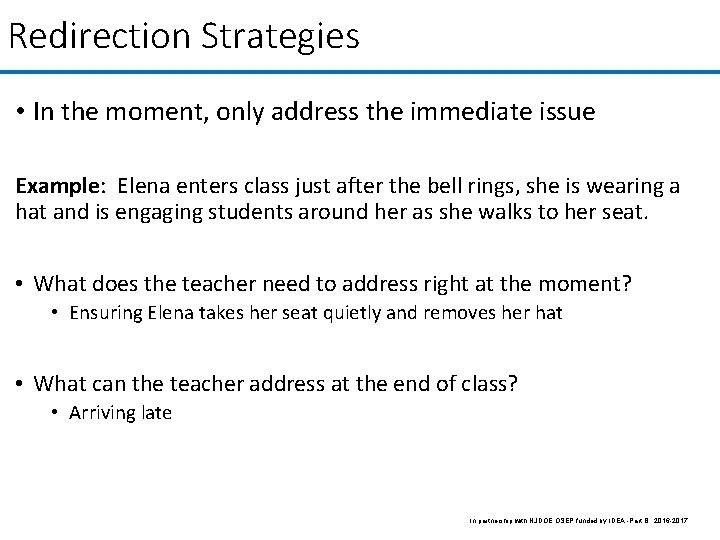
Redirection Strategies • In the moment, only address the immediate issue Example: Elena enters class just after the bell rings, she is wearing a hat and is engaging students around her as she walks to her seat. • What does the teacher need to address right at the moment? • Ensuring Elena takes her seat quietly and removes her hat • What can the teacher address at the end of class? • Arriving late In partnership with NJDOE OSEP funded by IDEA -Part B 2016 -2017
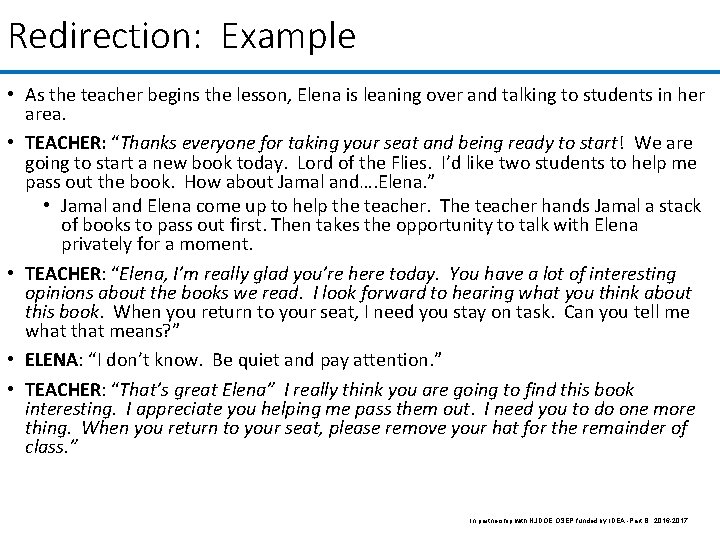
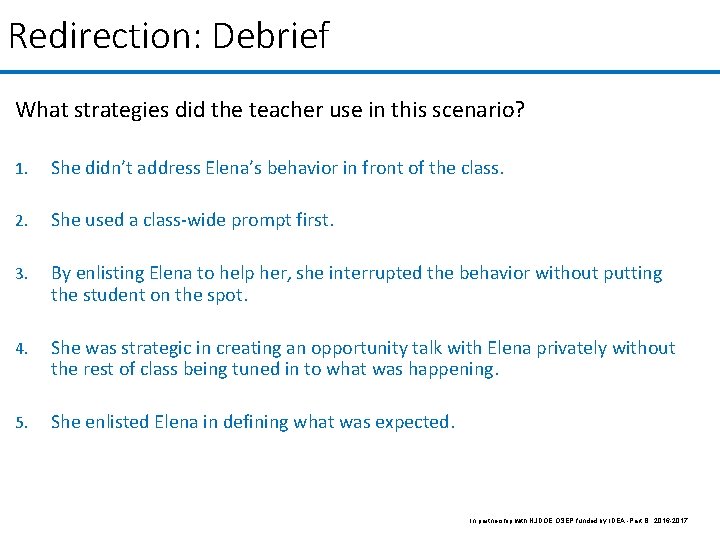
Redirection: Example • As the teacher begins the lesson, Elena is leaning over and talking to students in her area. • TEACHER: “Thanks everyone for taking your seat and being ready to start! We are going to start a new book today. Lord of the Flies. I’d like two students to help me pass out the book. How about Jamal and…. Elena. ” • Jamal and Elena come up to help the teacher. The teacher hands Jamal a stack of books to pass out first. Then takes the opportunity to talk with Elena privately for a moment. • TEACHER: “Elena, I’m really glad you’re here today. You have a lot of interesting opinions about the books we read. I look forward to hearing what you think about this book. When you return to your seat, I need you stay on task. Can you tell me what that means? ” • ELENA: “I don’t know. Be quiet and pay attention. ” • TEACHER: “That’s great Elena” I really think you are going to find this book interesting. I appreciate you helping me pass them out. I need you to do one more thing. When you return to your seat, please remove your hat for the remainder of class. ” In partnership with NJDOE OSEP funded by IDEA -Part B 2016 -2017
Redirection: Debrief What strategies did the teacher use in this scenario? 1. She didn’t address Elena’s behavior in front of the class. 2. She used a class-wide prompt first. 3. By enlisting Elena to help her, she interrupted the behavior without putting the student on the spot. 4. She was strategic in creating an opportunity talk with Elena privately without the rest of class being tuned in to what was happening. 5. She enlisted Elena in defining what was expected. In partnership with NJDOE OSEP funded by IDEA -Part B 2016 -2017
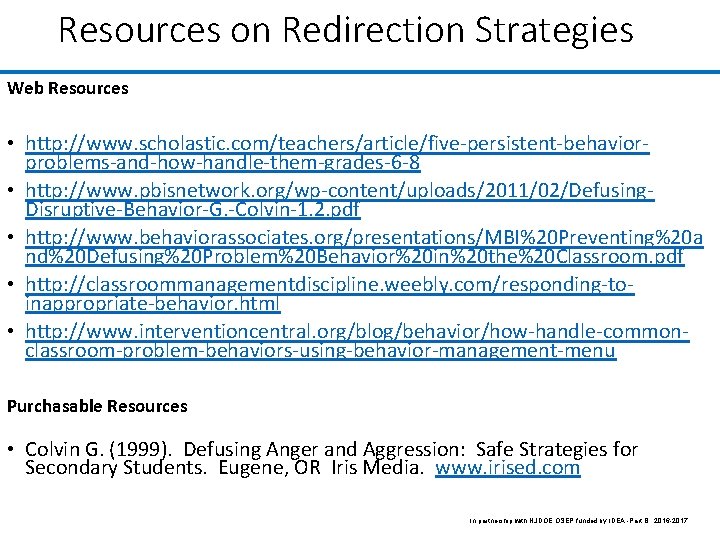
Resources on Redirection Strategies Web Resources • http: //www. scholastic. com/teachers/article/five-persistent-behaviorproblems-and-how-handle-them-grades-6 -8 • http: //www. pbisnetwork. org/wp-content/uploads/2011/02/Defusing. Disruptive-Behavior-G. -Colvin-1. 2. pdf • http: //www. behaviorassociates. org/presentations/MBI%20 Preventing%20 a nd%20 Defusing%20 Problem%20 Behavior%20 in%20 the%20 Classroom. pdf • http: //classroommanagementdiscipline. weebly. com/responding-toinappropriate-behavior. html • http: //www. interventioncentral. org/blog/behavior/how-handle-commonclassroom-problem-behaviors-using-behavior-management-menu Purchasable Resources • Colvin G. (1999). Defusing Anger and Aggression: Safe Strategies for Secondary Students. Eugene, OR Iris Media. www. irised. com In partnership with NJDOE OSEP funded by IDEA -Part B 2016 -2017
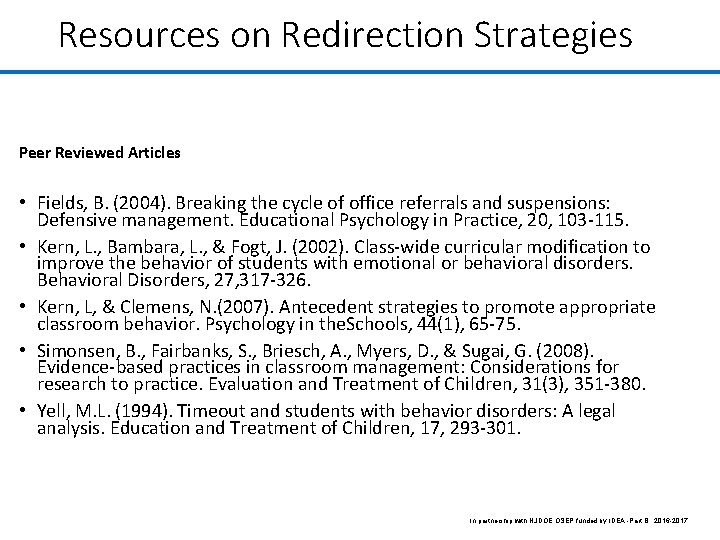
Resources on Redirection Strategies Peer Reviewed Articles • Fields, B. (2004). Breaking the cycle of office referrals and suspensions: Defensive management. Educational Psychology in Practice, 20, 103 -115. • Kern, L. , Bambara, L. , & Fogt, J. (2002). Class-wide curricular modification to improve the behavior of students with emotional or behavioral disorders. Behavioral Disorders, 27, 317 -326. • Kern, L, & Clemens, N. (2007). Antecedent strategies to promote appropriate classroom behavior. Psychology in the. Schools, 44(1), 65 -75. • Simonsen, B. , Fairbanks, S. , Briesch, A. , Myers, D. , & Sugai, G. (2008). Evidence-based practices in classroom management: Considerations for research to practice. Evaluation and Treatment of Children, 31(3), 351 -380. • Yell, M. L. (1994). Timeout and students with behavior disorders: A legal analysis. Education and Treatment of Children, 17, 293 -301. In partnership with NJDOE OSEP funded by IDEA -Part B 2016 -2017
MINIMIZING REINFORCEMENT WHEN REDIRECTING A BEHAVIOR In partnership with NJDOE OSE funded by IDEA -Part B 2017 -2018
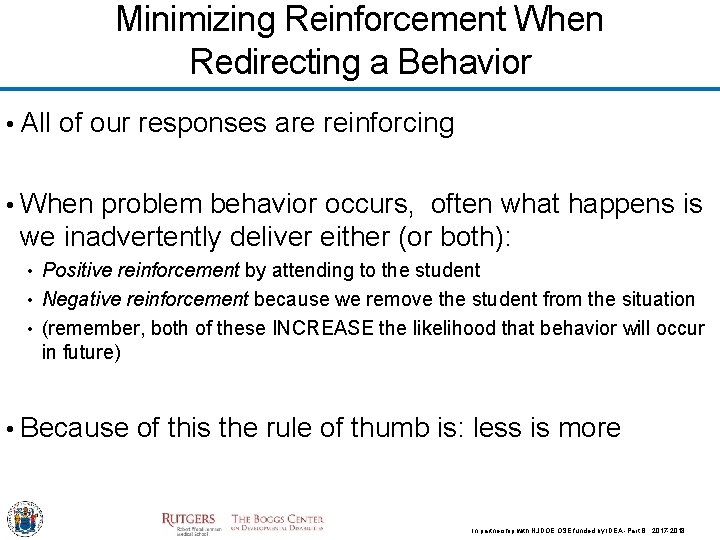
Minimizing Reinforcement When Redirecting a Behavior • All of our responses are reinforcing • When problem behavior occurs, often what happens is we inadvertently deliver either (or both): • Positive reinforcement by attending to the student • Negative reinforcement because we remove the student from the situation • (remember, both of these INCREASE the likelihood that behavior will occur in future) • Because of this the rule of thumb is: less is more In partnership with NJDOE OSE funded by IDEA -Part B 2017 -2018
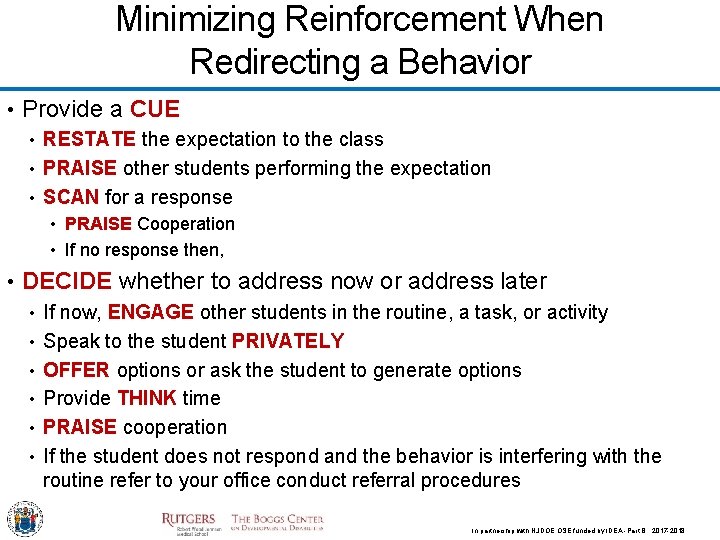
Minimizing Reinforcement When Redirecting a Behavior • Provide a CUE • RESTATE the expectation to the class • PRAISE other students performing the expectation • SCAN for a response • PRAISE Cooperation • If no response then, • DECIDE whether to address now or address later • If now, ENGAGE other students in the routine, a task, or activity • Speak to the student PRIVATELY • OFFER options or ask the student to generate options • Provide THINK time • PRAISE cooperation • If the student does not respond and the behavior is interfering with the routine refer to your office conduct referral procedures In partnership with NJDOE OSE funded by IDEA -Part B 2017 -2018