
CUDA Introduction Christian Trefftz Greg Wolffe Grand Valley

















- Slides: 71
CUDA: Introduction Christian Trefftz / Greg Wolffe Grand Valley State University Supercomputing 2008 Education Program
Terms What is GPGPU? General-Purpose computing on a Graphics Processing Unit Using graphic hardware for non-graphic computations What is CUDA? Compute Unified Device Architecture Software architecture for managing data-parallel programming Supercomputing 2008 Education Program 2
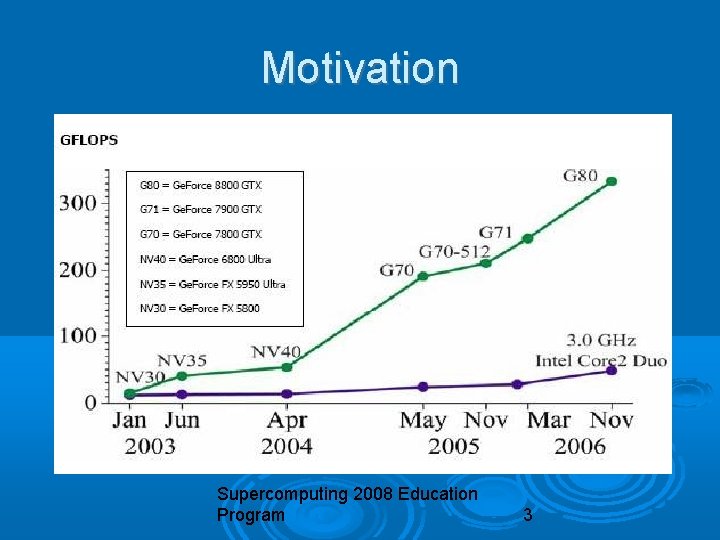
Motivation Supercomputing 2008 Education Program 3
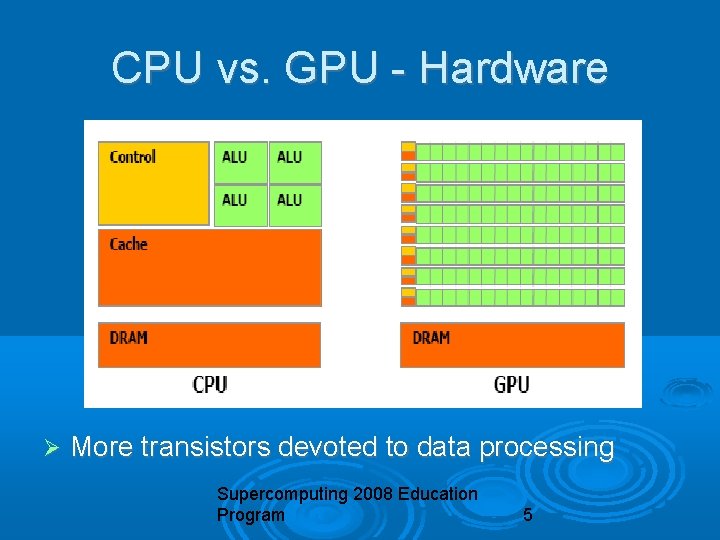
CPU vs. GPU CPU Fast caches Branching adaptability High performance GPU Multiple ALUs Fast onboard memory High throughput on parallel tasks • Executes program on each fragment/vertex CPUs are great for task parallelism GPUs are great for data parallelism Supercomputing 2008 Education Program 4
CPU vs. GPU - Hardware More transistors devoted to data processing Supercomputing 2008 Education Program 5
Traditional Graphics Pipeline Vertex processing Rasterizer Fragment processing Renderer (textures) Supercomputing 2008 Education Program 6
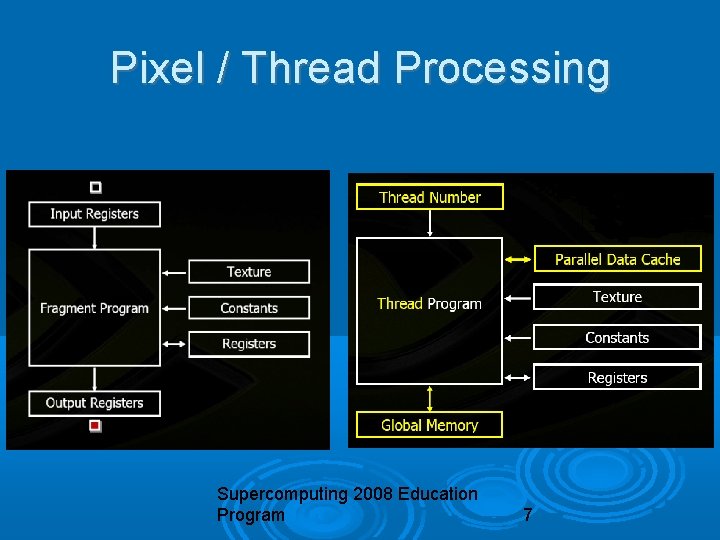
Pixel / Thread Processing Supercomputing 2008 Education Program 7
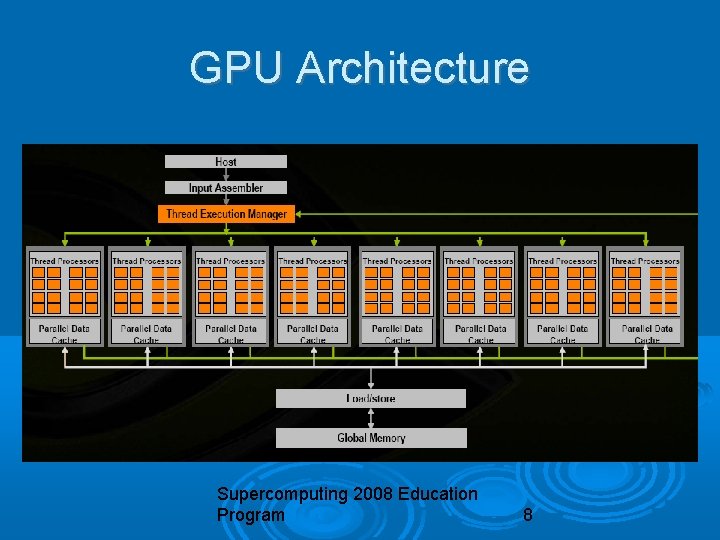
GPU Architecture Supercomputing 2008 Education Program 8
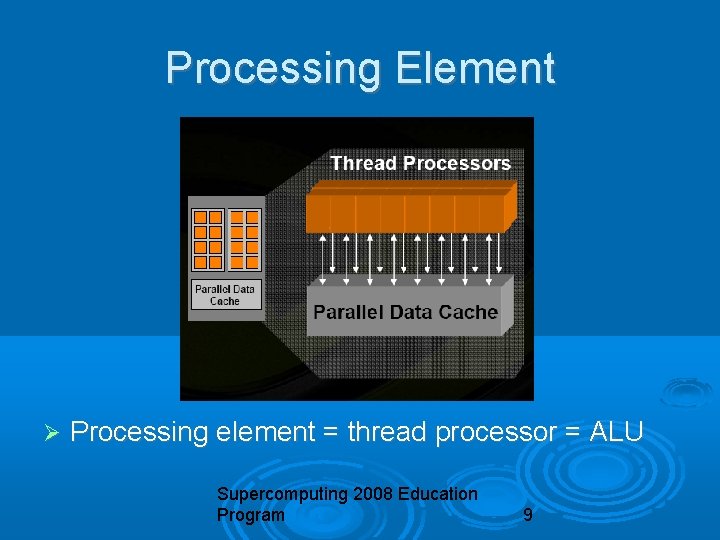
Processing Element Processing element = thread processor = ALU Supercomputing 2008 Education Program 9
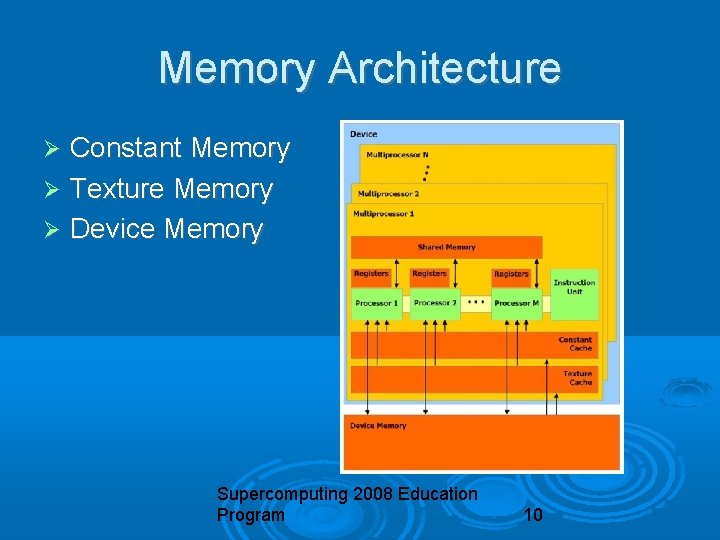
Memory Architecture Constant Memory Texture Memory Device Memory Supercomputing 2008 Education Program 10
Data-parallel Programming Think of the CPU as a massively-threaded co-processor Write “kernel” functions that execute on the device -- processing multiple data elements in parallel Keep it busy! massive threading Keep your data close! local memory Supercomputing 2008 Education Program 11
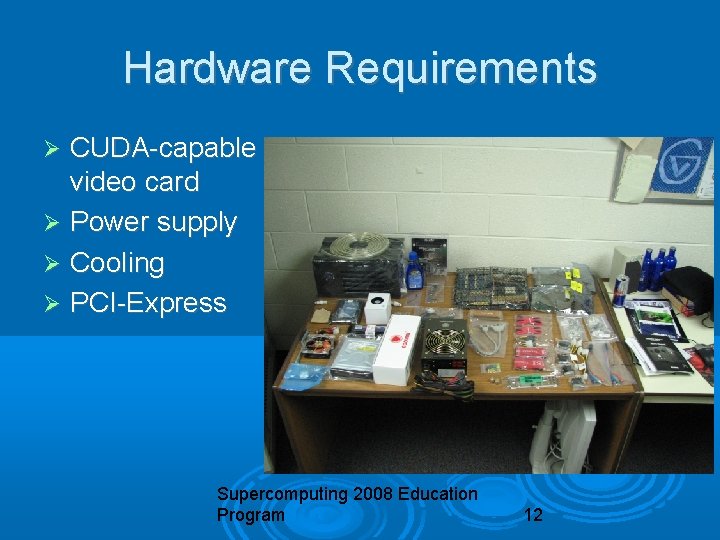
Hardware Requirements CUDA-capable video card Power supply Cooling PCI-Express Supercomputing 2008 Education Program 12
Supercomputing 2008 Education Program 13
Acknowledgements NVidia Corporation developer. nvidia. com/CUDA NVidia Technical Brief – Architecture Overview CUDA Programming Guide ACM Queue http: //www. acmqueue. org/ Supercomputing 2008 Education Program 14
A Gentle Introduction to CUDA Programming Supercomputing 2008 Education Program 15
Credits The code used in this presentation is based on code available in: the Tutorial on CUDA in Dr. Dobbs Journal Andrew Bellenir’s code for matrix multiplication Igor Majdandzic’s code for Voronoi diagrams NVIDIA’s CUDA programming guide Supercomputing 2008 Education Program 16
Software Requirements/Tools CUDA device driver CUDA Software Development Kit Emulator CUDA Toolkit Occupancy calculator Visual profiler Supercomputing 2008 Education Program 17
To compute, we need to: Allocate memory that will be used for the computation (variable declaration and allocation) Read the data that we will compute on (input) Specify the computation that will be performed Write to the appropriate device the results (output) Supercomputing 2008 Education Program 18
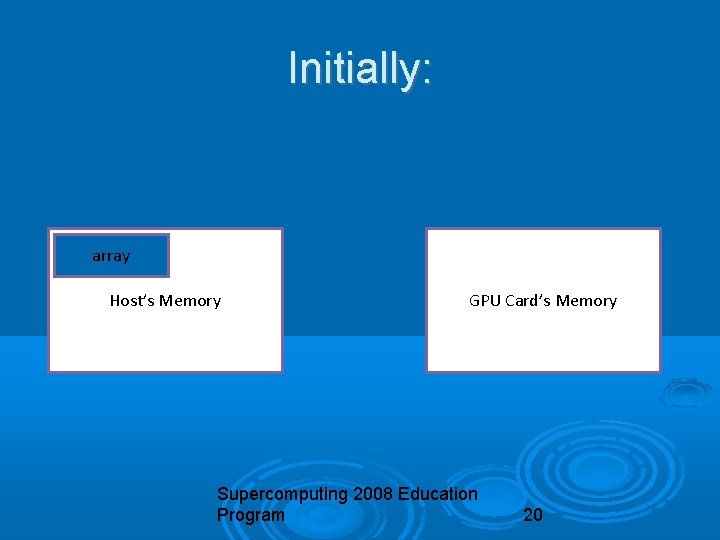
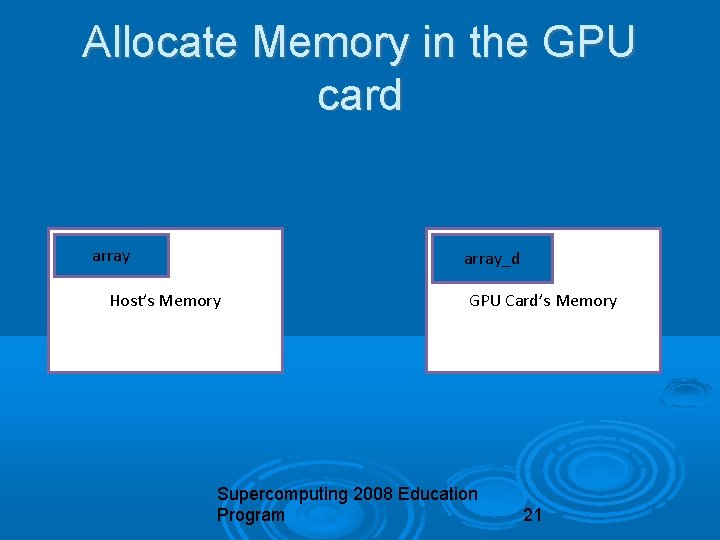
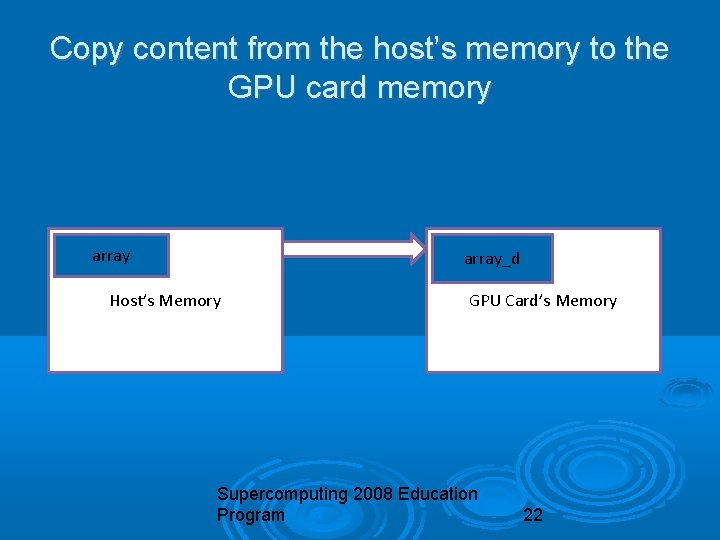
A GPU is a specialized computer We need to allocate space in the video card’s memory for the variables. The video card does not have I/O devices, hence we need to copy the input data from the memory in the host computer into the memory in the video card, using the variable allocated in the previous step. We need to specify code to execute. Copy the results back to the memory in the host computer. Supercomputing 2008 Education Program 19
Initially: array Host’s Memory GPU Card’s Memory Supercomputing 2008 Education Program 20
Allocate Memory in the GPU card array_d Host’s Memory GPU Card’s Memory Supercomputing 2008 Education Program 21
Copy content from the host’s memory to the GPU card memory array_d Host’s Memory GPU Card’s Memory Supercomputing 2008 Education Program 22
Execute code on the GPU MPs array_d Host’s Memory GPU Card’s Memory Supercomputing 2008 Education Program 23
Copy results back to the host memory array_d Host’s Memory GPU Card’s Memory Supercomputing 2008 Education Program 24
The Kernel It is necessary to write the code that will be executed in the stream processors in the GPU card That code, called the kernel, will be downloaded and executed, simultaneously and in lock-step fashion, in several (all? ) stream processors in the GPU card How is every instance of the kernel going to know which piece of data it is working on? Supercomputing 2008 Education Program 25
Grid Size and Block Size Programmers need to specify: The grid size: The size and shape of the data that the program will be working on The block size: The block size indicates the sub-area of the original grid that will be assigned to an MP (a set of stream processors that share local memory) Supercomputing 2008 Education Program 26
Block Size Recall that the “stream processors” of the GPU are organized as MPs (multiprocessors) and every MP has its own set of resources: Registers Local memory The block size needs to be chosen such that there are enough resources in an MP to execute a block at a time. Supercomputing 2008 Education Program 27
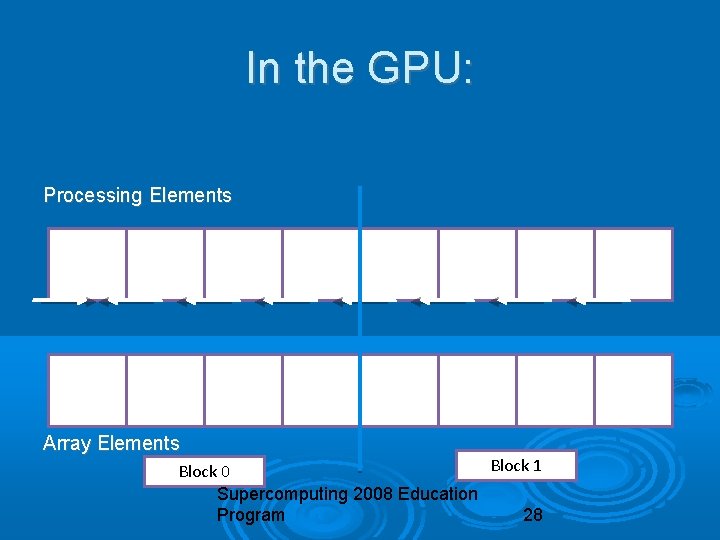
In the GPU: Processing Elements Array Elements Block 1 Block 0 Supercomputing 2008 Education Program 28
Let’s look at a very simple example The code has been divided into two files: simple. cu simple. c is ordinary code in C It allocates an array of integers, initializes it to values corresponding to the indices in the array and prints the array. It calls a function that modifies the array The array is printed again. Supercomputing 2008 Education Program 29
simple. c #include <stdio. h> #define SIZEOFARRAY 64 extern void fill. Array(int *a, int size); /* The main program */ int main(int argc, char *argv[]) { /* Declare the array that will be modified by the GPU */ int a[SIZEOFARRAY]; int i; /* Initialize the array to 0 s */ for(i=0; i < SIZEOFARRAY; i++) { a[i]=i; } /* Print the initial array */ printf("Initial state of the array: n"); for(i = 0; i < SIZEOFARRAY; i++) { printf("%d ", a[i]); } printf("n"); /* Call the function that will in turn call the function in the GPU that will fill the array */ fill. Array(a, SIZEOFARRAY); /* Now print the array after calling fill. Array */ printf("Final state of the array: n"); for(i = 0; i < SIZEOFARRAY; i++) { printf("%d ", a[i]); } printf("n"); return 0; } Supercomputing 2008 Education Program 30
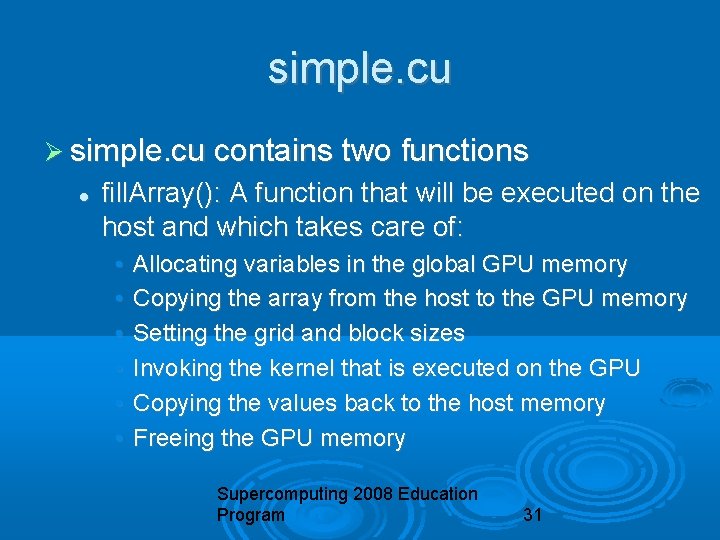
simple. cu contains two functions fill. Array(): A function that will be executed on the host and which takes care of: • • • Allocating variables in the global GPU memory Copying the array from the host to the GPU memory Setting the grid and block sizes Invoking the kernel that is executed on the GPU Copying the values back to the host memory Freeing the GPU memory Supercomputing 2008 Education Program 31
fill. Array (part 1) #define BLOCK_SIZE 32 extern "C" void fill. Array(int *array, int array. Size){ /* a_d is the GPU counterpart of the array that exists on the host memory */ int *array_d; Supercomputing 2008 Education Program 32
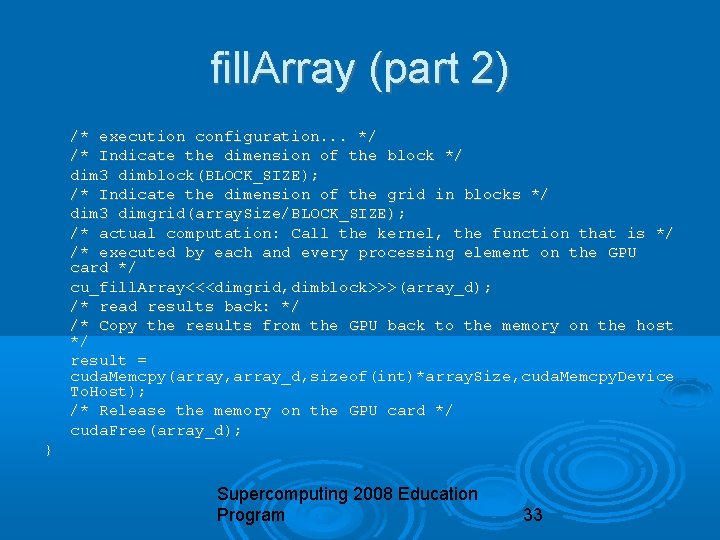
fill. Array (part 2) /* execution configuration. . . */ /* Indicate the dimension of the block */ dim 3 dimblock(BLOCK_SIZE); /* Indicate the dimension of the grid in blocks */ dim 3 dimgrid(array. Size/BLOCK_SIZE); /* actual computation: Call the kernel, the function that is */ /* executed by each and every processing element on the GPU card */ cu_fill. Array<<<dimgrid, dimblock>>>(array_d); /* read results back: */ /* Copy the results from the GPU back to the memory on the host */ result = cuda. Memcpy(array, array_d, sizeof(int)*array. Size, cuda. Memcpy. Device To. Host); /* Release the memory on the GPU card */ cuda. Free(array_d); } Supercomputing 2008 Education Program 33
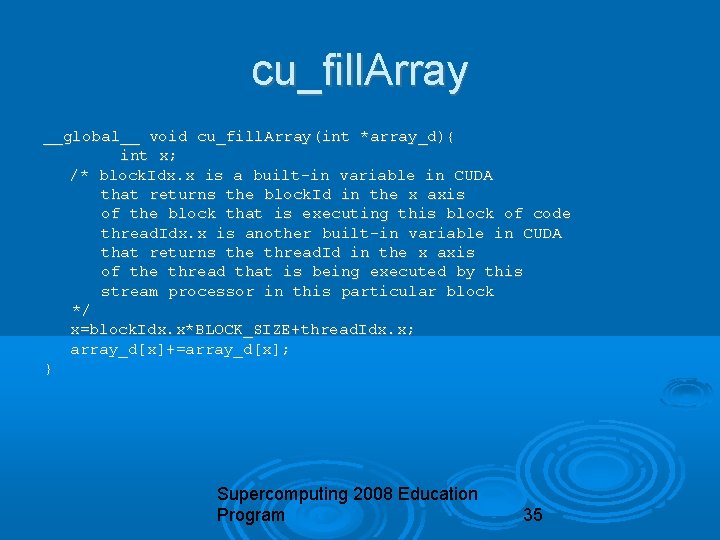
simple. cu (cont. ) The other function in simple. cu is cu_fill. Array() • This is the kernel that will be executed in every stream processor in the GPU • It is identified as a kernel by the use of the keyword: __global__ • This function uses the built-in variables block. Idx. x and thread. Idx. x to identify a particular position in the array Supercomputing 2008 Education Program 34
cu_fill. Array __global__ void cu_fill. Array(int *array_d){ int x; /* block. Idx. x is a built-in variable in CUDA that returns the block. Id in the x axis of the block that is executing this block of code thread. Idx. x is another built-in variable in CUDA that returns the thread. Id in the x axis of the thread that is being executed by this stream processor in this particular block */ x=block. Idx. x*BLOCK_SIZE+thread. Idx. x; array_d[x]+=array_d[x]; } Supercomputing 2008 Education Program 35
To compile: nvcc simple. cu –o simple The compiler generates the code for both the host and the GPU Demo on cuda. littlefe. net … Supercomputing 2008 Education Program 36
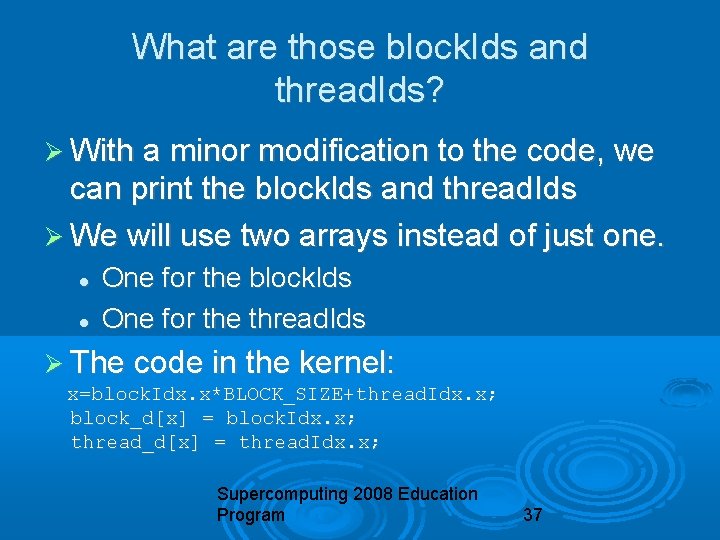
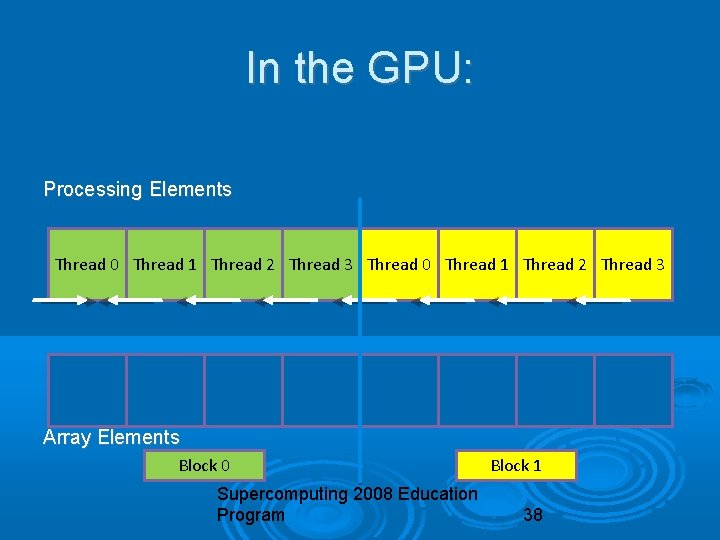
What are those block. Ids and thread. Ids? With a minor modification to the code, we can print the block. Ids and thread. Ids We will use two arrays instead of just one. One for the block. Ids One for the thread. Ids The code in the kernel: x=block. Idx. x*BLOCK_SIZE+thread. Idx. x; block_d[x] = block. Idx. x; thread_d[x] = thread. Idx. x; Supercomputing 2008 Education Program 37
In the GPU: Processing Elements Thread 0 Thread 1 Thread 2 Thread 3 Array Elements Block 0 Supercomputing 2008 Education Program Block 1 38
Hands-on Activity Compile with (one single line) nvcc block. And. Thread. c -o block. And. Thread. cu Run the program. /block. And. Thread Edit the file block. And. Thread. cu Modify the constant BLOCK_SIZE. The current value is 8, try replacing it with 4. Recompile as above Run the program and compare the output with the previous run. Supercomputing 2008 Education Program 39
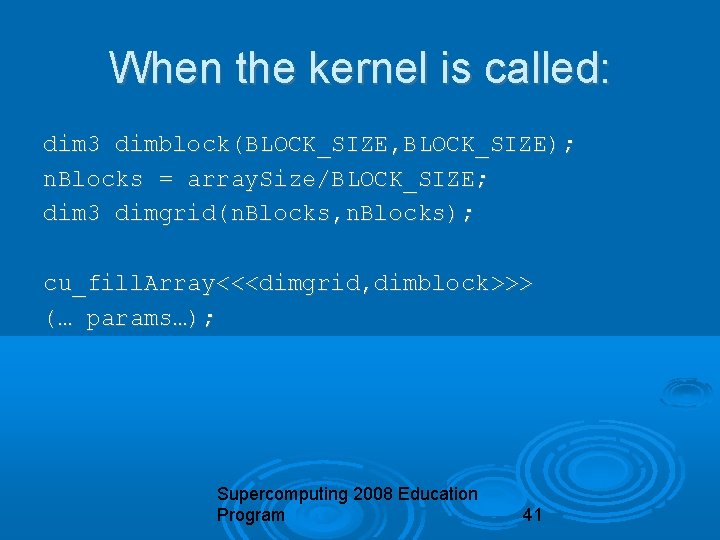
This can be extended to 2 dimensions See files: block. And. Thread 2 D. cu The gist in the kernel x = block. Idx. x*BLOCK_SIZE+thread. Idx. x; y = block. Idx. y*BLOCK_SIZE+thread. Idx. y; pos = x*size. Of. Array+y; block_d. X[pos] = block. Idx. x; Compile and run block. And. Thread 2 D nvcc block. And. Thread 2 D. cu -o block. And. Thread 2 D. /block. And. Thread 2 D Supercomputing 2008 Education Program 40
When the kernel is called: dim 3 dimblock(BLOCK_SIZE, BLOCK_SIZE); n. Blocks = array. Size/BLOCK_SIZE; dim 3 dimgrid(n. Blocks, n. Blocks); cu_fill. Array<<<dimgrid, dimblock>>> (… params…); Supercomputing 2008 Education Program 41
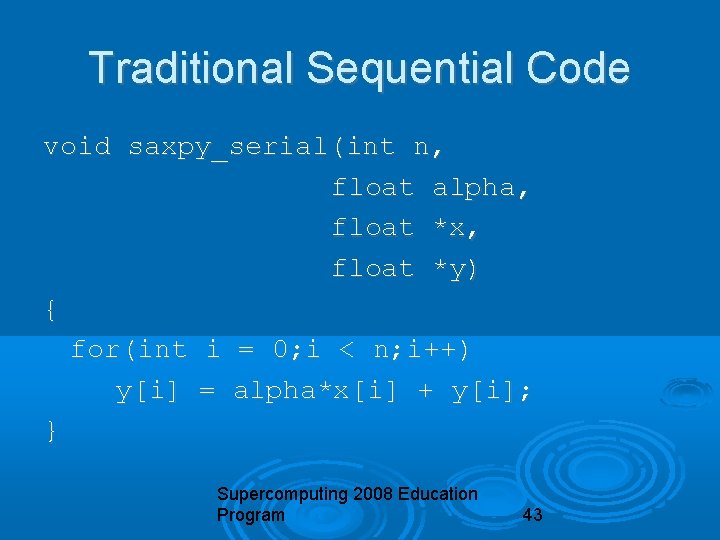
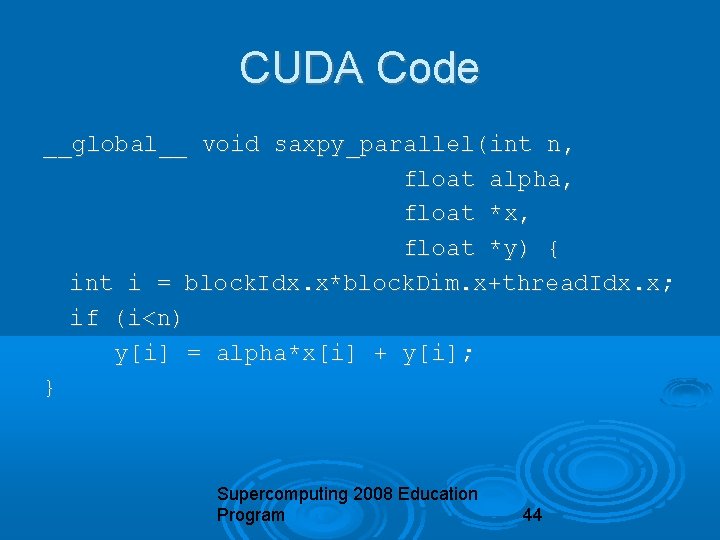
Another Example: saxpy SAXPY (Scalar Alpha X Plus Y) A common operation in linear algebra CUDA: loop iteration thread Supercomputing 2008 Education Program 42
Traditional Sequential Code void saxpy_serial(int n, float alpha, float *x, float *y) { for(int i = 0; i < n; i++) y[i] = alpha*x[i] + y[i]; } Supercomputing 2008 Education Program 43
CUDA Code __global__ void saxpy_parallel(int n, float alpha, float *x, float *y) { int i = block. Idx. x*block. Dim. x+thread. Idx. x; if (i<n) y[i] = alpha*x[i] + y[i]; } Supercomputing 2008 Education Program 44
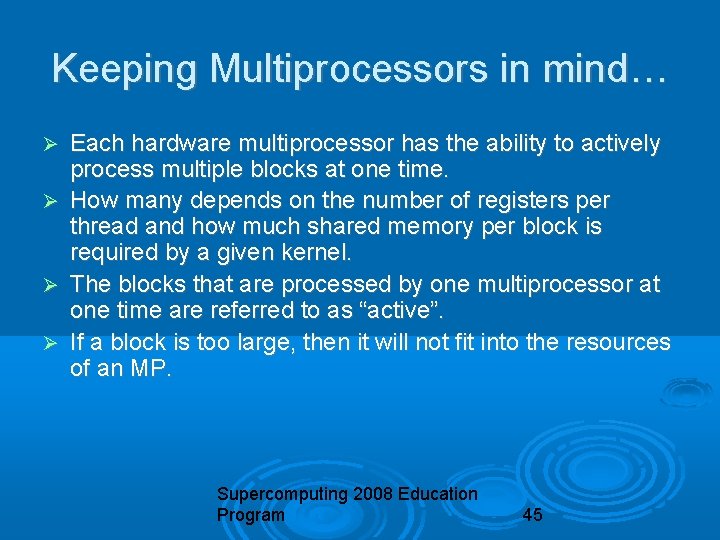
Keeping Multiprocessors in mind… Each hardware multiprocessor has the ability to actively process multiple blocks at one time. How many depends on the number of registers per thread and how much shared memory per block is required by a given kernel. The blocks that are processed by one multiprocessor at one time are referred to as “active”. If a block is too large, then it will not fit into the resources of an MP. Supercomputing 2008 Education Program 45
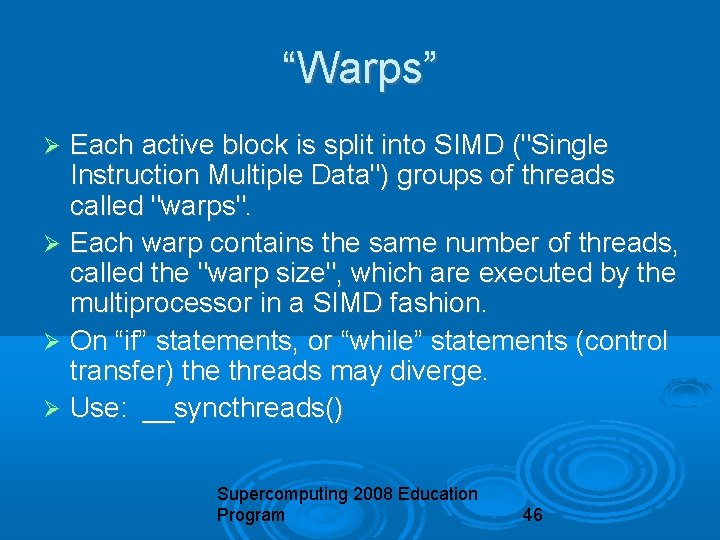
“Warps” Each active block is split into SIMD ("Single Instruction Multiple Data") groups of threads called "warps". Each warp contains the same number of threads, called the "warp size", which are executed by the multiprocessor in a SIMD fashion. On “if” statements, or “while” statements (control transfer) the threads may diverge. Use: __syncthreads() Supercomputing 2008 Education Program 46
A Real Application The Voronoi Diagram: A fundamental data structure in Computational Geometry Supercomputing 2008 Education Program 47
Definition : Let S be a set of n sites in Euclidean space of dimension d. For each site p of S, the Voronoi cell V(p) of p is the set of points that are closer to p than to other sites of S. The Voronoi diagram V(S) is the space partition induced by Voronoi cells. Supercomputing 2008 Education Program 48
Algorithms The classical sequential algorithm has complexity O(n log n) where n is the number of sites (seeds). If one only needs an approximation, on a grid of points (e. g. digital display): Assign a different color to each seed Calculate the distance from every point in the grid to all seeds Color each point with the color of its closest seed Supercomputing 2008 Education Program 49
Lends itself to implementation on a GPU… The calculation for every pixel is a good candidate to be carried out in parallel… Notice that the locations of the seeds are read-only in the kernel Thus we can use the texture map area in the GPU card, which is a fast read-only cache to store the seeds: __device__ __constant__ … Supercomputing 2008 Education Program 50
Demo on cuda… Supercomputing 2008 Education Program 51
Tips for improving performance Special thanks to Igor Majdandzic. Supercomputing 2008 Education Program 52
Memory Alignment Memory access on the GPU works much better if the data items are aligned at 64 byte boundaries. Hence, allocating 2 D arrays so that every row starts at a 64 -byte boundary address will improve performance. But that is difficult to do for a programmer Supercomputing 2008 Education Program 53
Allocating 2 D arrays with “pitch” CUDA offers special versions of: Memory allocation of 2 D arrays so that every row is padded (if necessary). The function determines the best pitch and returns it to the program. The function name is cuda. Malloc. Pitch() Memory copy operations that take into account the pitch that was chosen by the memory allocation operation. The function name is cuda. Memcpy 2 D() Supercomputing 2008 Education Program 54
Pitch Columns Padding Rows Pitch Supercomputing 2008 Education Program 55
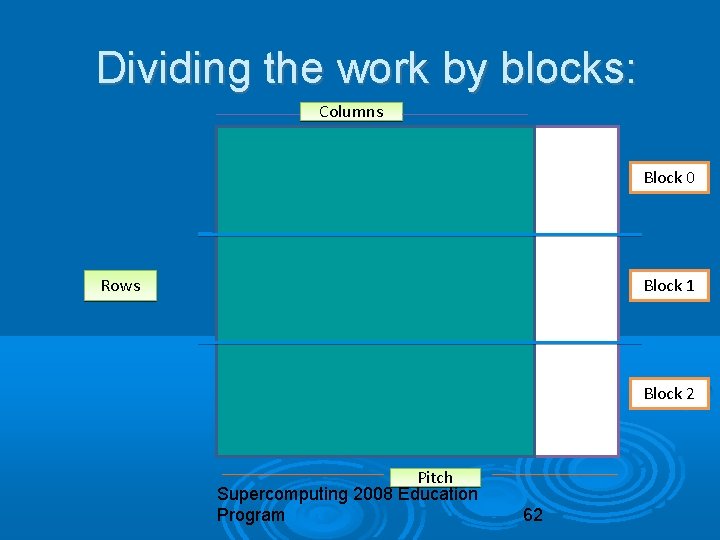
A simple example: See pitch. cu A matrix of 30 rows and 10 columns The work is divided into 3 blocks of 10 rows: Block size is 10 Grid size is 3 Supercomputing 2008 Education Program 56
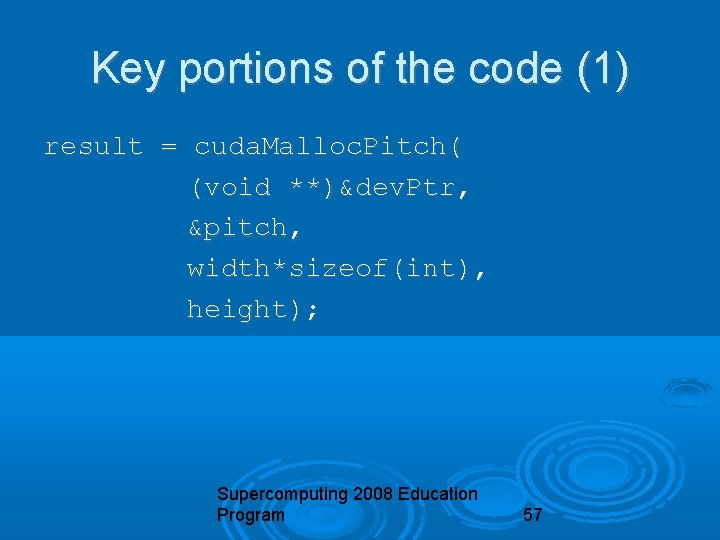
Key portions of the code (1) result = cuda. Malloc. Pitch( (void **)&dev. Ptr, &pitch, width*sizeof(int), height); Supercomputing 2008 Education Program 57
Key portions of the code (2) result = cuda. Memcpy 2 D( dev. Ptr, pitch, mat, width*sizeof(int), height, cuda. Memcpy. Host. To. Device); Supercomputing 2008 Education Program 58
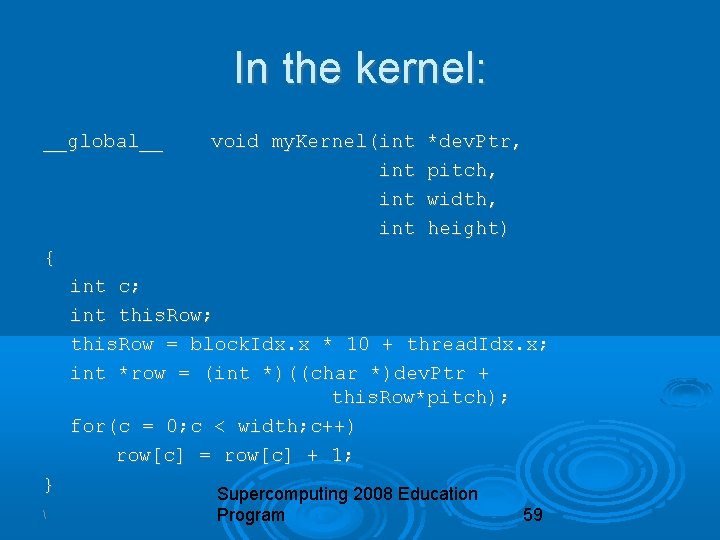
In the kernel: __global__ void my. Kernel(int *dev. Ptr, int pitch, int width, int height) { int c; int this. Row; this. Row = block. Idx. x * 10 + thread. Idx. x; int *row = (int *)((char *)dev. Ptr + this. Row*pitch); for(c = 0; c < width; c++) row[c] = row[c] + 1; } Supercomputing 2008 Education Program 59
The call to the kernel my. Kernel<<<3, 10>>>( dev. Ptr, pitch, width, height); Supercomputing 2008 Education Program 60
pitch Divide work by rows Notice that when using pitch, we divide the work by rows. Instead of using the 2 D decomposition of 2 D blocks, we are dividing the 2 D matrix into blocks of rows. Supercomputing 2008 Education Program 61
Dividing the work by blocks: Columns Block 0 Rows Block 1 Block 2 Pitch Supercomputing 2008 Education Program 62
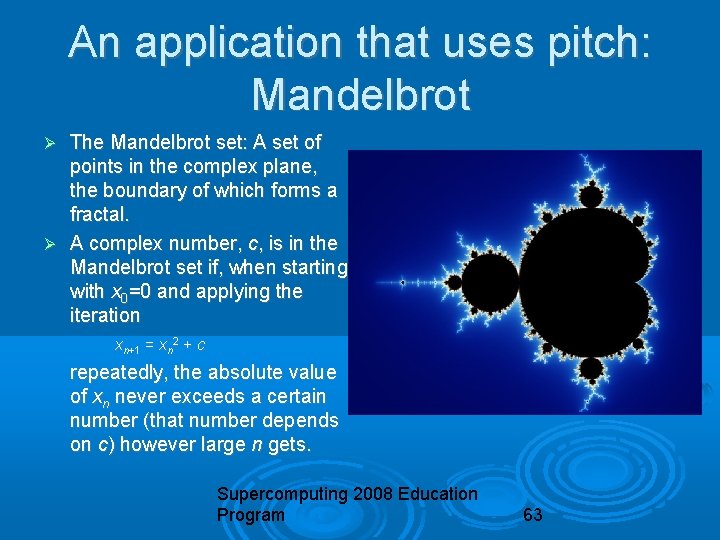
An application that uses pitch: Mandelbrot The Mandelbrot set: A set of points in the complex plane, the boundary of which forms a fractal. A complex number, c, is in the Mandelbrot set if, when starting with x 0=0 and applying the iteration xn+1 = xn 2 + c repeatedly, the absolute value of xn never exceeds a certain number (that number depends on c) however large n gets. Supercomputing 2008 Education Program 63
Demo: Comparison We can compare the execution times of: The sequential version The CUDA version Supercomputing 2008 Education Program 64
Performance Tip: Block Size Critical for performance Recommended value is 192 or 256 Maximum value is 512 Should be a multiple of 32 since this is the warp size for Series 8 GPUs and thus the native execution size for multiprocessors Limited by number of registers on the MP Series 8 GPU MPs have 8192 registers which are shared between all the threads on an MP Supercomputing 2008 Education Program 65
Performance Tip: Grid Size Critical for scalability Recommended value is at least 100, but 1000 would scale for many generations of hardware Actual value depends on size of the problem data It should be a multiple of the number of MPs for an even distribution of work (not a requirement though) Example: 24 blocks Grid will work efficiently on Series 8 (12 MPs), but it will waste resources on new GPUs with 32 MPs Supercomputing 2008 Education Program 66
Performance Tip: Code Divergance Control flow instructions diverge (threads take different paths of execution) Example: if, for, while Diverged code prevents SIMD execution – it forces serial execution (kills efficiency) One approach is to invoke a simpler kernel multiple times Liberal use of __syncthreads() Supercomputing 2008 Education Program 67
Performance Tip: Memory Latency 4 clock cycles for each memory read/write plus additional 400 -600 cycles for latency Memory latency can be hidden by keeping a large number of threads busy Keep number of threads per block (block size) and number of blocks per grid (grid size) as large as possible Constant memory can be used for constant data (variables that do not change). Constant memory is cached. Supercomputing 2008 Education Program 68
Performance Tip: Memory Reads Device is capable of reading a 32, 64 or 128 -bit number from memory with a single instruction Data has to be aligned in memory (this can be accomplished by using cuda. Malloc. Pitch() calls) If formatted properly, multiple threads from a warp can each receive a piece of memory with a single read instruction Supercomputing 2008 Education Program 69
Watchdog timer Operating system GUI may have a "watchdog" timer that causes programs using the primary graphics adapter to time out if they run longer than the maximum allowed time. Individual GPU program launches are limited to a run time of less than this maximum. Exceeding this time limit usually causes a launch failure. Possible solution: run CUDA on a GPU that is NOT attached to a display. Supercomputing 2008 Education Program 70
Resources on line http: //www. acmqueue. org/modules. php? name= Content&pa=showpage&pid=532 http: //www. ddj. com/hpc-high-performancecomputing/207200659 http: //www. nvidia. com/object/cuda_home. html# http: //www. nvidia. com/object/cuda_learn. html “Computation of Voronoi diagrams using a graphics processing unit” by Igor Majdandzic et al. available through IEEE Digital Library, DOI: 10. 1109/EIT. 2008. 4554342 Supercomputing 2008 Education Program 71