
Cuckoo Filter Practically Better Than Bloom Bin Fan

Cuckoo Filter: Practically Better Than Bloom Bin Fan (CMU/Google) David Andersen (CMU) Michael Kaminsky (Intel Labs) Michael Mitzenmacher (Harvard) 1
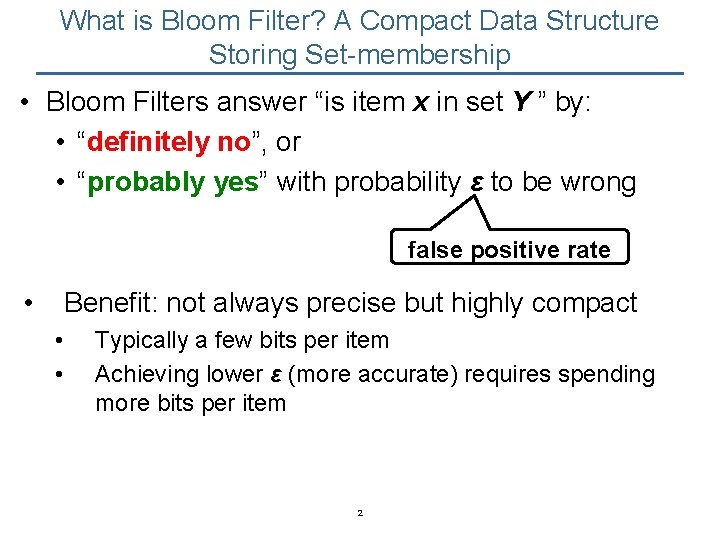
What is Bloom Filter? A Compact Data Structure Storing Set-membership • Bloom Filters answer “is item x in set Y ” by: • “definitely no”, or • “probably yes” with probability ε to be wrong false positive rate • Benefit: not always precise but highly compact • • Typically a few bits per item Achieving lower ε (more accurate) requires spending more bits per item 2
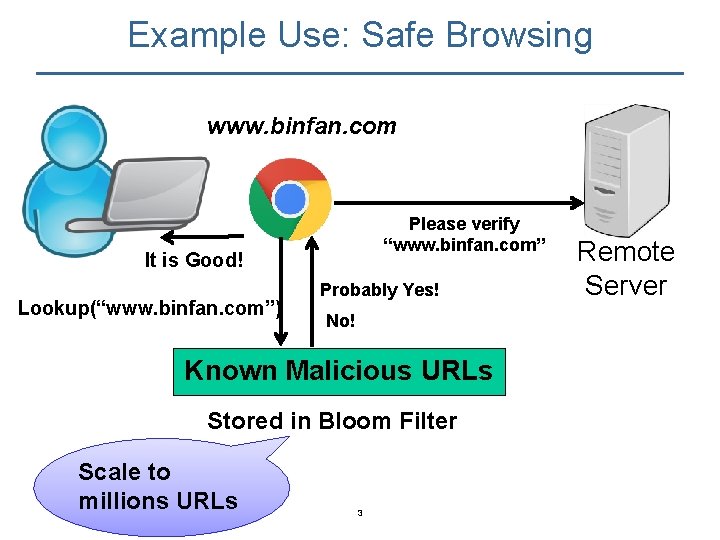
Example Use: Safe Browsing www. binfan. com Please verify “www. binfan. com” It is Good! Lookup(“www. binfan. com”) Probably Yes! No! Known Malicious URLs Stored in Bloom Filter Scale to millions URLs 3 Remote Server
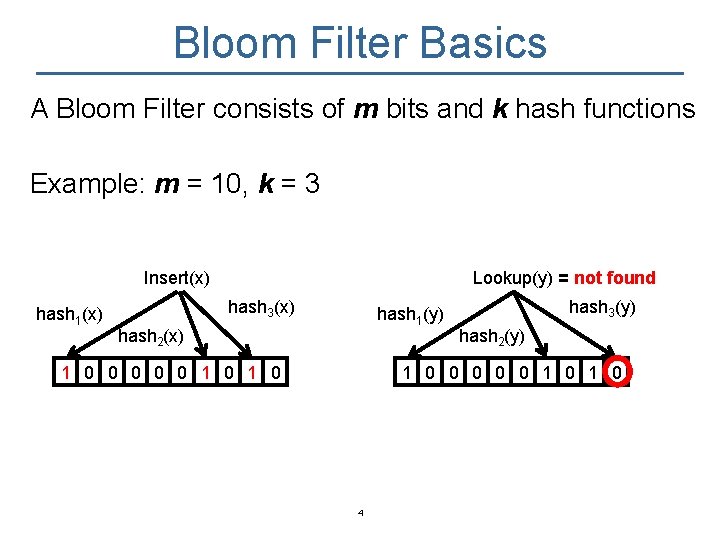
Bloom Filter Basics A Bloom Filter consists of m bits and k hash functions Example: m = 10, k = 3 Insert(x) hash 1(x) Lookup(y) = not found hash 3(x) hash 1(y) hash 2(x) 1 0 0 0 1 0 0 hash 3(y) hash 2(y) 1 0 0 0 1 0 4
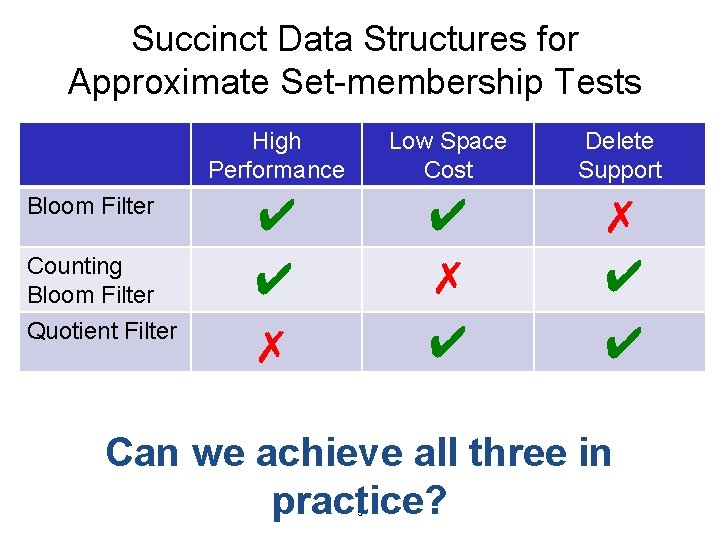
Succinct Data Structures for Approximate Set-membership Tests Bloom Filter Counting Bloom Filter Quotient Filter High Performance Low Space Cost Delete Support ✔ ✔ ✔ ✗ ✗ ✔ ✔ Can we achieve all three in practice? 5
Outline • Background • Cuckoo filter algorithm • Performance evaluation • Summary 6
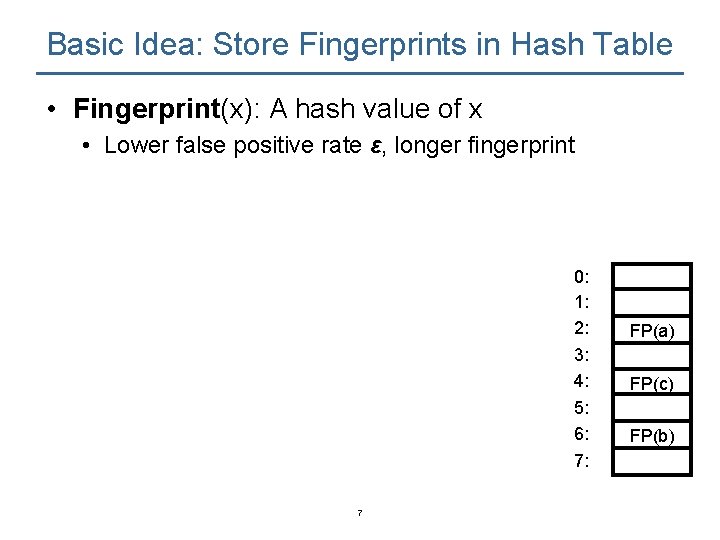
Basic Idea: Store Fingerprints in Hash Table • Fingerprint(x): A hash value of x • Lower false positive rate ε, longer fingerprint 0: 1: 2: 3: 4: 5: 6: 7: 7 FP(a) FP(c) FP(b)
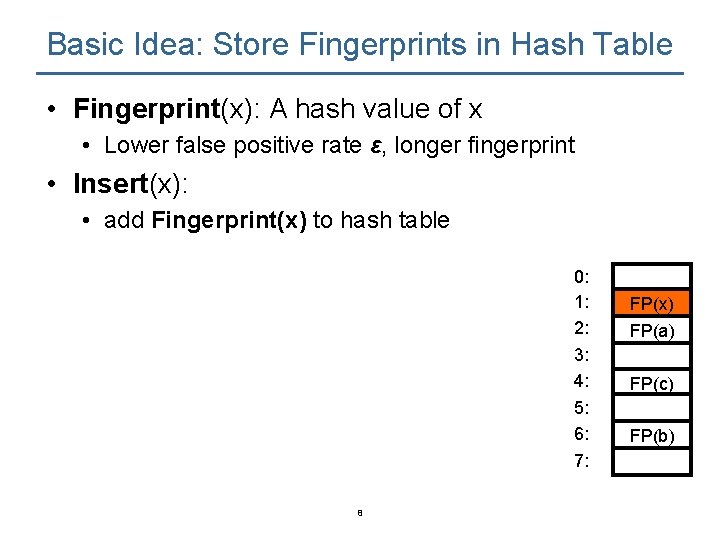
Basic Idea: Store Fingerprints in Hash Table • Fingerprint(x): A hash value of x • Lower false positive rate ε, longer fingerprint • Insert(x): • add Fingerprint(x) to hash table 0: 1: 2: 3: 4: 5: 6: 7: 8 FP(x) FP(a) FP(c) FP(b)
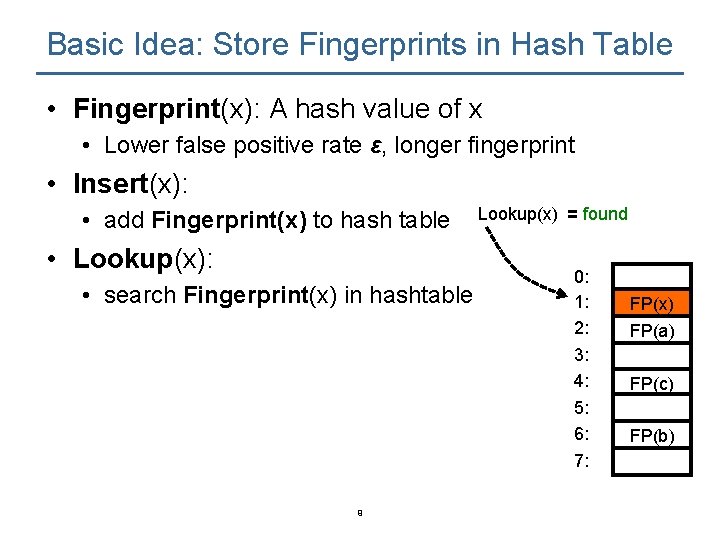
Basic Idea: Store Fingerprints in Hash Table • Fingerprint(x): A hash value of x • Lower false positive rate ε, longer fingerprint • Insert(x): • add Fingerprint(x) to hash table • Lookup(x): • search Fingerprint(x) in hashtable 9 Lookup(x) = found 0: 1: 2: 3: 4: 5: 6: 7: FP(x) FP(a) FP(c) FP(b)
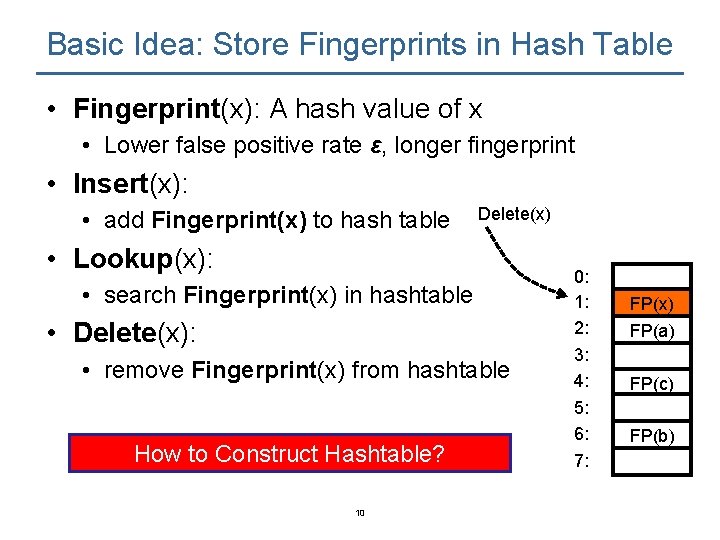
Basic Idea: Store Fingerprints in Hash Table • Fingerprint(x): A hash value of x • Lower false positive rate ε, longer fingerprint • Insert(x): • add Fingerprint(x) to hash table Delete(x) • Lookup(x): • search Fingerprint(x) in hashtable • Delete(x): • remove Fingerprint(x) from hashtable How to Construct Hashtable? 10 0: 1: 2: 3: 4: 5: 6: 7: FP(x) FP(a) FP(c) FP(b)
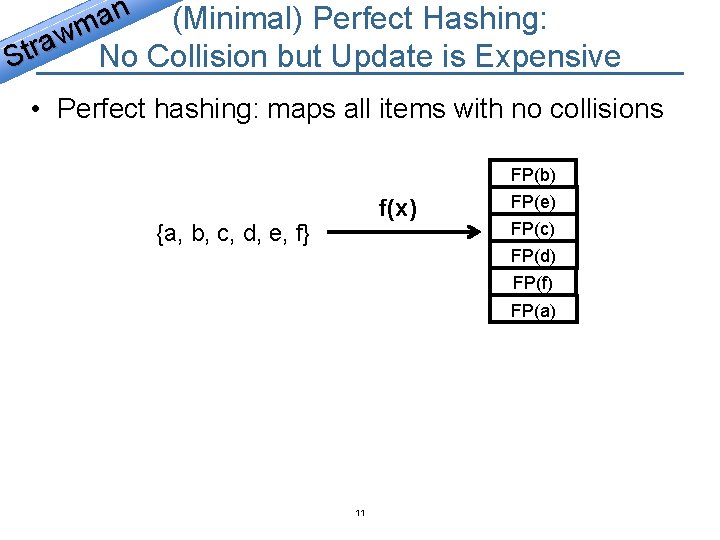
n (Minimal) Perfect Hashing: a m w a No Collision but Update is Expensive r t S • Perfect hashing: maps all items with no collisions FP(b) f(x) {a, b, c, d, e, f} FP(e) FP(c) FP(d) FP(f) FP(a) 11
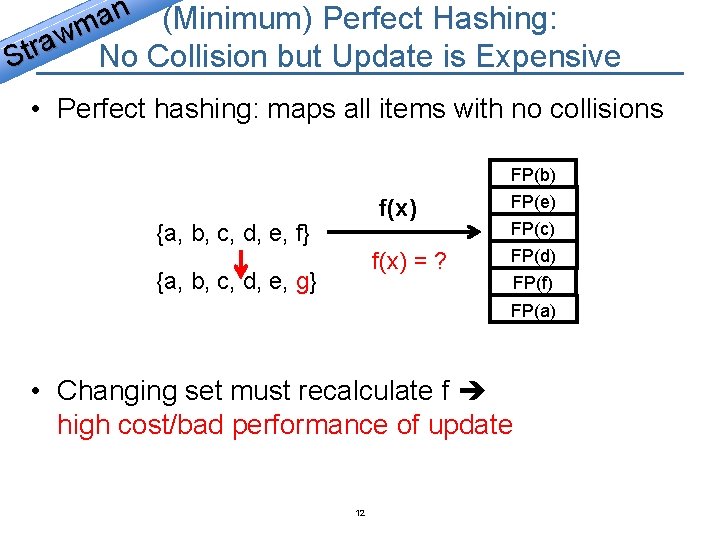
n (Minimum) Perfect Hashing: a m w a No Collision but Update is Expensive r t S • Perfect hashing: maps all items with no collisions FP(b) f(x) {a, b, c, d, e, f} f(x) = ? {a, b, c, d, e, g} FP(e) FP(c) FP(d) FP(f) FP(a) • Changing set must recalculate f high cost/bad performance of update 12
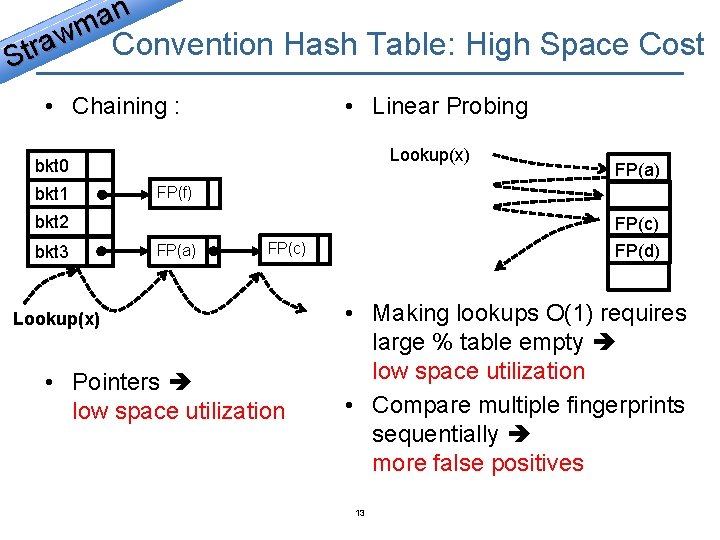
n a m w a Convention Hash Table: High Space Cost r t S • Chaining : • Linear Probing Lookup(x) bkt 0 bkt 1 FP(f) bkt 2 bkt 3 FP(a) FP(c) Lookup(x) • Pointers low space utilization FP(d) • Making lookups O(1) requires large % table empty low space utilization • Compare multiple fingerprints sequentially more false positives 13
![Cuckoo Hashing[Pagh 2004] Good But. . • High Space Utilization • 4 -way set-associative](http://slidetodoc.com/presentation_image_h/bb5a95351e65569a13e45429820002f5/image-14.jpg "Cuckoo Hashing[Pagh 2004] Good But. . • High Space Utilization • 4 -way set-associative")
Cuckoo Hashing[Pagh 2004] Good But. . • High Space Utilization • 4 -way set-associative table: >95% entries occupied • Fast Lookup: O(1) hash 1(x) lookup(x) hash 2(x) 0: 1: 2: 3: 4: 5: 6: 7: Standard cuckoo hashing doesn’t work with fingerprints 14 [Pagh 2004] Cuckoo hashing.
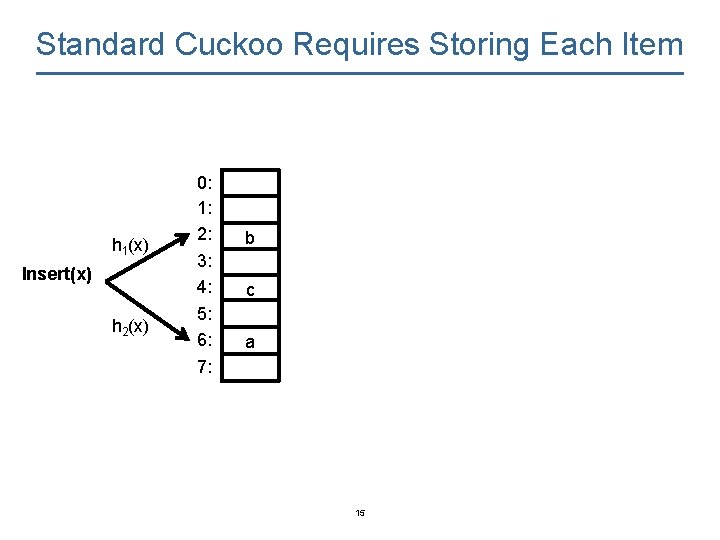
Standard Cuckoo Requires Storing Each Item h 1(x) Insert(x) h 2(x) 0: 1: 2: 3: 4: 5: 6: 7: b c a 15
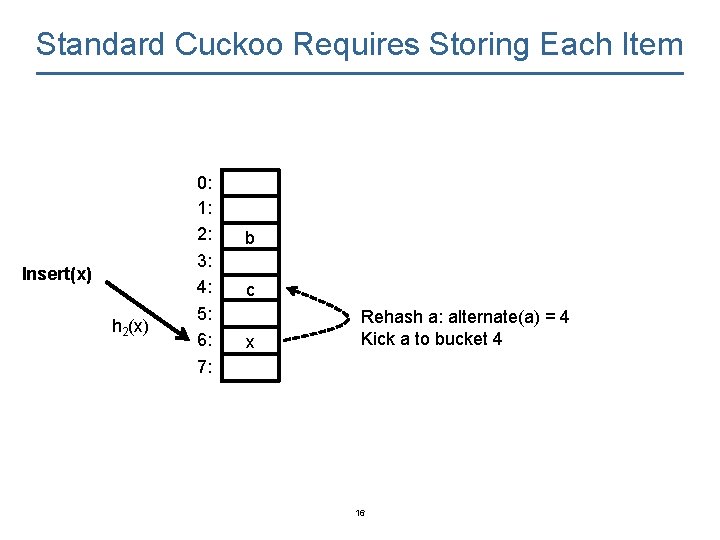
Standard Cuckoo Requires Storing Each Item Insert(x) h 2(x) 0: 1: 2: 3: 4: 5: 6: 7: b c x Rehash a: alternate(a) = 4 Kick a to bucket 4 16
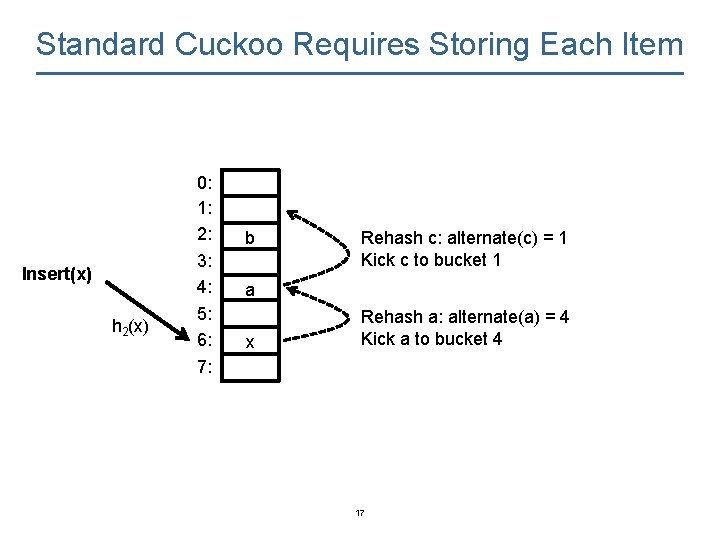
Standard Cuckoo Requires Storing Each Item Insert(x) h 2(x) 0: 1: 2: 3: 4: 5: 6: 7: b Rehash c: alternate(c) = 1 Kick c to bucket 1 a x Rehash a: alternate(a) = 4 Kick a to bucket 4 17
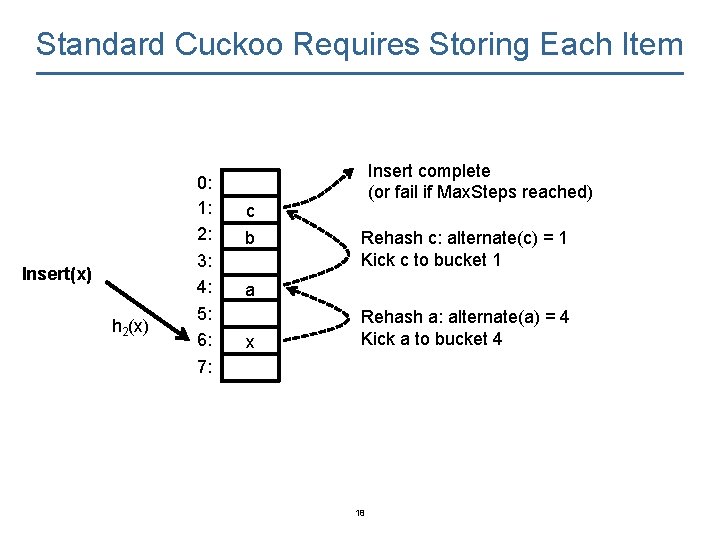
Standard Cuckoo Requires Storing Each Item Insert(x) h 2(x) 0: 1: 2: 3: 4: 5: 6: 7: c b Insert complete (or fail if Max. Steps reached) Rehash c: alternate(c) = 1 Kick c to bucket 1 a x Rehash a: alternate(a) = 4 Kick a to bucket 4 18
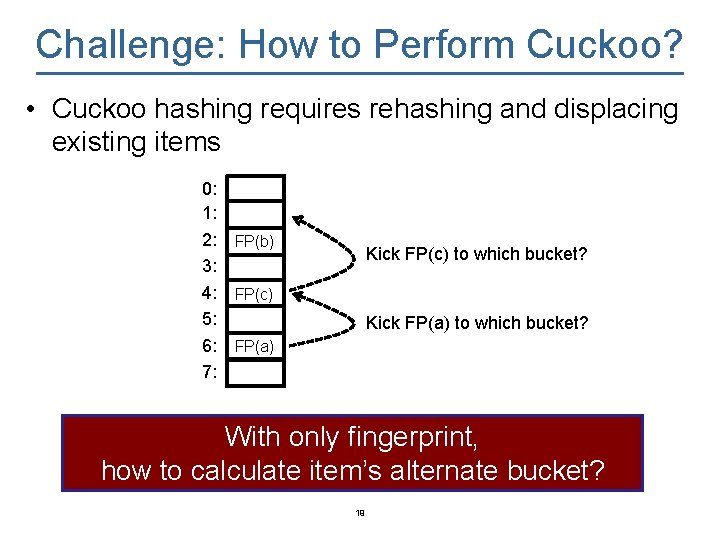
Challenge: How to Perform Cuckoo? • Cuckoo hashing requires rehashing and displacing existing items 0: 1: 2: FP(b) 3: 4: FP(c) 5: 6: FP(a) 7: Kick FP(c) to which bucket? Kick FP(a) to which bucket? With only fingerprint, how to calculate item’s alternate bucket? 19
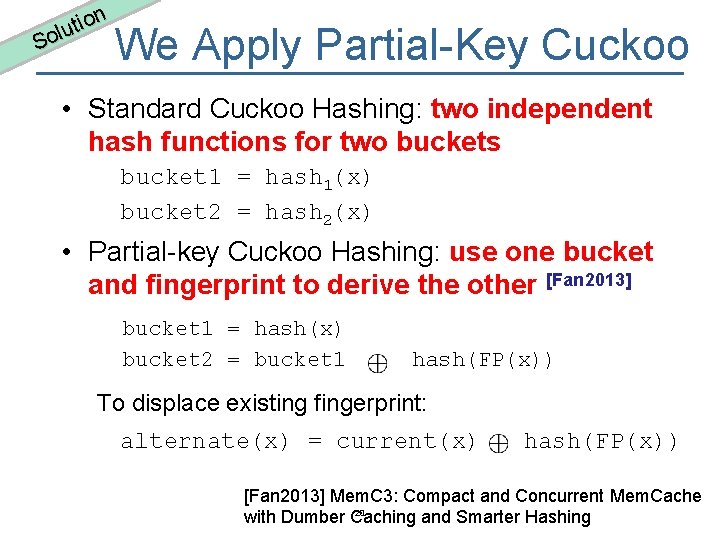
n o i t lu So We Apply Partial-Key Cuckoo • Standard Cuckoo Hashing: two independent hash functions for two buckets bucket 1 = hash 1(x) bucket 2 = hash 2(x) • Partial-key Cuckoo Hashing: use one bucket and fingerprint to derive the other [Fan 2013] bucket 1 = hash(x) bucket 2 = bucket 1 hash(FP(x)) To displace existing fingerprint: alternate(x) = current(x) hash(FP(x)) [Fan 2013] Mem. C 3: Compact and Concurrent Mem. Cache 20 with Dumber Caching and Smarter Hashing
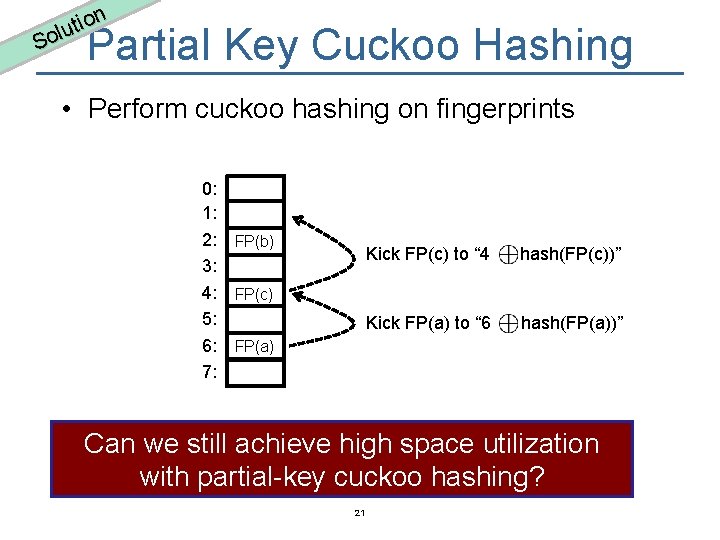
n o i t lu So Partial Key Cuckoo Hashing • Perform cuckoo hashing on fingerprints 0: 1: 2: FP(b) 3: 4: FP(c) 5: 6: FP(a) 7: Kick FP(c) to “ 4 hash(FP(c))” Kick FP(a) to “ 6 hash(FP(a))” Can we still achieve high space utilization with partial-key cuckoo hashing? 21
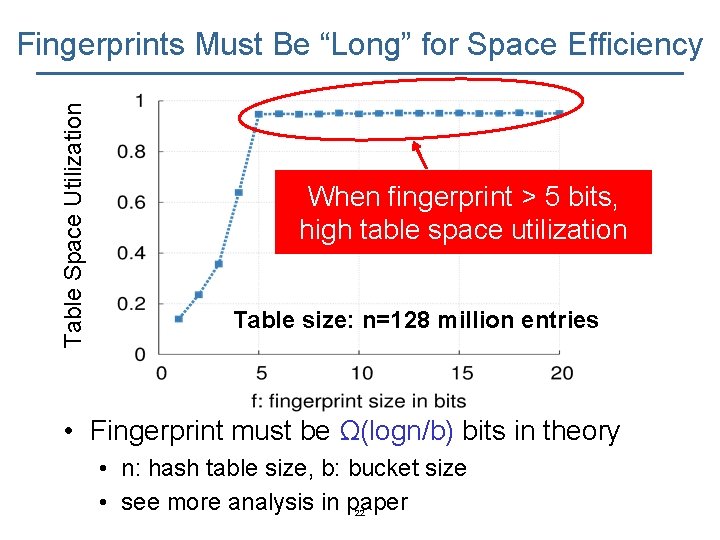
Table Space Utilization Fingerprints Must Be “Long” for Space Efficiency When fingerprint > 5 bits, high table space utilization Table size: n=128 million entries • Fingerprint must be Ω(logn/b) bits in theory • n: hash table size, b: bucket size • see more analysis in paper 22
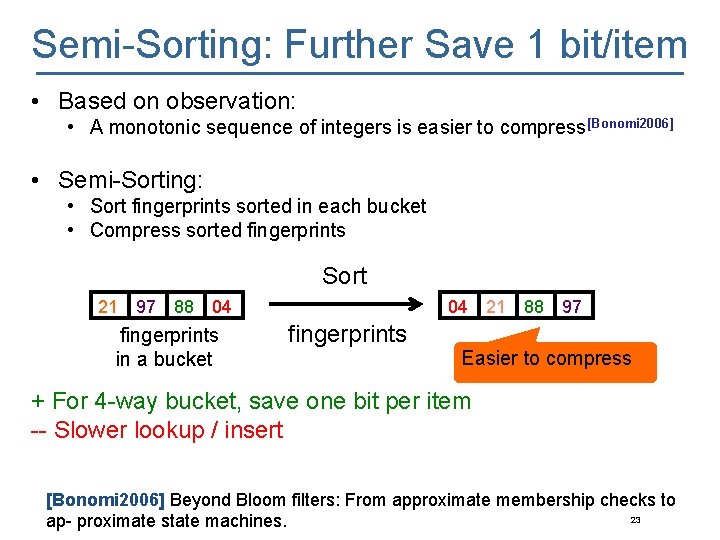
Semi-Sorting: Further Save 1 bit/item • Based on observation: • A monotonic sequence of integers is easier to compress[Bonomi 2006] • Semi-Sorting: • Sort fingerprints sorted in each bucket • Compress sorted fingerprints Sort 21 97 88 04 fingerprints in a bucket 04 21 88 97 fingerprints Easier to compress + For 4 -way bucket, save one bit per item -- Slower lookup / insert [Bonomi 2006] Beyond Bloom filters: From approximate membership checks to 23 ap- proximate state machines.
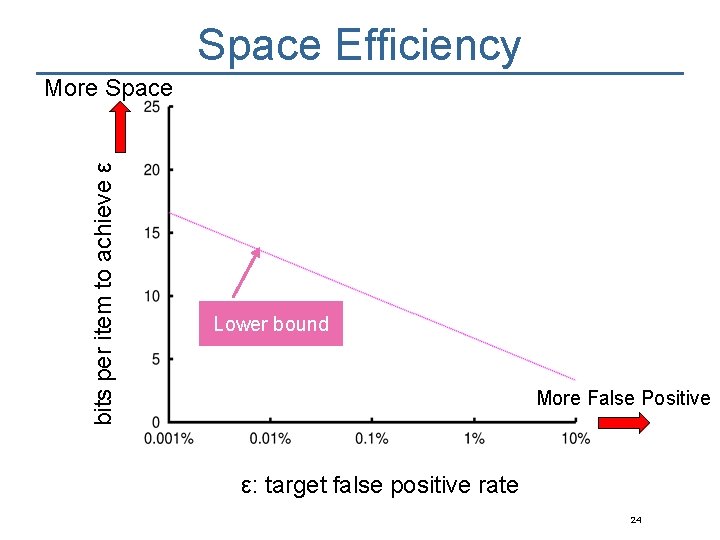
Space Efficiency bits per item to achieve ε More Space Lower bound More False Positive ε: target false positive rate 24
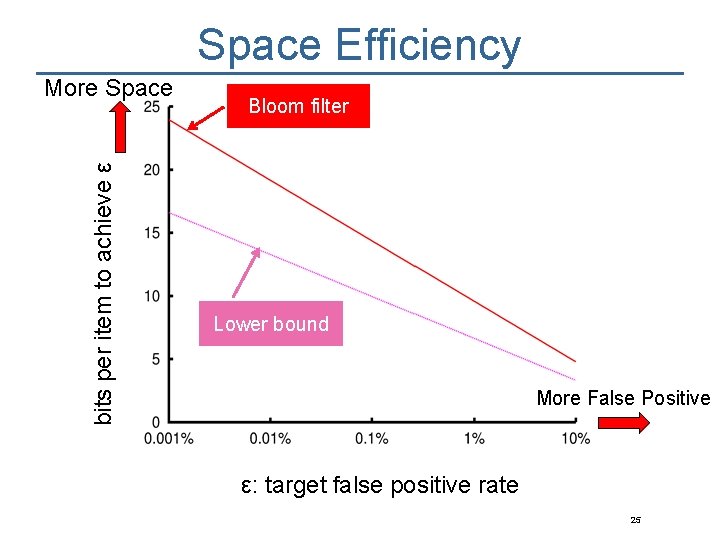
Space Efficiency bits per item to achieve ε More Space Bloom filter Lower bound More False Positive ε: target false positive rate 25
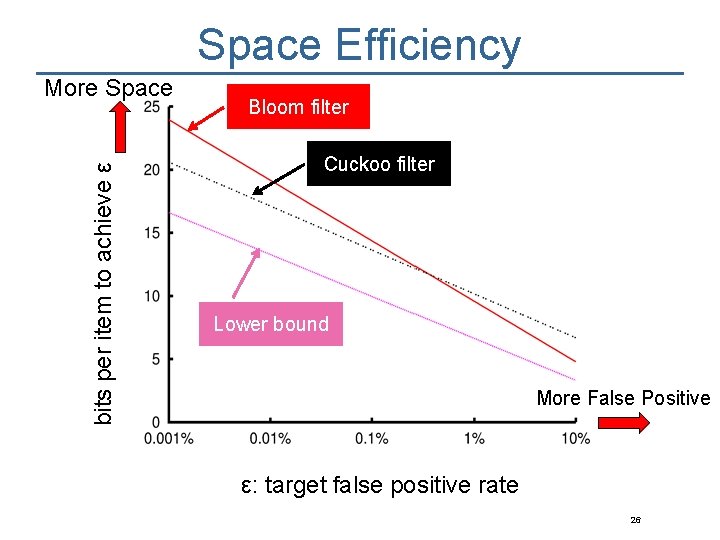
Space Efficiency bits per item to achieve ε More Space Bloom filter Cuckoo filter Lower bound More False Positive ε: target false positive rate 26

Space Efficiency bits per item to achieve ε More Space Bloom filter Cuckoo filter more compact than Bloom filter at 3% Lower bound Cuckoo filter + semisorting More False Positive ε: target false positive rate 27
Outline • Background • Cuckoo filter algorithm • Performance evaluation • Summary 28
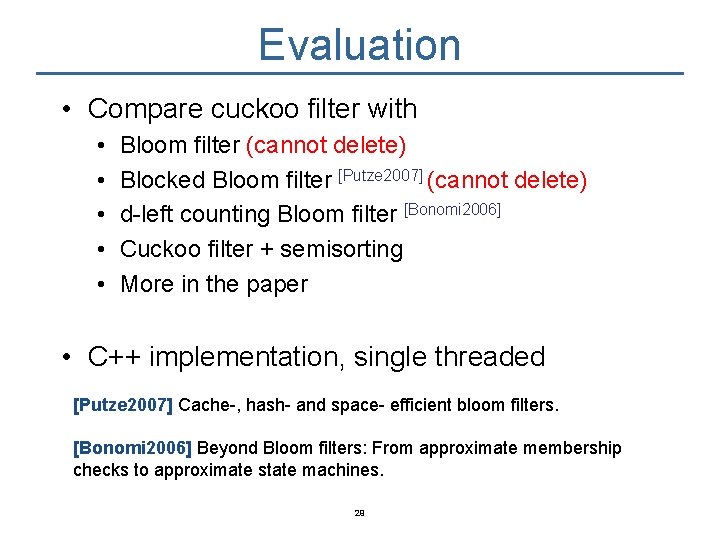
Evaluation • Compare cuckoo filter with • • • Bloom filter (cannot delete) Blocked Bloom filter [Putze 2007] (cannot delete) d-left counting Bloom filter [Bonomi 2006] Cuckoo filter + semisorting More in the paper • C++ implementation, single threaded [Putze 2007] Cache-, hash- and space- efficient bloom filters. [Bonomi 2006] Beyond Bloom filters: From approximate membership checks to approximate state machines. 29
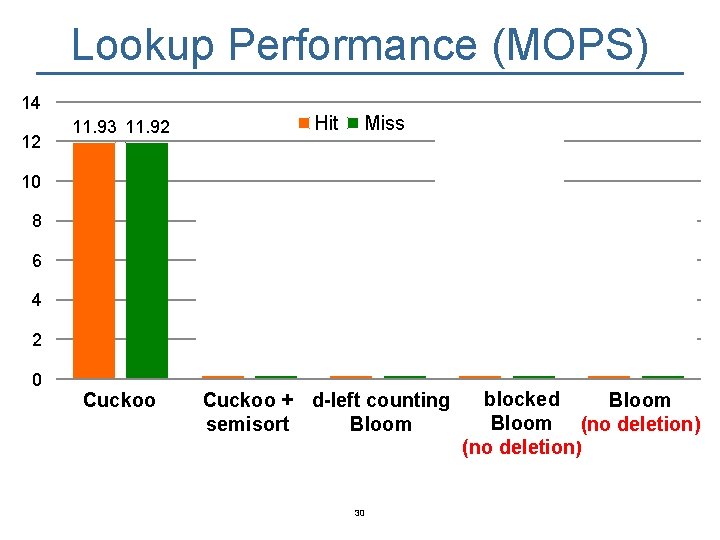
Lookup Performance (MOPS) 14 12 Hit 11. 93 11. 92 Miss 10 7. 96 8 6. 28 8. 51 12. 04 9. 26 8. 28 6. 45 6 4. 86 4 2 0 cf Cuckoo cfss + d-left dlbf Cuckoo counting semisort Bloom 30 blocked bbf bf Bloom (no deletion)
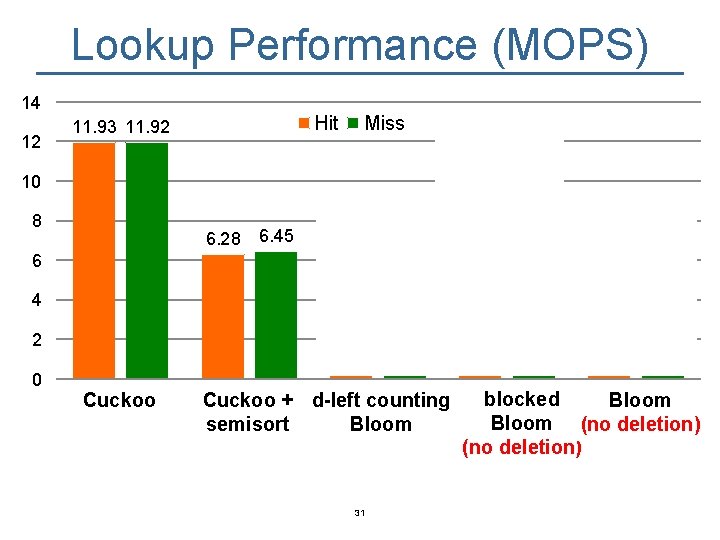
Lookup Performance (MOPS) 14 12 Hit 11. 93 11. 92 Miss 10 7. 96 8 6. 28 8. 51 12. 04 9. 26 8. 28 6. 45 6 4. 86 4 2 0 cf Cuckoo cfss + d-left dlbf Cuckoo counting semisort Bloom 31 blocked bbf bf Bloom (no deletion)
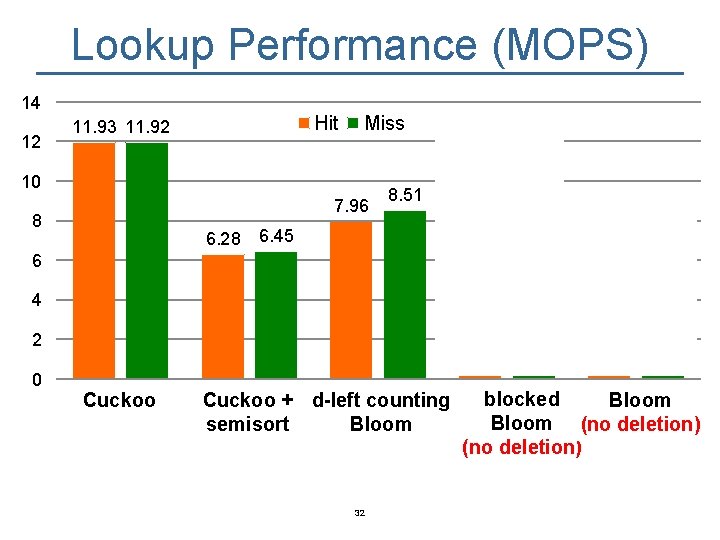
Lookup Performance (MOPS) 14 12 Hit 11. 93 11. 92 Miss 10 7. 96 8 6. 28 8. 51 12. 04 9. 26 8. 28 6. 45 6 4. 86 4 2 0 cf Cuckoo cfss + d-left dlbf Cuckoo counting semisort Bloom 32 blocked bbf bf Bloom (no deletion)
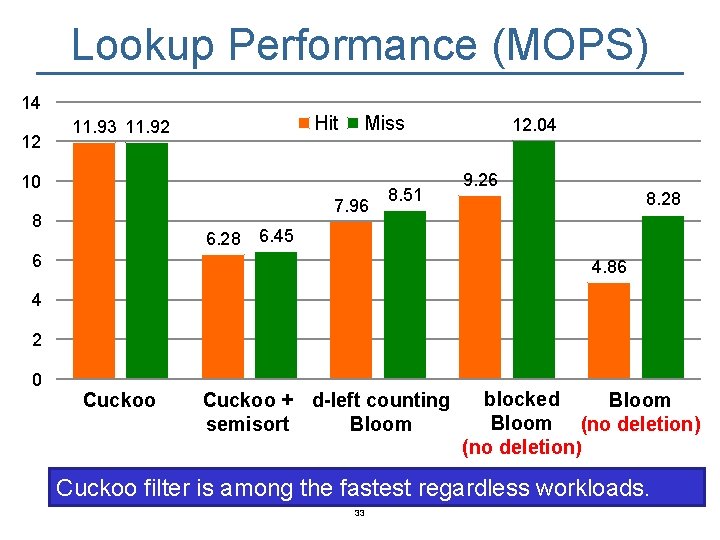
Lookup Performance (MOPS) 14 12 Hit 11. 93 11. 92 Miss 10 7. 96 8 6. 28 8. 51 12. 04 9. 26 8. 28 6. 45 6 4. 86 4 2 0 cf Cuckoo cfss + d-left dlbf Cuckoo counting semisort Bloom blocked bbf bf Bloom (no deletion) Cuckoo filter is among the fastest regardless workloads. 33
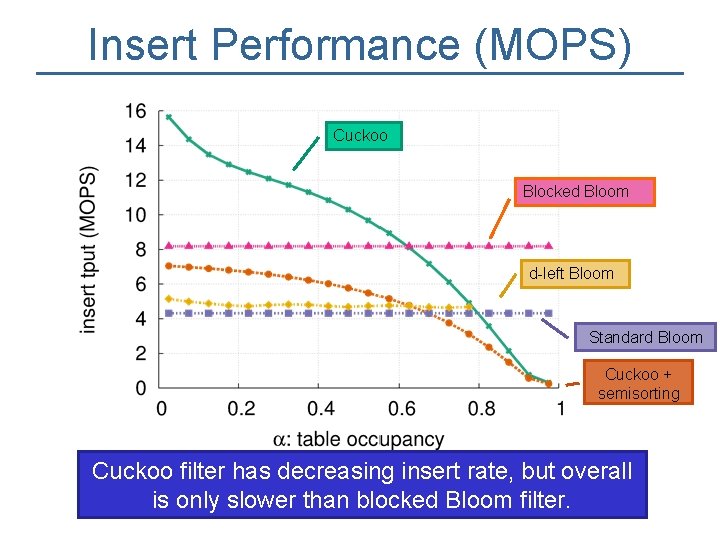
Insert Performance (MOPS) Cuckoo Blocked Bloom d-left Bloom Standard Bloom Cuckoo + semisorting Cuckoo filter has decreasing insert rate, but overall is only slower than blocked Bloom filter. 34
Summary • Cuckoo filter, a Bloom filter replacement: • • Deletion support High performance Less Space than Bloom filters in practice Easy to implement • Source code available in C++: • https: //github. com/efficient/cuckoofilter 35
- Slides: 35