
CUBIC Qian HE Steve CS 577 Prof Bob
CUBIC Qian HE (Steve) CS 577 – Prof. Bob Kinicki

Agenda • Brief Introduction of CUBIC • Prehistory of CUBIC – Standard TCP – BIC • CUBIC • Conclusion 1

Brief Introduction • CUBIC is a less aggressive and more systematic derivative of BIC, in which the window is a cubic function of time since the last congestion event, with the inflection point set to the window prior to the event. 2
Why do we need CUBIC-TCP? • Compares to: – Standard TCP – BIC-TCP 3
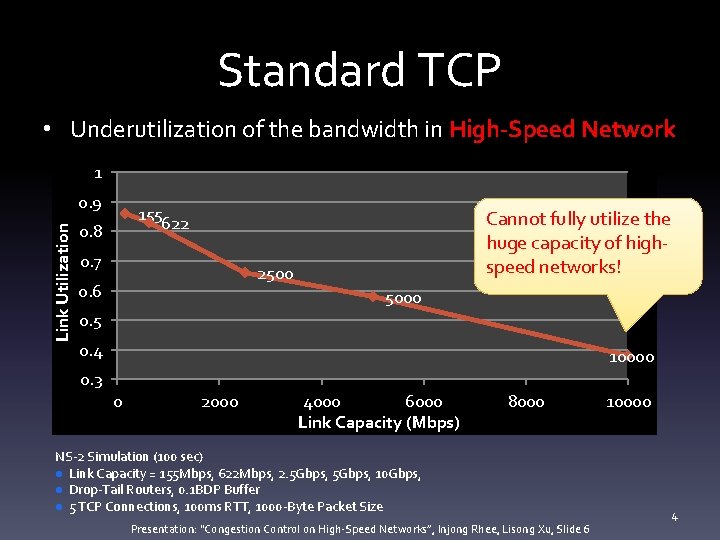
Standard TCP • Underutilization of the bandwidth in High-Speed Network 1 Link Utilization 0. 9 155622 0. 8 0. 7 Cannot fully utilize the huge capacity of highspeed networks! 2500 0. 6 5000 0. 5 0. 4 0. 3 10000 0 2000 4000 6000 Link Capacity (Mbps) 8000 NS-2 Simulation (100 sec) l Link Capacity = 155 Mbps, 622 Mbps, 2. 5 Gbps, 10 Gbps, l Drop-Tail Routers, 0. 1 BDP Buffer l 5 TCP Connections, 100 ms RTT, 1000 -Byte Packet Size Presentation: "Congestion Control on High-Speed Networks”, Injong Rhee, Lisong Xu, Slide 6 10000 4
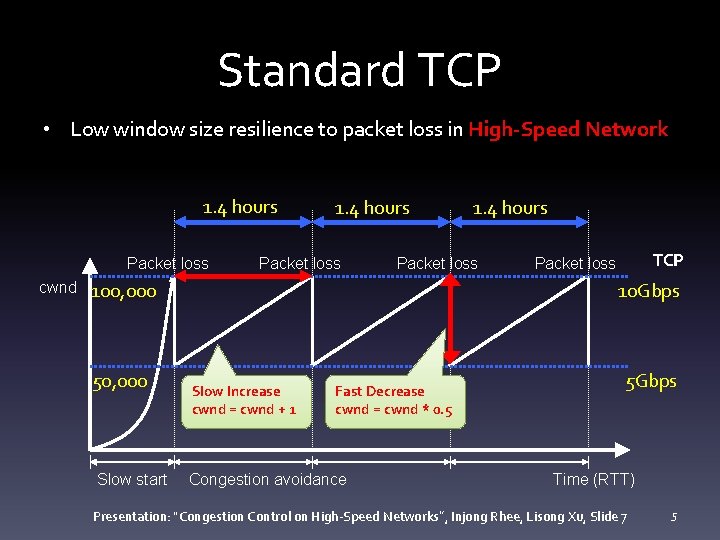
Standard TCP • Low window size resilience to packet loss in High-Speed Network 1. 4 hours Packet loss cwnd 1. 4 hours Packet loss 100, 000 50, 000 Slow start 1. 4 hours TCP Packet loss 10 Gbps Slow Increase cwnd = cwnd + 1 Fast Decrease cwnd = cwnd * 0. 5 Congestion avoidance 5 Gbps Time (RTT) Presentation: "Congestion Control on High-Speed Networks”, Injong Rhee, Lisong Xu, Slide 7 5
Why BIC? • Existing schemes have a severe RTT unfairness problem • RTT unfairness for high-speed networks occurs distinctly with drop tail routers for flows with large congestion windows where packet loss can be highly synchronized. 6
BIC • “Binary Increase Congestion Control (BIC) for Fast Long-Distance Networks”, Lisong Xu, Khaled Harfoush, and Injong Rhee, IEEE INFOCOM 2004 7
Goals of BIC • Scalability: BIC can scale its bandwidth share to 10 Gbps around 3. 5 e-8 loss rates (comparable to HSTCP which reaches 10 Gbps at 1 e-7). • RTT fairness: for large windows, BIC’s RTT unfairness is proportional to the inverse square of the RTT ratio as in AIMD. • TCP friendliness: BIC achieves bounded TCP fairness for all window sizes. Around high loss rates where TCP performs well, its TCP friendliness is comparable to STCP’s. • Fairness and convergence: compared to HSTCP and STCP, BIC achieves better bandwidth fairness over both short and long time scales, and faster convergence to a fair bandwidth share. 8
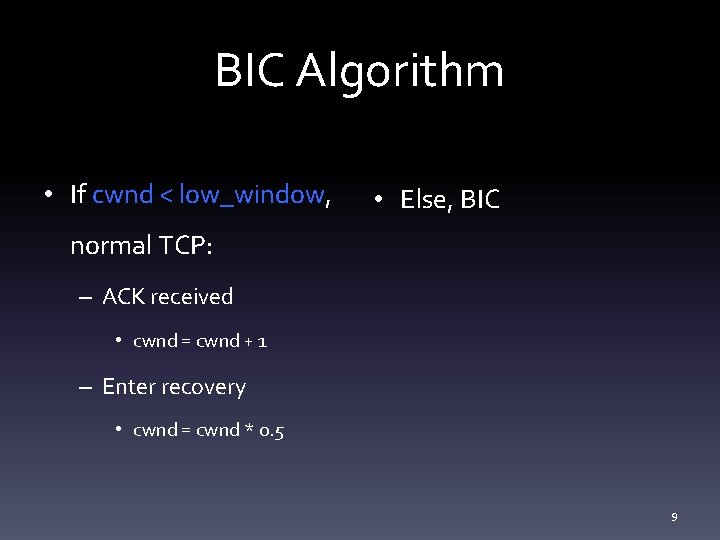
BIC Algorithm • If cwnd < low_window, • Else, BIC normal TCP: – ACK received • cwnd = cwnd + 1 – Enter recovery • cwnd = cwnd * 0. 5 9
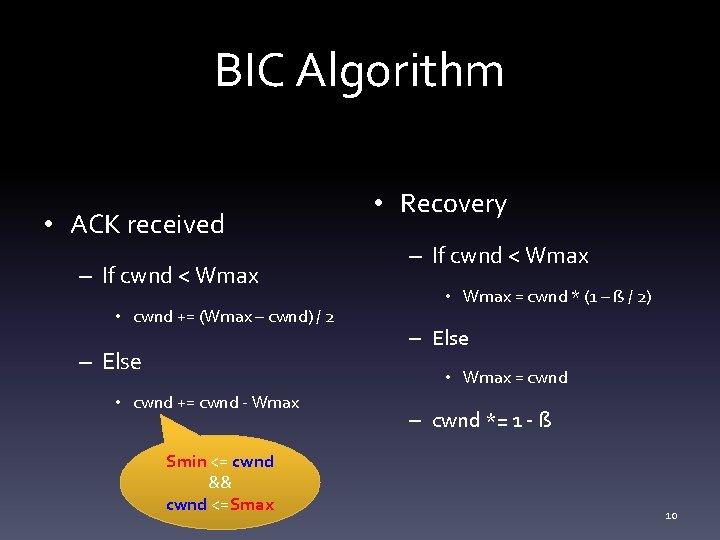
BIC Algorithm • ACK received – If cwnd < Wmax • cwnd += (Wmax – cwnd) / 2 – Else • Recovery – If cwnd < Wmax • Wmax = cwnd * (1 – ß / 2) – Else • Wmax = cwnd • cwnd += cwnd - Wmax Smin <= cwnd && cwnd <=Smax – cwnd *= 1 - ß 10
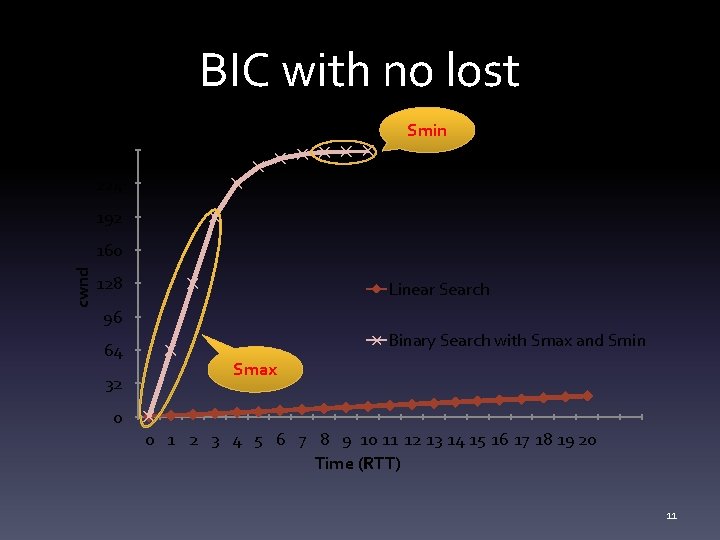
BIC with no lost Smin 256 224 192 cwnd 160 128 Linear Search 96 64 32 0 Binary Search with Smax and Smin Smax 0 1 2 3 4 5 6 7 8 9 10 11 12 13 14 15 16 17 18 19 20 Time (RTT) 11
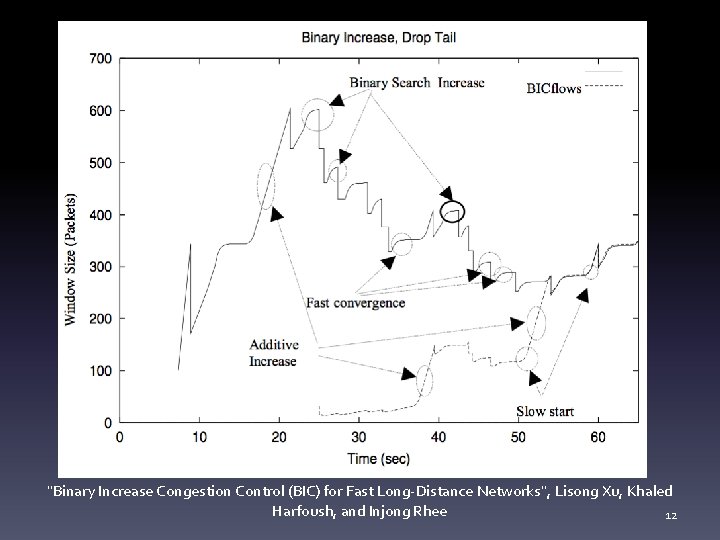
"Binary Increase Congestion Control (BIC) for Fast Long-Distance Networks", Lisong Xu, Khaled Harfoush, and Injong Rhee 12
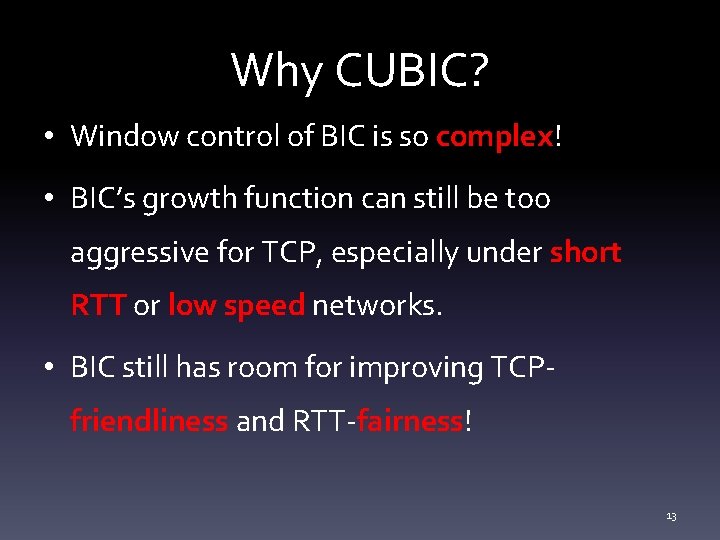
Why CUBIC? • Window control of BIC is so complex! • BIC’s growth function can still be too aggressive for TCP, especially under short RTT or low speed networks. • BIC still has room for improving TCPfriendliness and RTT-fairness! 13
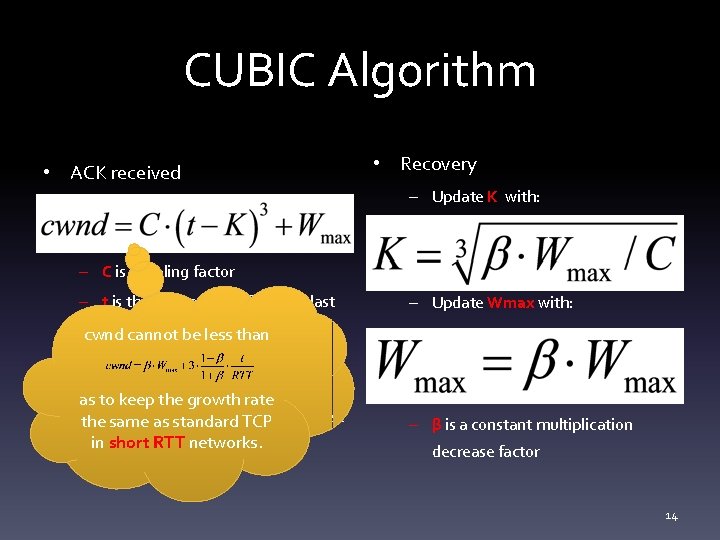
CUBIC Algorithm • ACK received • Recovery – Update K with: – C is a scaling factor – t is the elapsed time from the last – Update Wmax with: window reduction cwnd cannot be less than – Wmax is the window size just before the last window reduction as to keep the growth rate –the. Ksame is updated at the time as standard TCPof last lost inevent short RTT networks. – β is a constant multiplication decrease factor 14
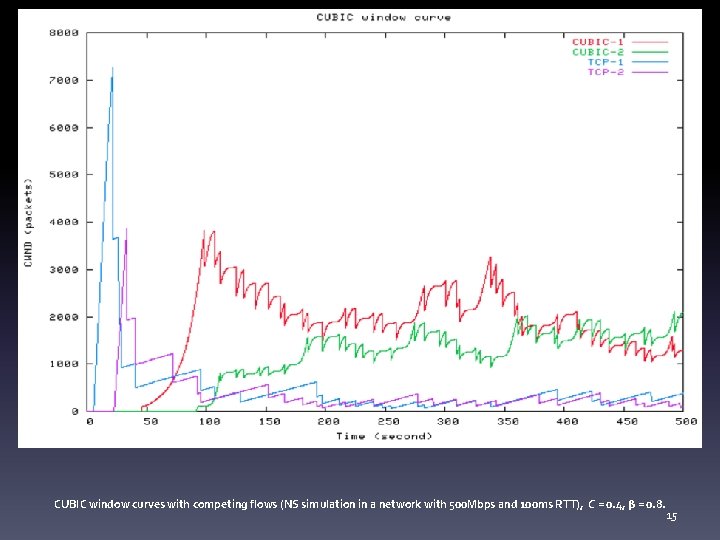
CUBIC window curves with competing flows (NS simulation in a network with 500 Mbps and 100 ms RTT), C = 0. 4, β = 0. 8. 15
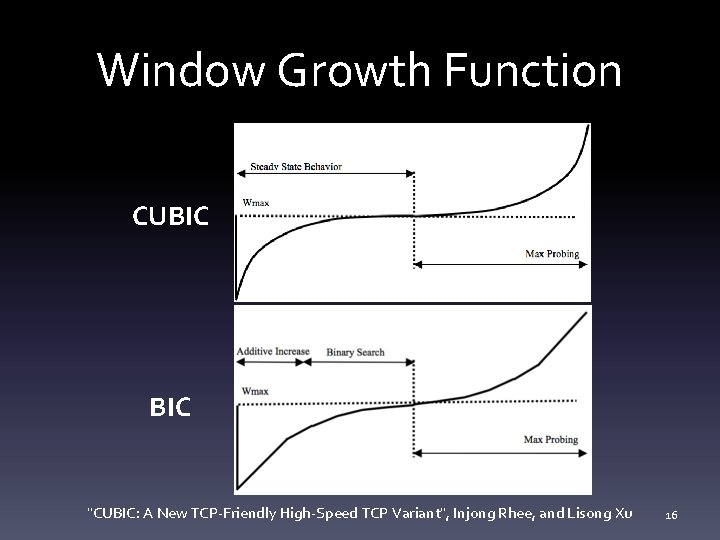
Window Growth Function CUBIC "CUBIC: A New TCP-Friendly High-Speed TCP Variant", Injong Rhee, and Lisong Xu 16
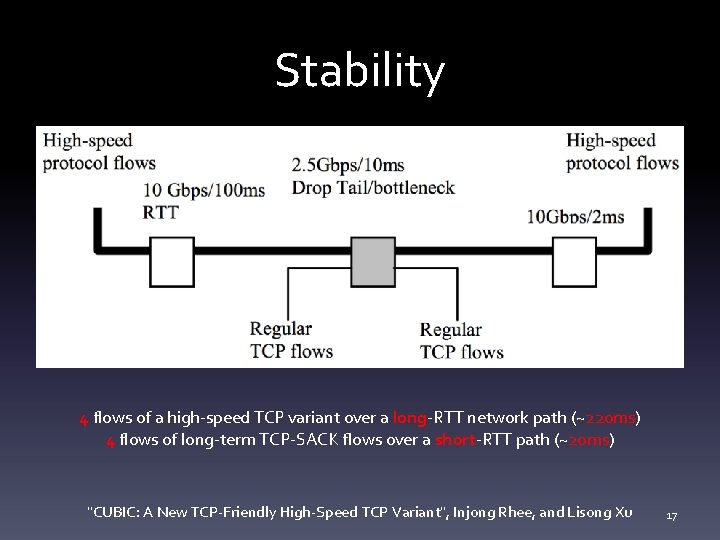
Stability 4 flows of a high-speed TCP variant over a long-RTT network path (~220 ms) 4 flows of long-term TCP-SACK flows over a short-RTT path (~20 ms) "CUBIC: A New TCP-Friendly High-Speed TCP Variant", Injong Rhee, and Lisong Xu 17
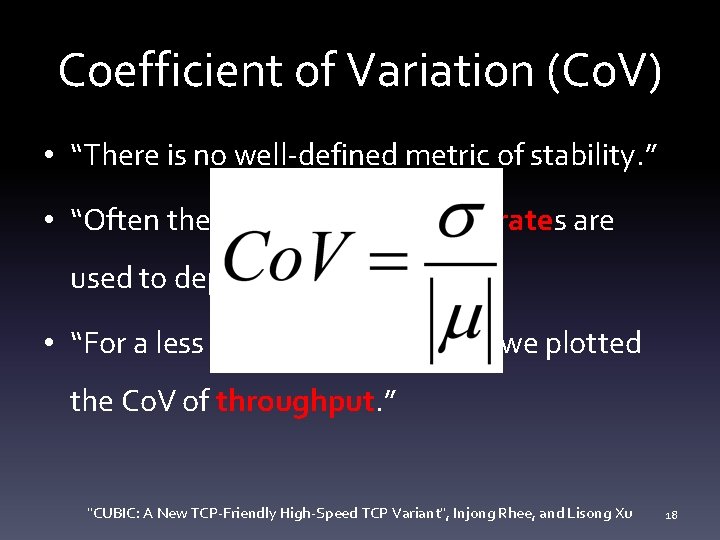
Coefficient of Variation (Co. V) • “There is no well-defined metric of stability. ” • “Often the Co. V of transmission rates are used to depict stability. ” • “For a less satisfactory measure, we plotted the Co. V of throughput. ” "CUBIC: A New TCP-Friendly High-Speed TCP Variant", Injong Rhee, and Lisong Xu 18
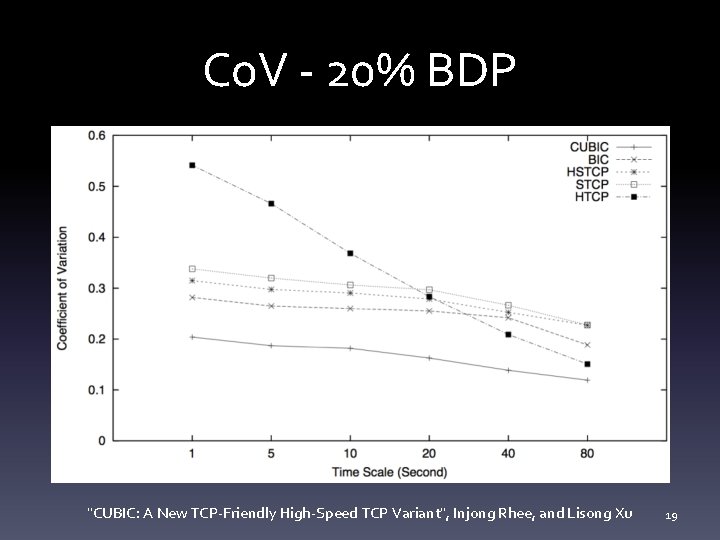
Co. V - 20% BDP "CUBIC: A New TCP-Friendly High-Speed TCP Variant", Injong Rhee, and Lisong Xu 19
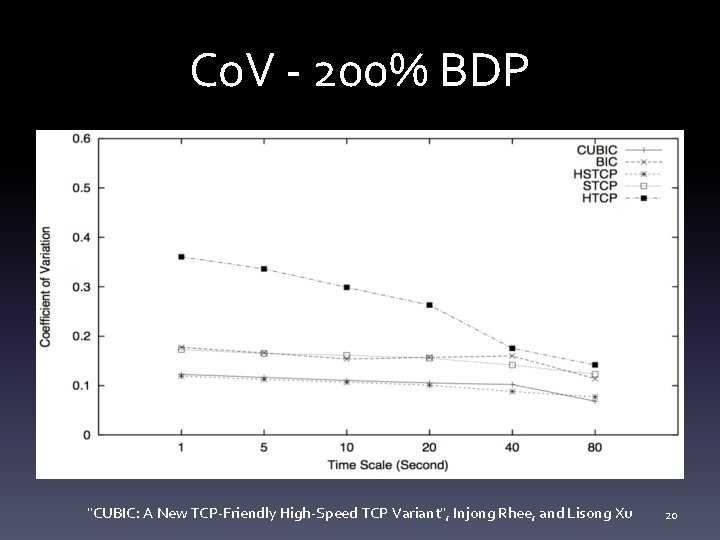
Co. V - 200% BDP "CUBIC: A New TCP-Friendly High-Speed TCP Variant", Injong Rhee, and Lisong Xu 20
Thanks
- Slides: 22