
Cube Sat Platform for Sea Hawk Clyde Space
Cube. Sat Platform for Sea. Hawk Clyde Space PDR Design © Clyde Space Ltd. 2015
Presentation Overview • Abbreviations • Requirements • Platform Design, Functional Architecture and Budgets • Payload Interfaces • Subsystem Design • Discussion topics 2 © Clyde Space Ltd. 2015
Abbreviations • • • ADCS: Attitude Determination and Control System ADM: Antenna Deployment Module BAT: Battery BCR: Battery Charge Regulator C&DH: Command Data Handling CONOPS: Concept of Operations CSS: Coarse Sun Sensor FSS: Fine Sun Sensor EPS: Electrical Power System GPS: Global Positioning System MTQ: Magnetorquer MTM: Magnetometer • • • OBC: On-board Computer OBDH: On-Board data handling PIM: Payload Interface Module PPT: Peak Power Tracker PLC: Payload Computer RG: Rate Gyroscopes RW(S): Reaction Wheels SA: Solar Array SADM: Solar Array Deployment Module SS: Sun Sensors STT: Star Tracker UIM: Umbilical Interface Module 3 © Clyde Space Ltd. 2015
Requirements © Clyde Space Ltd. 2015 4
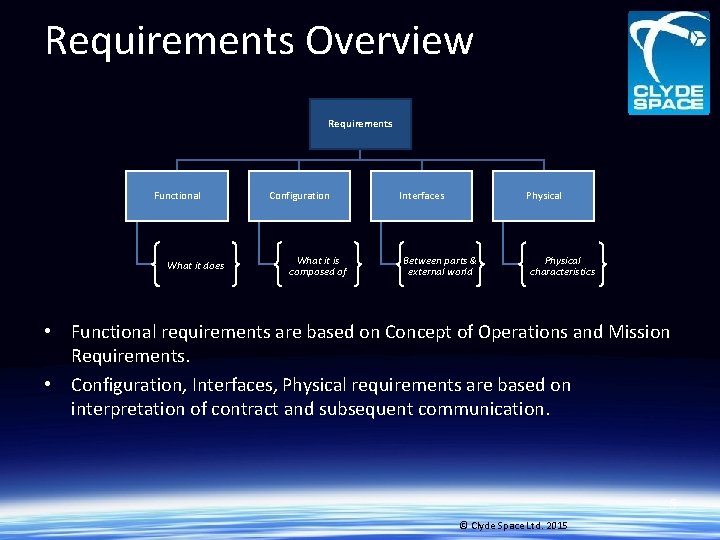
Requirements Overview Requirements Functional What it does Configuration What it is composed of Interfaces Physical Between parts & external world Physical characteristics • Functional requirements are based on Concept of Operations and Mission Requirements. • Configuration, Interfaces, Physical requirements are based on interpretation of contract and subsequent communication. 5 © Clyde Space Ltd. 2015
Requirements Flowdown CUSTOMER REQUIREMENT: The Platform shall support Hawk. Eye Payload operations and science data downlinking. • DERIVED REQUIREMENTS ON: – – – Operations Power Physical C&DH ADCS Communications • Based on interpretation of contract and communication till date. 6 © Clyde Space Ltd. 2015
Payload Ops Requirements OPERATIONS REQUIREMENT: The Platform shall support Hawk. Eye Payload operations and science data downlinking. • Platform shall support payload operations for at least 12 months, 24 months desirable. • Platform shall be able to operate between 400 and 540 km altitude. • Science observations will only be performed during sunlit part of the orbit, not during eclipse. 7 © Clyde Space Ltd. 2015
Power Requirements POWER REQUIREMENT: The power subsystem shall provide power to all subsystems; Mission mode and Tumbling mode • DERIVED REQUIREMENTS: – Power Generation • Configuration TBD, currently assuming a configuration of • 2 x 3 U deployable and body mounted solar arrays. – Power Distribution • Provide power on 3 V 3, 5 V, 12 V, Batt. V buses • Provide over-current protection – Power Consumption • See later Power Budget slide 8 © Clyde Space Ltd. 2015
Physical Requirements PLATFORM REQUIREMENT: The Platform shall be a 3 U Cube. Sat capable of supporting the Sea. Hawk payload. • DERIVED REQUIREMENTS: – – Cube. Sat Standard Primary Structure needed Support Payload Interfaces Shall accommodate all necessary modules and components 9 © Clyde Space Ltd. 2015
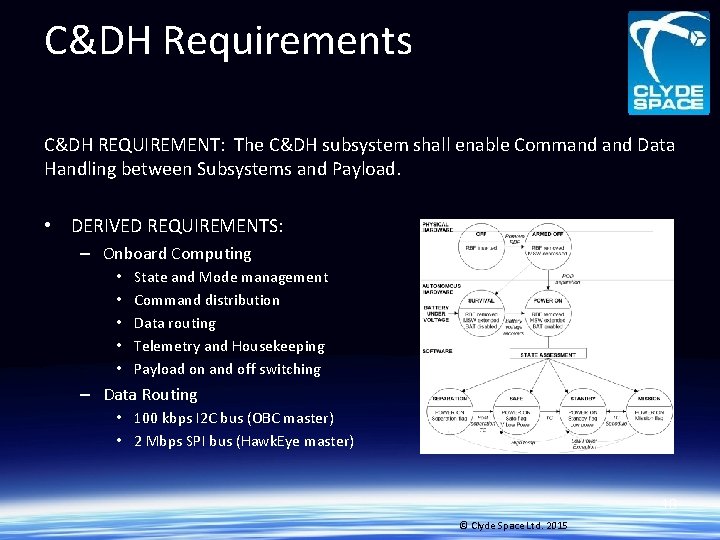
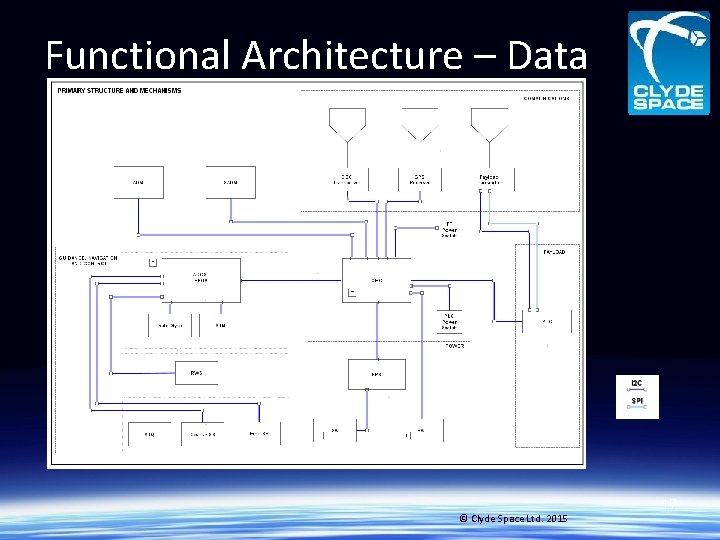
C&DH Requirements C&DH REQUIREMENT: The C&DH subsystem shall enable Command Data Handling between Subsystems and Payload. • DERIVED REQUIREMENTS: – Onboard Computing • • • State and Mode management Command distribution Data routing Telemetry and Housekeeping Payload on and off switching – Data Routing • 100 kbps I 2 C bus (OBC master) • 2 Mbps SPI bus (Hawk. Eye master) 10 © Clyde Space Ltd. 2015
ADCS Requirements ADCS REQUIREMENT: The ADCS subsystem shall provide necessary pointing accuracy and stability for payload operations. • DERIVED REQUIREMENTS: – – – – Pointing accuracy of at least 6 o for binned operations. Pointing accuracy of at least 3 o for full resolution operations. De-tumble and Pointing Modes required Accuracy and Stability Reorientation Time Fine Sun sensors required Reaction Wheels required 11 © Clyde Space Ltd. 2015
Communication Requirements COMMUNICATIONS REQUIREMENT: The Communication subsystem shall provide spacecraft communications to support payload data downlink, spacecraft telecommand telemetry. • DERIVED REQUIREMENTS: – – Full duplex communication with VUTRX High-speed downlink with STX Antennas for all transmitters, receivers and transceivers CCSDS Protocol for ground segment communications 12 © Clyde Space Ltd. 2015
Platform Design © Clyde Space Ltd. 2015 13
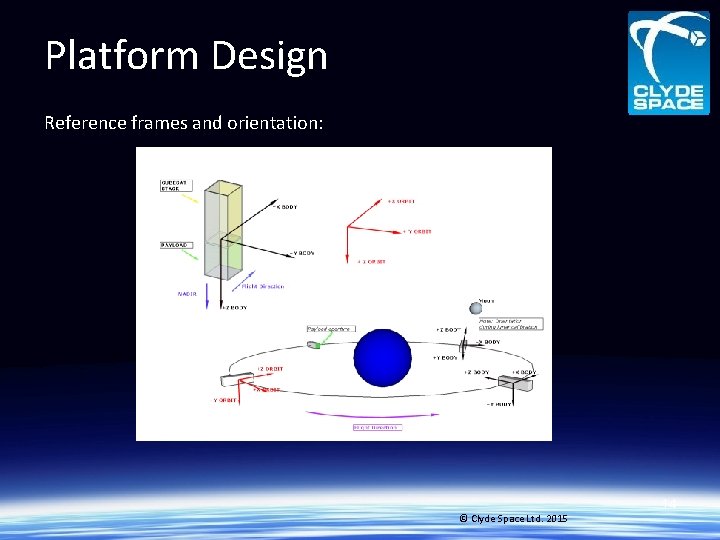
Platform Design Reference frames and orientation: © Clyde Space Ltd. 2015 14
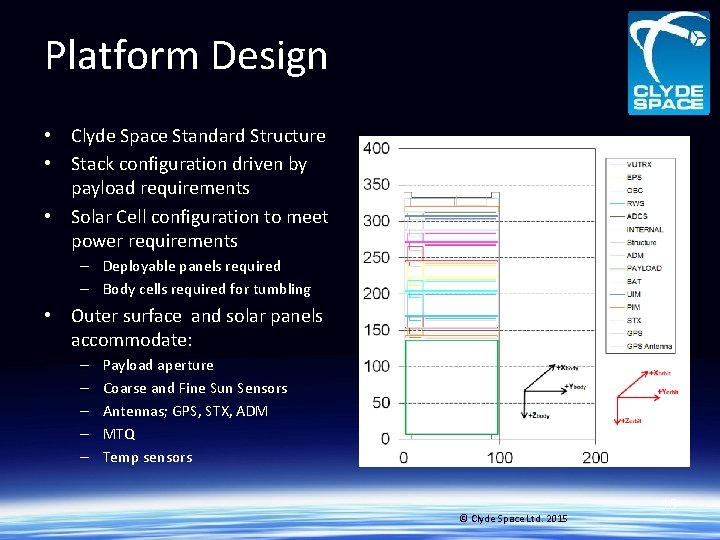
Platform Design • Clyde Space Standard Structure • Stack configuration driven by payload requirements • Solar Cell configuration to meet power requirements – Deployable panels required – Body cells required for tumbling • Outer surface and solar panels accommodate: – – – Payload aperture Coarse and Fine Sun Sensors Antennas; GPS, STX, ADM MTQ Temp sensors © Clyde Space Ltd. 2015 15
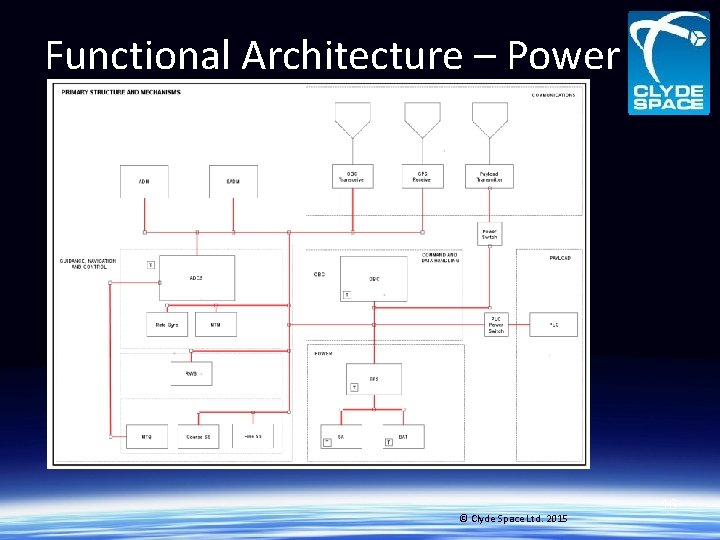
Functional Architecture – Power © Clyde Space Ltd. 2015 16
Functional Architecture – Data © Clyde Space Ltd. 2015 17
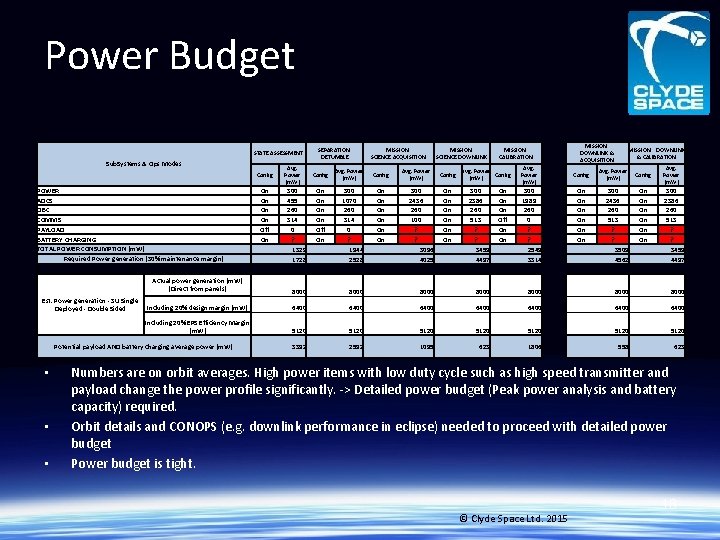
Power Budget STATE ASSESSMENT Sub. Systems & Ops Modes Avg. Power (m. W) Config POWER ADCS OBC COMMS PAYLOAD BATTERY CHARGING TOTAL POWER CONSUMPTION (m. W) Required Power generation (30% maintenance margin) Actual power generation (m. W) (Direct from panels) Est. Power generation - 3 U Single Including 20% design margin (m. W) Deployed - Double Sided Including 20% EPS Efficiency Margin (m. W) Potential payload AND battery charging average power (m. W) • • • On On Off On 300 455 260 314 0 ? 1329 1728 SEPARATION: DETUMBLE Avg. Power (m. W) Config On On Off On 300 1070 260 314 0 ? 1944 2528 MISSION: MISSION: SCIENCE ACQUISITION SCIENCE DOWNLINK Avg. Power (m. W) Config On On On 300 2436 260 100 ? ? 3096 4025 Config MISSION: CALIBRATION Avg. Power Config (m. W) On On On 300 2386 260 513 ? ? 3459 4497 On On On Off On On Avg. Power (m. W) 300 1989 260 0 ? ? 2549 3314 MISSION: DOWNLINK & ACQUISITION MISSION: DOWNLINK & CALIBRATION Avg. Power (m. W) Config On On On 300 2436 260 513 ? ? 3509 4562 Config On On On Avg. Power (m. W) 300 2386 260 513 ? ? 3459 4497 8000 8000 6400 6400 5120 5120 3392 2592 1095 623 1806 558 623 Numbers are on orbit averages. High power items with low duty cycle such as high speed transmitter and payload change the power profile significantly. -> Detailed power budget (Peak power analysis and battery capacity) required. Orbit details and CONOPS (e. g. downlink performance in eclipse) needed to proceed with detailed power budget Power budget is tight. © Clyde Space Ltd. 2015 18
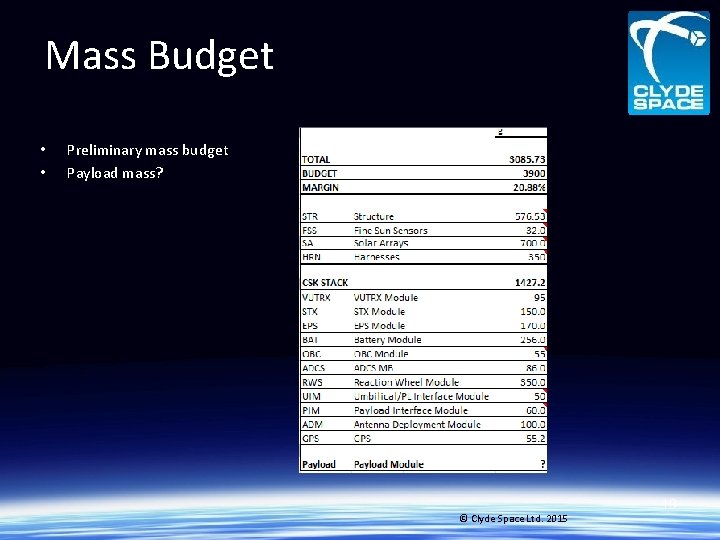
Mass Budget • • Preliminary mass budget Payload mass? © Clyde Space Ltd. 2015 19
Payload interfaces • Power: – EPS - Hawk. Eye: 3 V 3, 5 V, 12 V and/or batt. V power bus connection (switchable) • Data: – OBC - PLC (OBC Master): – PLC - High Speed Transmitter (Payload master): I 2 C SPI (data), I 2 C(control) • Physical: – – – Mounting Brackets / Sub-structure CSK Header or interface board? Apertures Alignment/On-orbit calibration Harnessing / Routing Environmental / EMC Coexistence © Clyde Space Ltd. 2015 20
Subsystem Design © Clyde Space Ltd. 2015 21
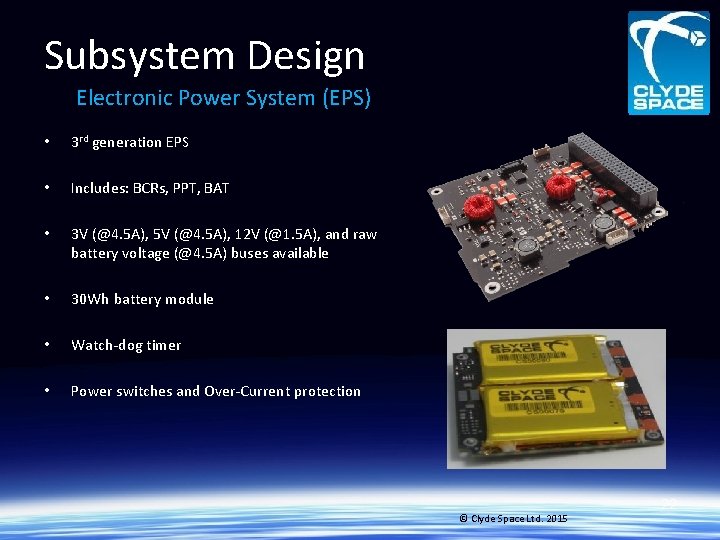
Subsystem Design Electronic Power System (EPS) • 3 rd generation EPS • Includes: BCRs, PPT, BAT • 3 V (@4. 5 A), 5 V (@4. 5 A), 12 V (@1. 5 A), and raw battery voltage (@4. 5 A) buses available • 30 Wh battery module • Watch-dog timer • Power switches and Over-Current protection © Clyde Space Ltd. 2015 22
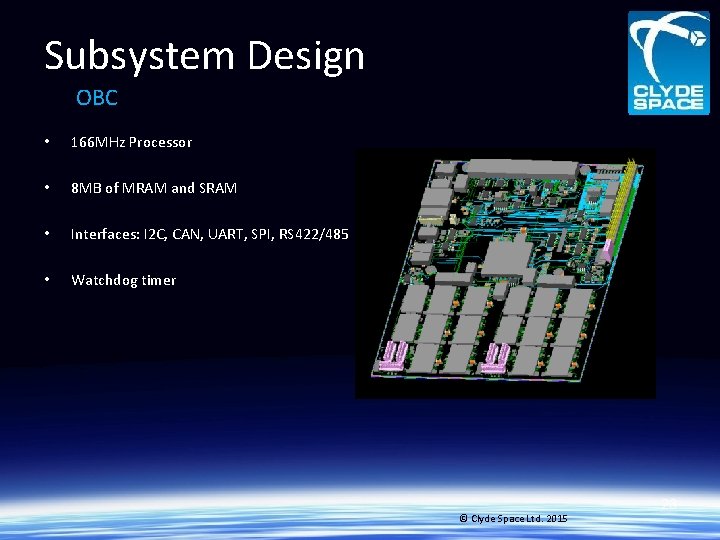
Subsystem Design OBC • 166 MHz Processor • 8 MB of MRAM and SRAM • Interfaces: I 2 C, CAN, UART, SPI, RS 422/485 • Watchdog timer © Clyde Space Ltd. 2015 23
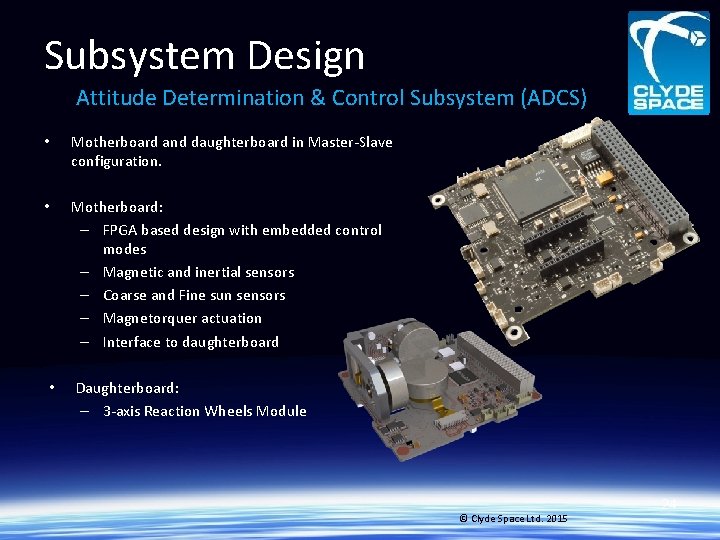
Subsystem Design Attitude Determination & Control Subsystem (ADCS) • Motherboard and daughterboard in Master-Slave configuration. • Motherboard: – FPGA based design with embedded control modes – Magnetic and inertial sensors – Coarse and Fine sun sensors – Magnetorquer actuation – Interface to daughterboard • Daughterboard: – 3 -axis Reaction Wheels Module © Clyde Space Ltd. 2015 24
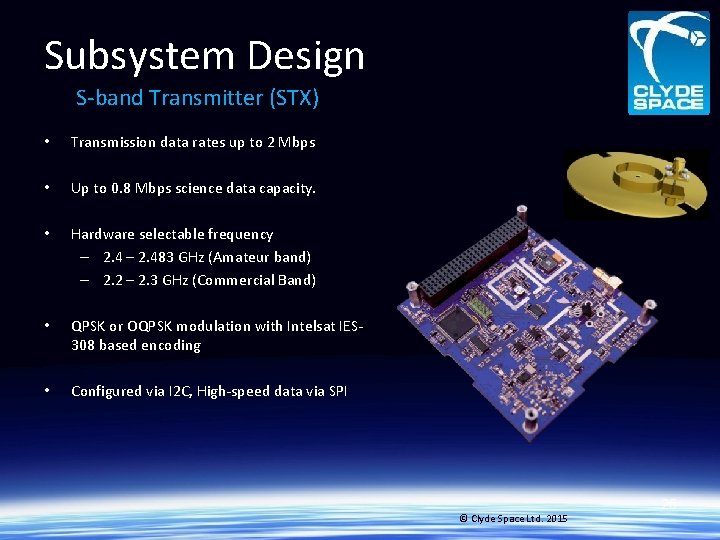
Subsystem Design S-band Transmitter (STX) • Transmission data rates up to 2 Mbps • Up to 0. 8 Mbps science data capacity. • Hardware selectable frequency – 2. 483 GHz (Amateur band) – 2. 2 – 2. 3 GHz (Commercial Band) • QPSK or OQPSK modulation with Intelsat IES 308 based encoding • Configured via I 2 C, High-speed data via SPI © Clyde Space Ltd. 2015 25
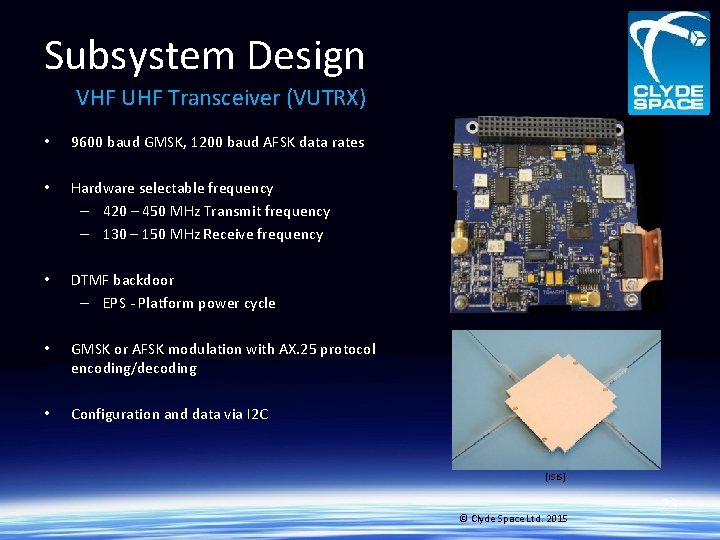
Subsystem Design VHF UHF Transceiver (VUTRX) • 9600 baud GMSK, 1200 baud AFSK data rates • Hardware selectable frequency – 420 – 450 MHz Transmit frequency – 130 – 150 MHz Receive frequency • DTMF backdoor – EPS - Platform power cycle • GMSK or AFSK modulation with AX. 25 protocol encoding/decoding • Configuration and data via I 2 C [ISIS] © Clyde Space Ltd. 2015 26
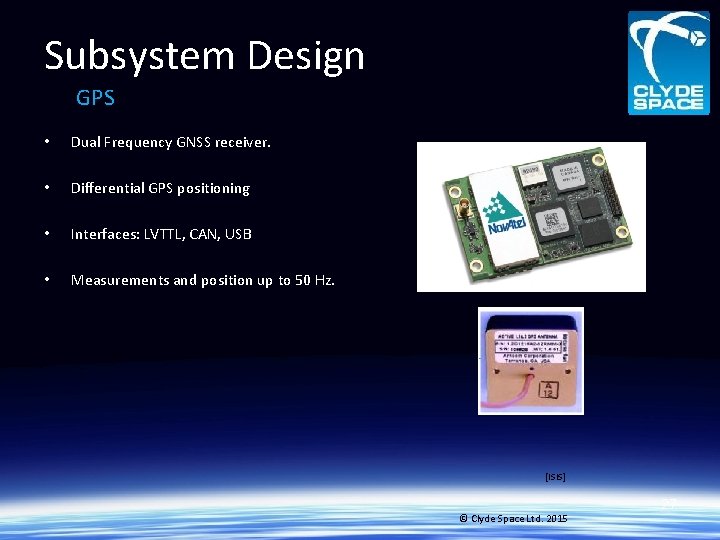
Subsystem Design GPS • Dual Frequency GNSS receiver. • Differential GPS positioning • Interfaces: LVTTL, CAN, USB • Measurements and position up to 50 Hz. [ISIS] © Clyde Space Ltd. 2015 27
Design Issues © Clyde Space Ltd. 2015 28
Design Issues Concept of Operations • • • Orbit determines platform design and payload support capabilities. What orbit do we want to operate in? Launcher determines launchpod and the available space for the Cubesat and puts requirements on the primary structure. Which launchpod are we looking to use? Platform only allows for sunlit operations. How are we going to do moon/flatfield calibration shots? Power • • • Power Generation depends fully on the orbit. Orbit information is needed before we can proceed with platform design and solar array configuration. Required powerbudget for Hawk. Eye? 3 V 3, 5 V, 12 V and Batt. V available. Which do Hawk. Eye need? © Clyde Space Ltd. 2015 29
Design Issues Physical structure and Interface • • • Cubesat formfactor is limited to 100 x 100 mm. Current Payload dimensions extend beyond this envelope. How is the Payload going to fit? Platform uses CSK headers for module interfaces. Payload interface module is available but what is needed on it? Umbilical connection needed for any outside connections after assembly? (Pre-flight configuration, debugging, etc) Mounting of modules is done via standard brackets? Does the Payload match with those? Payload orientation is limited by structure and interfaces. Which way are we going to orient the payload? Cubesat structure does not include any controllable apertures. How are we going to perform outgassing? © Clyde Space Ltd. 2015 30
Design Issues OBDH and C&DH • • • The platform will switch the power supply to the Payload on and off. How does the payload switches between Full Resolution and Binned Operations? Payload housekeeping data handling through VUTRX? What capacity/data rate for payload housekeeping data is needed? OBC is designed for high efficiency processing of small amount of command an control data. How will the science data handling and dark frame subtraction be done? Communications • • CCSDS and AX. 25 Protocol is used by the platform. Will this cause issues with the ground segment interface? S-band Patch antenna positioning: Should be nadir pointing, will interfere with payload apertures. © Clyde Space Ltd. 2015 31
Design Issues ADCS • • • Platform will deform due to launch and operations. How do we plan to align/calibrate the ADCS with the observation axis? Pointing accuracy and stability will not be perfect due to disturbances. How much pointing inaccuracy and instability can the payload correct for? Required pointing stability for science and calibration? Required pointing accuracy for moon pointing? (flatfielding)? Platform contains a GPS. Is GPS time/position required by payload? Is there a requirement for pointing axis rotation control? © Clyde Space Ltd. 2015 32
Design Issues Environment • • • How is the payload going to perform temperature monitoring? Temperature operating range depends on Orbit. Similar platforms missions go from -20 to +50 °C. Temperature variation vary based on concept of operations and selected orbit. Magnetometers are sensitive to anything above 0. 8 Gauss. Magnetic field strength of magnet that controls the shutter should be less than that at MTM location. Permanent magnets will always interfere with attitude, should be avoided. Testing and Integration • How will the payload be tested before shipping to, and platform integration at, Clyde Space? © Clyde Space Ltd. 2015 33
Questions? © Clyde Space Ltd. 2015 34
- Slides: 34