
Cube Sat Challenge Team Using MBSE for Operational
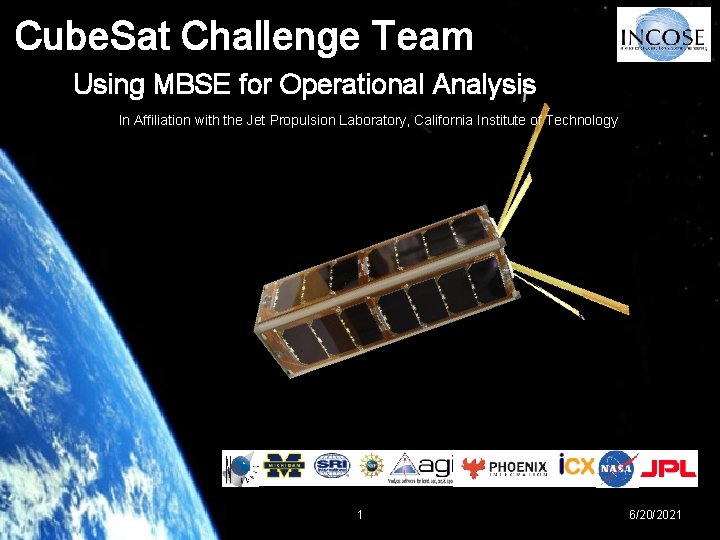
Cube. Sat Challenge Team Using MBSE for Operational Analysis In Affiliation with the Jet Propulsion Laboratory, California Institute of Technology 1 6/20/2021
Cube. Sat Challenge Team JPL Louise Anderson Christopher Delp Elyse Fosse Bjorn Cole Leo Cheng JPL Uni AGI Sara Spangelo James Cutler Phoenix Inte Grant Soremekun 2 David Kaslow Int Manas Bajaj Rose Yntema 6/20/2021
Agenda MBSE Initiative Motivation Radio Explorer Mission (RAX) using Sys. ML Overview of Analysis Demonstrations Operations Prediction of State Phoenix Integration - Model. Center Spacecraft Control (Flight-Ground) Cameo Simulation Toolkit Acausal Analysis & Requirements Paramagic Document Generation and Editing Results Future Plans 3 6/20/2021
INCOSE Space Systems Challenge Team Demonstrate Applicability of MBSE to Space Systems Launched and Operational Mission Sharable INCOSE is an International Organization Broad Team NASA, CSA Industry Academia (MIT, GIT, Umich)
INCOSE Space Systems Challenge Team 5 years of MBSE Investigations and Demos Fire. Sat Model Industry and Academic participation Space Systems Library Parametric Library based on SMAD (Wertz & Larson) Cube. Sat Application Framework Integrated Tools 5 6/20/2021
Better Systems Engineering Modeling as a Means 6 6/20/2021
Driving Idea: Systems Engineering Specifications Systems Engineers in the Space Domain Produce Information Functions Describing the Problem Trades System Functional and Behavioral Design Specifying System Components and Integrations Verification and Validation (V&V) Deployment and Fielding Operational Support Products Analysis (Simulation, Tests, etc) Reports on Analysis Plans Design Descriptions Interface Descriptions Requirements Relationships are primarily inter-disciplinary 7 6/20/2021

Challenge: Communication and Consistency • Challenges • Communicating the system in a world of models • • How do you extract all the rich detail from these simulations into System Specification? DOORS? Documents/Slides/Spreadsheets? How do you assert mutual consistency between models? Meetings? Emails? • Need an equally rich mechanism for expressing the system design – Human readable – Machine readable 8 6/20/2021
Role of Languages in MBSE Enterprise From multiple points of view Capture and express information about the system Provide analyzable representations of the system Authoritative source of information about the system 9 6/20/2021
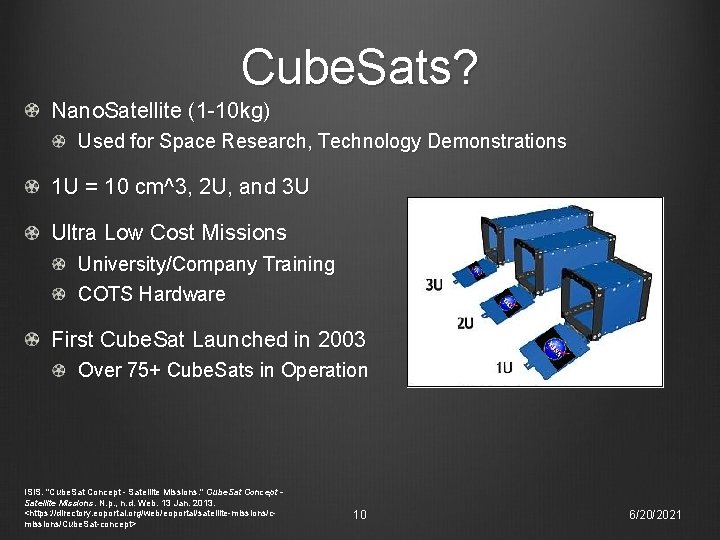
Cube. Sats? Nano. Satellite (1 -10 kg) Used for Space Research, Technology Demonstrations 1 U = 10 cm^3, 2 U, and 3 U Ultra Low Cost Missions University/Company Training COTS Hardware First Cube. Sat Launched in 2003 Over 75+ Cube. Sats in Operation ISIS. "Cube. Sat Concept - Satellite Missions. " Cube. Sat Concept Satellite Missions. N. p. , n. d. Web. 13 Jan. 2013. <https: //directory. eoportal. org/web/eoportal/satellite-missions/cmissions/Cube. Sat-concept> 10 6/20/2021
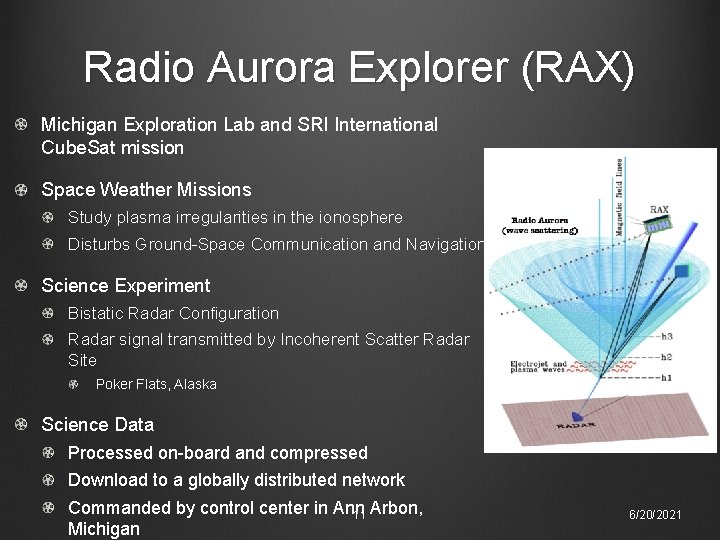
Radio Aurora Explorer (RAX) Michigan Exploration Lab and SRI International Cube. Sat mission Space Weather Missions Study plasma irregularities in the ionosphere Disturbs Ground-Space Communication and Navigation Science Experiment Bistatic Radar Configuration Radar signal transmitted by Incoherent Scatter Radar Site Poker Flats, Alaska Science Data Processed on-board and compressed Download to a globally distributed network Commanded by control center in Ann 11 Arbon, Michigan 6/20/2021
Demonstration Overview System Model Description Cube. Sat Framework RAX Implementation Power Prediction Analysis Power loads analysis driven by operational scenario Spacecraft Behavior Prediction Analysis Spacecraft state analysis driven by operational scenario Communication Design and Requirements Analysis Design criteria and constraints based on design parameters Document Generation and Reporting Document and reports of model and analysis 12 6/20/2021
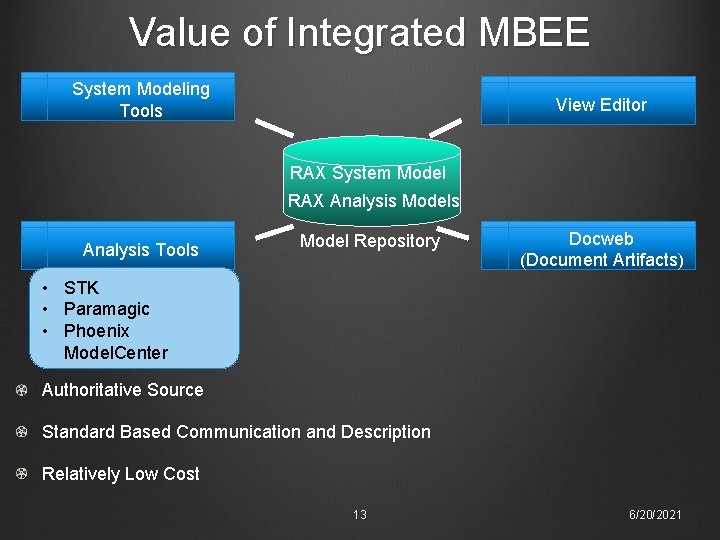
Value of Integrated MBEE System Modeling Tools View Editor RAX System Model RAX Analysis Models Analysis Tools Model Repository Docweb (Document Artifacts) • STK • Paramagic • Phoenix Model. Center Authoritative Source Standard Based Communication and Description Relatively Low Cost 13 6/20/2021
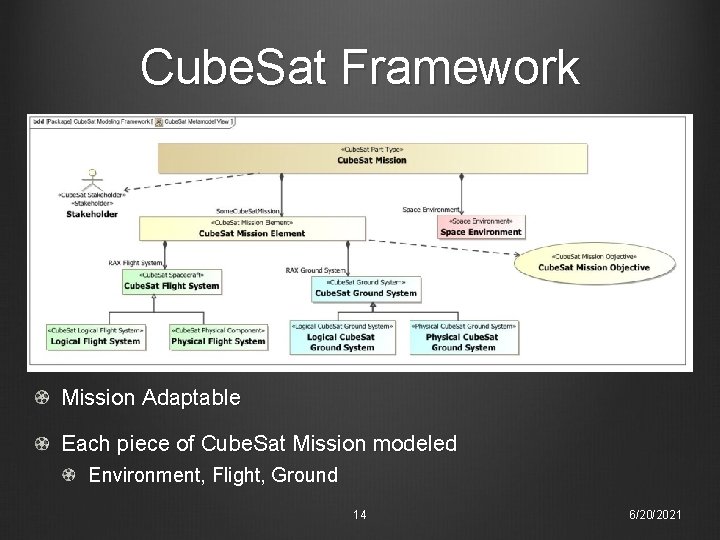
Cube. Sat Framework Mission Adaptable Each piece of Cube. Sat Mission modeled Environment, Flight, Ground 14 6/20/2021
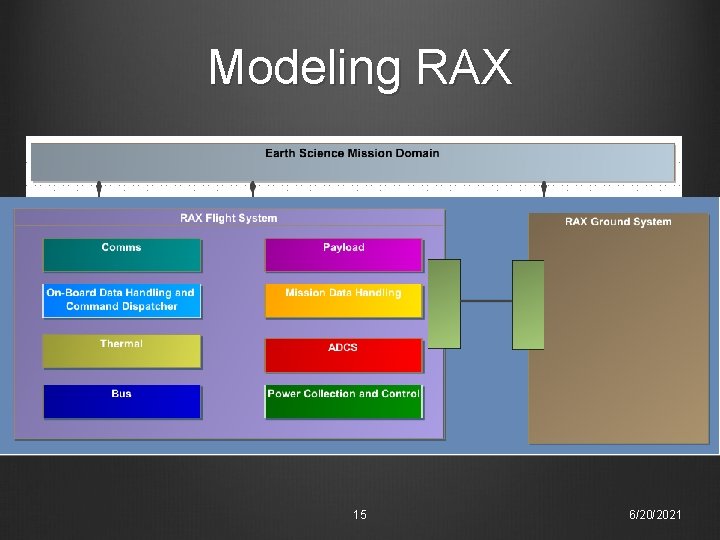
Modeling RAX 15 6/20/2021
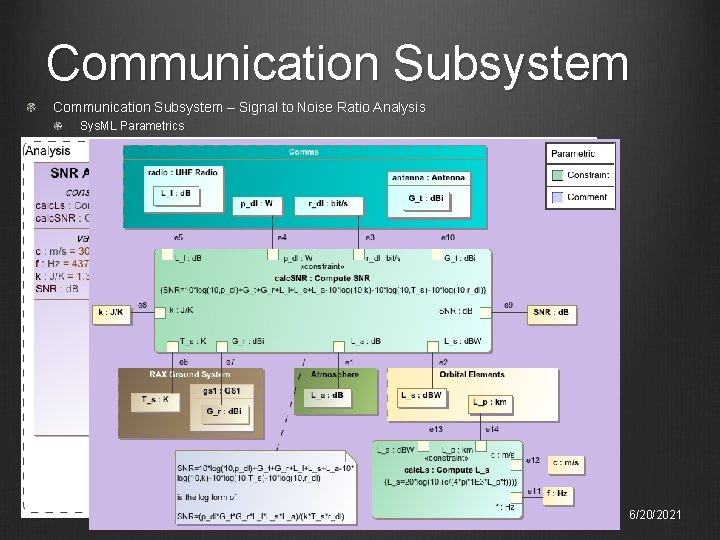
Communication Subsystem – Signal to Noise Ratio Analysis Sys. ML Parametrics 16 6/20/2021
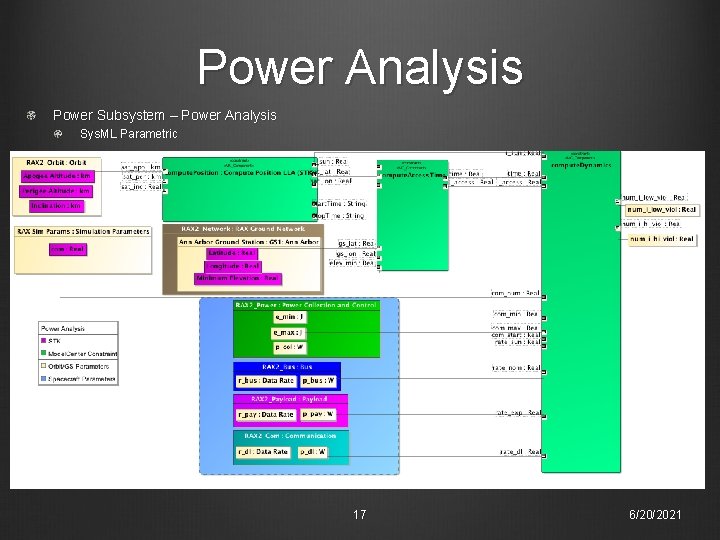
Power Analysis Power Subsystem – Power Analysis Sys. ML Parametric 17 6/20/2021
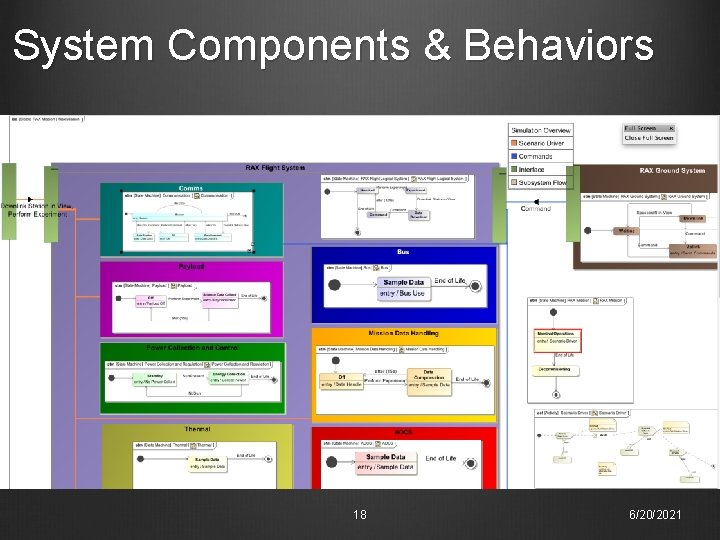
System Components & Behaviors 18 6/20/2021
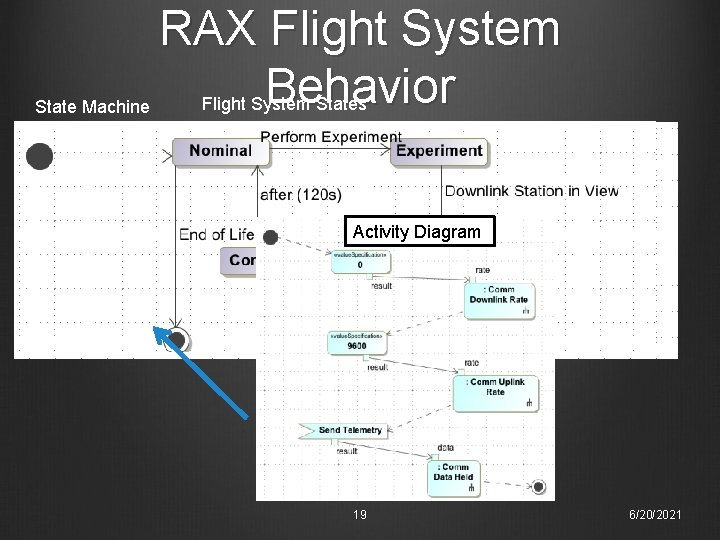
State Machine RAX Flight System Behavior Flight System States Activity Diagram 19 6/20/2021
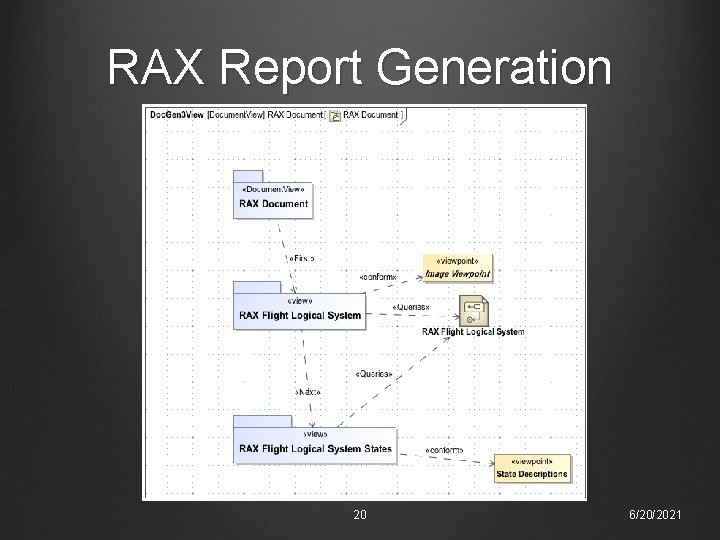
RAX Report Generation 20 6/20/2021
Results & Successes Effectively described different views of RAX System Analyzed the RAX Model according to common practices in Space Systems Engineering Analysis completed with COTS Tools Integrated around standard Sys. ML models Demonstrated capability to generate Documents from models “Develop With What you Fly With” End to End Integration and Analysis concept 21 6/20/2021
Summary of Issues and Challenges Gaps in full integration of Analysis Scalable enterprise access to model data No master orchestrator controlling timing and coordination for all possible analysis execution Both Sys. ML and MBSE analysis tools are limited in temporal semantics Time is key factor for space systems engineering Limited applicability of parametrics to behavior aspects of the model 22 6/20/2021
Demo Videos 23 6/20/2021
Affiliation: Jet Propulsion Laboratory, California Institute of Technology Acknowledgments: Part of this research was carried out at the Jet Propulsion Laboratory, California Institute of Technology, under a contract with the National Aeronautics and Space Administration Copyright: Copyright 2013. All rights reserved.
QUESTIONS? 25 6/20/2021
Backup Successes and Challenge for each demo 26 6/20/2021
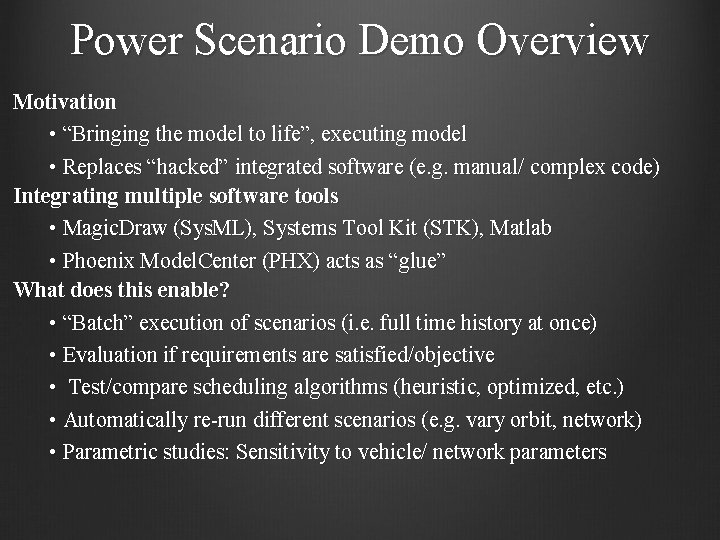
Power Scenario Demo Overview Motivation • “Bringing the model to life”, executing model • Replaces “hacked” integrated software (e. g. manual/ complex code) Integrating multiple software tools • Magic. Draw (Sys. ML), Systems Tool Kit (STK), Matlab • Phoenix Model. Center (PHX) acts as “glue” What does this enable? • “Batch” execution of scenarios (i. e. full time history at once) • Evaluation if requirements are satisfied/objective • Test/compare scheduling algorithms (heuristic, optimized, etc. ) • Automatically re-run different scenarios (e. g. vary orbit, network) • Parametric studies: Sensitivity to vehicle/ network parameters
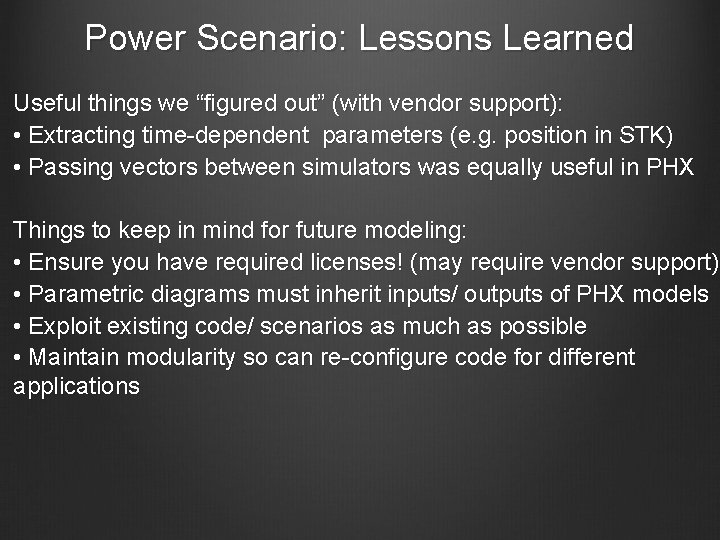
Power Scenario: Lessons Learned Useful things we “figured out” (with vendor support): • Extracting time-dependent parameters (e. g. position in STK) • Passing vectors between simulators was equally useful in PHX Things to keep in mind for future modeling: • Ensure you have required licenses! (may require vendor support) • Parametric diagrams must inherit inputs/ outputs of PHX models • Exploit existing code/ scenarios as much as possible • Maintain modularity so can re-configure code for different applications
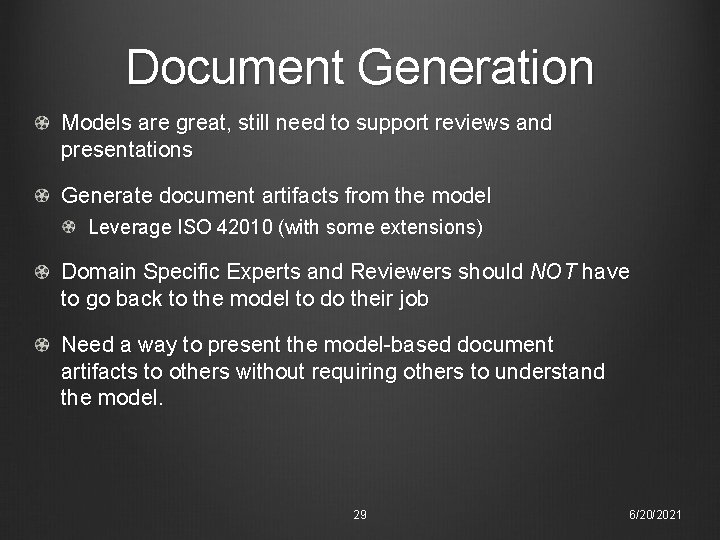
Document Generation Models are great, still need to support reviews and presentations Generate document artifacts from the model Leverage ISO 42010 (with some extensions) Domain Specific Experts and Reviewers should NOT have to go back to the model to do their job Need a way to present the model-based document artifacts to others without requiring others to understand the model. 29 6/20/2021
Challenge Team History 2007 – First Challenge Team was Founded 2007 -2010 Sys. ML Model of Fire. Sat (SMAD Textbook) Sys. ML Suitability for modeling space missions 2011 – Cube. Sat Initiative Began Cube. Sat Modeling Framework Foundation to model/design many current and future Cube. Sat missions 2012 Applying Sys. ML Framework to Operational Mission 30 6/20/2021
Timeline of Activity Y 1: MIT/Ga. Tech Student Fire. Sat Example Y 2 -4: Sys. ML model of Fire. Sat Space Analysis Library using SMAD (Space Mission Analysis and Design textbook, Wertz and Larson) Basic Model of Fire. Sat Solar Panel Trade Satellite Toolkit Integration Y 5 ->: Cube. Sat: An Architecture Framework and Method for Space Systems MBSE
Fire. Sat MIT/Ga. Tech Collaboration Build an integrated model of Fire. Sat Sub. Systems in Matlab, STK, Excel Integrated with Phoenix Model Center Student Teams Mentored by Industry Experts from INCOSE SSWG Successes executable trade model for Fire. Sat Challenges Difficult to build Sub. System models were difficult to integrate No architecture of the model integration or key parameters Difficult to Audit for completeness correctness
Fire. Sat Sys. ML Model Build Sys. ML model of Fire. Sat Learn Sys. ML Describe Fire. Sat using Sys. ML Compare Model Description against typical document representation Successes Models of descriptions from book Model views corresponding to documents Challenges Technique of modeling and applying the methodology Table representations Model Analysis Document Production
Sys. ML Space Analysis Library Build Library of analysis from SMAD Build approach to Vn. V for Library Successes Libraries for many analysis types Useful testing approach Challenges Deep subject – much could not be captured Executability (significantly improved since) Units and Dimensions (significantly improved since) Presentation of equations
Fire. Sat Solar Panel Trade Use Library to replicate Solar Panel Sizing Trade Fire. Sat Model and Library-> executable trade Successes Successfully built executable trade Hard-linked to requirements Powerful view of driving systems properties Challenges Executability (improving since) Debugging Scaling
Fire. Sat Integrated Modeling Integrate Fire. Sat Sys. ML Model with Satellite Tool. Kit Exchange Orbit Scenario properties Successes Basic Exchange of Parameters Direct comparison of MBSE in Sys. ML and STK Explicit link between models and requirements Challenges Integration Complicated Difficult to Scale
Cube. Sat: Framework and Method Build a Modeling Framework and Method for Cube. Sats Cube. Sat Domain-Specific Terms SE Framework for Modeling Cube. Sat Missions, Spacecraft, and Ground Systems Example Application using RAX Mission Successes First version of Framework Early version of multiple executable demos Challenges Resources Executability Integration
Consensus of Team Modeling with Sys. ML Everything was hard at first Methodology is critical to a model that hangs together Sys. ML simplified construction of basic things like functions and properties Sys. ML tastes like early CAD apps Libraries of model analysis were effective in making solar panel trade Integration with STK Document Comparison Model unified properties between views Simplified understanding of the System The common Sys. ML language improved communication between teams and simplified collaboration Automated reports allowed for more time to focus on engineering
- Slides: 38