
CTS2 Vendor Benchmark Briefing Benchmarking Lead Ian Karlin
CTS-2 Vendor Benchmark Briefing Benchmarking Lead: Ian Karlin (LLNL) Team: Matt Leininger (LLNL), Josip Loncaric (LANL), Howard Pritchard (LANL), Doug Pase (Sandia), Anthony Agelastos (Sandia)
High Level CTS-2 Goals • Deliver relatively low risk cycles to our users • This includes standing up, stabilizing and integrating systems quickly • Deliver these cycles with hardware that requires low porting effort • Build on existing programming models and previous CTS and ATS machines • Deliver the best cost performance we can given the other constraints • This includes capital and operating costs Benchmarks are meant to help us address the cost performance part of our goals.
Why we added benchmarks for CTS-2 • CTS-2 is focused on getting the best cost performance • There multiple viable processor families • Within each processor family there are multiple skus that could be viable The goal of benchmarking requirements is to assist the offeror in selecting the most promising technologies on a cost performance basis.
Benchmarking Philosophy • Keep things as simple as possible, while still getting the information we need • We aim to keep the benchmark projection cost down to enable bids from multiple integrators • Reuse benchmarks that vendors are familiar with from other procurements when possible
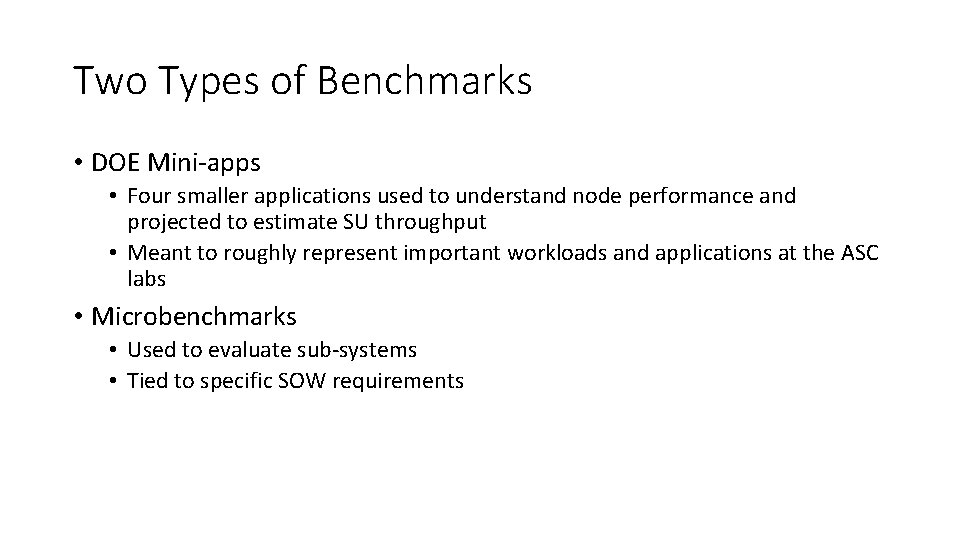
Two Types of Benchmarks • DOE Mini-apps • Four smaller applications used to understand node performance and projected to estimate SU throughput • Meant to roughly represent important workloads and applications at the ASC labs • Microbenchmarks • Used to evaluate sub-systems • Tied to specific SOW requirements
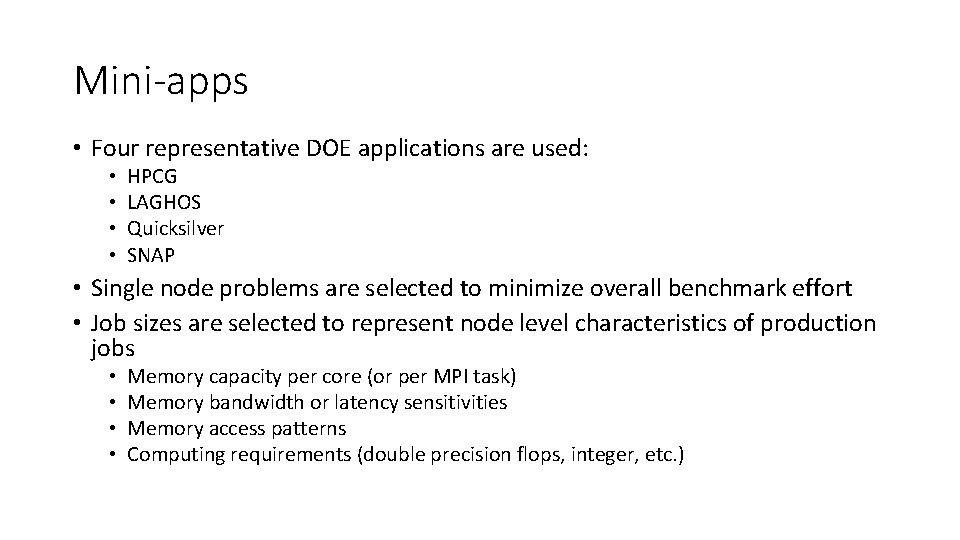
Mini-apps • Four representative DOE applications are used: • • HPCG LAGHOS Quicksilver SNAP • Single node problems are selected to minimize overall benchmark effort • Job sizes are selected to represent node level characteristics of production jobs • • Memory capacity per core (or per MPI task) Memory bandwidth or latency sensitivities Memory access patterns Computing requirements (double precision flops, integer, etc. )
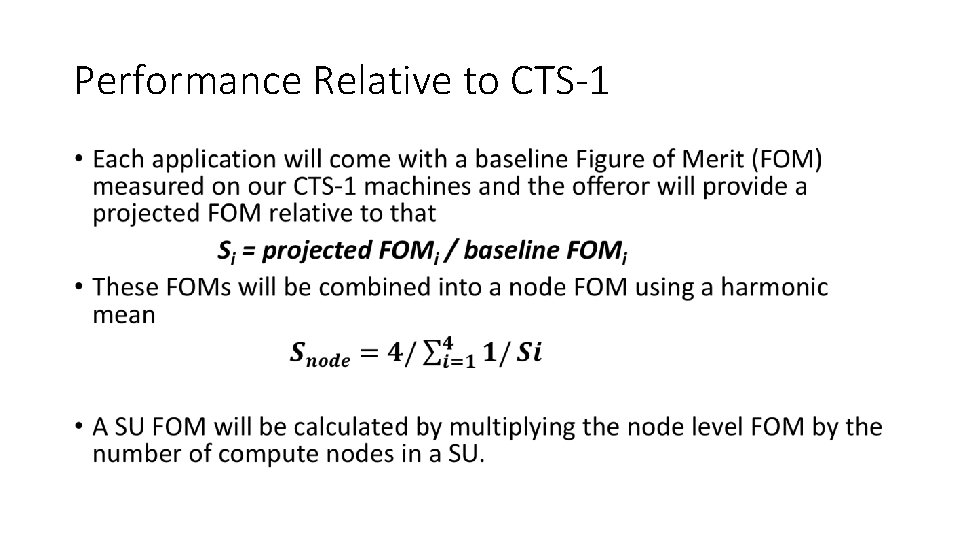
Performance Relative to CTS-1 •
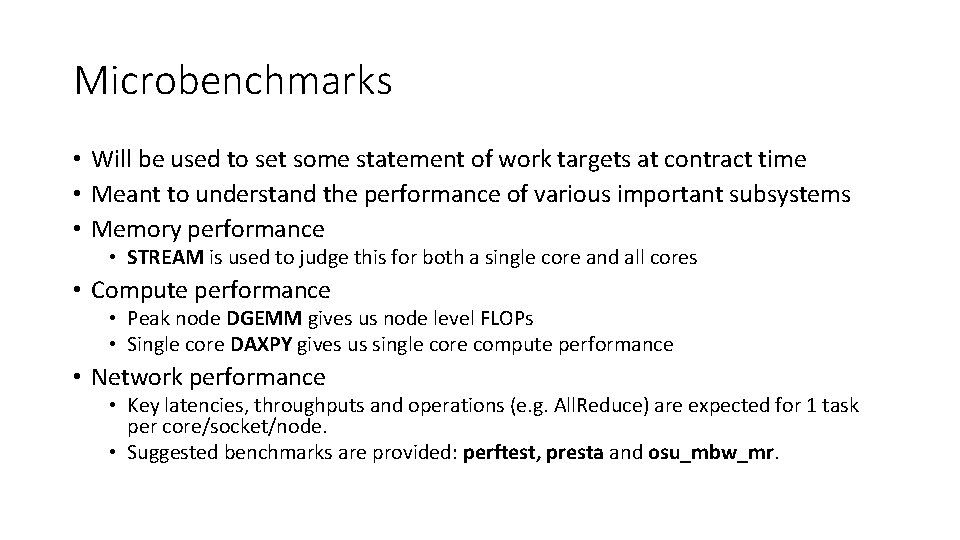
Microbenchmarks • Will be used to set some statement of work targets at contract time • Meant to understand the performance of various important subsystems • Memory performance • STREAM is used to judge this for both a single core and all cores • Compute performance • Peak node DGEMM gives us node level FLOPs • Single core DAXPY gives us single core compute performance • Network performance • Key latencies, throughputs and operations (e. g. All. Reduce) are expected for 1 task per core/socket/node. • Suggested benchmarks are provided: perftest, presta and osu_mbw_mr.
General Benchmark Rules • Benchmark codes should not be modified unless noted in benchmark descriptions • CTS-2 aims to run our codes well as they are written today with minimal effort by our application teams • Vendors are encouraged to use the best compiler and flags for each application
What We are Expecting • We are expecting projections, though if you have the hardware you are bidding exact values are always better. • Projections can use: • Previous hardware and modeling • Simulators of the future nodes • Other modeling and projection methods as appropriate • When possible projections should be recreatable by the labs if desired. • Describe the methodology in enough detail that someone else can recreate it • We expect bidders to document test hardware, compiler flags and other software used • Simulations of the proposed hardware, will be described in similar detail, but may not be recreatable by the labs.
• HPCG is driven by a multigrid preconditioned conjugate gradient algorithm that exercises the key kernels on a nested set of coarse grids • Local symmetric Gauss-Seidel smoother with a sparse triangular solve • The basic operations include sparse matrix-vector multiplication, vector updates, and global dot products • Reference implementation is written in C++ w/ MPI and Open. MP support • Mix of compute- and bandwidth-bound performance inhibitors • The Run Rules prescribe a fixed problem size per HPCG instance and allows the vendor to run as many instances and threads per instance as they would like to maximize HPCG workload throughput.
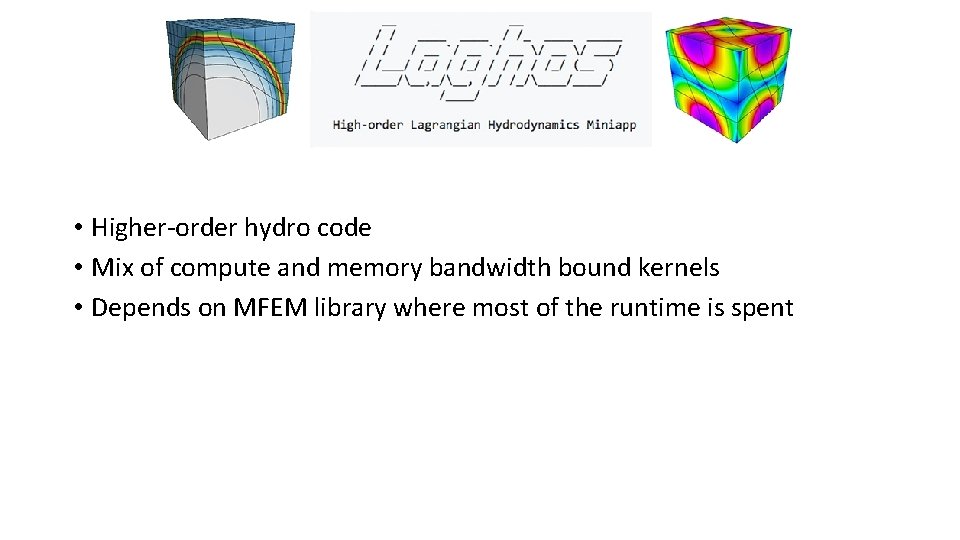
• Higher-order hydro code • Mix of compute and memory bandwidth bound kernels • Depends on MFEM library where most of the runtime is spent
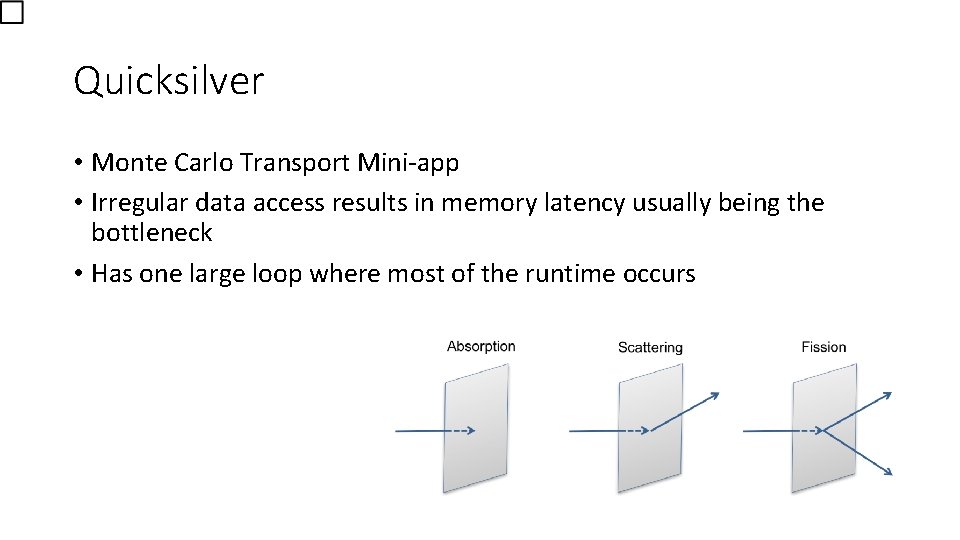
Quicksilver • Monte Carlo Transport Mini-app • Irregular data access results in memory latency usually being the bottleneck • Has one large loop where most of the runtime occurs
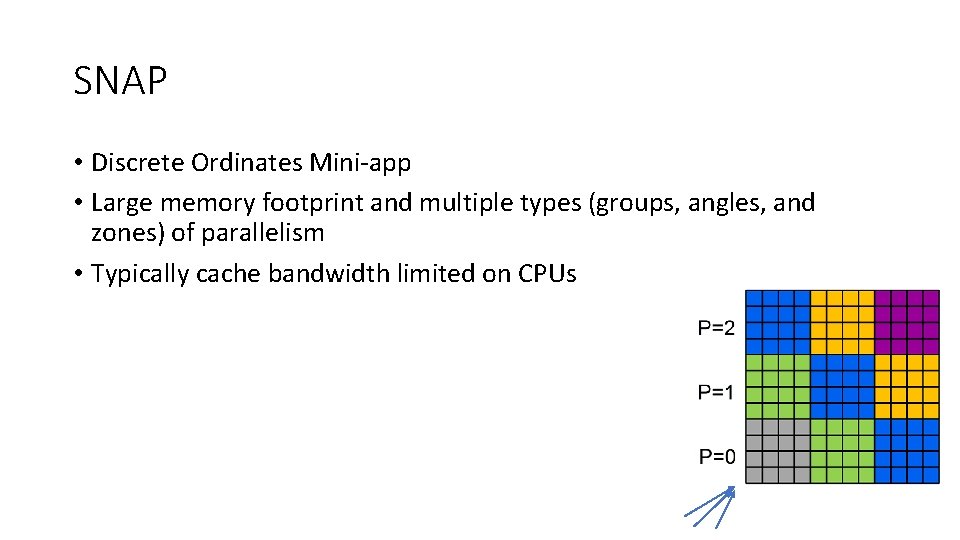
SNAP • Discrete Ordinates Mini-app • Large memory footprint and multiple types (groups, angles, and zones) of parallelism • Typically cache bandwidth limited on CPUs
Things not covered by our benchmarks • Networking beyond micro-benchmarks • Architecture decision points • GPU benchmarks • NVMe • Etc. The proposed system will be evaluated on its ability to support these options not their performance. For any of these features we will work with the chosen integrator to select the best cost performance options as needed.
Notes to the Vendors • Benchmarks are just one of many factors in CTS-2 evaluation • Benchmarks are no less and no more important than those other factors (see future DRAFT SOW for more details) • If you think a chip that does not benchmark best is the right one for us bid it and tell us why • E. g. power consumption and reliability are better • E. g. better cost/performance • Other requirements matter as well so do not optimize your design only for the best benchmark numbers. Remember this is a best value procurement focused on overall cost performance including operating costs and other factors (see slide 2) are also very important to our decision making.
Questions and Feedback • If you have questions later please send mail to: • cts 2 -benchmarks@llnl. gov • Benchmarks are available here: • https: //hpc. llnl. gov/cts-2 -benchmarks

Disclaimer This document was prepared as an account of work sponsored by an agency of the United States government. Neither the United States government nor Lawrence Livermore National Security, LLC, nor any of their employees makes any warranty, expressed or implied, or assumes any legal liability or responsibility for the accuracy, completeness, or usefulness of any information, apparatus, product, or process disclosed, or represents that its use would not infringe privately owned rights. Reference herein to any specific commercial product, process, or service by trade name, trademark, manufacturer, or otherwise does not necessarily constitute or imply its endorsement, recommendation, or favoring by the United States government or Lawrence Livermore National Security, LLC. The views and opinions of authors expressed herein do not necessarily state or reflect those of the United States government or Lawrence Livermore National Security, LLC, and shall not be used for advertising or product endorsement purposes. This work was performed under the auspices of the U. S. Department of Energy by Lawrence Livermore National Laboratory under contract DE-AC 52 -07 NA 27344. Lawrence Livermore National Security, LLC LLNL-PRES-774947
- Slides: 18