
CTF 3 Operation CTF 3 Others HighPower RF
- Slides: 11
CTF 3 Operation
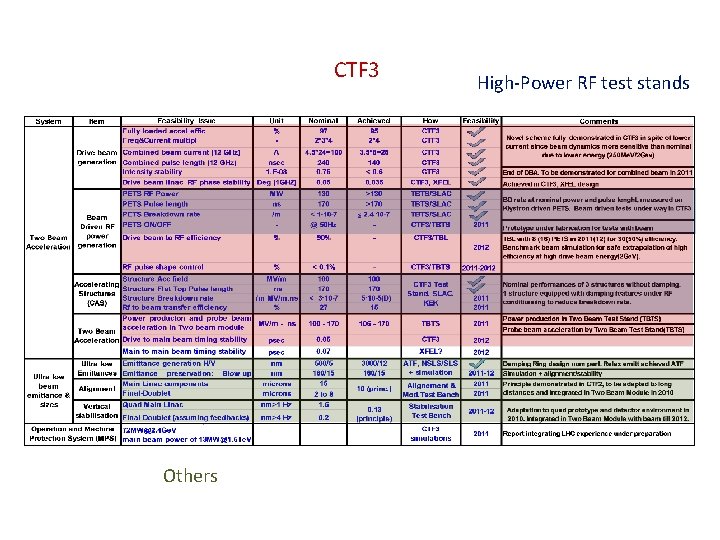
CTF 3 Others High-Power RF test stands
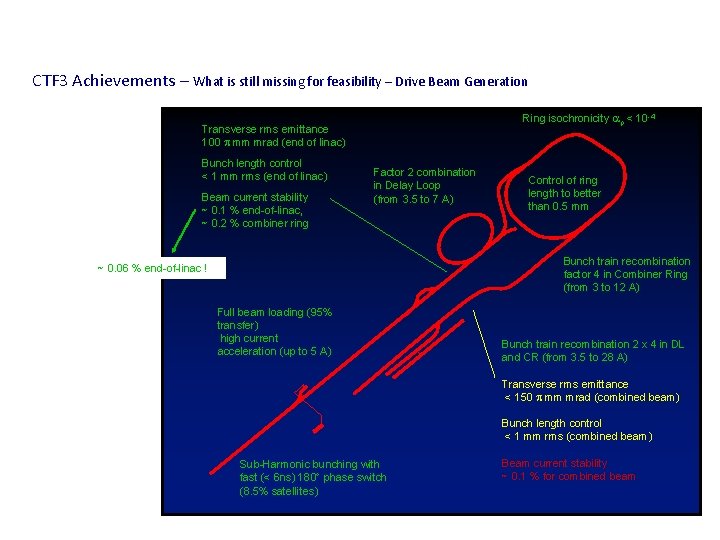
CTF 3 Achievements – What is still missing for feasibility – Drive Beam Generation Ring isochronicity ap < 10 -4 Transverse rms emittance 100 p mm mrad (end of linac) Bunch length control < 1 mm rms (end of linac) Beam current stability ~ 0. 1 % end-of-linac, ~ 0. 2 % combiner ring Factor 2 combination in Delay Loop (from 3. 5 to 7 A) Control of ring length to better than 0. 5 mm Bunch train recombination factor 4 in Combiner Ring (from 3 to 12 A) ~ 0. 06 % end-of-linac ! Full beam loading (95% transfer) high current acceleration (up to 5 A) Bunch train recombination 2 x 4 in DL and CR (from 3. 5 to 28 A) Transverse rms emittance < 150 p mm mrad (combined beam) Bunch length control < 1 mm rms (combined beam) Sub-Harmonic bunching with fast (< 6 ns) 180 phase switch (8. 5% satellites) Beam current stability ~ 0. 1 % for combined beam
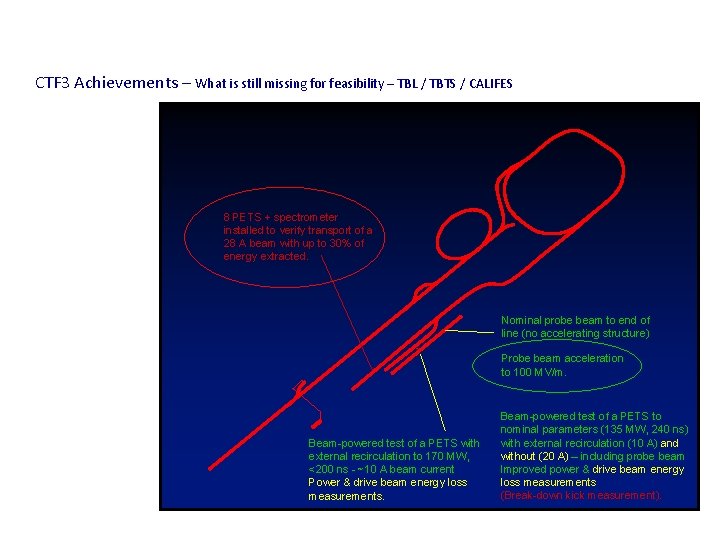
CTF 3 Achievements – What is still missing for feasibility – TBL / TBTS / CALIFES 8 PETS + spectrometer installed to verify transport of a 28 A beam with up to 30% of energy extracted. Nominal probe beam to end of line (no accelerating structure) Probe beam acceleration to 100 MV/m. Beam-powered test of a PETS with external recirculation to 170 MW, <200 ns - ~10 A beam current Power & drive beam energy loss measurements. Beam-powered test of a PETS to nominal parameters (135 MW, 240 ns) with external recirculation (10 A) and without (20 A) – including probe beam Improved power & drive beam energy loss measurements (Break-down kick measurement).
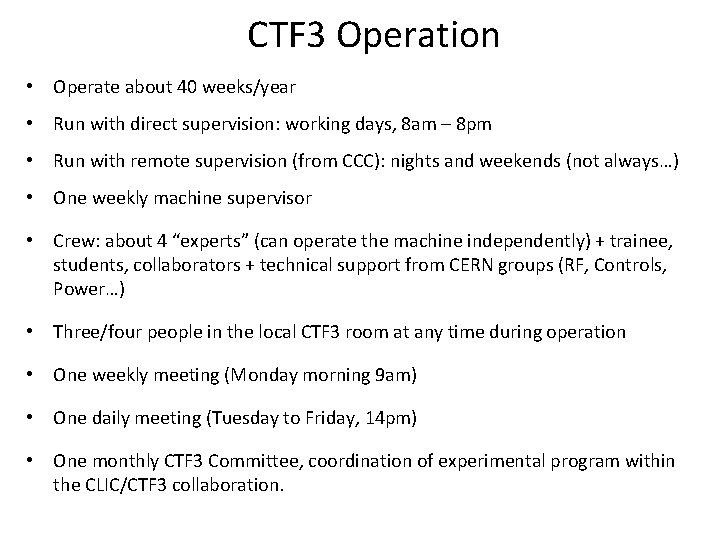
CTF 3 Operation • Operate about 40 weeks/year • Run with direct supervision: working days, 8 am – 8 pm • Run with remote supervision (from CCC): nights and weekends (not always…) • One weekly machine supervisor • Crew: about 4 “experts” (can operate the machine independently) + trainee, students, collaborators + technical support from CERN groups (RF, Controls, Power…) • Three/four people in the local CTF 3 room at any time during operation • One weekly meeting (Monday morning 9 am) • One daily meeting (Tuesday to Friday, 14 pm) • One monthly CTF 3 Committee, coordination of experimental program within the CLIC/CTF 3 collaboration.
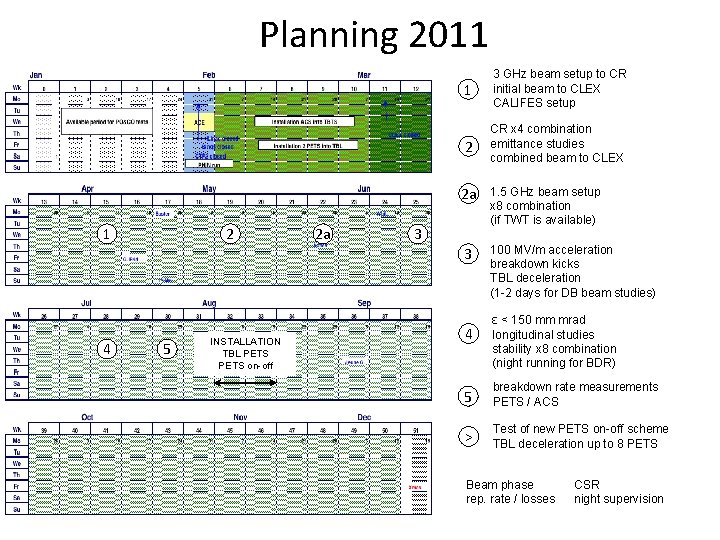
Planning 2011 1 4 2 5 INSTALLATION TBL PETS on-off 2 a 1 3 GHz beam setup to CR initial beam to CLEX CALIFES setup 2 CR x 4 combination emittance studies combined beam to CLEX 2 a 1. 5 GHz beam setup x 8 combination (if TWT is available) 3 100 MV/m acceleration breakdown kicks TBL deceleration (1 -2 days for DB beam studies) 3 4 ε < 150 mm mrad longitudinal studies stability x 8 combination (night running for BDR) 5 breakdown rate measurements PETS / ACS > Test of new PETS on-off scheme TBL deceleration up to 8 PETS Beam phase rep. rate / losses CSR night supervision
The facility from 2012 to 2016: CTF 3+ • CTF should continue to run until 2016 • Completion of the present program (deceleration tests in TBL with 16 PETS tanks) Three new main topics: • Nominal CLIC modules tested with beam • Drive beam phase feed-forward experiment, drive beam stability studies • 12 GHz RF power production and high power tests of accelerating structures and components in TBL
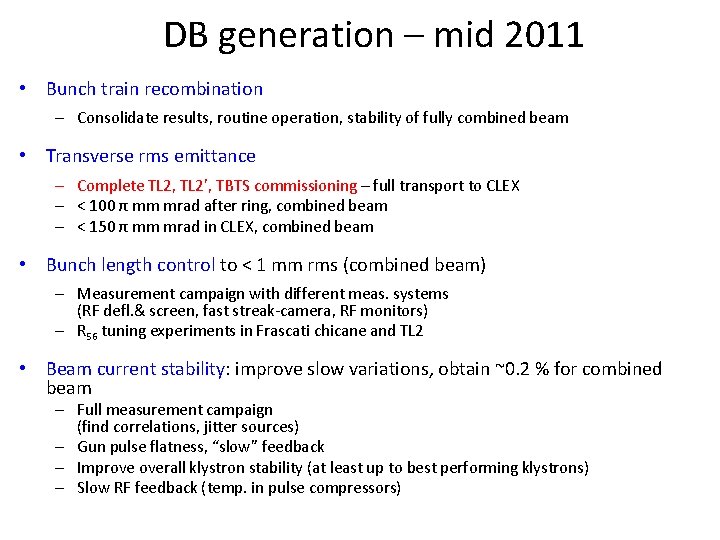
DB generation – mid 2011 • Bunch train recombination – Consolidate results, routine operation, stability of fully combined beam • Transverse rms emittance – Complete TL 2, TL 2’, TBTS commissioning – full transport to CLEX – < 100 π mm mrad after ring, combined beam – < 150 π mm mrad in CLEX, combined beam • Bunch length control to < 1 mm rms (combined beam) – Measurement campaign with different meas. systems (RF defl. & screen, fast streak-camera, RF monitors) – R 56 tuning experiments in Frascati chicane and TL 2 • Beam current stability: improve slow variations, obtain ~0. 2 % for combined beam – Full measurement campaign (find correlations, jitter sources) – Gun pulse flatness, “slow” feedback – Improve overall klystron stability (at least up to best performing klystrons) – Slow RF feedback (temp. in pulse compressors)
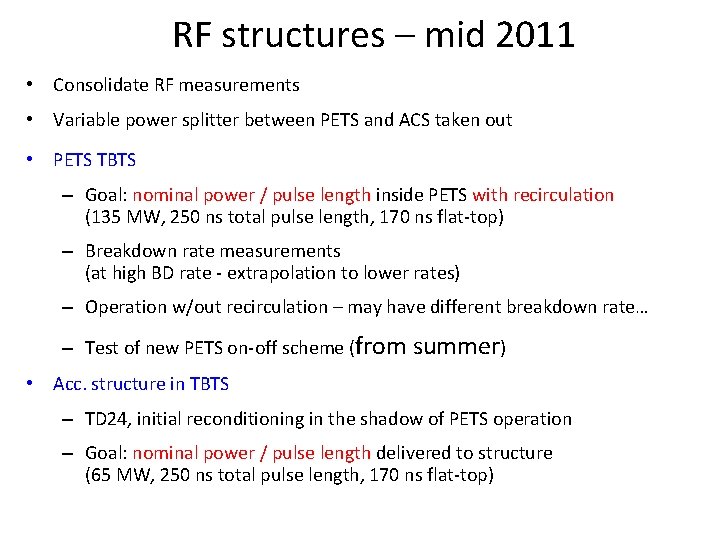
RF structures – mid 2011 • Consolidate RF measurements • Variable power splitter between PETS and ACS taken out • PETS TBTS – Goal: nominal power / pulse length inside PETS with recirculation (135 MW, 250 ns total pulse length, 170 ns flat-top) – Breakdown rate measurements (at high BD rate - extrapolation to lower rates) – Operation w/out recirculation – may have different breakdown rate… – Test of new PETS on-off scheme (from summer) • Acc. structure in TBTS – TD 24, initial reconditioning in the shadow of PETS operation – Goal: nominal power / pulse length delivered to structure (65 MW, 250 ns total pulse length, 170 ns flat-top)
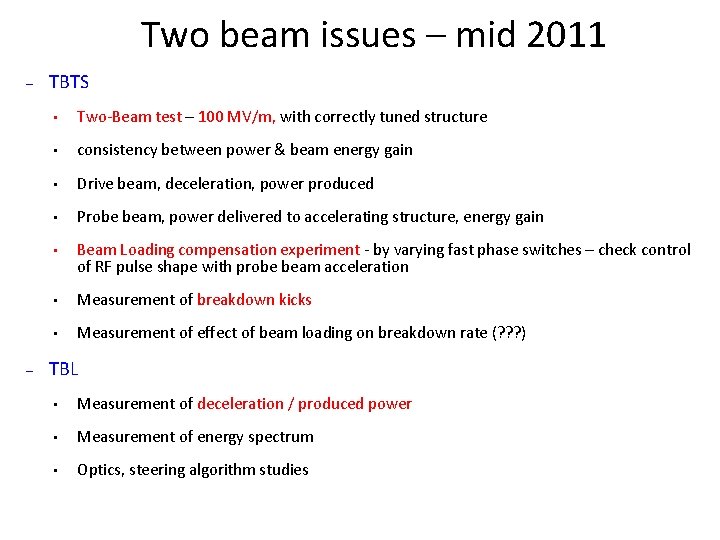
Two beam issues – mid 2011 – TBTS • Two-Beam test – 100 MV/m, with correctly tuned structure • consistency between power & beam energy gain • Drive beam, deceleration, power produced • Probe beam, power delivered to accelerating structure, energy gain • – Beam Loading compensation experiment - by varying fast phase switches – check control of RF pulse shape with probe beam acceleration • Measurement of breakdown kicks • Measurement of effect of beam loading on breakdown rate (? ? ? ) TBL • Measurement of deceleration / produced power • Measurement of energy spectrum • Optics, steering algorithm studies