
CTE Dr Pete Biglin DO May 14 2106
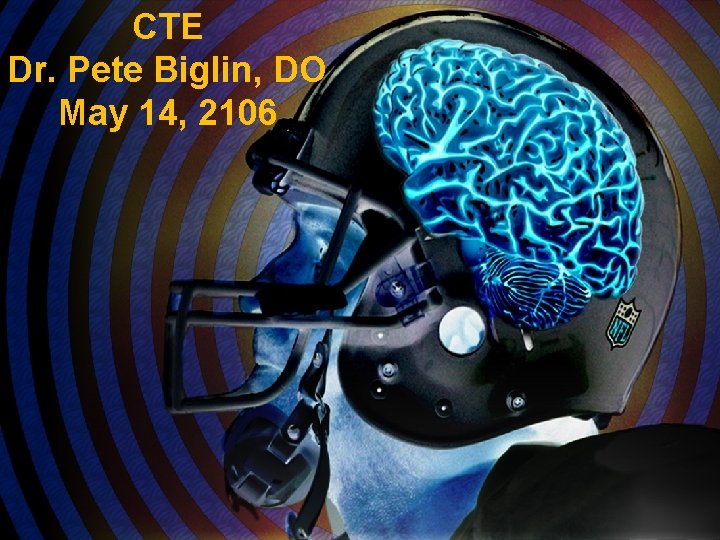
CTE Dr. Pete Biglin, DO May 14, 2106
DR. PETE BIGLIN, DO Board Certified: 1. Physical Medicine & Rehabilitation 2. Pain Management 3. Sports Medicine 4. Electrodiagnosis-EMG Training: 1. Wayne State University- PM&R 2. Michigan State University Fellowship - Sports Medicine
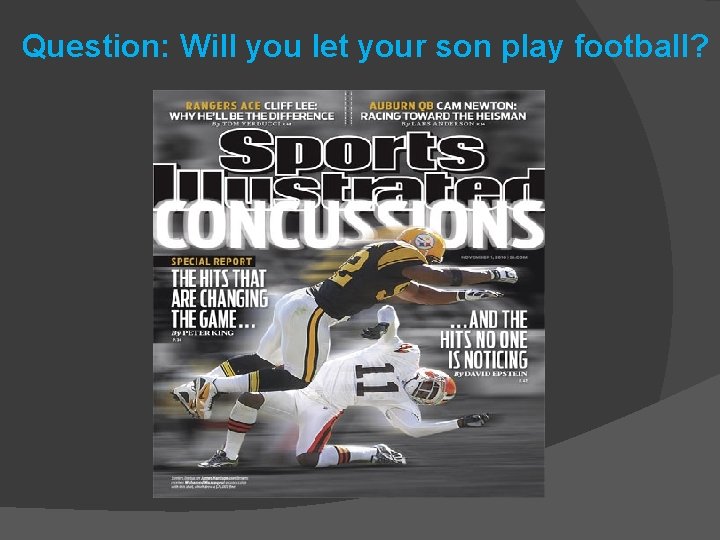
Question: Will you let your son play football?
CONCUSSION SUMMARY ARTICLE Consensus statement on concussion in sport: the 4 th International Conference in Sport held in Zurich, November 2012 – (CSC 2012) Breaking News!. . Consensus statement on concussion: 5 th international conference to be held in Berlin, Germany October 2016
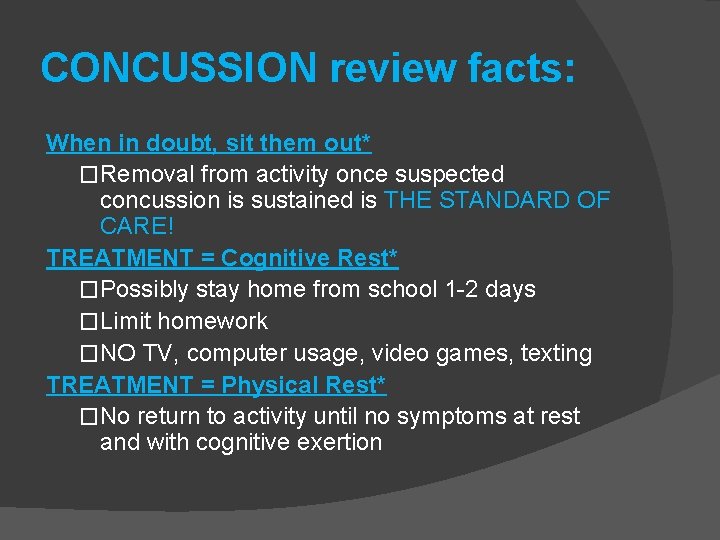
CONCUSSION review facts: When in doubt, sit them out* �Removal from activity once suspected concussion is sustained is THE STANDARD OF CARE! TREATMENT = Cognitive Rest* �Possibly stay home from school 1 -2 days �Limit homework �NO TV, computer usage, video games, texting TREATMENT = Physical Rest* �No return to activity until no symptoms at rest and with cognitive exertion
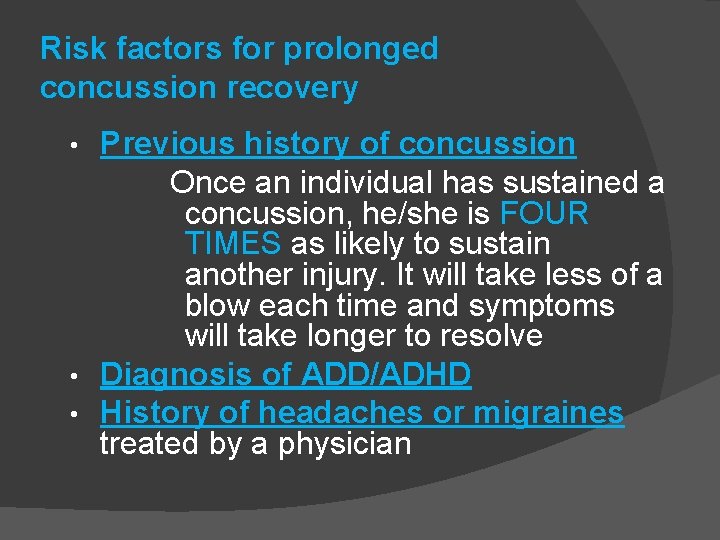
Risk factors for prolonged concussion recovery Previous history of concussion Once an individual has sustained a concussion, he/she is FOUR TIMES as likely to sustain another injury. It will take less of a blow each time and symptoms will take longer to resolve • Diagnosis of ADD/ADHD • History of headaches or migraines treated by a physician •
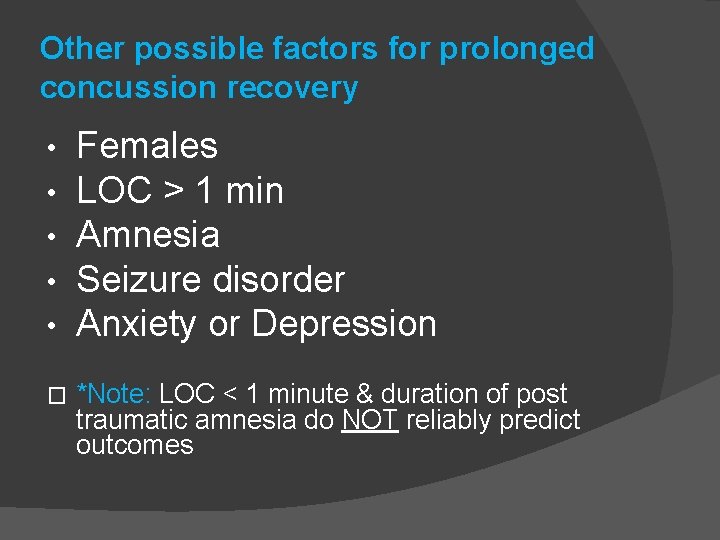
Other possible factors for prolonged concussion recovery • • • Females LOC > 1 min Amnesia Seizure disorder Anxiety or Depression � *Note: LOC < 1 minute & duration of post traumatic amnesia do NOT reliably predict outcomes
CTE : Chronic Traumatic Encephalopathy
What is CTE? “Chronic traumatic encephalopathy” � Progressive degenerative disease of the brain � History of repetitive brain traumaconcussions and sub-concussive trauma to the head that may not cause symptoms � Buildup of tau protein � Occurs in athletes as well as military veterans �
How do you get CTE? � Repetitive brain trauma (concussive and sub-concussive) � Number of hits unknown � Other factors-genetics…. . Not everyone with a history of repeated brain trauma develops the disease!
CTE � CT E is a neuropathologically distinct, slowly progressive Taupathy (Tau protein) with a clear environmental cause. � Estimated incidence - 17% of patients with repetitive concussion can develop CTE
CTE First called “punch drunk” 1920 s in boxers. Original medical term “Dementia Pugilistica” � 49 cases described in all medical literature between 1928 and 2009. 39 cases were boxers. One case was Australian circus performer- “dwarf-throwing” � Who is affected? –boxing, football, ice hockey, soccer, wrestling and military veterans. Victims of domestic violence and “head-bangers” �

How is CTE diagnosed? � Postmortem autopsy ONLYneuropathological analysis- Tau protein in the form of neurofibrillary tangleswhich eventually lead to brain cell death. � Right now there is no diagnostic methods for patients that are living
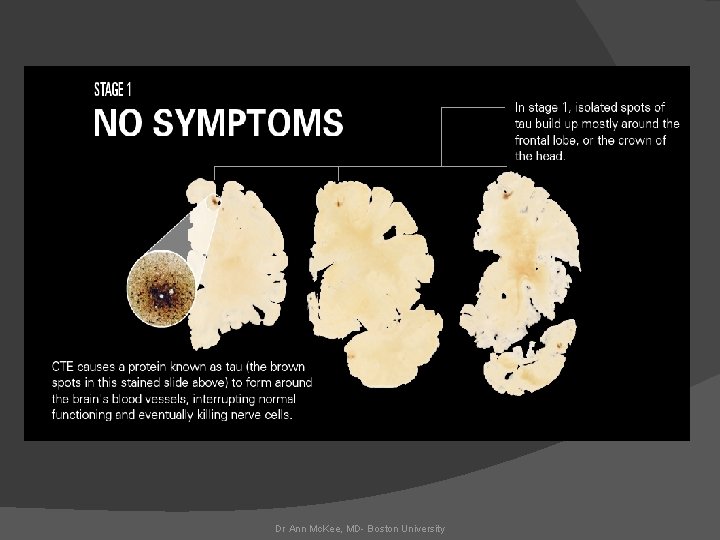
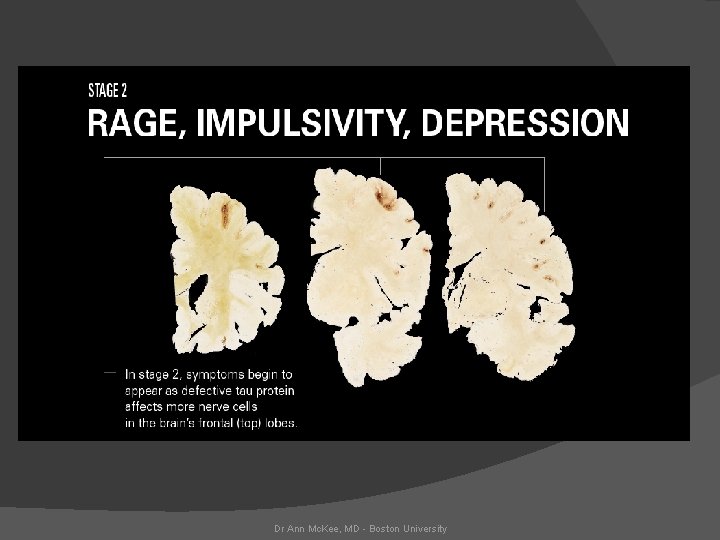
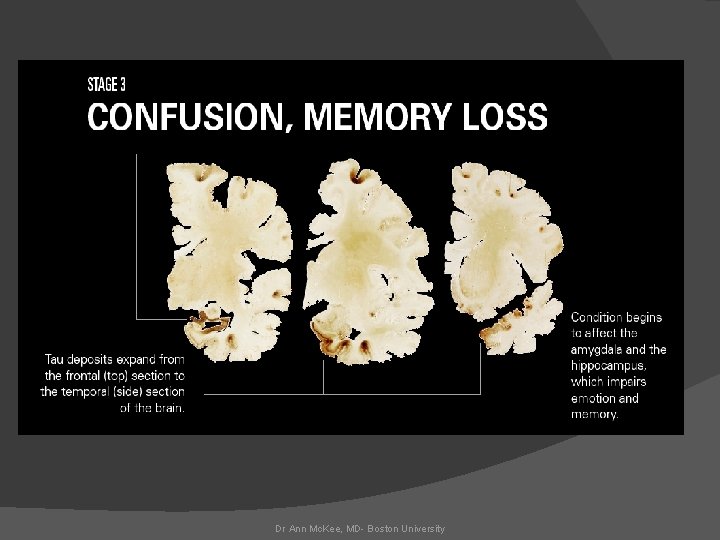
Stages of CTE Headaches, diminished attention & concentration, possible dizziness II. Depression, social instability, erratic behavior short-term memory impairment III. Cognitive impairment, problems with executive functions specifically planning, organization and multitasking IV. Full blown dementia, bradykinesia, tremor, vertigo, deafness and suicidality I.
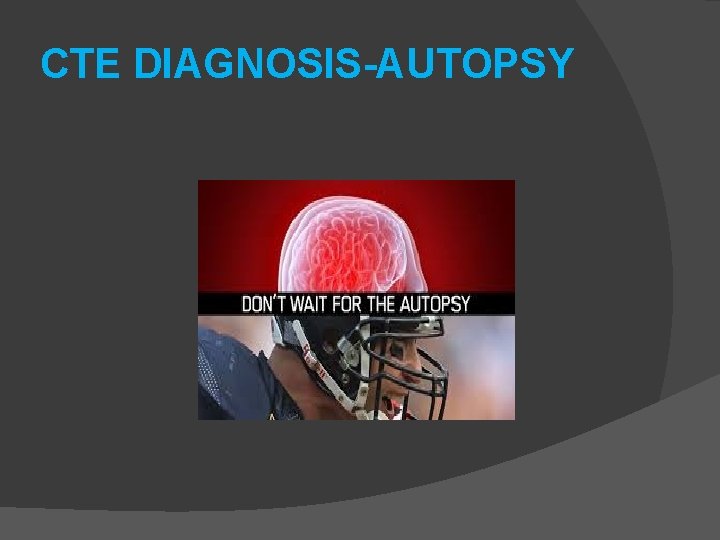
CTE DIAGNOSIS-AUTOPSY
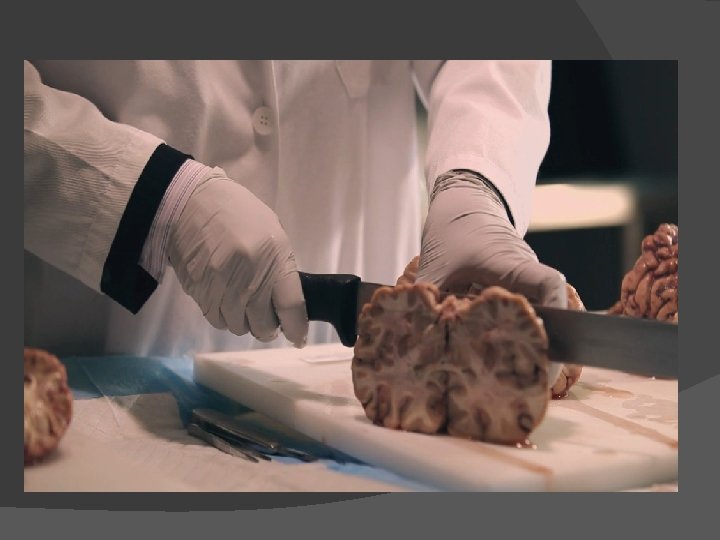
CTE Gross Brain Pathology � Decreased brain weight � Atrophy of frontal and temporal cortex � Enlarged third ventricle, and lateral ventricle � Pallor of the Substantia Nigra � Atrophy of all factory, thalamus brainstem and cerebellum
CTE microscopic brain pathology � Neuron cell loss (cell death) � TAU protein deposition forming as dense neuro-fibrillatory tangles (NFT) � Beta amyloid deposition uncommon
Dr Ann Mc. Kee, MD- Boston University
Dr Ann Mc. Kee, MD - Boston University
Dr Ann Mc. Kee, MD- Boston University
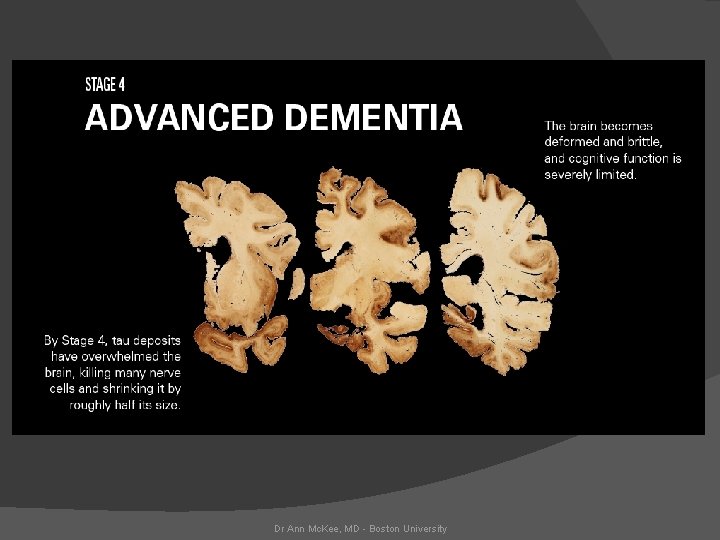
Dr Ann Mc. Kee, MD - Boston University
CTE diagnosis in living athletes ******Not available at this time******* � Possibilities and future studies: �PET tracers designed to find Tau protein (not specific enough at this time) �Functional MRI �DTI (DWI) imaging (Diffusion Tensor Imaging) �Serum blood testing for auto immune antibodies versus brain tissue
Differences CTE and Alzheimer’s CTE present earlier 40 s � Initial symptoms- Alzheimer’s disease and memory problems while CTE involves problems and reasoning, problem solving, impulse control and aggression which is not seen in Alzheimer’s � Different postmortem neuropathological findings �
CTE Case 1 - 45 -year-old male � Accidental gunshot wound while cleaning a gun. � Retired NFL player � Possible 12 concussions during college and professional career. Only one medically confirmed � Never diagnosed with post concussive syndrome
CTE Case 1 - 45 -year-old male � � � Family history negative for dementia or psychiatric illness At age 40 - symptoms noticed by family included short-term memory loss, impaired organization and planning and problem-solving. He would repeatedly asked the same questions over and over. He would asked to rent a movie that he had already seen. Towards the end of his life he would become angry and verbally aggressive over insignificant issues CTE found postmortem
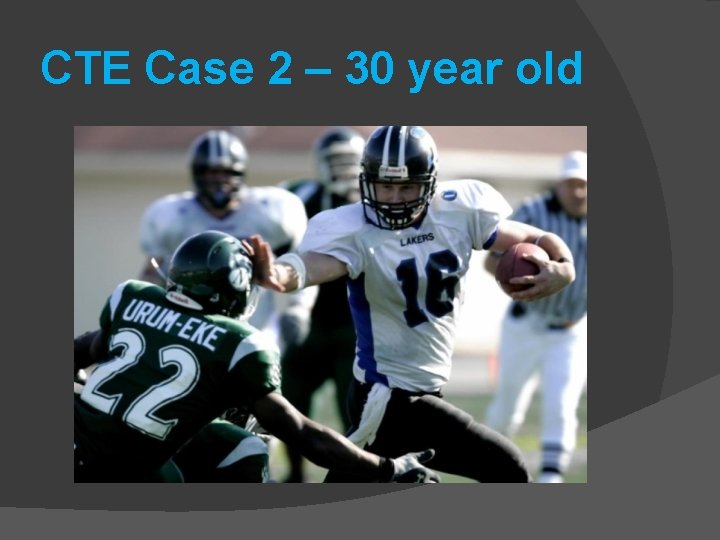
CTE Case 2 – 30 year old
CTE Case 2 – 30 year old Died of pneumonia caused by inhaling his vomit while in the wilderness- 2013 � CTE found on autopsy - Severity of CTE described as moderate. � Paranoia and anxiety symptoms reported by family up to a year before his death � “ CTE possibly affected his judgment, insight and behavior, but there are other factors including use of oxycodone that most likely contributed to his death” �
Case 2 – 30 year old � Quote from a family friend: “ He didn’t run out of bounds. He put his head down and got the first down. He wasn’t the guide to through the ball away. He probably took some hits shouldn’t have” � Medical records and # confirmed concussions-not available
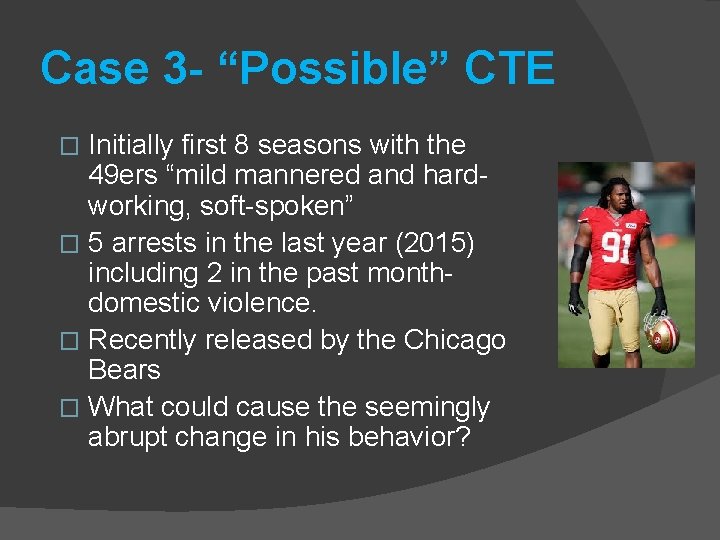
Case 3 - “Possible” CTE Initially first 8 seasons with the 49 ers “mild mannered and hardworking, soft-spoken” � 5 arrests in the last year (2015) including 2 in the past monthdomestic violence. � Recently released by the Chicago Bears � What could cause the seemingly abrupt change in his behavior? �
CTE Prevention possibilities � Reduced the number of concussions or mild TBI � Changes in rules to prevent “violence” versus “aggressive play” (e. g. penalizing intentional hits to the head) � Appropriate concussion treatment � Strict return to play guidelines
CTE Prevention possibilities Opinion: “In athletes, by instituting and following proper guidelines for return to play after a concussion, it is possible that the frequency of sports related CTE could be dramatically reduced or perhaps, entirely prevented. ”
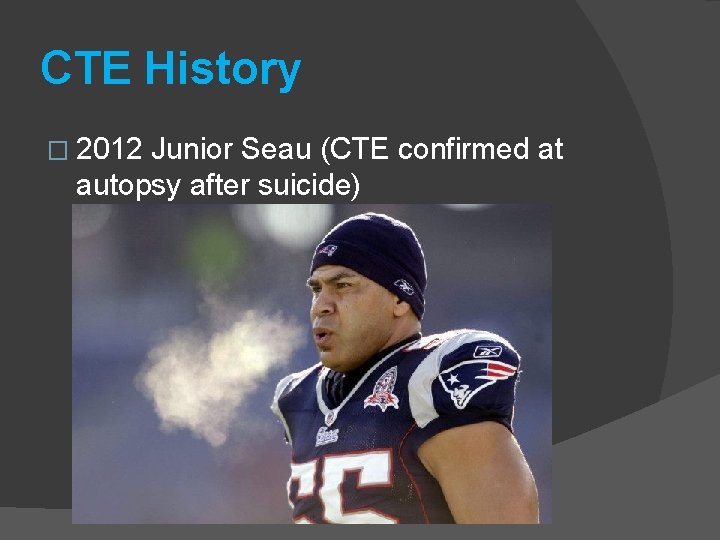
CTE History � 2012 Junior Seau (CTE confirmed at autopsy after suicide)
CTE Fears � Concussion does not equal CTE � Post concussive syndrome does not equal CTE � Football it self does not cause CTE � Suicide is a multi-factorial entity, & does not equal CTE (possible higher frequency in pro football than other sports)
CTE History � 2010 - CTE confirmed in a 17 -year-old football player (youngest ever diagnosed) � 2011 - July: NFL changed Return to Play guidelines and also reduced the number of contact practices allowed � 2015 Boston University identified CTE 96% of NFL players examined at autopsy
CTE debate � Hypothesis that repeated concussions cause CTE cannot be definitively proven (to date, there is also no evidence to falsify this hypothesis) � However, growing body of evidence and the NFL (by admission) support hypothesis that repeated concussions cause CTE
SUMMARY- CTE There is no available evidence that isolated, & well managed concussions give rise to CTE. This is why our job as medical professionals covering athletic events is so important (preventing longterm disability). � Next GOAL: diagnose in someone alive & define treatment and prevention strategies �
REFERENCES Chronic Traumatic Encephalopathy in Athletes: Progressive Tauopathy following Repetitive Head Injury (J Neuropathol Exp 2009 July; 68(7) 709735) � Boston University: Center for the Study of Traumatic Encephalopathy (CSTE) � Consensus statement on concussion in sport: the 4 th International Conference in Sport held in Zurich, November 2012 –(CSC 2012) �
- Slides: 38