
CTDI Measurement with OSL Dosimeters Scott Emerson MS
![Limit of Conventional CTDI Measurements[1] Ø CTDI is defined for axial scanning Ø Application](https://slidetodoc.com/presentation_image_h2/69daa8756a18a7540d74114eb962fdb5/image-6.jpg "Limit of Conventional CTDI Measurements[1] Ø CTDI is defined for axial scanning Ø Application")


- Slides: 22
CTDI Measurement with OSL Dosimeters Scott Emerson, MS Beaumont Hospital, Royal Oak
Collaboration of this Project Ø Yongguang Liang, Ph. D. Ø Subhash Danak M. S. Ø Dennis Aurand, M. S. Ø Cheryl Culver-Schultz, M. S.
Outline Ø CTDI Background Ø Methods with nano. Dots Ø Results and Analysis Ø Discussion and Conclusion
Objective Ø Investigate the viability of optically stimulated luminescent (OSL) dosimeters in CTDIvol measurement Ø Compare OSL dose to: l l Scanner displayed CTDIvol Ion chamber measured CTDIvol Ø Investigate future applications
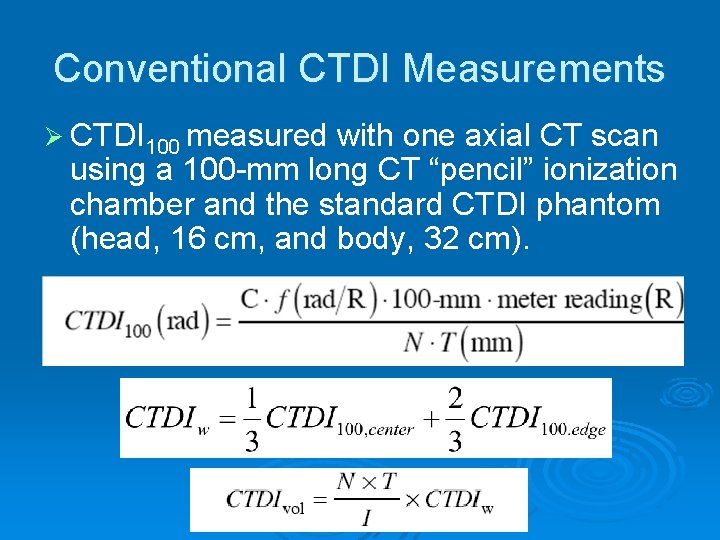
Conventional CTDI Measurements Ø CTDI 100 measured with one axial CT scan using a 100 -mm long CT “pencil” ionization chamber and the standard CTDI phantom (head, 16 cm, and body, 32 cm).
Limit of Conventional CTDI Measurements[1] Ø CTDI is defined for axial scanning Ø Application to dose in helical scanning is conceptually presumptuous Ø Current CTDI 100 -based measurements are becoming more limited as CT beams widen along z l l l Move from fan to cone beam Exclude contributions radiation scattered beyond the 100 -mm range of integration along z In turn, underestimates the cumulative dose
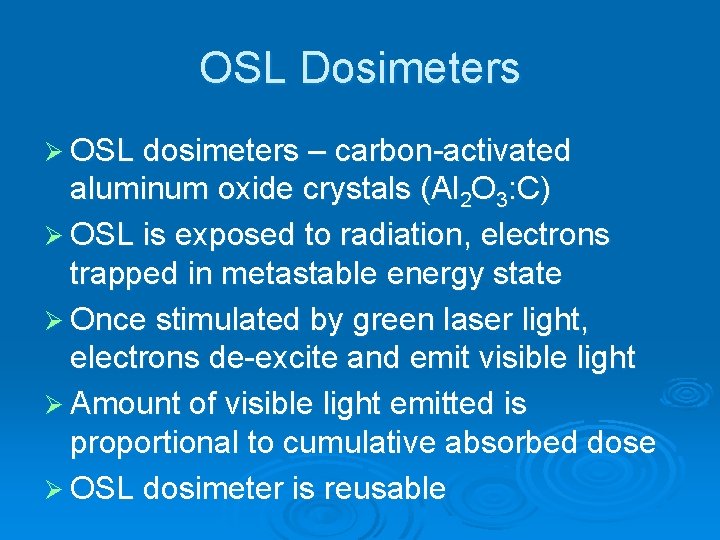
OSL Dosimeters Ø OSL dosimeters – carbon-activated aluminum oxide crystals (Al 2 O 3: C) Ø OSL is exposed to radiation, electrons trapped in metastable energy state Ø Once stimulated by green laser light, electrons de-excite and emit visible light Ø Amount of visible light emitted is proportional to cumulative absorbed dose Ø OSL dosimeter is reusable
Use of OSL Dosimeters Skin dose measurements 1. CT Dosimetry: Comparison of Measurement Techniques and Devices [2] 2. Skin dose study for CT brain perfusion protocols at Beaumont and other clinics a) “Skin Dose in Routine CT Brain Perfusion Studies Using Siemens 64 slice, Definition Dual Source, and Flash CT Scanners”, Yongguang Liang et. al. , accepted as Alternate Paper for 2010 RSNA annual meeting b) “Radiation Dose of Patient Receiving CTA and CTP Studies of Brain”, P Lin and D Hackney, Med. Phys. 37, 3116 (2010) (Beth Israel Deaconess Medical Center, Boston, MA ) Ø Fluoroscopy entrance skin dose measurements Ø
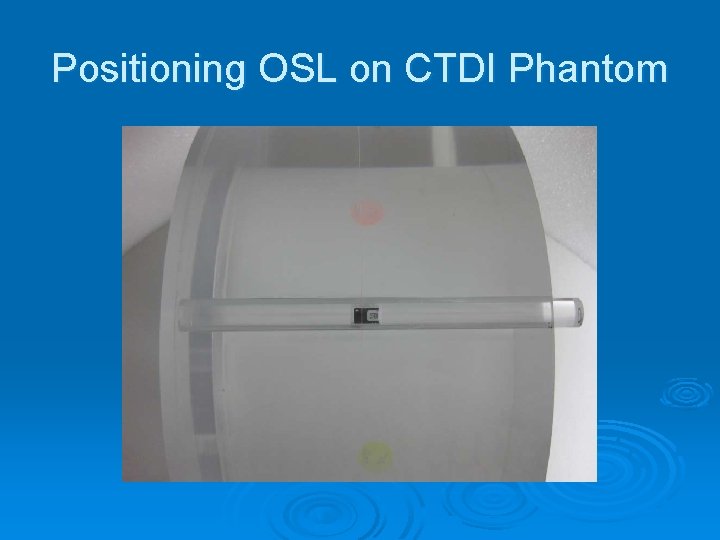
Measurement Set Up Ø Equipment used: 1. Siemens Somatom Sensation 16 -slice CT scanner 2. Landauer OSL dosimeters and In. Light® micro. Star system for reading dose 3. Standard CTDI phantom, acrylic rods with a notch at the middle to hold the OSL dosimeters. 4. Radcal model 9015 with 100 mm pencil ion chamber
Notch of Acrylic Rod
Positioning OSL on CTDI Phantom
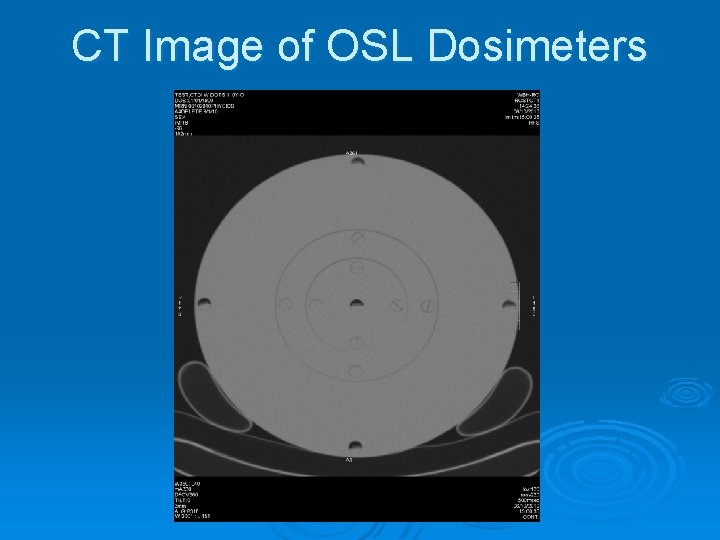
CT Image of OSL Dosimeters
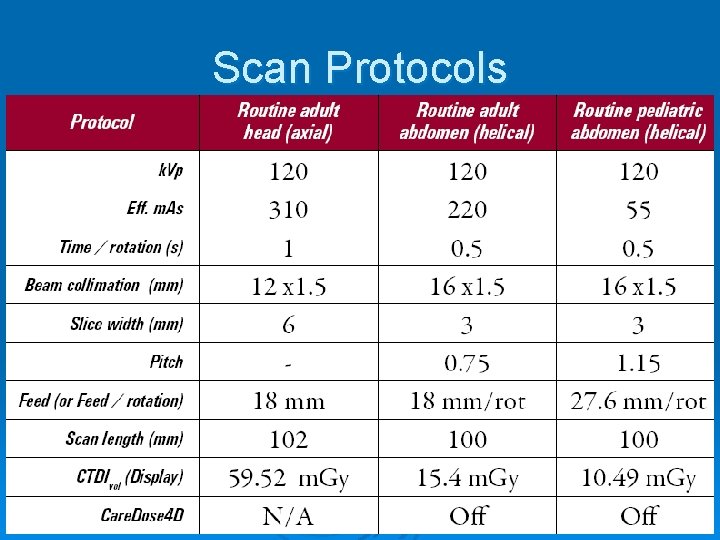
Scan Protocols
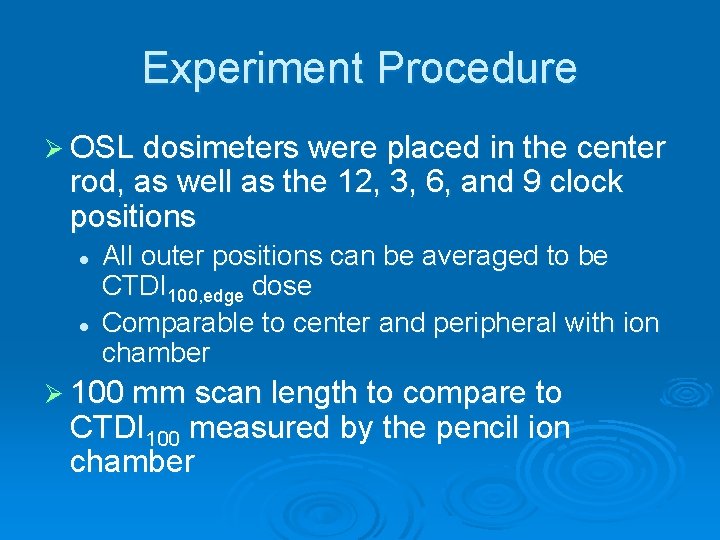
Experiment Procedure Ø OSL dosimeters were placed in the center rod, as well as the 12, 3, 6, and 9 clock positions l l All outer positions can be averaged to be CTDI 100, edge dose Comparable to center and peripheral with ion chamber Ø 100 mm scan length to compare to CTDI 100 measured by the pencil ion chamber
Experiment Procedure Ø 10 minute post-exposure delay allows the signal from the transient thermal traps to dissipate before reading the dose [4] Ø Exposure were repeated four times for each protocol l Scanner reproducibility previously proven with ion chamber measurements during annual tests
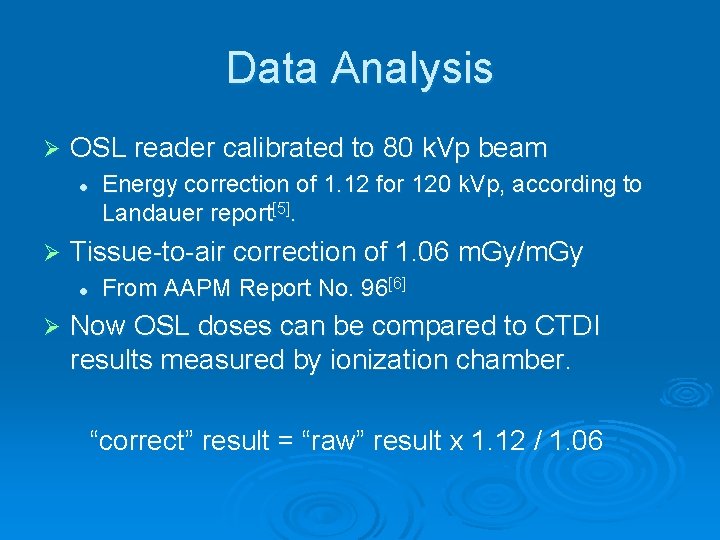
Data Analysis Ø OSL reader calibrated to 80 k. Vp beam l Ø Tissue-to-air correction of 1. 06 m. Gy/m. Gy l Ø Energy correction of 1. 12 for 120 k. Vp, according to Landauer report[5]. From AAPM Report No. 96[6] Now OSL doses can be compared to CTDI results measured by ionization chamber. “correct” result = “raw” result x 1. 12 / 1. 06
Results of Three Protocols
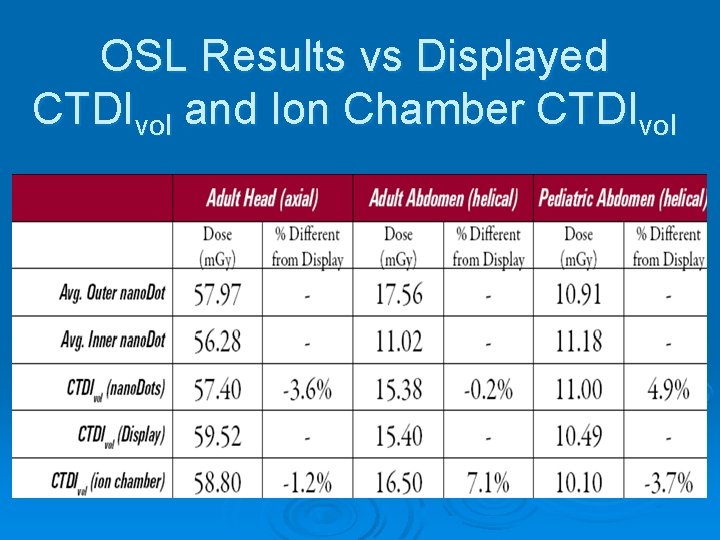
OSL Results vs Displayed CTDIvol and Ion Chamber CTDIvol
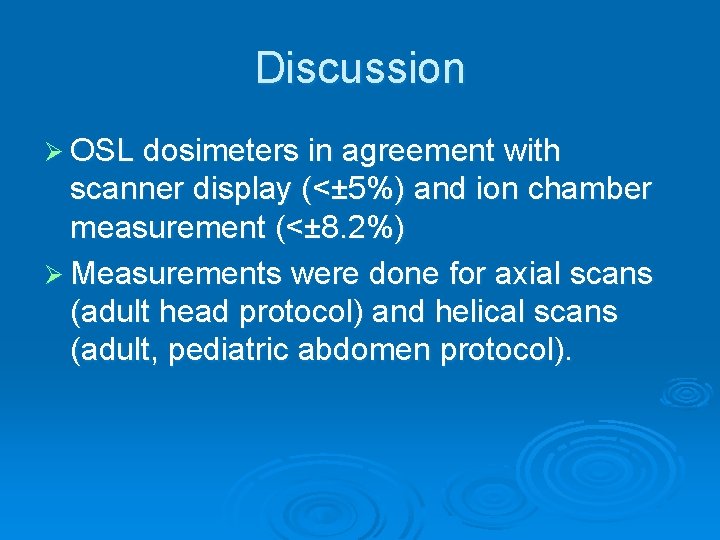
Discussion Ø OSL dosimeters in agreement with scanner display (<± 5%) and ion chamber measurement (<± 8. 2%) Ø Measurements were done for axial scans (adult head protocol) and helical scans (adult, pediatric abdomen protocol).
Conclusion and Future Study Ø OSL Dosimeter can be used to measure the CTDI with a comparable accuracy to the conventional ionization chamber measurement for a scan length of no more than 10 cm Ø OSL can be used to measure CT dose for both axial and helical scans
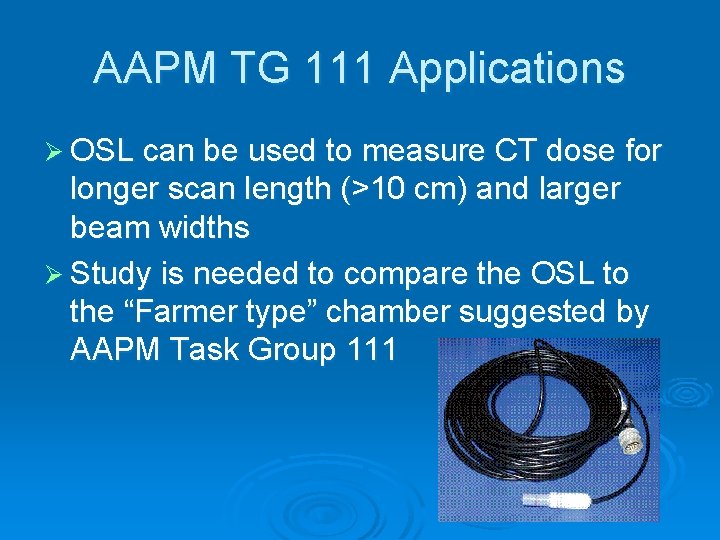
AAPM TG 111 Applications Ø OSL can be used to measure CT dose for longer scan length (>10 cm) and larger beam widths Ø Study is needed to compare the OSL to the “Farmer type” chamber suggested by AAPM Task Group 111
References 1. 2. 3. 4. 5. 6. American Association of Physicists in Medicine (AAPM) Task Group 111 Report, “Comprehensive Methodology for the Evaluation of Radiation Dose in X-Ray Computed Tomography“, AAPM Task Group 111, February 2010 John A Bauhs et. al. ; “CT Dosimetry: Comparison of Measurement Techniques and Devices”, January 2008 Radio. Graphics, 28, 245 -253 C Ruan et. al. ; “Determination of multislice computed tomography dose index (CTDI) using optically stimulated luminescence technology”, Med. Phys. 37, 3560 (2010) Jursinic, P. A. ; “Characterization of optically stimulated luminescent dosimeters, OSLDs, for clinical dosimetric measurements”, Medical Physics, Vol. 34 (12) December 2007 Yahkne, Ph. D. , C. J. , Hanify, R. D. , and Salasky, M. R. , “Microstar Calibration Conversion Factors for Dots”, Landauer In. Light. TM Systems American Association of Physicists in Medicine (AAPM) Report No. 96, “The Measurement, Reporting, and Management of Radiation Dose in CT”, AAPM Task Group 23, January 2008