
CTC MTC 222 Strength of Materials Chapter 5
- Slides: 9
CTC / MTC 222 Strength of Materials Chapter 5 Torsional Shear Stress and Torsional Deformation
Chapter Objectives • Define torque and compute the magnitude of torque • • exerted on a member subjected to torsional loading Compute the maximum shear stress in a member subjected to torsional loading Define polar moment of inertia and polar section modulus and compute their values for round shafts Compute the angle of twist of a member loaded in torsion Define the relationship between power, torque and rotational speed
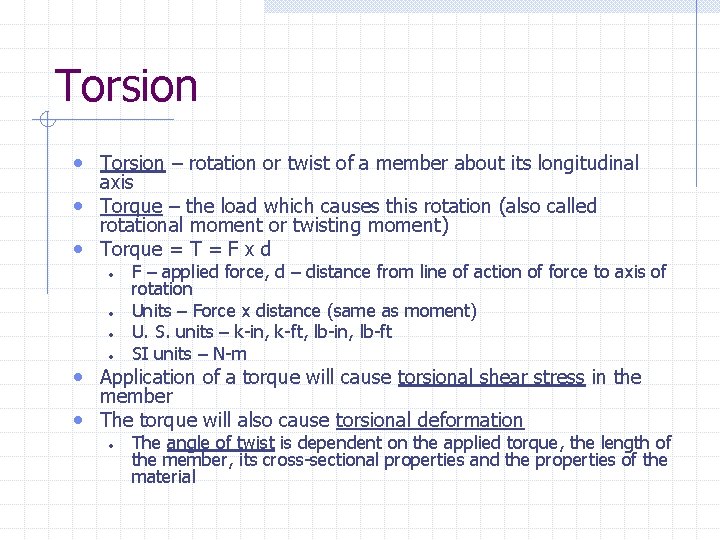
Torsion • Torsion – rotation or twist of a member about its longitudinal axis • Torque – the load which causes this rotation (also called rotational moment or twisting moment) • Torque = T = F x d • • F – applied force, d – distance from line of action of force to axis of rotation Units – Force x distance (same as moment) U. S. units – k-in, k-ft, lb-in, lb-ft SI units – N-m • Application of a torque will cause torsional shear stress in the member • The torque will also cause torsional deformation • The angle of twist is dependent on the applied torque, the length of the member, its cross-sectional properties and the properties of the material
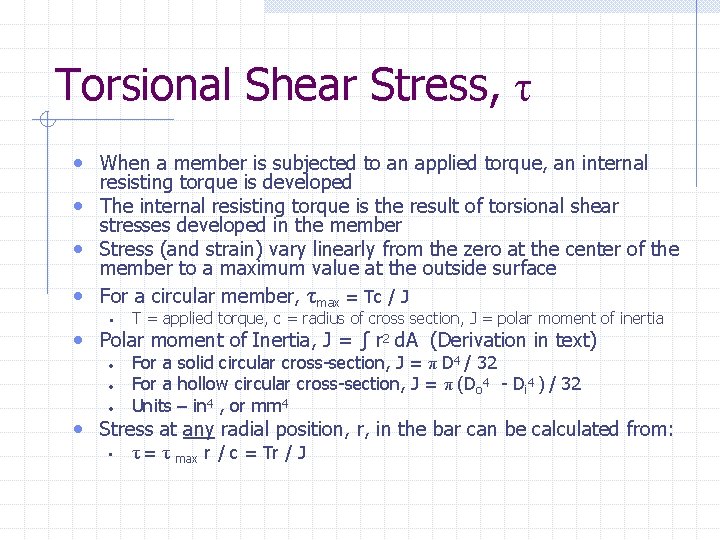
Torsional Shear Stress, τ • When a member is subjected to an applied torque, an internal resisting torque is developed • The internal resisting torque is the result of torsional shear stresses developed in the member • Stress (and strain) vary linearly from the zero at the center of the member to a maximum value at the outside surface • For a circular member, τmax = Tc / J • T = applied torque, c = radius of cross section, J = polar moment of inertia • Polar moment of Inertia, J = ∫ r 2 d. A (Derivation in text) • For a solid circular cross-section, J = π D 4 / 32 For a hollow circular cross-section, J = π (Do 4 - Di 4 ) / 32 Units – in 4 , or mm 4 • τ = τ max r / c = Tr / J • • • Stress at any radial position, r, in the bar can be calculated from:
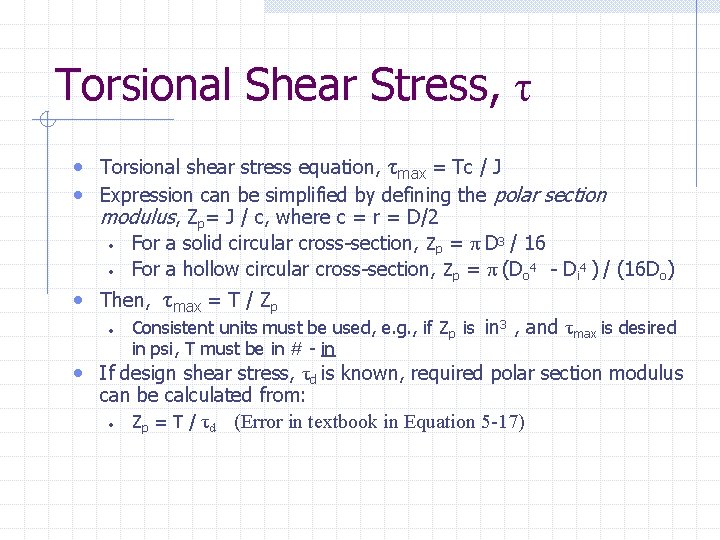
Torsional Shear Stress, τ • Torsional shear stress equation, τmax = Tc / J • Expression can be simplified by defining the polar section modulus, Zp= J / c, where c = r = D/2 • • For a solid circular cross-section, Zp = π D 3 / 16 For a hollow circular cross-section, Zp = π (Do 4 - Di 4 ) / (16 Do) • Then, τmax = T / Zp • Consistent units must be used, e. g. , if Zp is in 3 , and τmax is desired in psi, T must be in # - in • If design shear stress, τd is known, required polar section modulus can be calculated from: • Zp = T / τd (Error in textbook in Equation 5 -17)
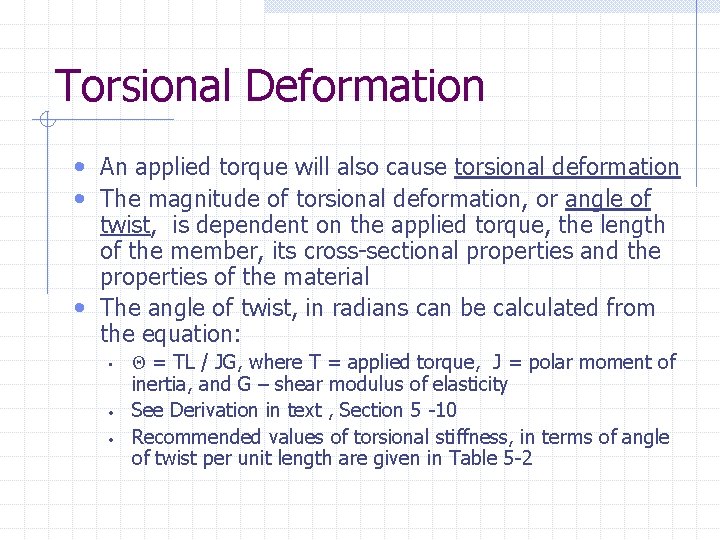
Torsional Deformation • An applied torque will also cause torsional deformation • The magnitude of torsional deformation, or angle of twist, is dependent on the applied torque, the length of the member, its cross-sectional properties and the properties of the material • The angle of twist, in radians can be calculated from the equation: • • • Θ = TL / JG, where T = applied torque, J = polar moment of inertia, and G – shear modulus of elasticity See Derivation in text , Section 5 -10 Recommended values of torsional stiffness, in terms of angle of twist per unit length are given in Table 5 -2
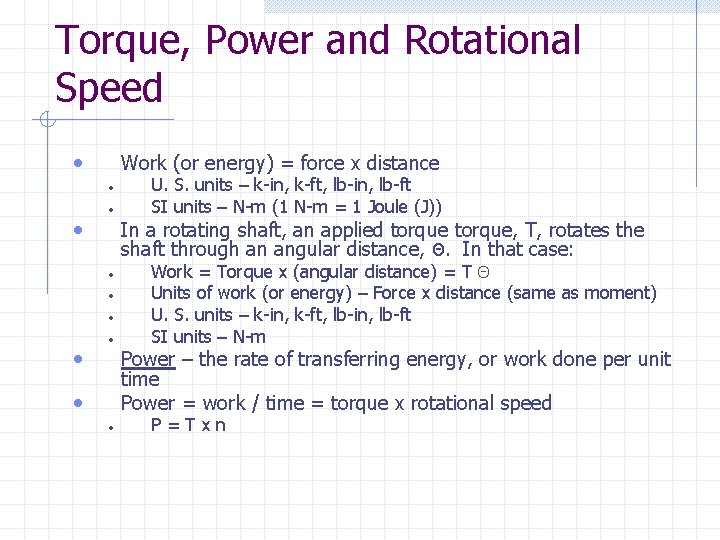
Torque, Power and Rotational Speed • Work (or energy) = force x distance • • • In a rotating shaft, an applied torque, T, rotates the shaft through an angular distance, Θ. In that case: • • U. S. units – k-in, k-ft, lb-in, lb-ft SI units – N-m (1 N-m = 1 Joule (J)) • Work = Torque x (angular distance) = T Θ Units of work (or energy) – Force x distance (same as moment) U. S. units – k-in, k-ft, lb-in, lb-ft SI units – N-m Power – the rate of transferring energy, or work done per unit time Power = work / time = torque x rotational speed • • P=Txn
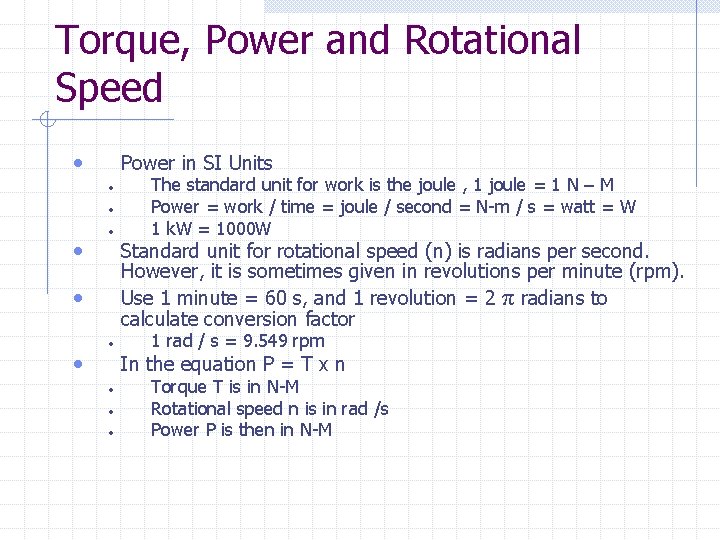
Torque, Power and Rotational Speed • Power in SI Units • • Standard unit for rotational speed (n) is radians per second. However, it is sometimes given in revolutions per minute (rpm). Use 1 minute = 60 s, and 1 revolution = 2 π radians to calculate conversion factor • • The standard unit for work is the joule , 1 joule = 1 N – M Power = work / time = joule / second = N-m / s = watt = W 1 k. W = 1000 W • 1 rad / s = 9. 549 rpm In the equation P = T x n • • • Torque T is in N-M Rotational speed n is in rad /s Power P is then in N-M
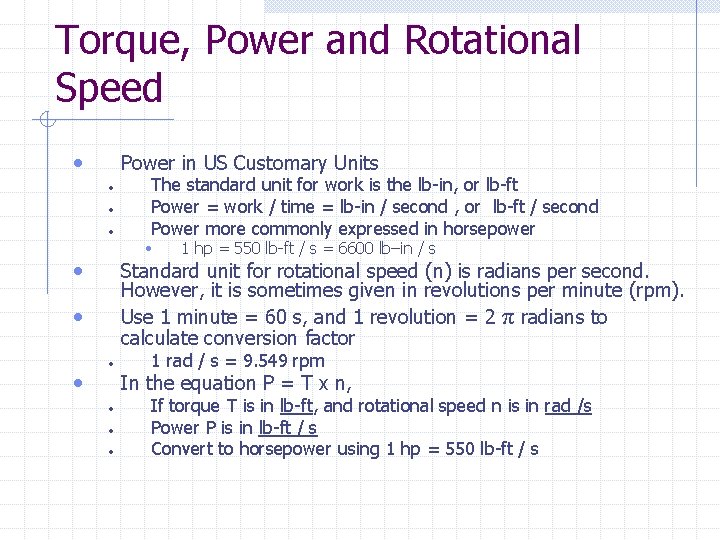
Torque, Power and Rotational Speed • Power in US Customary Units • • • 1 hp = 550 lb-ft / s = 6600 lb–in / s Standard unit for rotational speed (n) is radians per second. However, it is sometimes given in revolutions per minute (rpm). Use 1 minute = 60 s, and 1 revolution = 2 π radians to calculate conversion factor • • The standard unit for work is the lb-in, or lb-ft Power = work / time = lb-in / second , or lb-ft / second Power more commonly expressed in horsepower • 1 rad / s = 9. 549 rpm In the equation P = T x n, • • • If torque T is in lb-ft, and rotational speed n is in rad /s Power P is in lb-ft / s Convert to horsepower using 1 hp = 550 lb-ft / s