
CTC 475 Income taxes ATCF CTC 475 Review




- Slides: 24
CTC 475 Income taxes ATCF
CTC 475 Review Depreciation Historical Methods Straight Line (SL) Declining Balance (DB-200% or 150%) Sum of the Years Digits (SOYD or SYD) Current Method MACRS-GDS or ADS
Objectives Understand the basics of graduated taxes Know how to develop an ATCF using depreciation allowances
Tax Concepts Taxes affect cash flows Any economic analysis should be on an after-tax basis ATCF’s are develop by adjusting BTCF’s for taxes paid or received Taxes are affected by BTCF, tax rate and depreciation
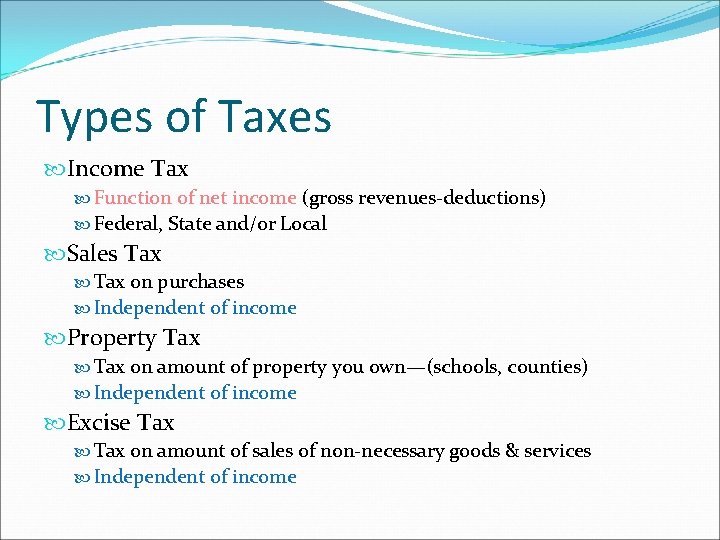
Types of Taxes Income Tax Function of net income (gross revenues-deductions) Federal, State and/or Local Sales Tax on purchases Independent of income Property Tax on amount of property you own—(schools, counties) Independent of income Excise Tax on amount of sales of non-necessary goods & services Independent of income
Which tax do we consider? Usually income tax
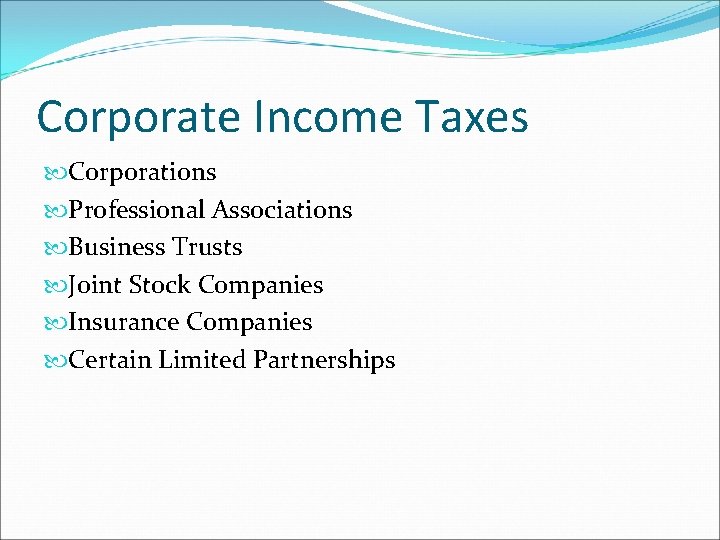
Corporate Income Taxes Corporations Professional Associations Business Trusts Joint Stock Companies Insurance Companies Certain Limited Partnerships
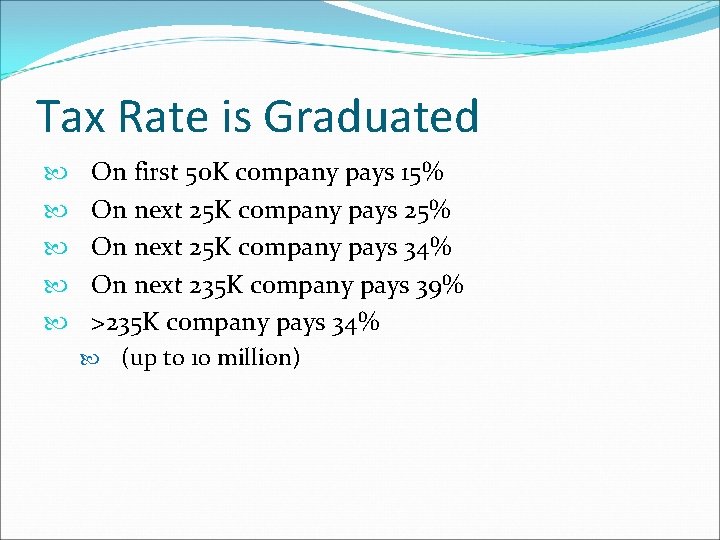
Corporate Income Tax Rates Taxable Income (TI) Tax Rate (%) 0<TI<=50 K 15% 50 K<TI<=75 K 25% 75 K<TI<=100 K 34% 100 K<TI<=335 K 39% 335<TI<=10, 000 K 34%
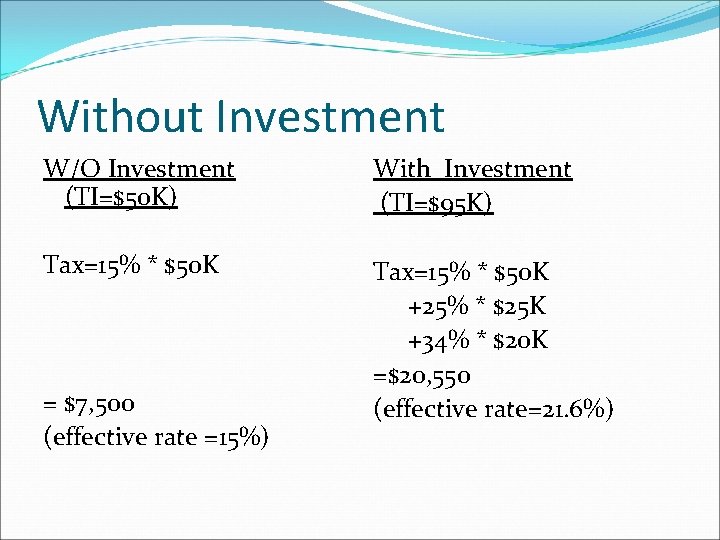
Tax Rate is Graduated On first 50 K company pays 15% On next 25 K company pays 25% On next 25 K company pays 34% On next 235 K company pays 39% >235 K company pays 34% (up to 10 million)
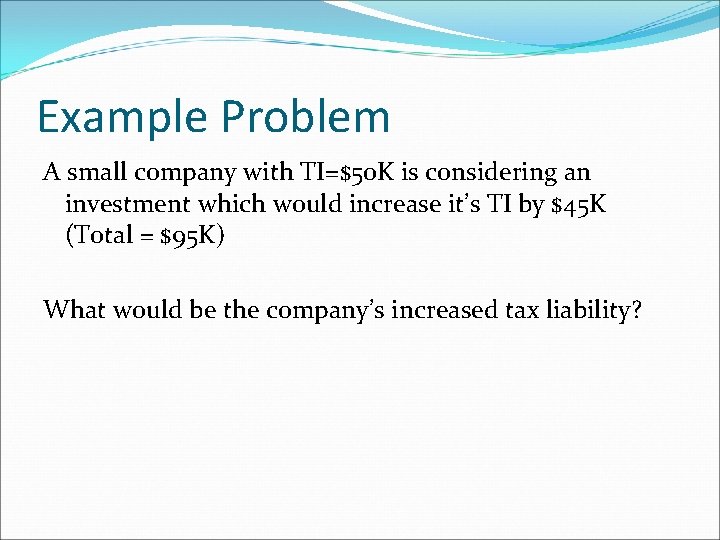
Example Problem A small company with TI=$50 K is considering an investment which would increase it’s TI by $45 K (Total = $95 K) What would be the company’s increased tax liability?
Without Investment W/O Investment (TI=$50 K) With Investment (TI=$95 K) Tax=15% * $50 K +25% * $25 K +34% * $20 K =$20, 550 (effective rate=21. 6%) = $7, 500 (effective rate =15%)
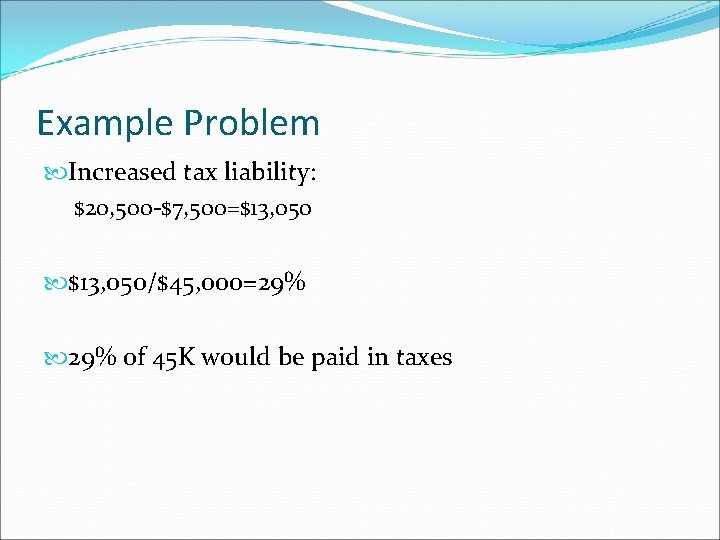
Example Problem Increased tax liability: $20, 500 -$7, 500=$13, 050/$45, 000=29% of 45 K would be paid in taxes
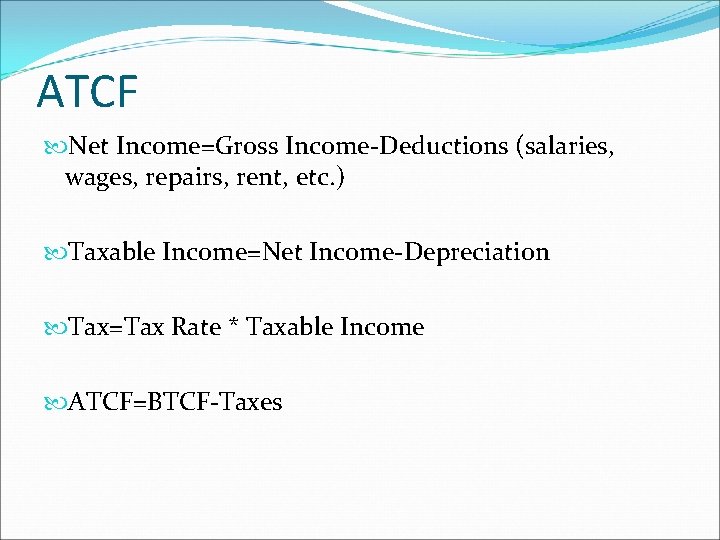
ATCF Net Income=Gross Income-Deductions (salaries, wages, repairs, rent, etc. ) Taxable Income=Net Income-Depreciation Tax=Tax Rate * Taxable Income ATCF=BTCF-Taxes
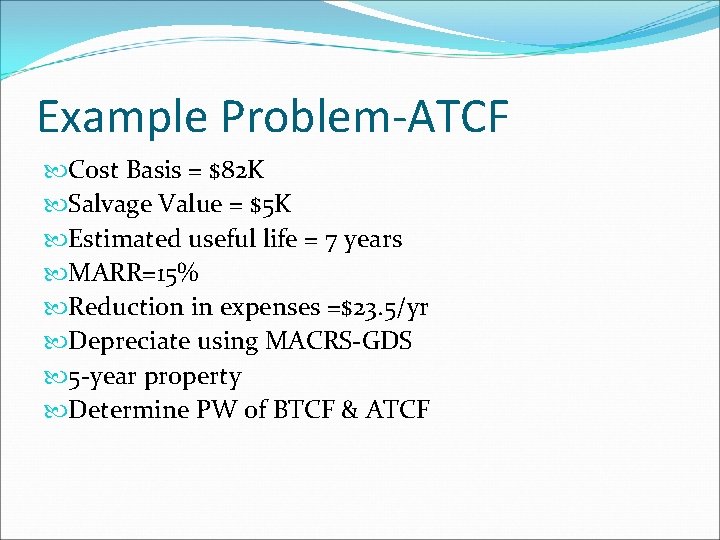
Example Problem-ATCF Cost Basis = $82 K Salvage Value = $5 K Estimated useful life = 7 years MARR=15% Reduction in expenses =$23. 5/yr Depreciate using MACRS-GDS 5 -year property Determine PW of BTCF & ATCF
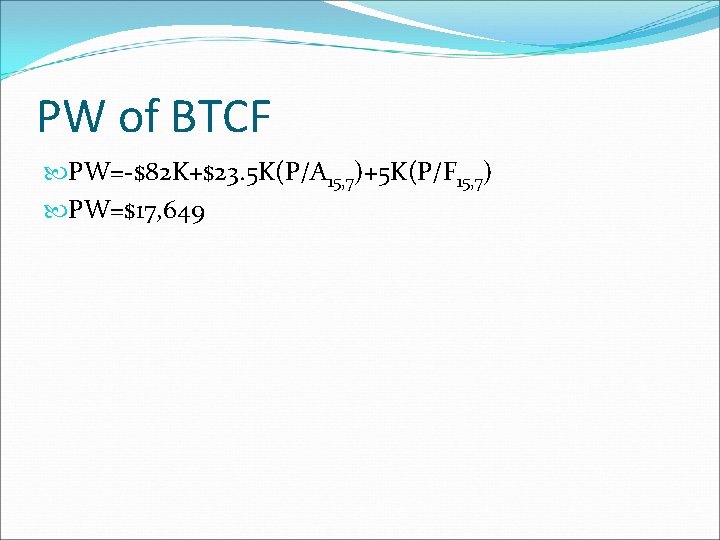
PW of BTCF PW=-$82 K+$23. 5 K(P/A 15, 7)+5 K(P/F 15, 7) PW=$17, 649
ATCF-Calculate Depreciation EOY Calculation Depreciation (MACRS) 1 20%*$82 K= $16, 400 2 32%*$82 K= $26, 240 3 19. 2%*$82 K= $15, 744 4 11. 52%*$82 K= $9, 446 5 11. 52%*$82 K= $9, 446 6 5. 76%*$82 K= $4, 723
Notes: If you add depreciation amounts (MACRS-GDS) you should get the cost basis Also remember that depreciation lasts one more year than the recovery period (i. e. 6 instead of 5 years)
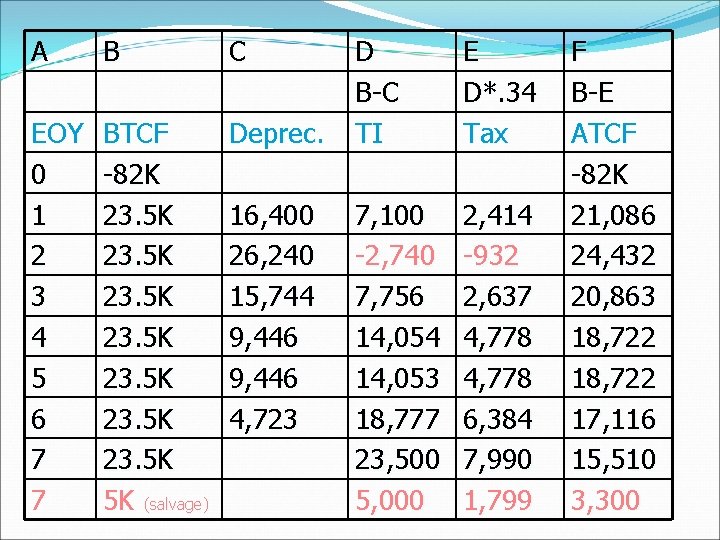
A B C EOY 0 1 2 3 4 5 6 7 7 BTCF -82 K 23. 5 K 23. 5 K 5 K (salvage) Deprec. 16, 400 26, 240 15, 744 9, 446 4, 723 D B-C TI E D*. 34 Tax 7, 100 -2, 740 7, 756 14, 054 14, 053 18, 777 23, 500 5, 000 2, 414 -932 2, 637 4, 778 6, 384 7, 990 1, 799 F B-E ATCF -82 K 21, 086 24, 432 20, 863 18, 722 17, 116 15, 510 3, 300
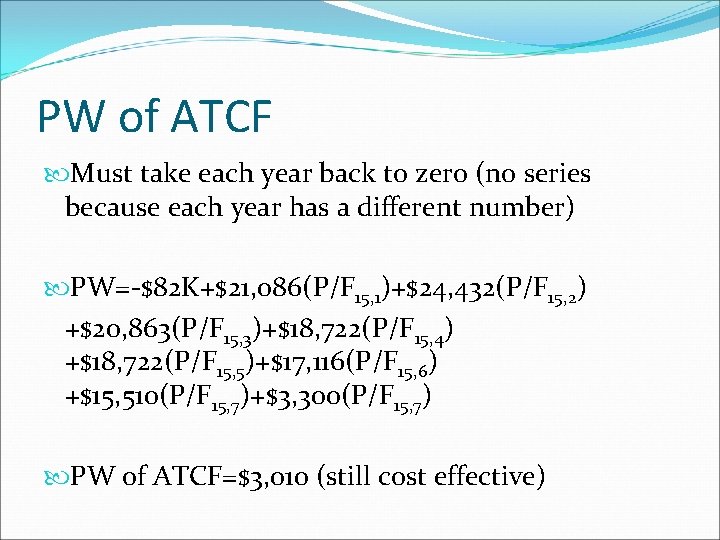
PW of ATCF Must take each year back to zero (no series because each year has a different number) PW=-$82 K+$21, 086(P/F 15, 1)+$24, 432(P/F 15, 2) +$20, 863(P/F 15, 3)+$18, 722(P/F 15, 4) +$18, 722(P/F 15, 5)+$17, 116(P/F 15, 6) +$15, 510(P/F 15, 7)+$3, 300(P/F 15, 7) PW of ATCF=$3, 010 (still cost effective)
ATCF’s are impacted by: Depreciation methods Recovery period Planning horizon Different tax rates BTCF
Other comments: Depreciation is not a cash flow but is needed to determine taxes Taxes are a cash flow Under MACRS-GDS the sum of depreciation amounts should equal the cost basis Negative taxes--assumes a company is able to reduce it’s overall taxes
MARR In the previous example, the same MARR was used to determine PW of the BTCF and ATCF A lower MARR is acceptable for after-tax cash flows General Rule: For BTCF, use before-tax MARR For ATCF, use after-tax MARR
Before-Tax MARR; After-Tax Marr Approximate relationship between the two: BT MARR=AT MARR/(1 -Effective Tax Rate) Example: BTCF MARR=25% and tax rate is 40% ATCF MARR is approximately 15%
Next lecture Estimating cash flows Inflation