
CTA for Pulmonary Embolism When to Image Based
CTA for Pulmonary Embolism When to Image Based on Choosing Wisely® and ACR Appropriateness Criteria®
What Is R-SCAN? § Collaborative activity for referring clinicians and radiologists to improve patient care through clinical improvement § R-SCAN Collaboration Goals: § Ensure patients receive the most appropriate imaging exam at the most appropriate time based on evidence -based appropriate use criteria § Reduce unnecessary imaging tests focused on imaging Choosing Wisely® topics § Lower the cost of care 2
Why Participate? § R-SCAN Offers: § Data-driven system for moving toward value-based imaging and patient care § Opportunity to focus on highly relevant imaging exams to improve utilization § Collaborators can fulfill their Improvement Activity requirements under the MIPS § Easy way to practice with clinical decision support (CDS) technology § In preparation for PAMA § Free and immediate access to Web-based tools and CME activities 3
Problem: Overutilization of CT Angiography for Pulmonary Embolism § The signs and symptoms of pulmonary embolism (PE) are nonspecific, and the diagnosis can be missed clinically § It is estimated > 50% of cases of PE go undiagnosed and clinical concern has driven a substantial increase in the utilization of imaging, especially CT scanning[1]. § According to Hess et al [2], the number of emergency department (ED) CT examinations increased from 41. 1 per 1, 000 in 2000 to 74. 4 per 1, 000 in 2010 (an 81% absolute increase). 1. Bruno, M. A. , Mahraj, R. P. M. , Whitener, C. J. , De. Flitch, C. J. , Beck, M. J. , Geeting, G. K. An interdepartmental consensus statement on the optimal utilization of enhanced helical CT scanning of the chest for the diagnosis of pulmonary embolism (CT-PA) at Penn State Milton S. Hershey Medical Center. Penn State. 2014. 2. Hess, E. P. , Haas, L. R. , Shah, N. D. , Stroebel, R. J. , Denham, C. R. , and Swensen, S. J. Trends in computed tomography utilization rates: a longitudinal practice-based study. J Patient Saf. 2014; 10: 52– 58 4
Using Evidence to Guide Imaging Ordering § Choosing Wisely campaign § Collaborative effort between ABIM Foundation and over 70 medical specialty societies § Helps patients and medical professionals avoid wasteful or unnecessary medical tests, treatments and procedures § Many medical associations agree that there are situations when CTA is inappropriate for suspected pulmonary emboli, including: § American College of Emergency Physicians § Society of Nuclear Medicine and Molecular Imaging § American College of Radiology 5
Using Evidence to Guide Imaging Ordering § ACR Appropriateness Criteria® § Assist referring physicians and other providers in making the most appropriate imaging or treatment decisions for specific clinical conditions § Employs input of physicians from other medical specialties and societies to provide important clinical perspectives 6
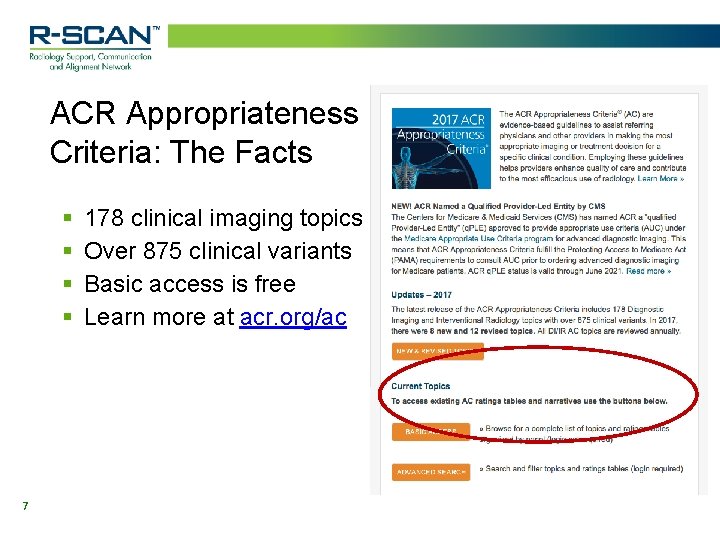
ACR Appropriateness Criteria: The Facts § § 7 178 clinical imaging topics Over 875 clinical variants Basic access is free Learn more at acr. org/ac
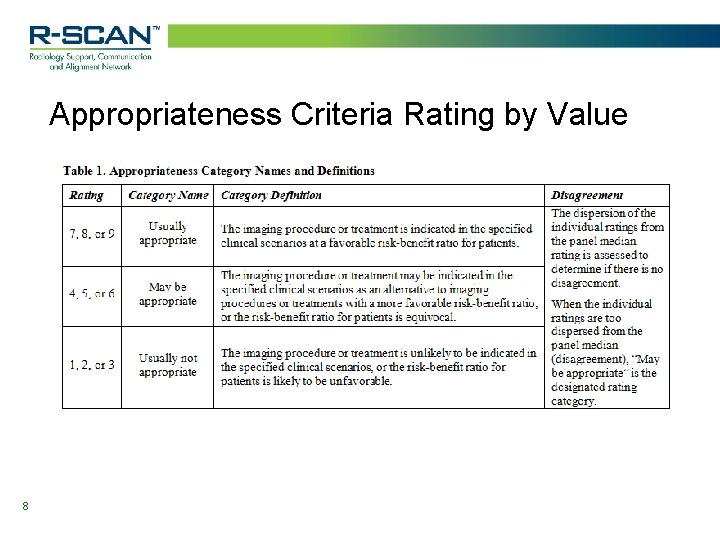
Appropriateness Criteria Rating by Value 8
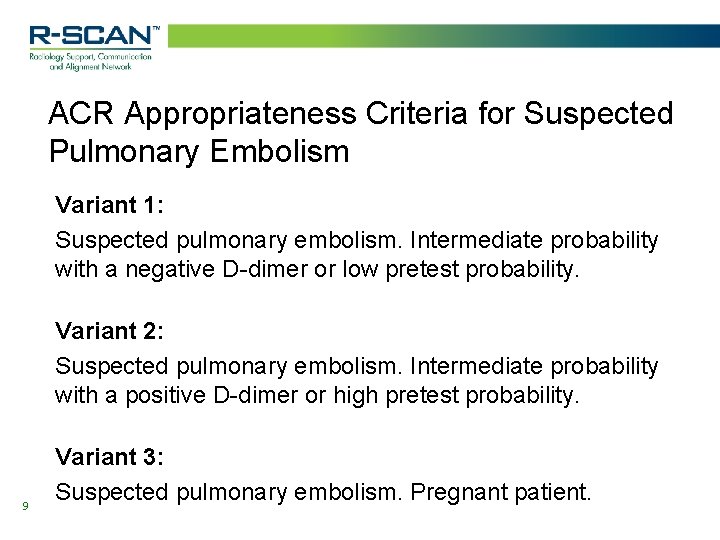
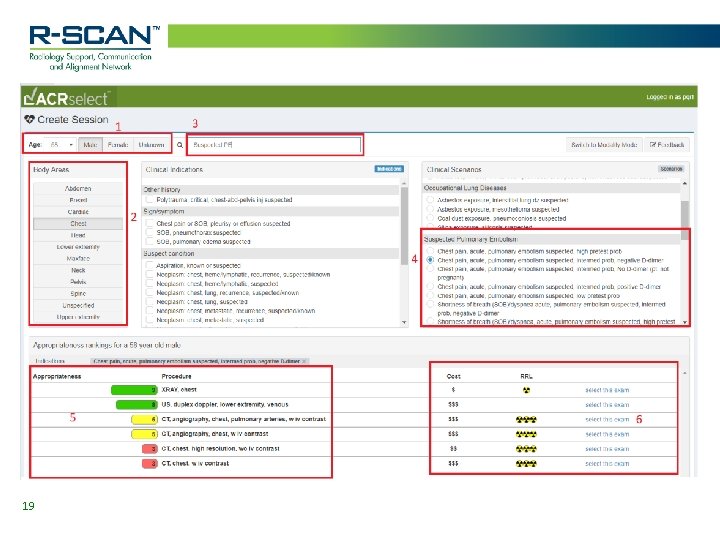
ACR Appropriateness Criteria for Suspected Pulmonary Embolism Variant 1: Suspected pulmonary embolism. Intermediate probability with a negative D-dimer or low pretest probability. Variant 2: Suspected pulmonary embolism. Intermediate probability with a positive D-dimer or high pretest probability. 9 Variant 3: Suspected pulmonary embolism. Pregnant patient.

Alignment of Appropriateness Criteria and Choosing Wisely 10 All CTA for PE imaging variants and clinical scenarios: https: //acsearch. acr. org/docs/69404/Narrative/
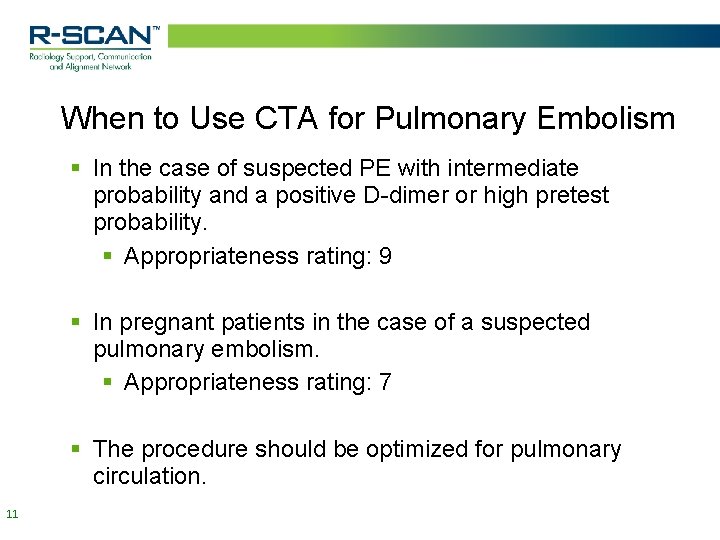
When to Use CTA for Pulmonary Embolism § In the case of suspected PE with intermediate probability and a positive D-dimer or high pretest probability. § Appropriateness rating: 9 § In pregnant patients in the case of a suspected pulmonary embolism. § Appropriateness rating: 7 § The procedure should be optimized for pulmonary circulation. 11

Use of the D-Dimer Assay 12 § A negative D-dimer effectively excludes PE or DVT § Limited value in the following situations: § Patients with a significant thrombotic process or condition § Pregnant, postoperative, trauma patients § Patients determined to be at high risk of PE by validated clinical criteria § Wells' Criteria § Geneva Score / Simplified Geneva Score § PERC Rule
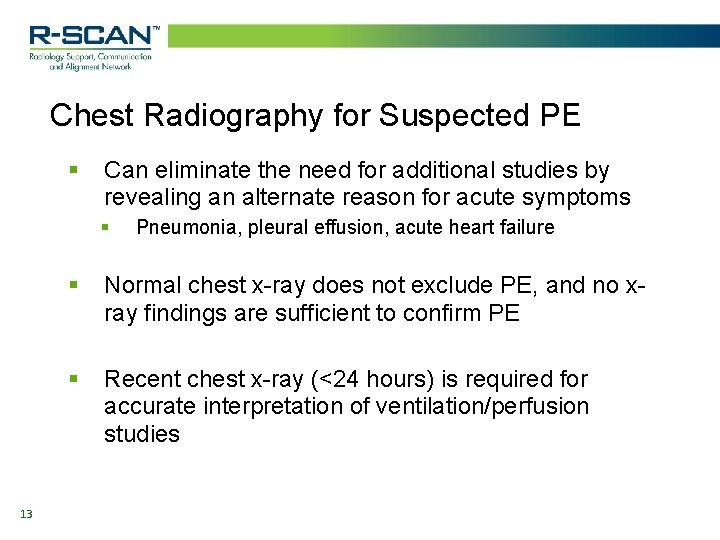
Chest Radiography for Suspected PE § Can eliminate the need for additional studies by revealing an alternate reason for acute symptoms § 13 Pneumonia, pleural effusion, acute heart failure § Normal chest x-ray does not exclude PE, and no xray findings are sufficient to confirm PE § Recent chest x-ray (<24 hours) is required for accurate interpretation of ventilation/perfusion studies

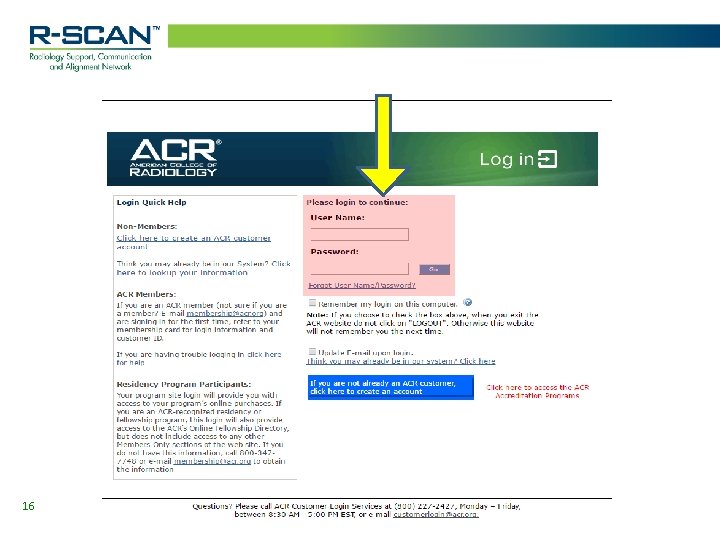
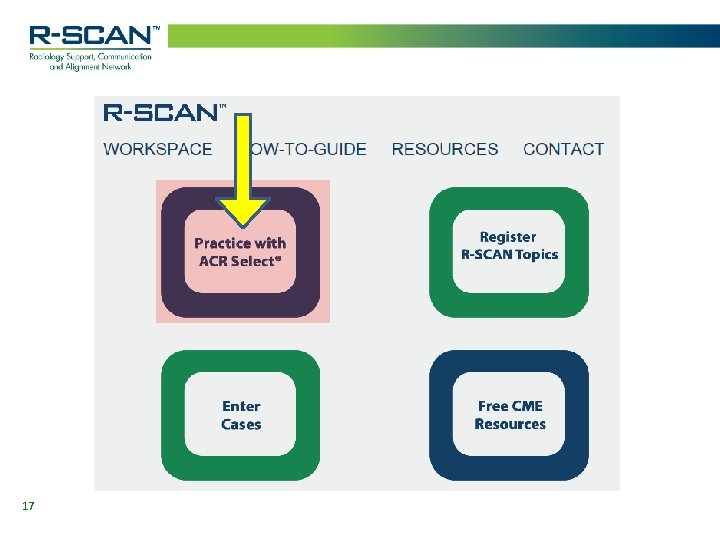
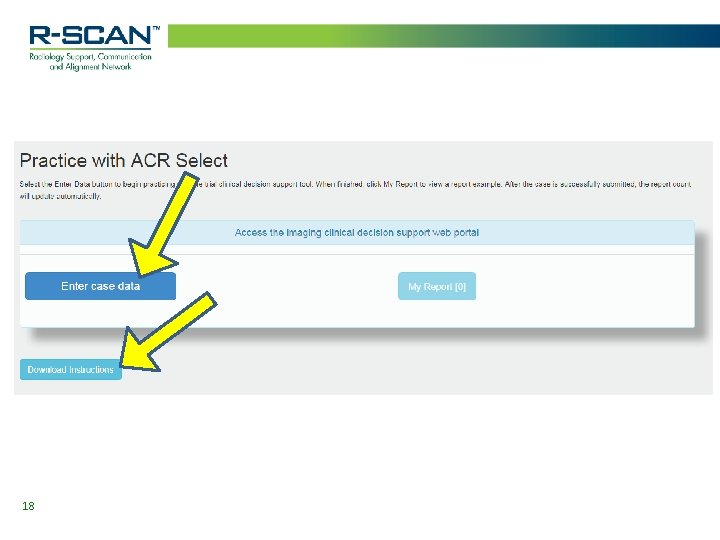
R-SCAN and Clinical Decision Support § The ACR Select® CDS tool is a web-based version ACR Appropriateness Criteria § R-SCAN participants gain free access to a customized, stand-alone version of ACR Select § Available through a web portal § No IT involvement required § R-SCAN uses CDS in a novel way § For case review to determine alignment with the ACR AC 14
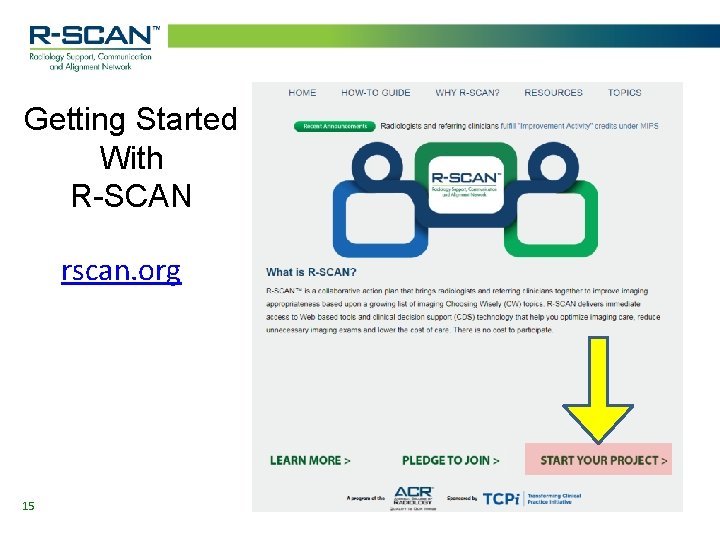
Getting Started With R-SCAN rscan. org 15
16
17
18
19
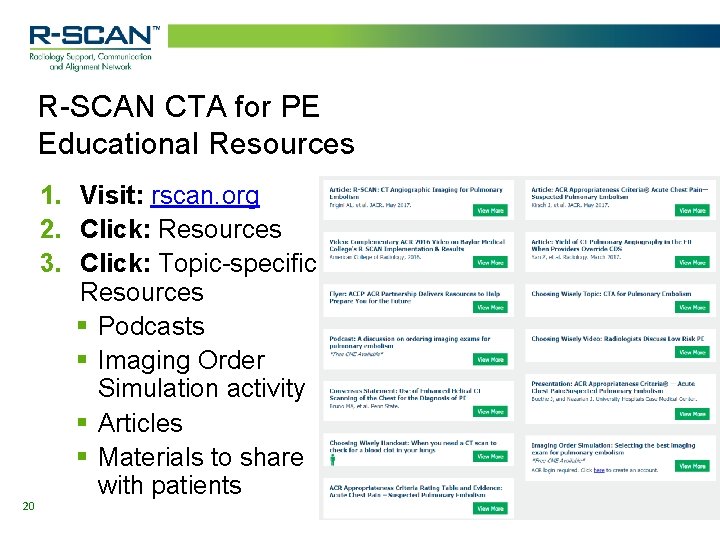
R-SCAN CTA for PE Educational Resources 20 1. Visit: rscan. org 2. Click: Resources 3. Click: Topic-specific Resources § Podcasts § Imaging Order Simulation activity § Articles § Materials to share with patients
R-SCAN Resources With CME § Podcast § A radiologist and referring physician discuss strategies of image ordering related suspected pulmonary embolism; approved for. 5 CME § Learn more § Imaging Order Simulation Activity § Test your knowledge in selecting the best imaging exam for various indications § Free with CME 21
Key Points: Talking With Patients § Choosing Wisely: CT Imaging Concerns § Imaging won’t help you feel better or improve faster § Imaging is expensive, costing hundreds or thousands of dollars § Imaging can also lead to unnecessary treatments and complications from these treatments § X-rays and CT scans use radiation 22
Case 1 § A 26 -year-old man presents with shortness of breath § No clinical signs of deep vein thrombosis (DVT), and pulmonary embolism (PE) is not the most likely diagnosis § Heart rate is 105 § Hemoptysis is not seen and no history of surgery, PE, DVT, or malignancy § The modified Wells criteria is 1. 5, pulmonary embolus could not be excluded based on the PERC Rule § The D-dimer is negative. 23 § Questions: § What imaging would be most appropriate for this patient? § What other questions would you ask? § What is the focus of your physical exam?
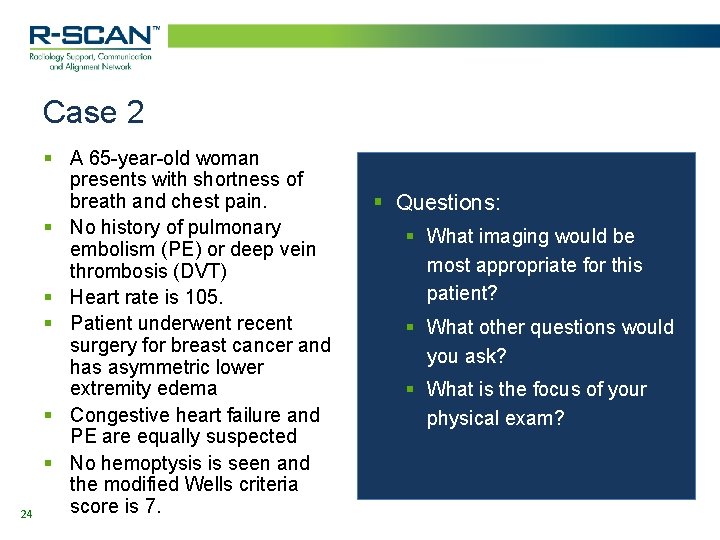
Case 2 24 § A 65 -year-old woman presents with shortness of breath and chest pain. § No history of pulmonary embolism (PE) or deep vein thrombosis (DVT) § Heart rate is 105. § Patient underwent recent surgery for breast cancer and has asymmetric lower extremity edema § Congestive heart failure and PE are equally suspected § No hemoptysis is seen and the modified Wells criteria score is 7. § Questions: § What imaging would be most appropriate for this patient? § What other questions would you ask? § What is the focus of your physical exam?
Summary § Diagnostic efforts in radiology are aimed at (1) reaching an acceptable level of diagnostic certainty of PE to warrant anticoagulant therapy, using the least invasive tests, and (2) excluding other reasons for the patient’s symptoms. § D-dimer levels will be elevated with any significant thrombotic process, so this test is of limited value in pregnant, postoperative, and trauma patients. § D-dimer is also of limited value in patients determined to be at high risk of PE by validated clinical criteria. § In all other settings, a negative D-dimer test effectively excludes PE or DVT 25
Blank slide for radiologist to add custom info 26
Blank slide for radiologist to add custom info 27
Questions? 28
- Slides: 28