
CTA Cherenkov Telescope Array CTA JosepM Paredes Massimo
- Slides: 27
CTA Cherenkov Telescope Array CTA Josep-M. Paredes & Massimo Persic for CTA Consortium Vulcano, May 30, 2009
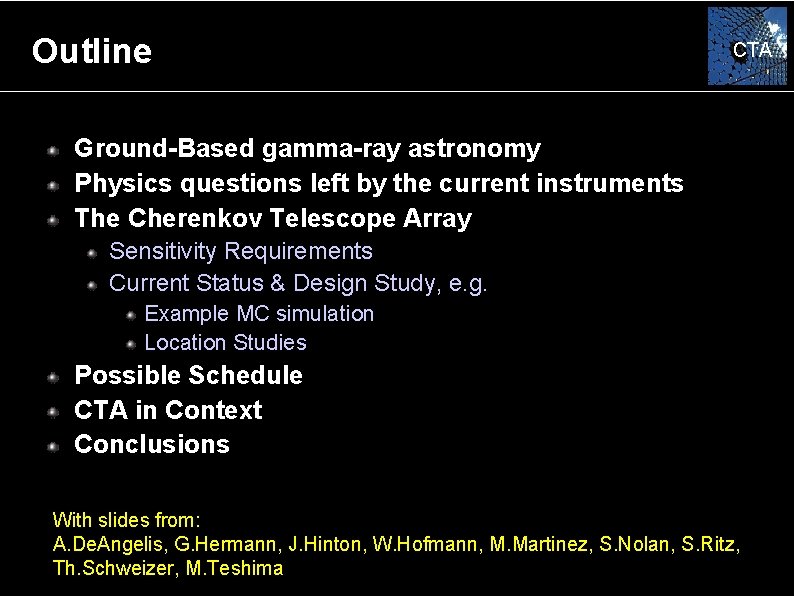
Outline CTA Ground-Based gamma-ray astronomy Physics questions left by the current instruments The Cherenkov Telescope Array Sensitivity Requirements Current Status & Design Study, e. g. Example MC simulation Location Studies Possible Schedule CTA in Context Conclusions With slides from: A. De. Angelis, G. Hermann, J. Hinton, W. Hofmann, M. Martinez, S. Nolan, S. Ritz, Th. Schweizer, M. Teshima
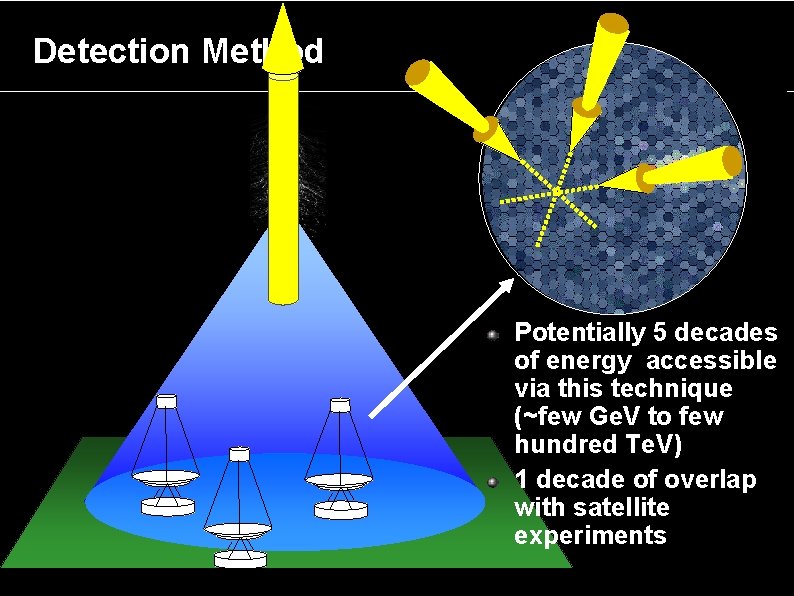
Detection Method CTA Potentially 5 decades of energy accessible via this technique (~few Ge. V to few hundred Te. V) 1 decade of overlap with satellite experiments
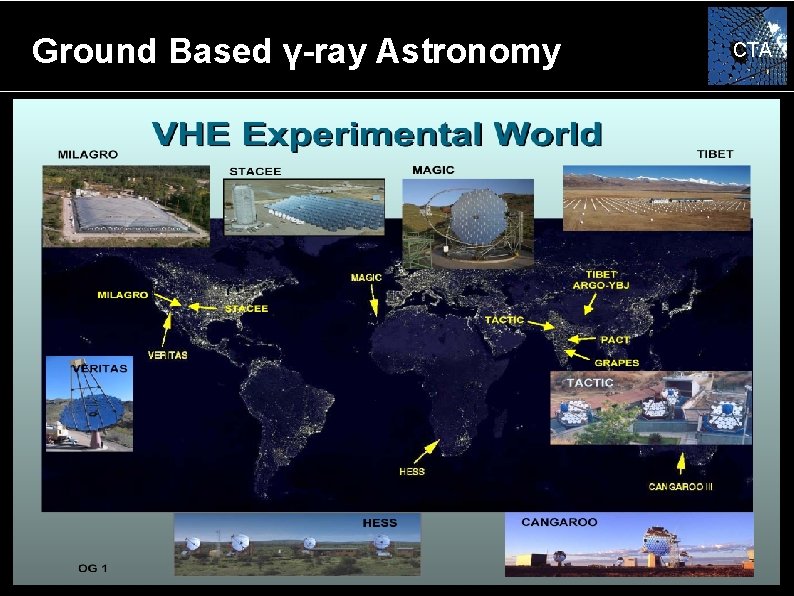
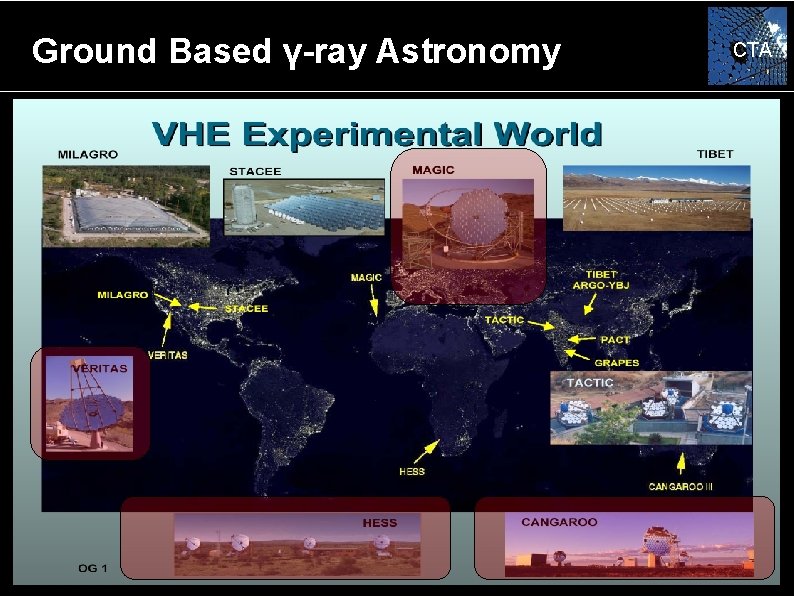
Ground Based γ-ray Astronomy CTA
Ground Based γ-ray Astronomy CTA
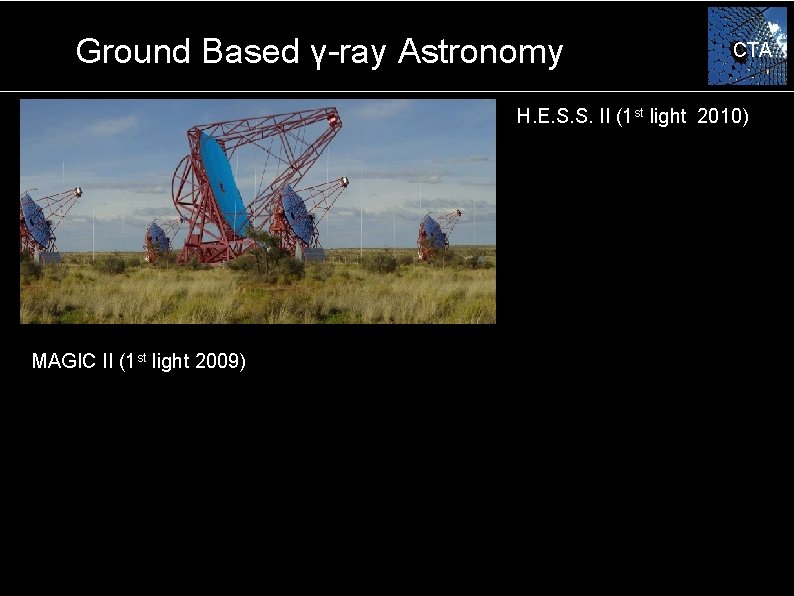
Ground Based γ-ray Astronomy CTA H. E. S. S. II (1 st light 2010) MAGIC II (1 st light 2009)
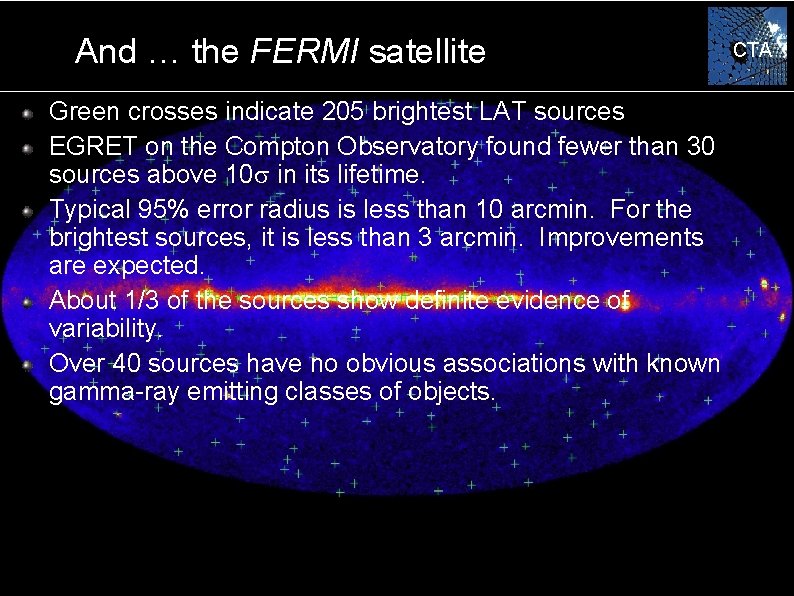
And … the FERMI satellite Green crosses indicate 205 brightest LAT sources EGRET on the Compton Observatory found fewer than 30 sources above 10 s in its lifetime. Typical 95% error radius is less than 10 arcmin. For the brightest sources, it is less than 3 arcmin. Improvements are expected. About 1/3 of the sources show definite evidence of variability. Over 40 sources have no obvious associations with known gamma-ray emitting classes of objects. CTA
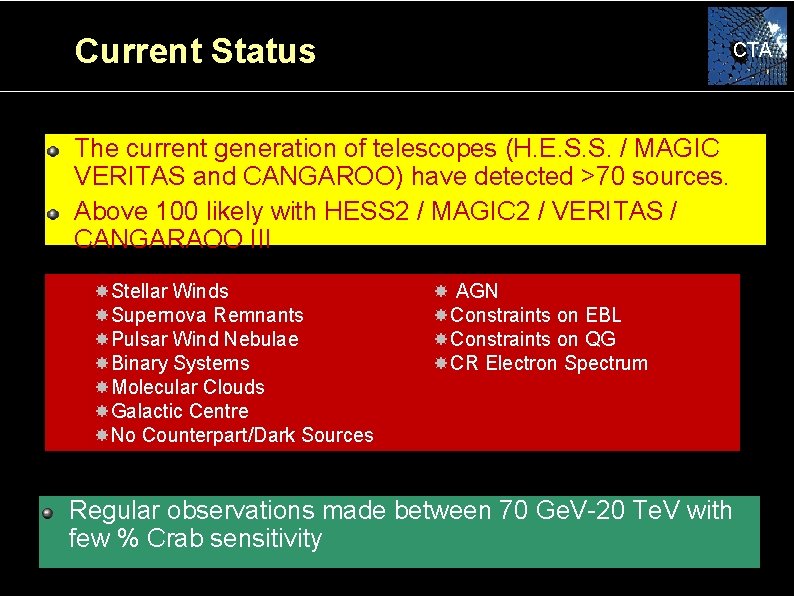
Current Status CTA The current generation of telescopes (H. E. S. S. / MAGIC VERITAS and CANGAROO) have detected >70 sources. Above 100 likely with HESS 2 / MAGIC 2 / VERITAS / CANGARAOO III Stellar Winds Supernova Remnants Pulsar Wind Nebulae Binary Systems Molecular Clouds Galactic Centre No Counterpart/Dark Sources AGN Constraints on EBL Constraints on QG CR Electron Spectrum Regular observations made between 70 Ge. V-20 Te. V with few % Crab sensitivity
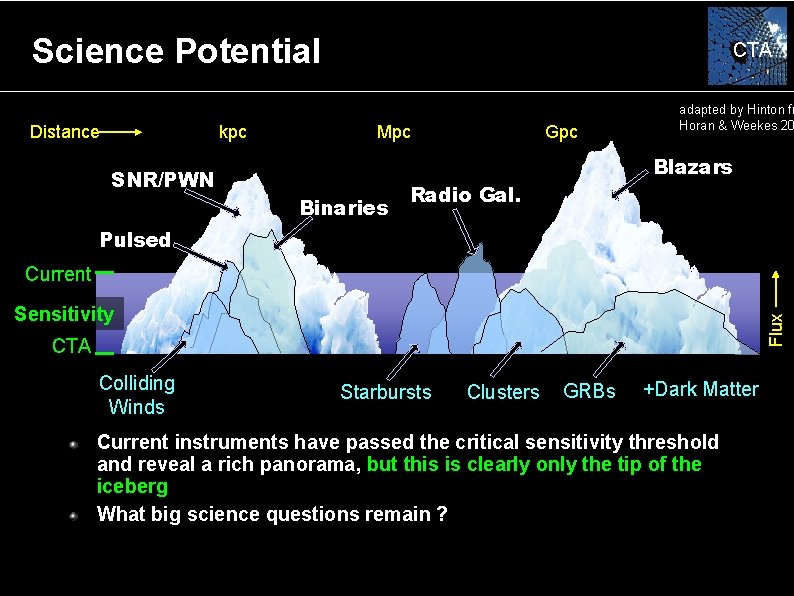
Science Potential Distance kpc SNR/PWN CTA Mpc Gpc adapted by Hinton fr Horan & Weekes 20 Blazars Binaries Radio Gal. Pulsed Current Flux Sensitivity CTA Colliding Winds Starbursts Clusters GRBs +Dark Matter Current instruments have passed the critical sensitivity threshold and reveal a rich panorama, but this is clearly only the tip of the iceberg What big science questions remain ?
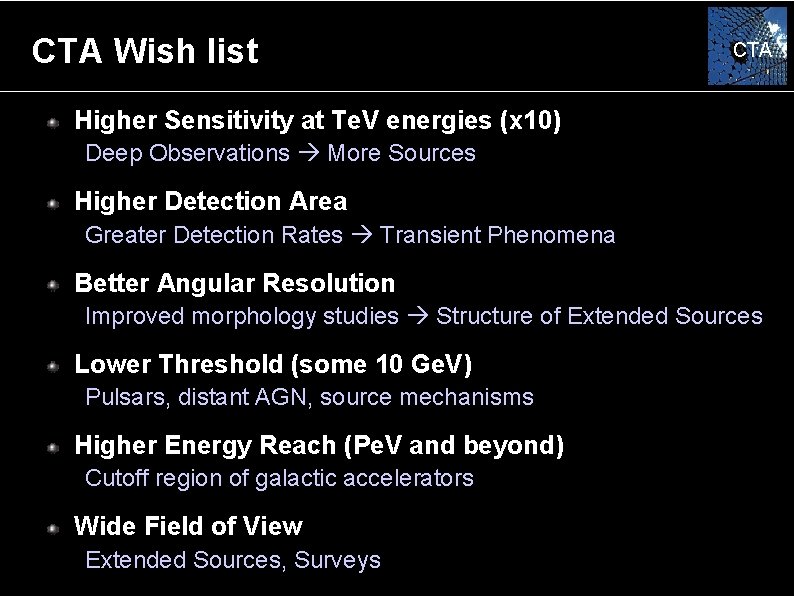
CTA Wish list CTA Higher Sensitivity at Te. V energies (x 10) Deep Observations More Sources Higher Detection Area Greater Detection Rates Transient Phenomena Better Angular Resolution Improved morphology studies Structure of Extended Sources Lower Threshold (some 10 Ge. V) Pulsars, distant AGN, source mechanisms Higher Energy Reach (Pe. V and beyond) Cutoff region of galactic accelerators Wide Field of View Extended Sources, Surveys
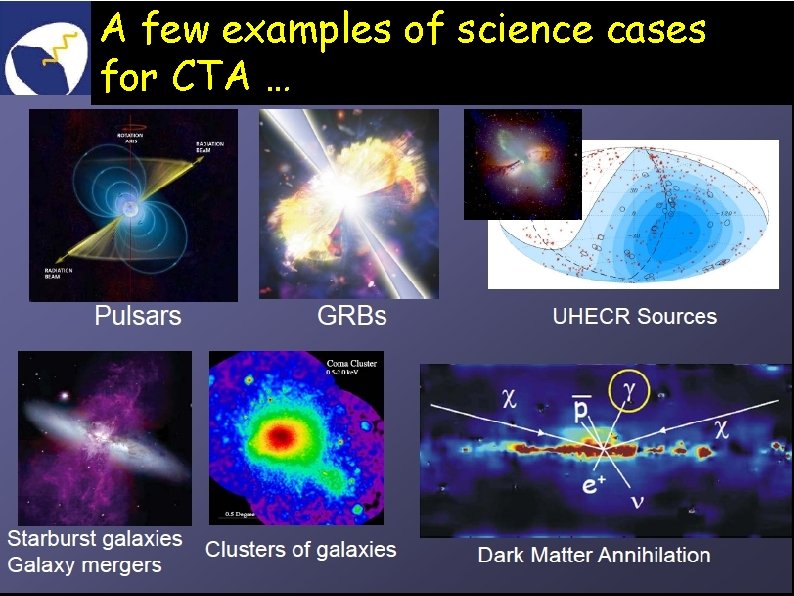
A few examples of science cases for CTA … CTA
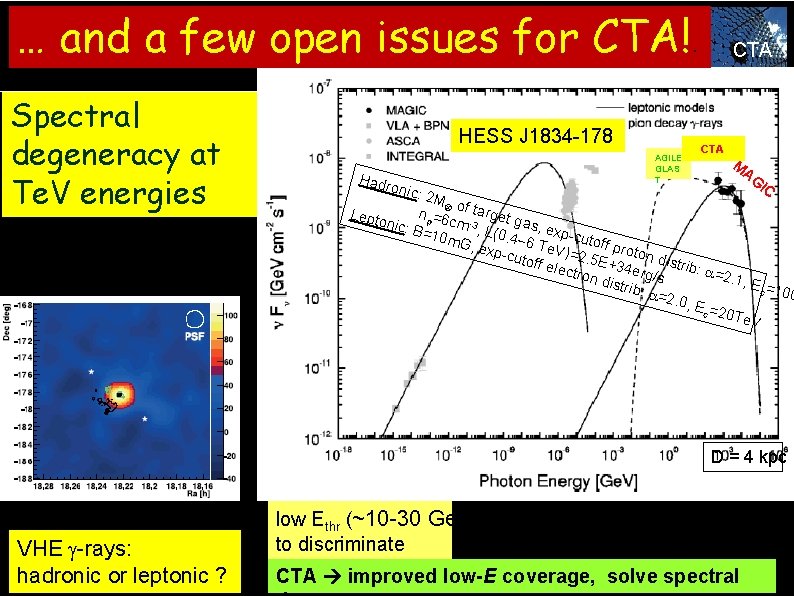
… and a few open issues for CTA!. Spectral degeneracy at Te. V energies HESS J 1834 -178 uuu Hadr onic: 2 AGILE GLAS T CTA M AG IC MÄ o np =6 f target g Lept onic: c a B=10 m 3, L(0. 4 s, exp-c ut m. G, exp- 6 Te. V)= off proto cutof n 2 f elec. 5 E+34 e distrib: a r tron =2. 1 distri g/s , E= b: a= c 100 2. 0, Ec =2 0 Te. V D = 4 kpc VHE g-rays: hadronic or leptonic ? low Ethr (~10 -30 Ge. V) to discriminate CTA improved low-E coverage, solve spectral
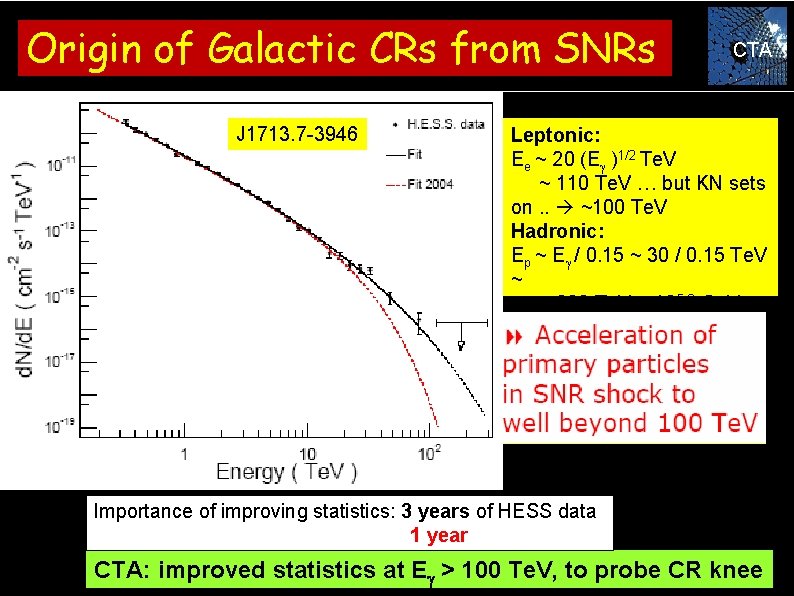
Origin of Galactic CRs from SNRs J 1713. 7 -3946 CTA Leptonic: Ee ~ 20 (Eg )1/2 Te. V ~ 110 Te. V … but KN sets on. . ~100 Te. V Hadronic: Ep ~ Eg / 0. 15 ~ 30 / 0. 15 Te. V ~ ~ 200 Te. V = 105. 3 Ge. V Importance of improving statistics: 3 years of HESS data 1 year CTA: improved statistics at Eg > 100 Te. V, to probe CR knee
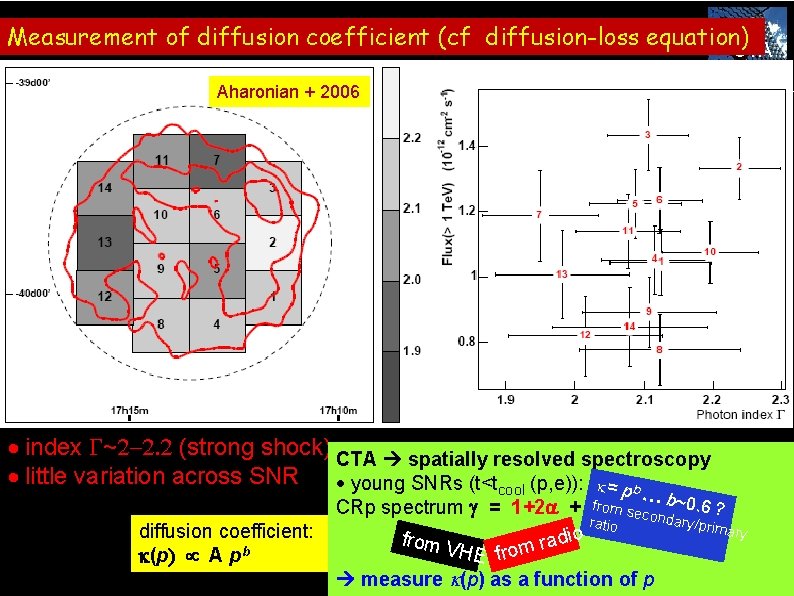
Measurement of diffusion coefficient (cf diffusion-loss equation) CTA Aharonian + 2006 · index G~2 -2. 2 (strong shock) CTA spatially resolved spectroscopy · little variation across SNR · young SNRs (t<tcool (p, e)): k= b diffusion coefficient: k(p) µ A pb p …b ~0. 6 ? from s CRp spectrum g = 1+2 a + b econ from radio ratio VHE from measure k(p) as a function of p dary/p rimary
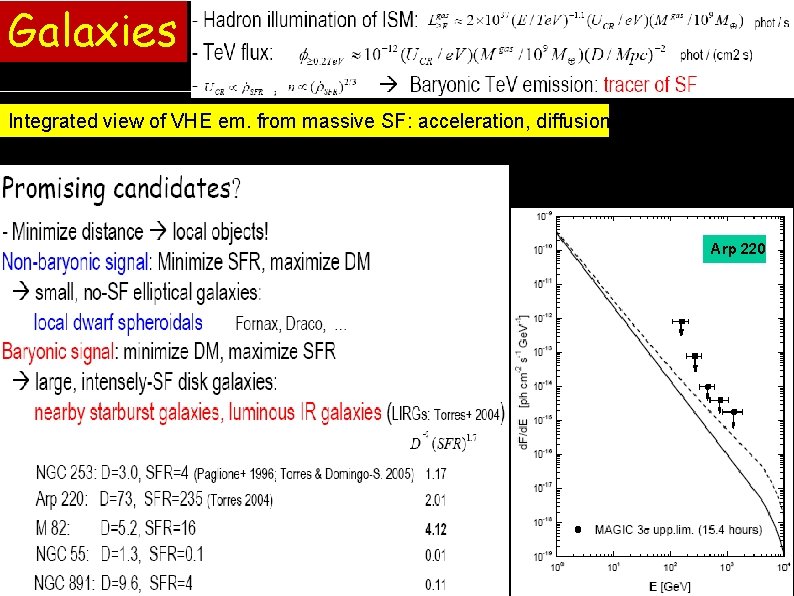
Galaxies CTA Integrated view of VHE em. from massive SF: acceleration, diffusion, energy loss Arp 220
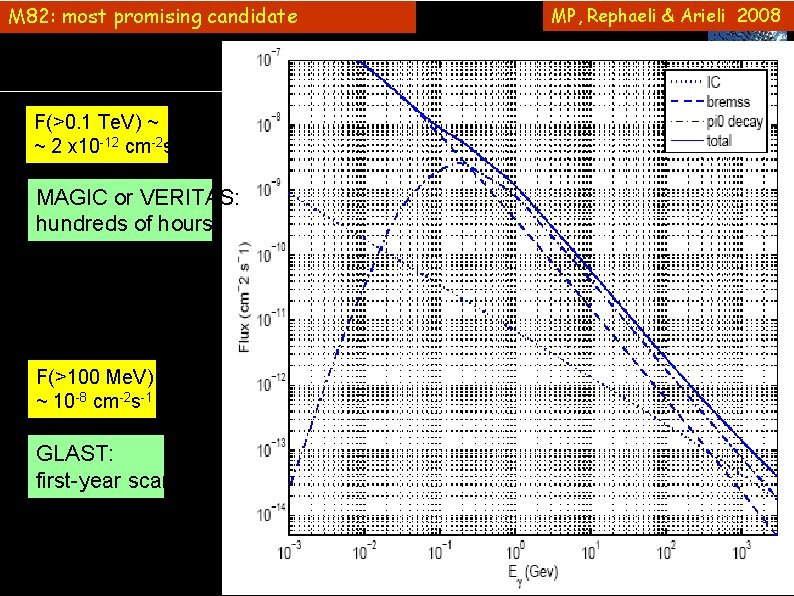
M 82: most promising candidate MP, Rephaeli & Arieli 2008 CTA F(>0. 1 Te. V) ~ ~ 2 x 10 -12 cm-2 s-1 MAGIC or VERITAS: hundreds of hours F(>100 Me. V) ~ ~ 10 -8 cm-2 s-1 GLAST: first-year scan
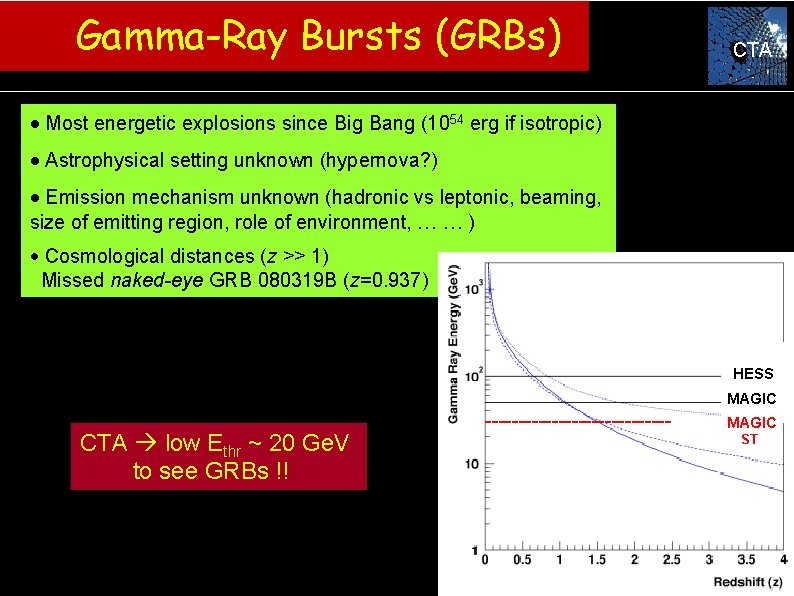
Gamma-Ray Bursts (GRBs) CTA · Most energetic explosions since Big Bang (1054 erg if isotropic) · Astrophysical setting unknown (hypernova? ) · Emission mechanism unknown (hadronic vs leptonic, beaming, size of emitting region, role of environment, … … ) · Cosmological distances (z >> 1) Missed naked-eye GRB 080319 B (z=0. 937) Gggg HESS MAGIC CTA low Ethr ~ 20 Ge. V to see GRBs !! -------------- MAGIC ST
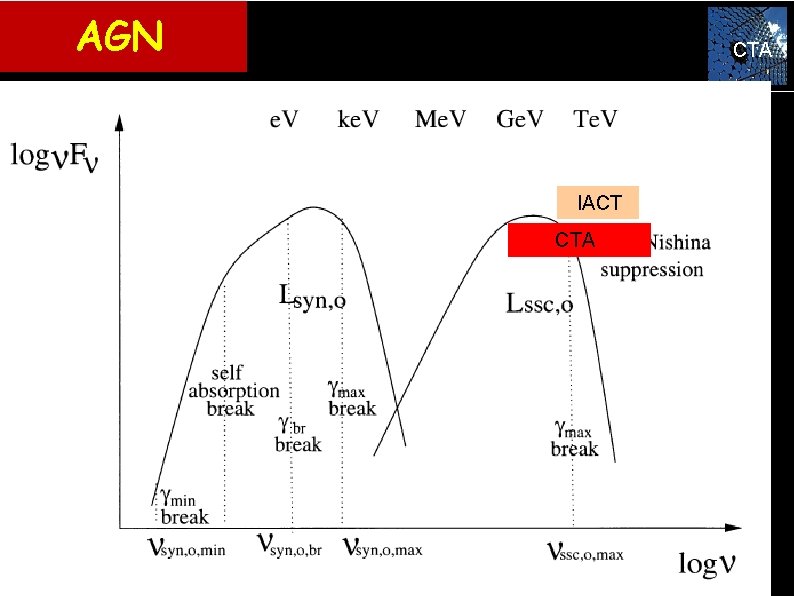
AGN CTA IACT CTA
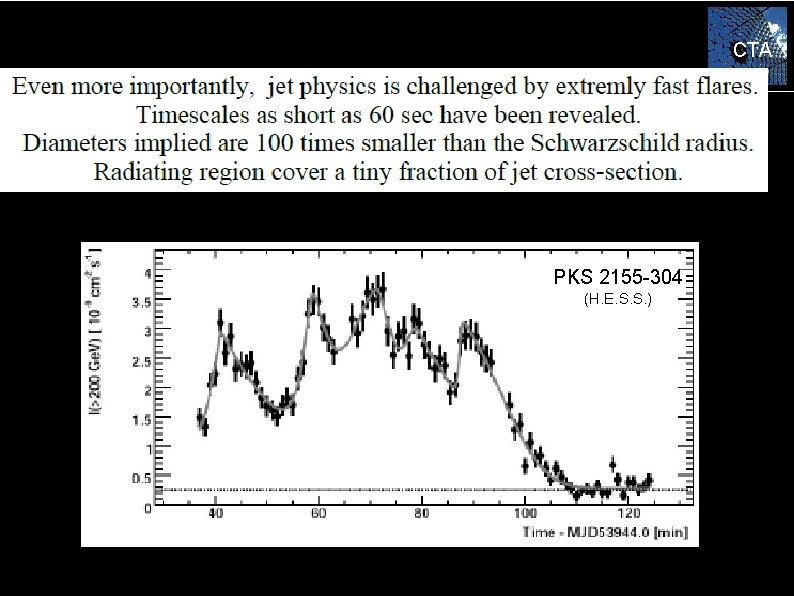
CTA PKS 2155 -304 (H. E. S. S. )
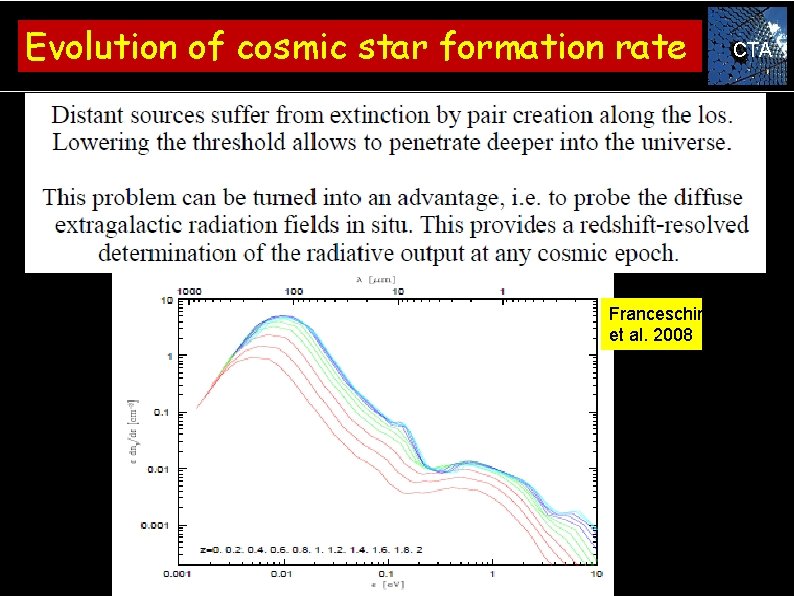
Evolution of cosmic star formation rate Franceschini et al. 2008 CTA
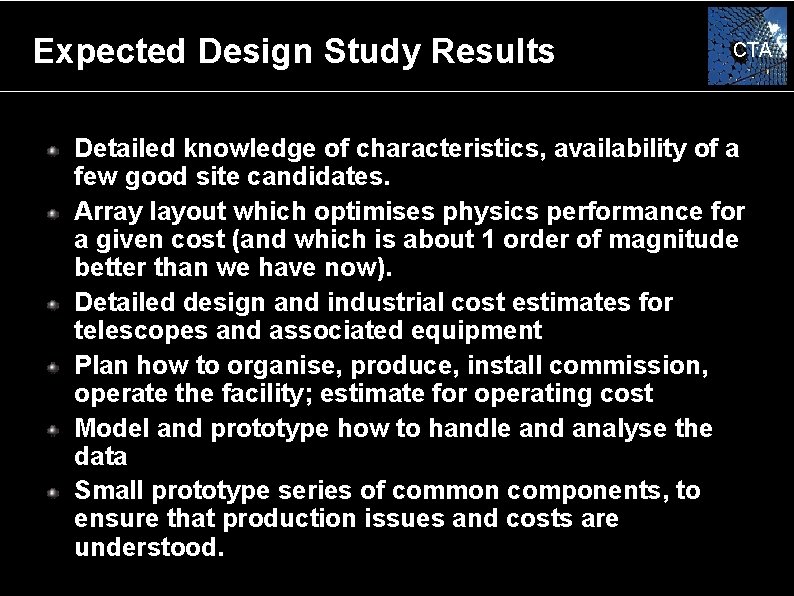
Expected Design Study Results CTA Detailed knowledge of characteristics, availability of a few good site candidates. Array layout which optimises physics performance for a given cost (and which is about 1 order of magnitude better than we have now). Detailed design and industrial cost estimates for telescopes and associated equipment Plan how to organise, produce, install commission, operate the facility; estimate for operating cost Model and prototype how to handle and analyse the data Small prototype series of common components, to ensure that production issues and costs are understood.
CTA : The Observatory CTA will be a normal astrophysical observatory, open to the community, with professional operators, A 0 s and support for data analysis. Data will be public after some time (1 year ? ) 50% of observation time for construction consortium
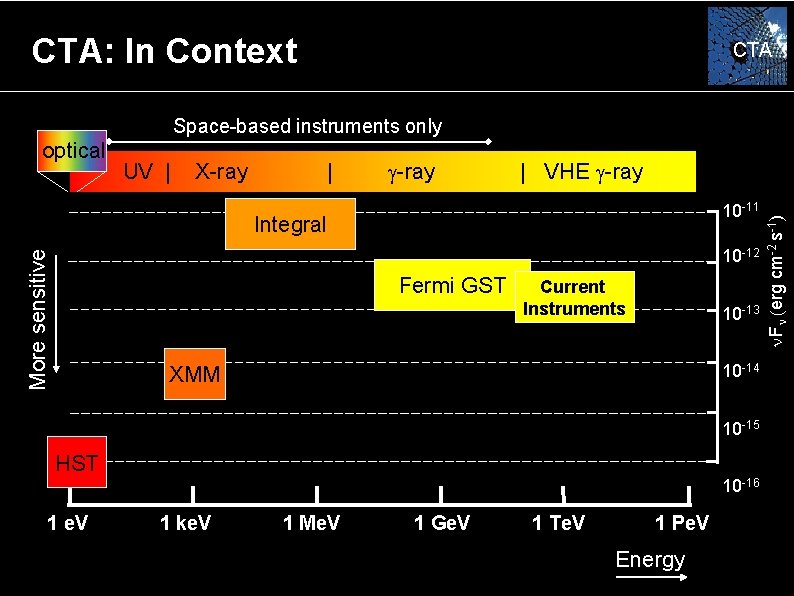
CTA: In Context CTA Space-based instruments only UV | X-ray | g-ray | VHE g-ray 10 -11 Integral More sensitive 10 -12 Fermi GST Current Instruments 10 -13 10 -14 XMM 10 -15 HST 10 -16 1 e. V 1 ke. V 1 Me. V 1 Ge. V 1 Te. V 1 Pe. V Energy n. Fn (erg cm-2 s-1) optical
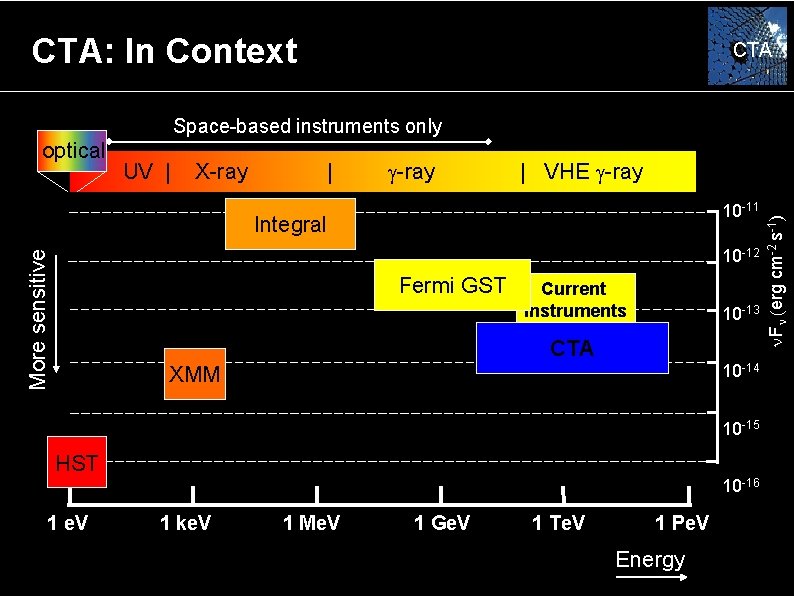
CTA: In Context CTA Space-based instruments only UV | X-ray | g-ray | VHE g-ray 10 -11 Integral More sensitive 10 -12 Fermi GST Current Instruments 10 -13 CTA 10 -14 XMM 10 -15 HST 10 -16 1 e. V 1 ke. V 1 Me. V 1 Ge. V 1 Te. V 1 Pe. V Energy n. Fn (erg cm-2 s-1) optical
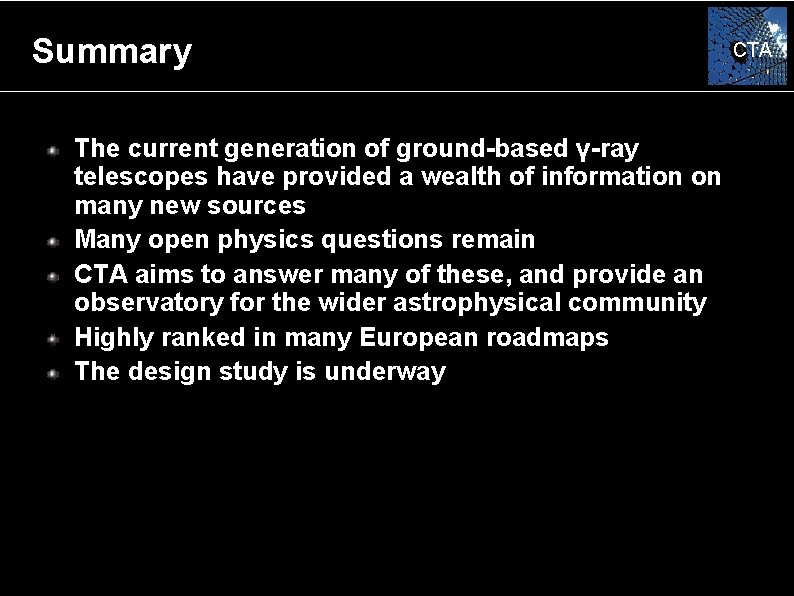
Summary The current generation of ground-based γ-ray telescopes have provided a wealth of information on many new sources Many open physics questions remain CTA aims to answer many of these, and provide an observatory for the wider astrophysical community Highly ranked in many European roadmaps The design study is underway CTA
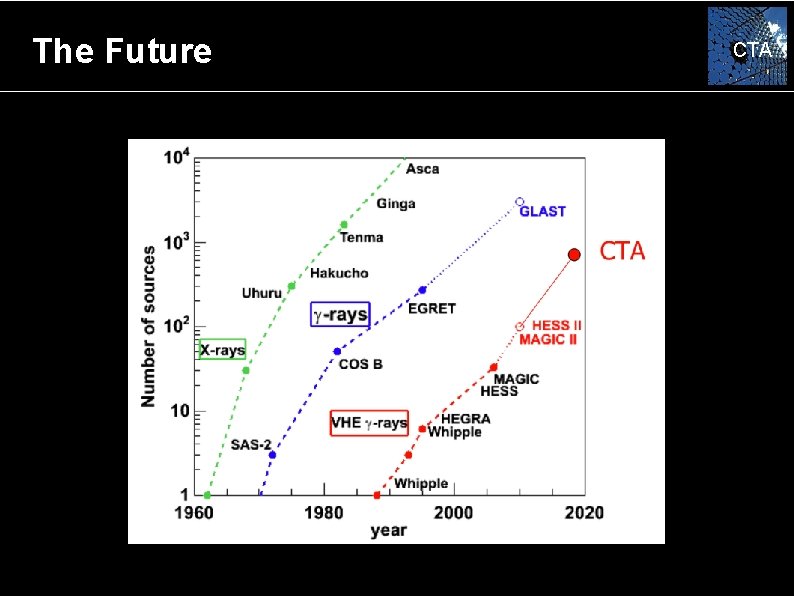
The Future CTA
CTA Thanks!