
CT for Minor Pediatric Head Injury When to
- Slides: 39
CT for Minor Pediatric Head Injury When to Image Based on Choosing Wisely® and ACR Appropriateness Criteria®
What Is R-SCAN? § Collaborative activity for referring clinicians and radiologists to improve patient care through clinical improvement § R-SCAN Collaboration Goals: § Ensure patients receive the most appropriate imaging exam at the most appropriate time based on evidence -based appropriate use criteria § Reduce unnecessary imaging tests focused on imaging Choosing Wisely® topics § Lower the cost of care 2
Why Participate? § R-SCAN Offers: 3 § Data-driven system for moving toward value-based imaging and patient care § Opportunity to focus on highly relevant imaging exams to improve utilization § Collaborators can fulfill their Improvement Activity requirements under the MIPS § Easy way to practice with clinical decision support (CDS) technology § In preparation for PAMA § Free and immediate access to Web-based tools and CME activities
Problem: Overutilization of CT Imaging for Minor Pediatric Head Injury 4 § Head trauma in children occurs frequently, and accounts for over 600, 000 emergency department (ED) visits yearly in the United States [1]. § CT use has more than doubled in the last decade, with the highest rate of growth seen in the emergency setting [2]. At least half of children assessed in US EDs with head trauma undergo CT scans [3]. § Of these, only 0. 1% to 0. 6% of scans identify an abnormality resulting in surgical management [4, 5]. CT scans are not without risk. Exposure to ionizing radiation has been linked to the development of cancer. The effect is particularly significant in young children, who both are more susceptible to the effects of radiation and have a longer lifespan during which they may develop a radiation-induced cancer [6, 7, 8].
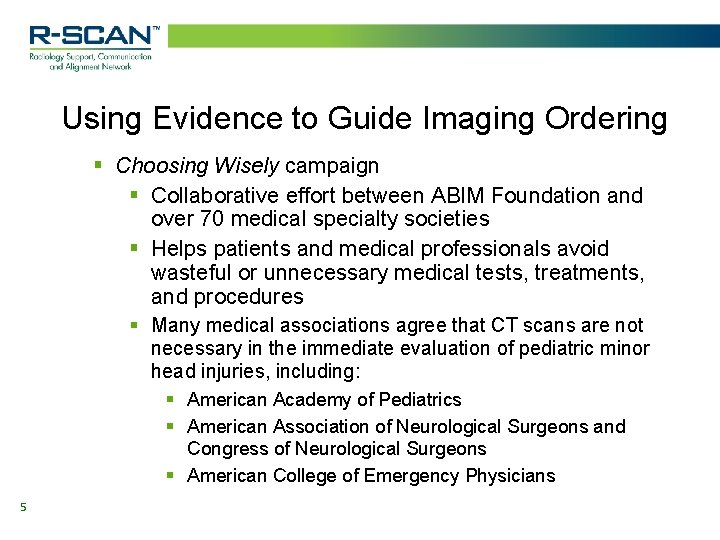
Using Evidence to Guide Imaging Ordering § Choosing Wisely campaign § Collaborative effort between ABIM Foundation and over 70 medical specialty societies § Helps patients and medical professionals avoid wasteful or unnecessary medical tests, treatments, and procedures § Many medical associations agree that CT scans are not necessary in the immediate evaluation of pediatric minor head injuries, including: § American Academy of Pediatrics § American Association of Neurological Surgeons and Congress of Neurological Surgeons § American College of Emergency Physicians 5
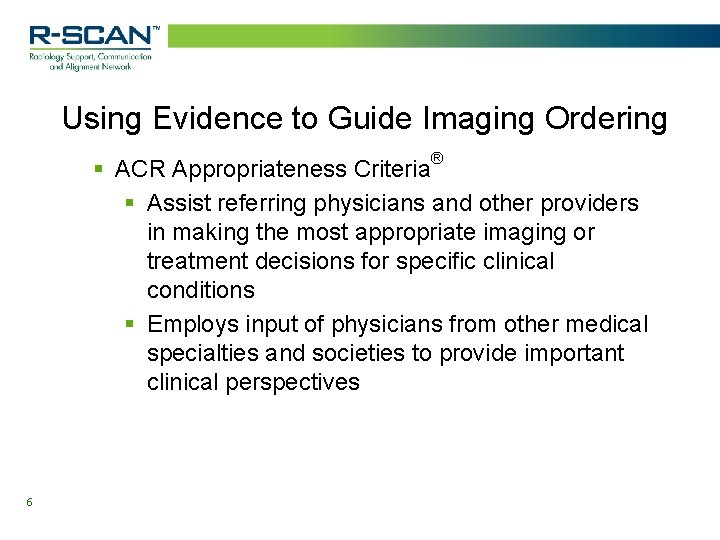
Using Evidence to Guide Imaging Ordering ® § ACR Appropriateness Criteria § Assist referring physicians and other providers in making the most appropriate imaging or treatment decisions for specific clinical conditions § Employs input of physicians from other medical specialties and societies to provide important clinical perspectives 6
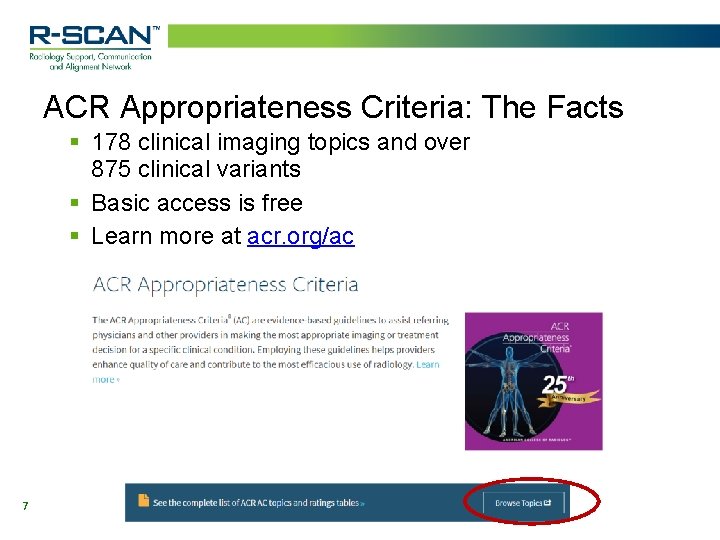
ACR Appropriateness Criteria: The Facts § 178 clinical imaging topics and over 875 clinical variants § Basic access is free § Learn more at acr. org/ac 7
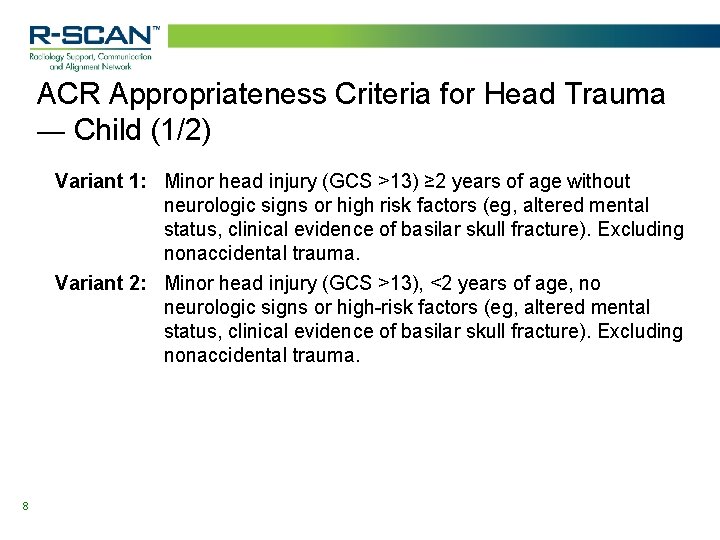
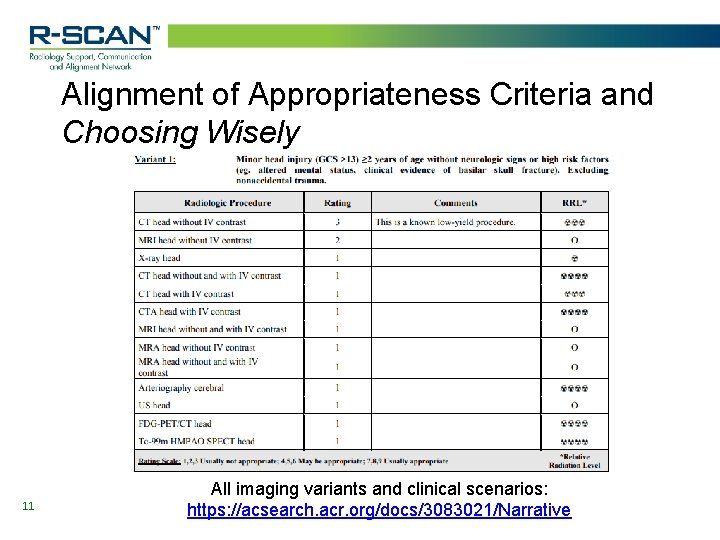
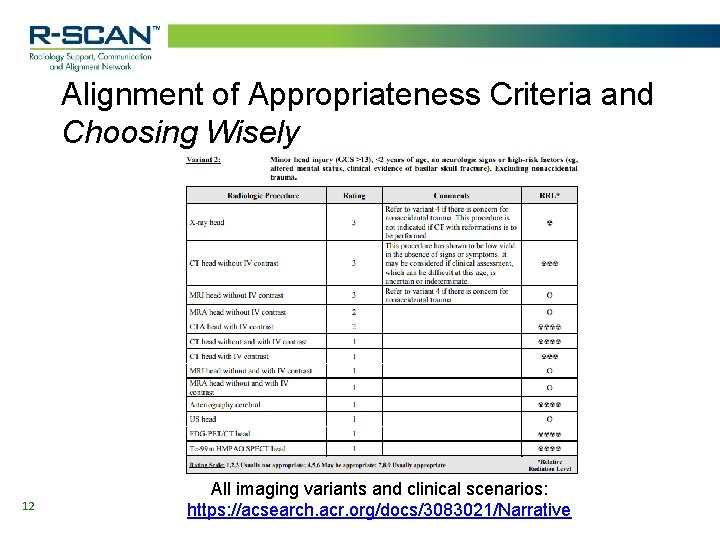
ACR Appropriateness Criteria for Head Trauma — Child (1/2) Variant 1: Minor head injury (GCS >13) ≥ 2 years of age without neurologic signs or high risk factors (eg, altered mental status, clinical evidence of basilar skull fracture). Excluding nonaccidental trauma. Variant 2: Minor head injury (GCS >13), <2 years of age, no neurologic signs or high-risk factors (eg, altered mental status, clinical evidence of basilar skull fracture). Excluding nonaccidental trauma. 8
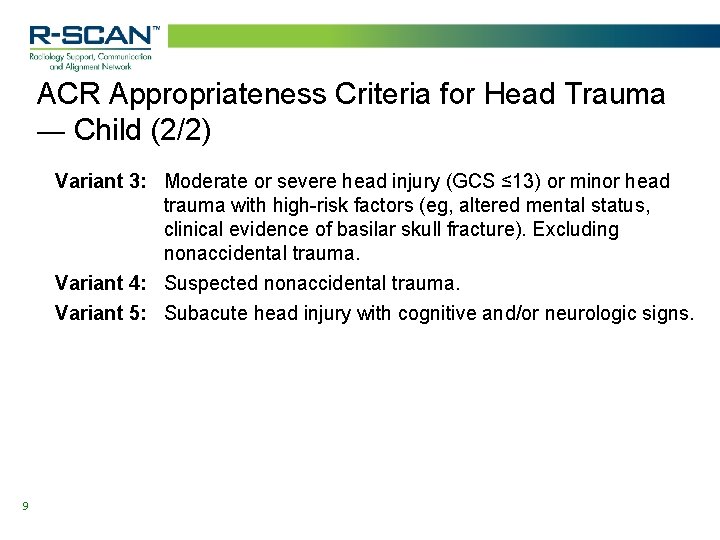
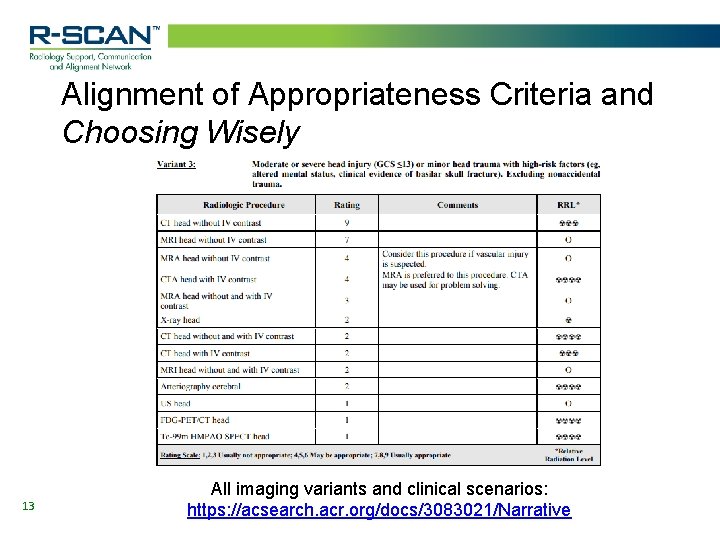
ACR Appropriateness Criteria for Head Trauma — Child (2/2) Variant 3: Moderate or severe head injury (GCS ≤ 13) or minor head trauma with high-risk factors (eg, altered mental status, clinical evidence of basilar skull fracture). Excluding nonaccidental trauma. Variant 4: Suspected nonaccidental trauma. Variant 5: Subacute head injury with cognitive and/or neurologic signs. 9
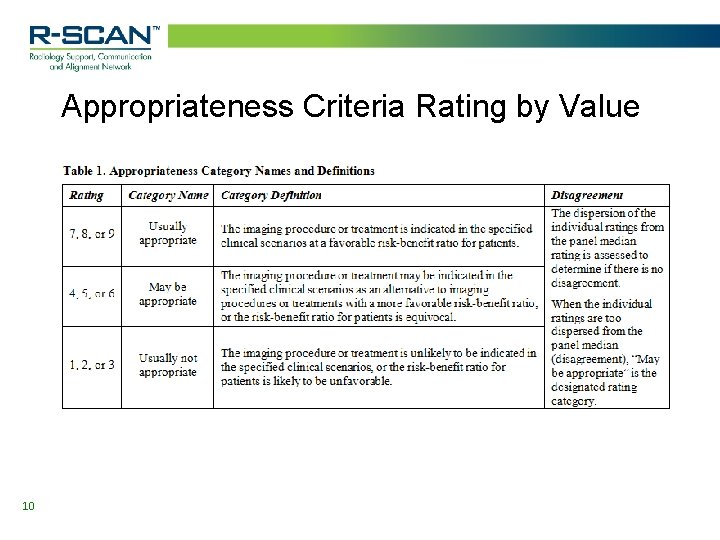
Appropriateness Criteria Rating by Value 10
Alignment of Appropriateness Criteria and Choosing Wisely 11 All imaging variants and clinical scenarios: https: //acsearch. acr. org/docs/3083021/Narrative
Alignment of Appropriateness Criteria and Choosing Wisely 12 All imaging variants and clinical scenarios: https: //acsearch. acr. org/docs/3083021/Narrative
Alignment of Appropriateness Criteria and Choosing Wisely 13 All imaging variants and clinical scenarios: https: //acsearch. acr. org/docs/3083021/Narrative
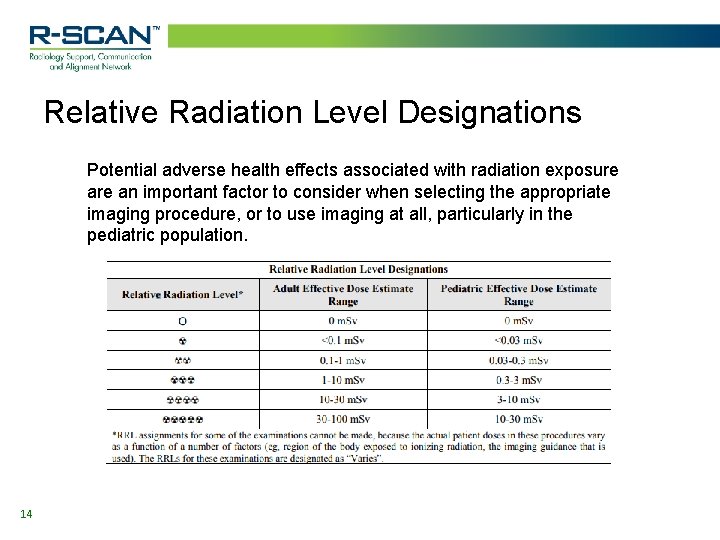
Relative Radiation Level Designations Potential adverse health effects associated with radiation exposure an important factor to consider when selecting the appropriate imaging procedure, or to use imaging at all, particularly in the pediatric population. 14
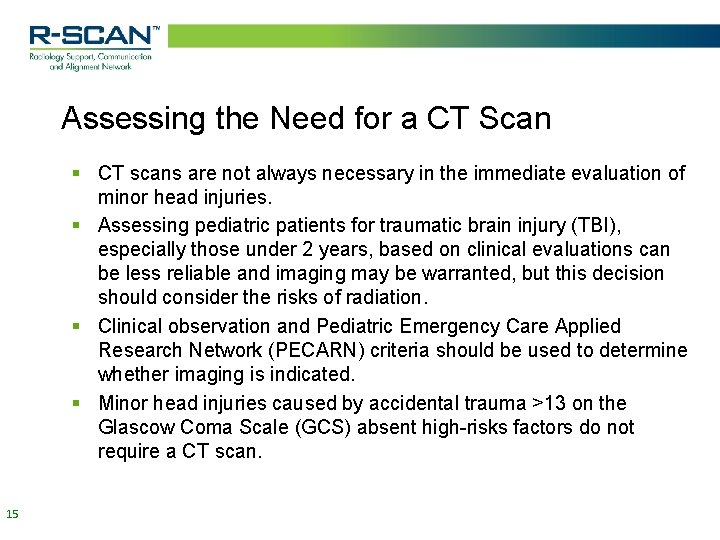
Assessing the Need for a CT Scan § CT scans are not always necessary in the immediate evaluation of minor head injuries. § Assessing pediatric patients for traumatic brain injury (TBI), especially those under 2 years, based on clinical evaluations can be less reliable and imaging may be warranted, but this decision should consider the risks of radiation. § Clinical observation and Pediatric Emergency Care Applied Research Network (PECARN) criteria should be used to determine whether imaging is indicated. § Minor head injuries caused by accidental trauma >13 on the Glascow Coma Scale (GCS) absent high-risks factors do not require a CT scan. 15
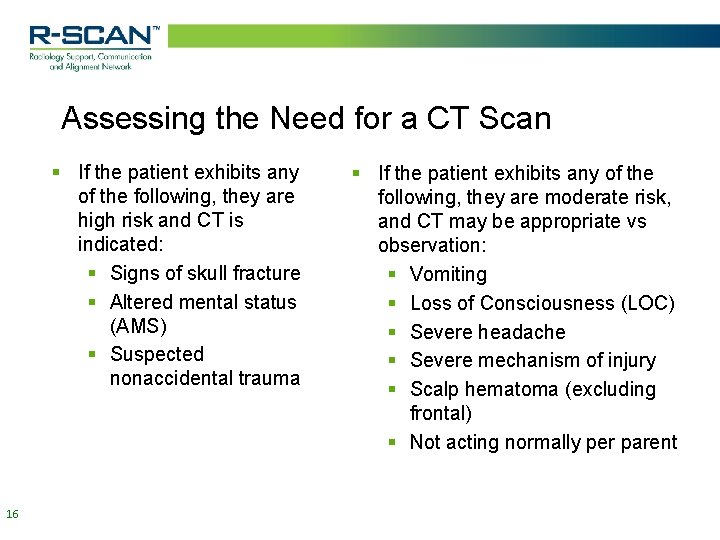
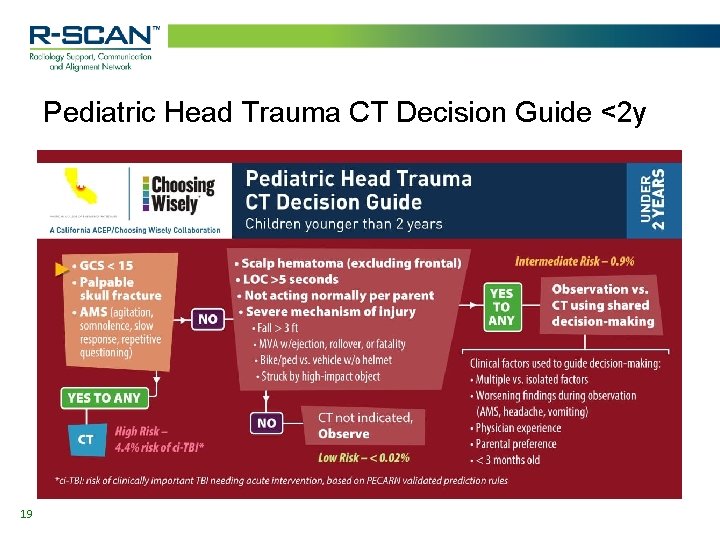
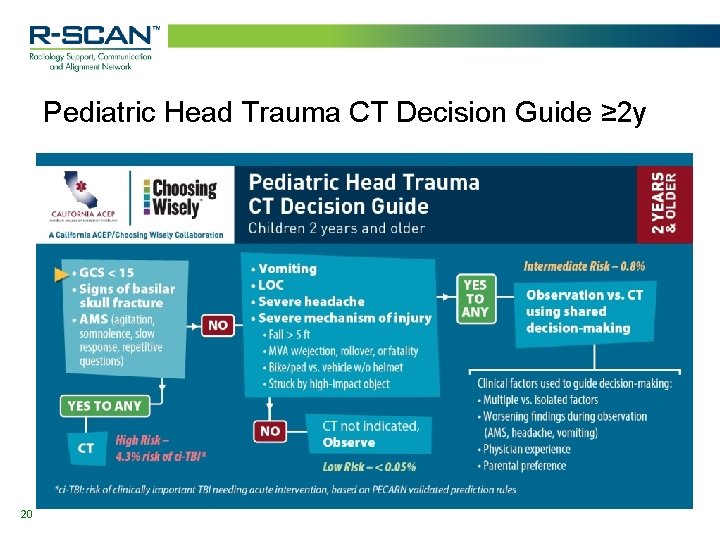
Assessing the Need for a CT Scan § If the patient exhibits any of the following, they are high risk and CT is indicated: § Signs of skull fracture § Altered mental status (AMS) § Suspected nonaccidental trauma 16 § If the patient exhibits any of the following, they are moderate risk, and CT may be appropriate vs observation: § Vomiting § Loss of Consciousness (LOC) § Severe headache § Severe mechanism of injury § Scalp hematoma (excluding frontal) § Not acting normally per parent
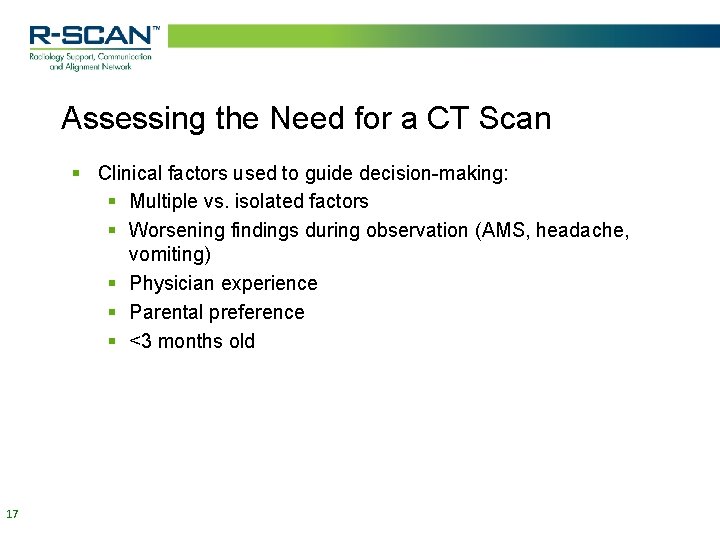
Assessing the Need for a CT Scan § Clinical factors used to guide decision-making: § Multiple vs. isolated factors § Worsening findings during observation (AMS, headache, vomiting) § Physician experience § Parental preference § <3 months old 17
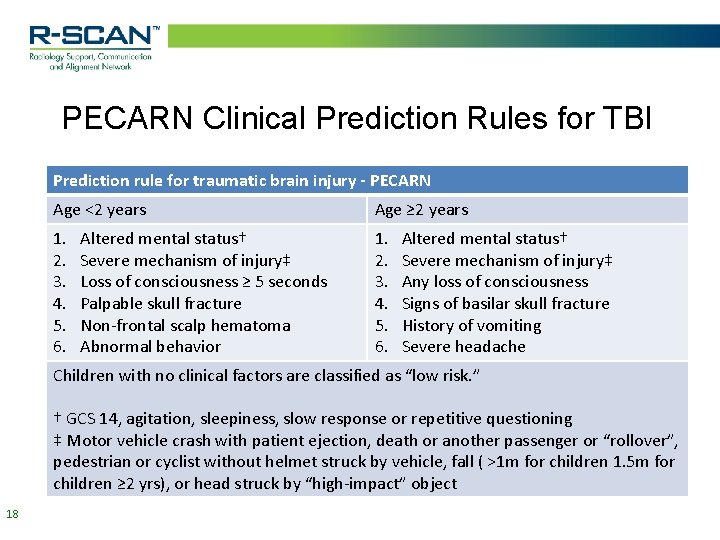
PECARN Clinical Prediction Rules for TBI Prediction rule for traumatic brain injury - PECARN Age <2 years Age ≥ 2 years 1. 2. 3. 4. 5. 6. Altered mental status† Severe mechanism of injury‡ Loss of consciousness ≥ 5 seconds Palpable skull fracture Non-frontal scalp hematoma Abnormal behavior Altered mental status† Severe mechanism of injury‡ Any loss of consciousness Signs of basilar skull fracture History of vomiting Severe headache Children with no clinical factors are classified as “low risk. ” † GCS 14, agitation, sleepiness, slow response or repetitive questioning ‡ Motor vehicle crash with patient ejection, death or another passenger or “rollover”, pedestrian or cyclist without helmet struck by vehicle, fall ( >1 m for children 1. 5 m for children ≥ 2 yrs), or head struck by “high-impact” object 18
Pediatric Head Trauma CT Decision Guide <2 y 19
Pediatric Head Trauma CT Decision Guide ≥ 2 y 20
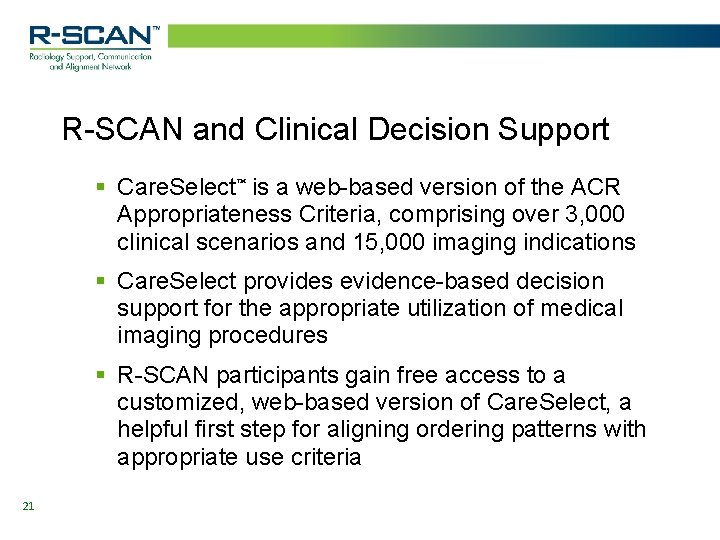
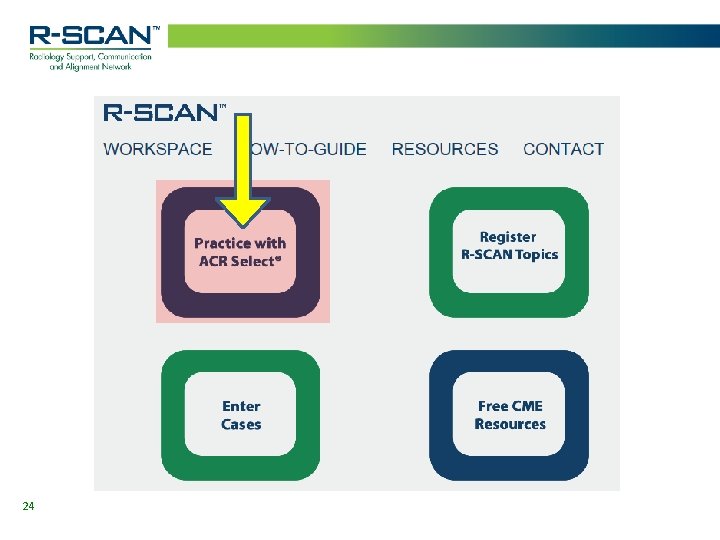
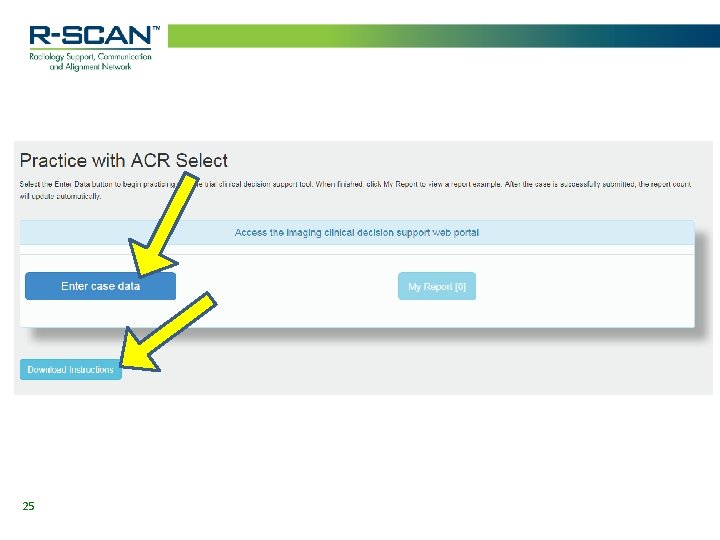
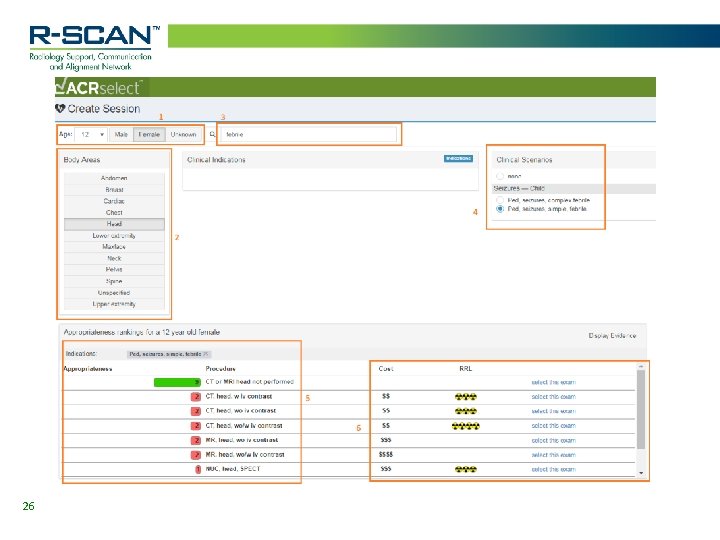
R-SCAN and Clinical Decision Support § Care. Select is a web-based version of the ACR Appropriateness Criteria, comprising over 3, 000 clinical scenarios and 15, 000 imaging indications § Care. Select provides evidence-based decision support for the appropriate utilization of medical imaging procedures § R-SCAN participants gain free access to a customized, web-based version of Care. Select, a helpful first step for aligning ordering patterns with appropriate use criteria 21
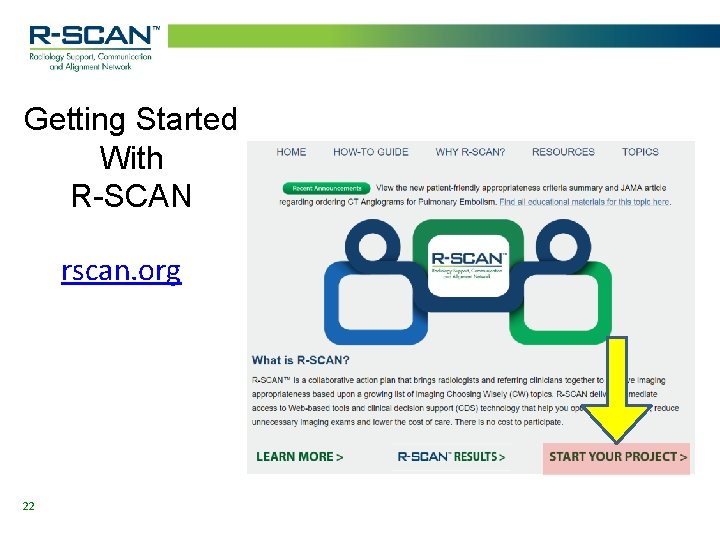
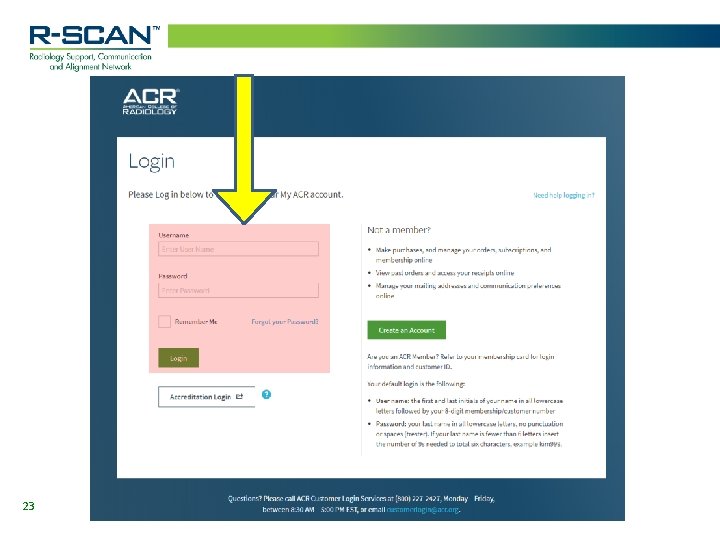
Getting Started With R-SCAN rscan. org 22
23
24
25
26
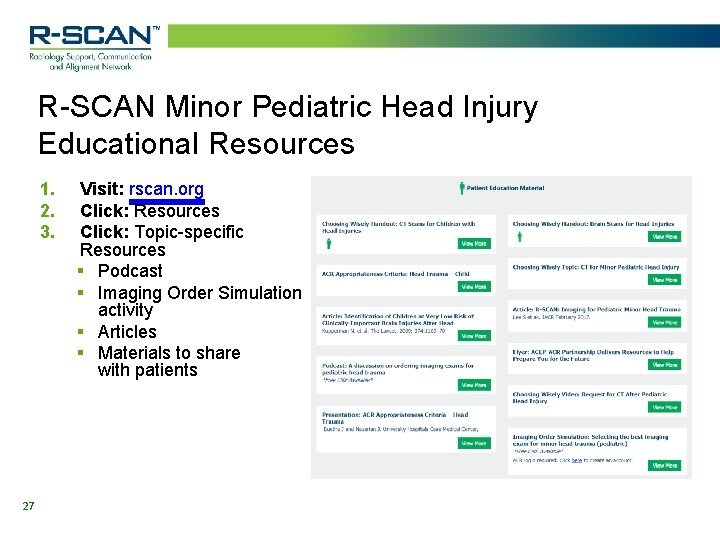
R-SCAN Minor Pediatric Head Injury Educational Resources 1. 2. 3. 27 Visit: rscan. org Click: Resources Click: Topic-specific Resources § Podcast § Imaging Order Simulation activity § Articles § Materials to share with patients
R-SCAN Resources With CME § Podcast § A radiologist and referring physician discuss strategies of CT image ordering for cases of minor pediatric head injury; approved for. 5 CME § Learn more § Imaging Order Simulation Activity § Test your knowledge in selecting the best imaging exam for various indications § Free with CME 28
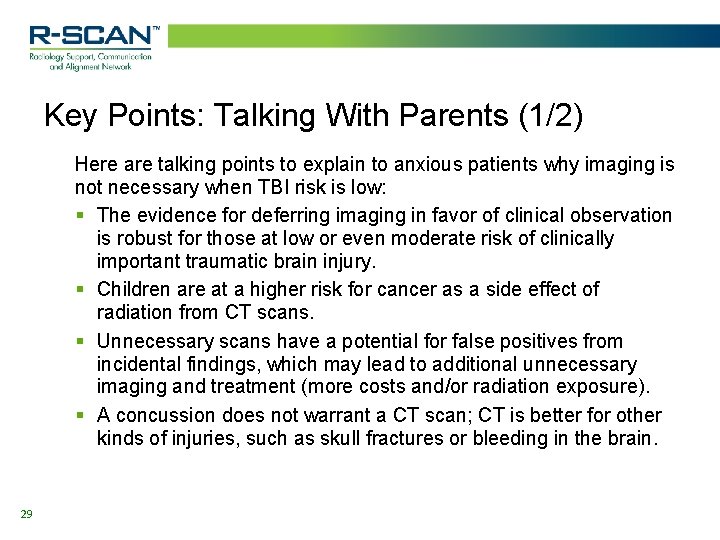
Key Points: Talking With Parents (1/2) Here are talking points to explain to anxious patients why imaging is not necessary when TBI risk is low: § The evidence for deferring imaging in favor of clinical observation is robust for those at low or even moderate risk of clinically important traumatic brain injury. § Children are at a higher risk for cancer as a side effect of radiation from CT scans. § Unnecessary scans have a potential for false positives from incidental findings, which may lead to additional unnecessary imaging and treatment (more costs and/or radiation exposure). § A concussion does not warrant a CT scan; CT is better for other kinds of injuries, such as skull fractures or bleeding in the brain. 29
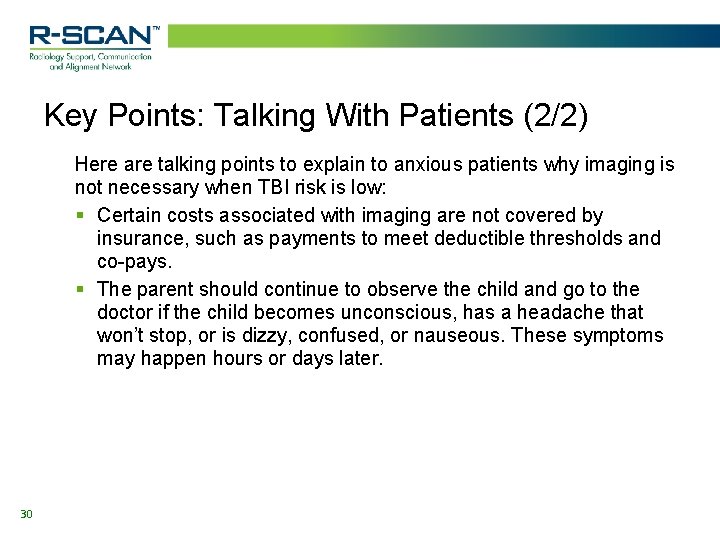
Key Points: Talking With Patients (2/2) Here are talking points to explain to anxious patients why imaging is not necessary when TBI risk is low: § Certain costs associated with imaging are not covered by insurance, such as payments to meet deductible thresholds and co-pays. § The parent should continue to observe the child and go to the doctor if the child becomes unconscious, has a headache that won’t stop, or is dizzy, confused, or nauseous. These symptoms may happen hours or days later. 30
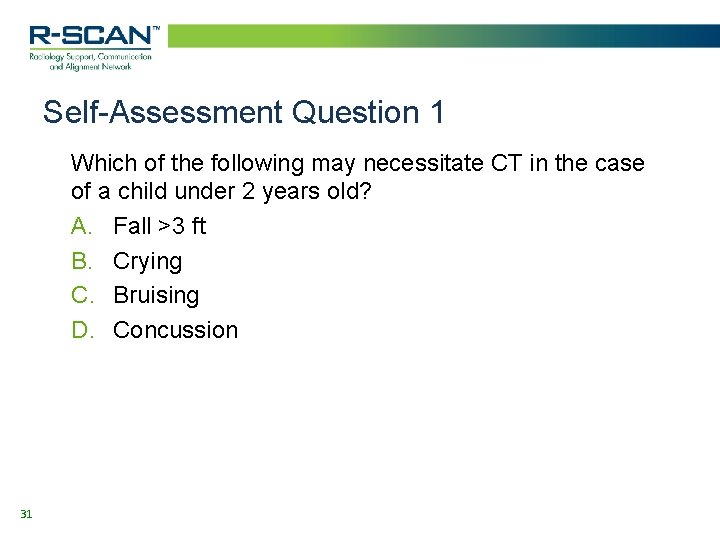
Self-Assessment Question 1 Which of the following may necessitate CT in the case of a child under 2 years old? A. Fall >3 ft B. Crying C. Bruising D. Concussion 31
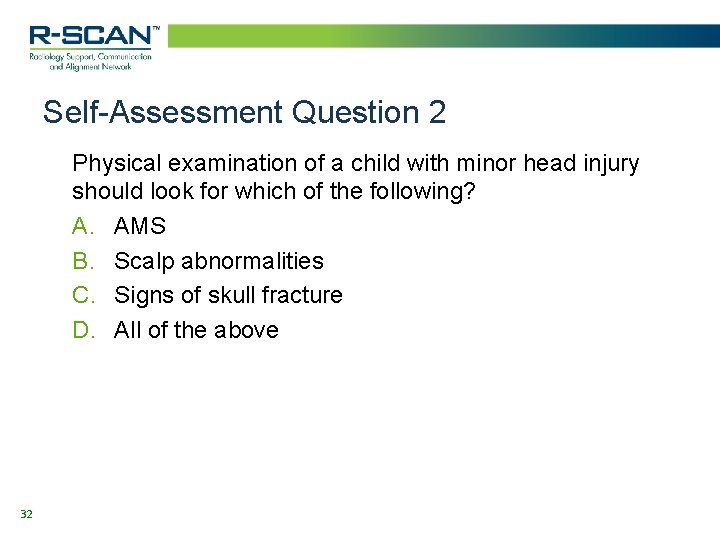
Self-Assessment Question 2 Physical examination of a child with minor head injury should look for which of the following? A. AMS B. Scalp abnormalities C. Signs of skull fracture D. All of the above 32
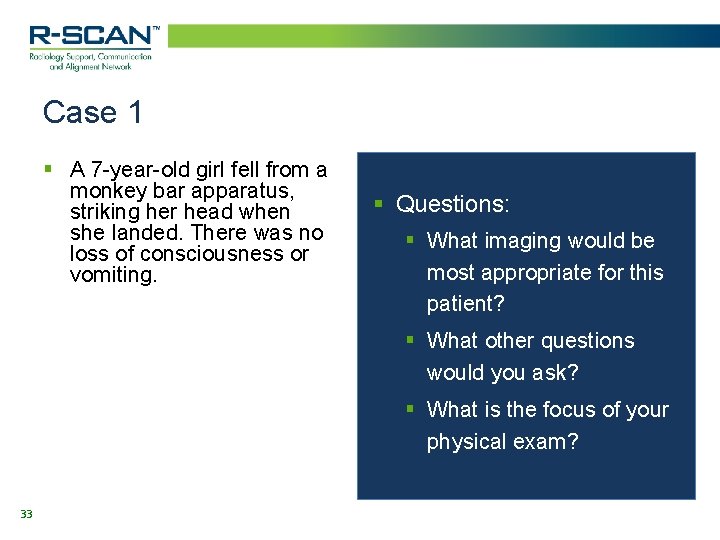
Case 1 § A 7 -year-old girl fell from a monkey bar apparatus, striking her head when she landed. There was no loss of consciousness or vomiting. § Questions: § What imaging would be most appropriate for this patient? § What other questions would you ask? § What is the focus of your physical exam? 33
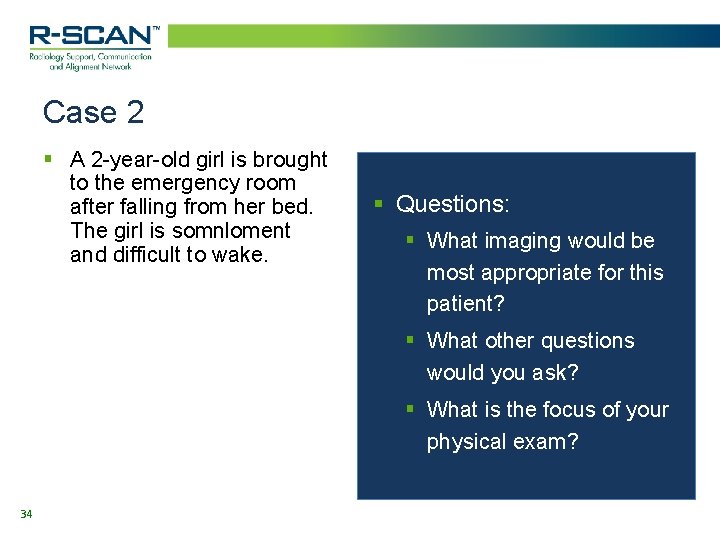
Case 2 § A 2 -year-old girl is brought to the emergency room after falling from her bed. The girl is somnloment and difficult to wake. § Questions: § What imaging would be most appropriate for this patient? § What other questions would you ask? § What is the focus of your physical exam? 34
Blank slide for radiologist to add custom info 35
Blank slide for radiologist to add custom info 36
Summary § Imaging is typically not indicated in children with minor head injury and no neurological signs or high risk factors. § Half of children sent to the ER with head injuries receive CT scans, but only one third of these identify abnormalities or require neurosurgical intervention. § The decision to image should consider the increased risks of ionizing radiation in children. § Providers should explain when imaging is necessary and the dangers of radiation to anxious parents of low risk patients. 37
Summary § Clinical observation and Pediatric Emergency Care Applied Research Network (PECARN) criteria should be used to determine whether imaging is indicated. § Low risk—CT is not indicated: GCS >13 without neurological signs, AMS, or skull fracture § Moderate risk—CT may be indicated: GCS >13, vomiting, LOC, severe headache, severe mechanism of injury, scalp hematoma, abnormal behavior per parent § High risk—CT is indicated: GCS ≤ 13, AMS, or skull fracture § However, neurologic examination can be difficult in younger children and infants, and imaging in this setting may be appropriate if the clinical assessment is uncertain or indeterminate. 38
Questions? 39