
CST ELEMENT STIFFNESS MATRIX Strain energy Element Stiffness
![ELEMENT 1 cont. • Matrix [B] • Plane Stress Condition How do you check](https://slidetodoc.com/presentation_image_h2/c4d6b32f9efd41f5ff04f1d3612dced2/image-8.jpg "ELEMENT 1 cont. • Matrix [B] • Plane Stress Condition How do you check")
![ELEMENT 2 cont. • Matrix [B] • Stiffness Matrix 10](https://slidetodoc.com/presentation_image_h2/c4d6b32f9efd41f5ff04f1d3612dced2/image-10.jpg "ELEMENT 2 cont. • Matrix [B] • Stiffness Matrix 10")
- Slides: 19
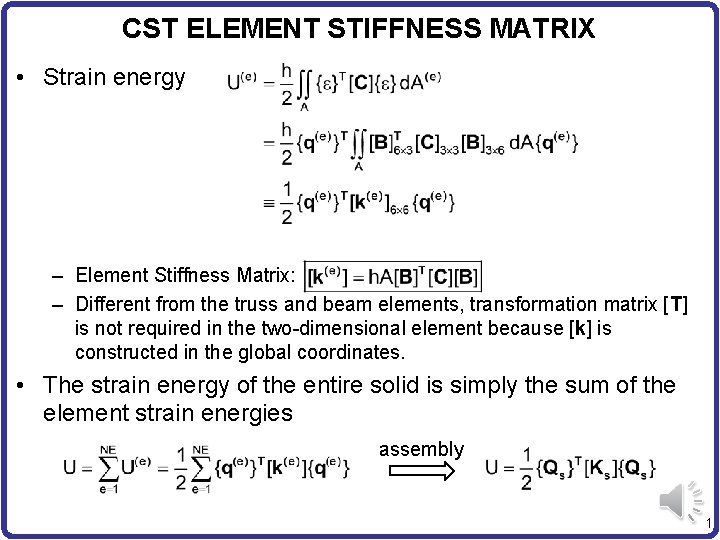
CST ELEMENT STIFFNESS MATRIX • Strain energy – Element Stiffness Matrix: – Different from the truss and beam elements, transformation matrix [T] is not required in the two-dimensional element because [k] is constructed in the global coordinates. • The strain energy of the entire solid is simply the sum of the element strain energies assembly 1
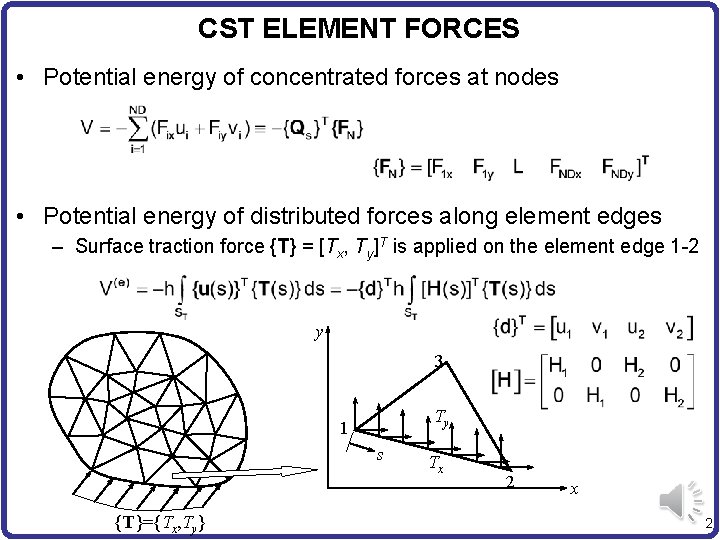
CST ELEMENT FORCES • Potential energy of concentrated forces at nodes • Potential energy of distributed forces along element edges – Surface traction force {T} = [Tx, Ty]T is applied on the element edge 1 -2 y 3 Ty 1 s {T}={Tx, Ty} Tx 2
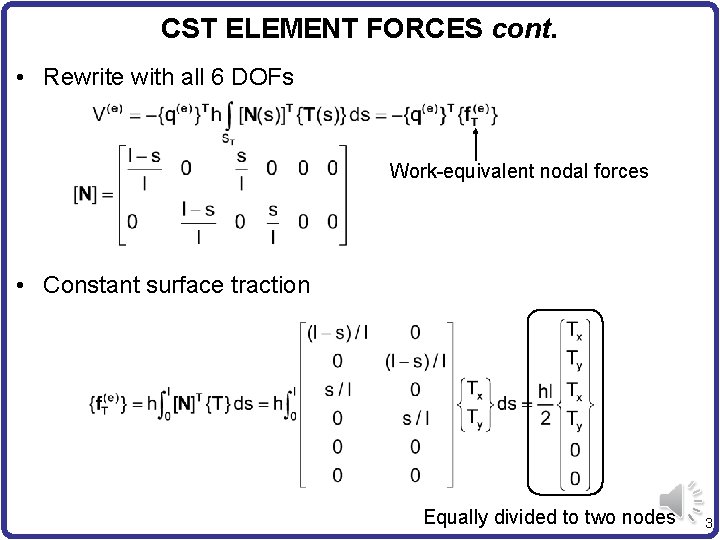
CST ELEMENT FORCES cont. • Rewrite with all 6 DOFs Work-equivalent nodal forces • Constant surface traction Equally divided to two nodes 3
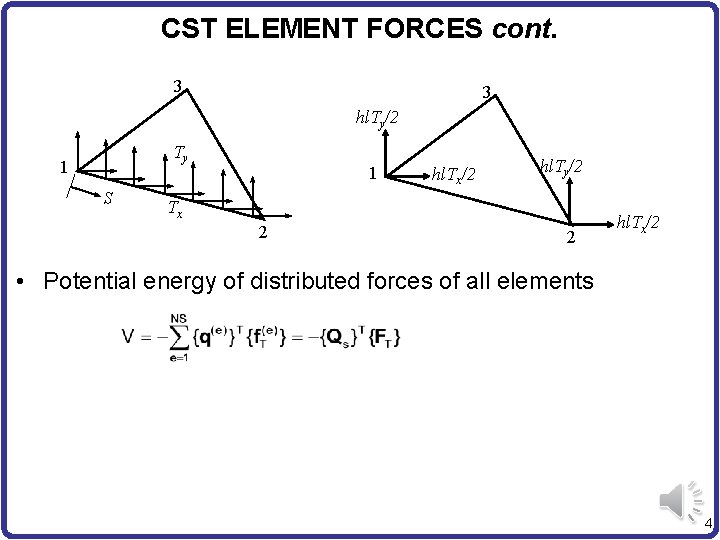
CST ELEMENT FORCES cont. 3 3 hl. Ty/2 Ty 1 S 1 hl. Tx/2 hl. Ty/2 Tx 2 2 hl. Tx/2 • Potential energy of distributed forces of all elements 4
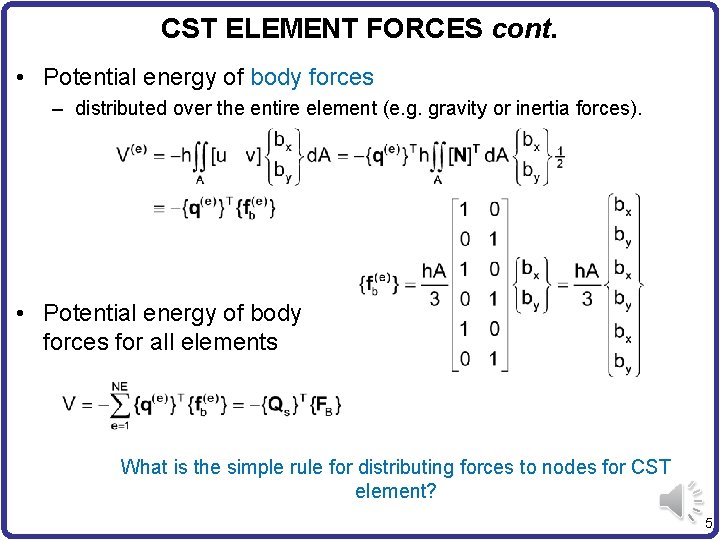
CST ELEMENT FORCES cont. • Potential energy of body forces – distributed over the entire element (e. g. gravity or inertia forces). • Potential energy of body forces for all elements What is the simple rule for distributing forces to nodes for CST element? 5
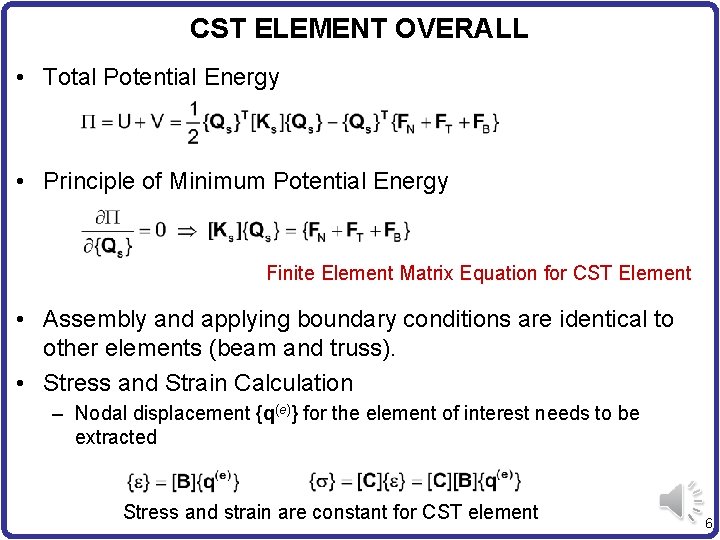
CST ELEMENT OVERALL • Total Potential Energy • Principle of Minimum Potential Energy Finite Element Matrix Equation for CST Element • Assembly and applying boundary conditions are identical to other elements (beam and truss). • Stress and Strain Calculation – Nodal displacement {q(e)} for the element of interest needs to be extracted Stress and strain are constant for CST element 6
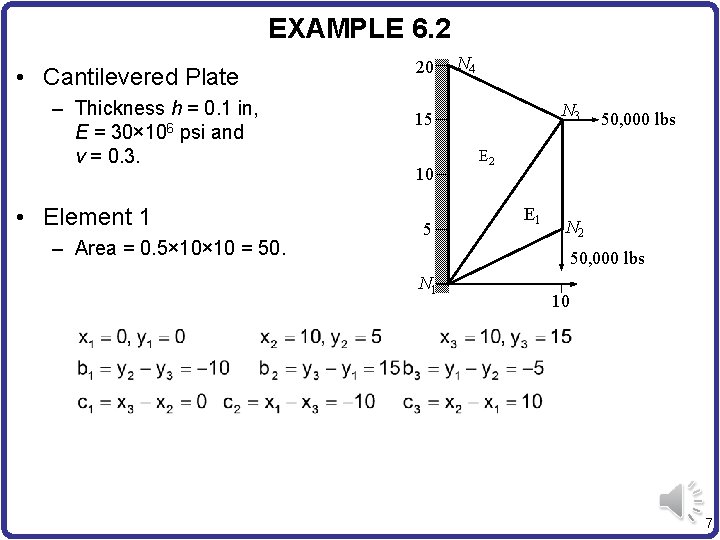
EXAMPLE 6. 2 • Cantilevered Plate – Thickness h = 0. 1 in, E = 30× 106 psi and ν = 0. 3. • Element 1 – Area = 0. 5× 10 = 50. 20 N 4 N 3 15 10 5 50, 000 lbs E 2 E 1 N 2 50, 000 lbs N 1 10 7
ELEMENT 1 cont. • Matrix [B] • Plane Stress Condition How do you check B for errors? 8
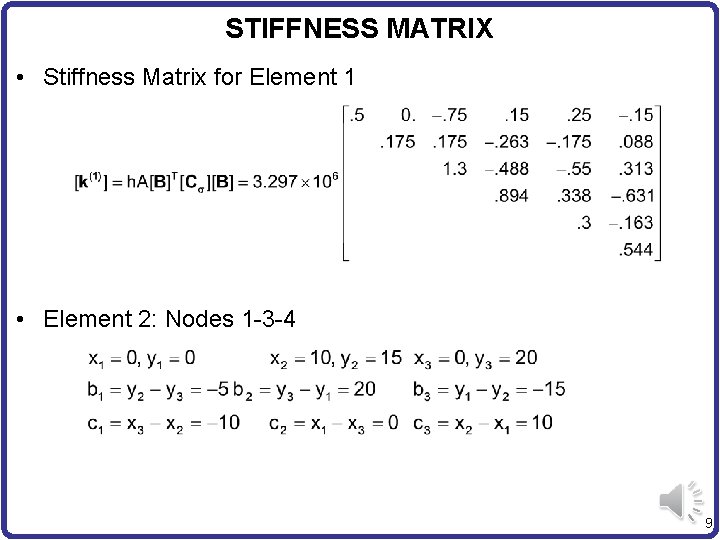
STIFFNESS MATRIX • Stiffness Matrix for Element 1 • Element 2: Nodes 1 -3 -4 9
ELEMENT 2 cont. • Matrix [B] • Stiffness Matrix 10
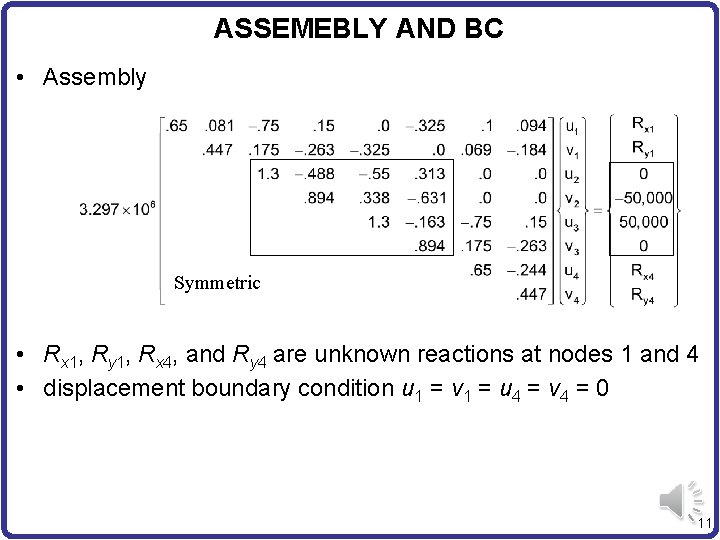
ASSEMEBLY AND BC • Assembly Symmetric • Rx 1, Ry 1, Rx 4, and Ry 4 are unknown reactions at nodes 1 and 4 • displacement boundary condition u 1 = v 1 = u 4 = v 4 = 0 11
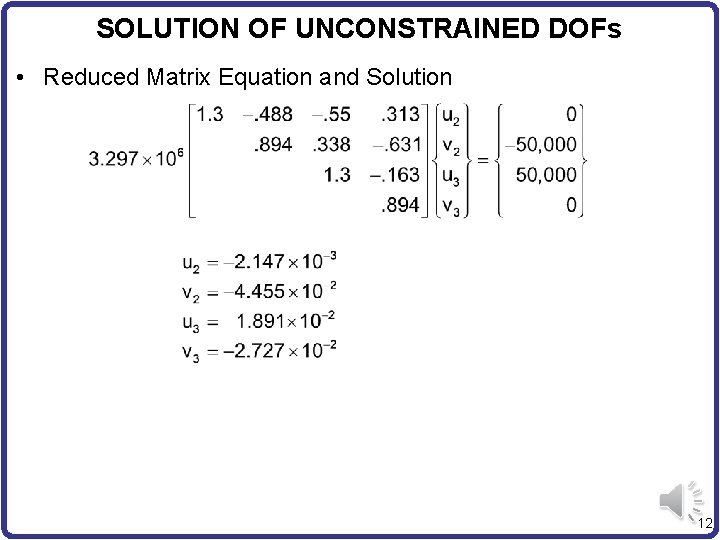
SOLUTION OF UNCONSTRAINED DOFs • Reduced Matrix Equation and Solution 12
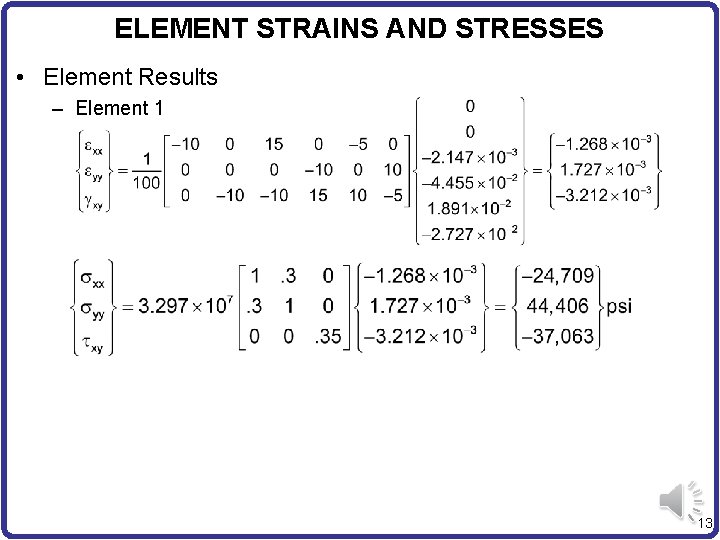
ELEMENT STRAINS AND STRESSES • Element Results – Element 1 13
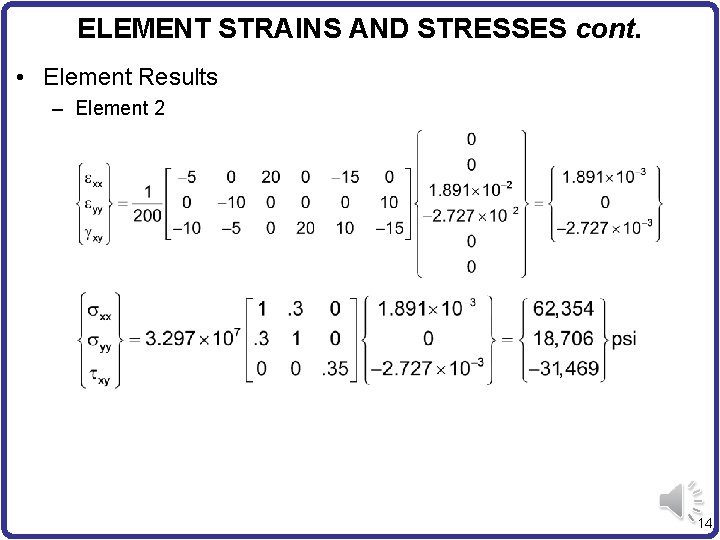
ELEMENT STRAINS AND STRESSES cont. • Element Results – Element 2 14
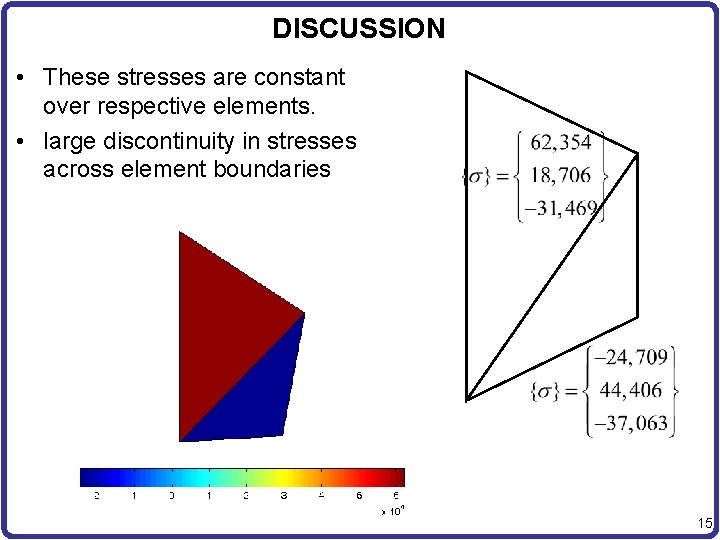
DISCUSSION • These stresses are constant over respective elements. • large discontinuity in stresses across element boundaries 15
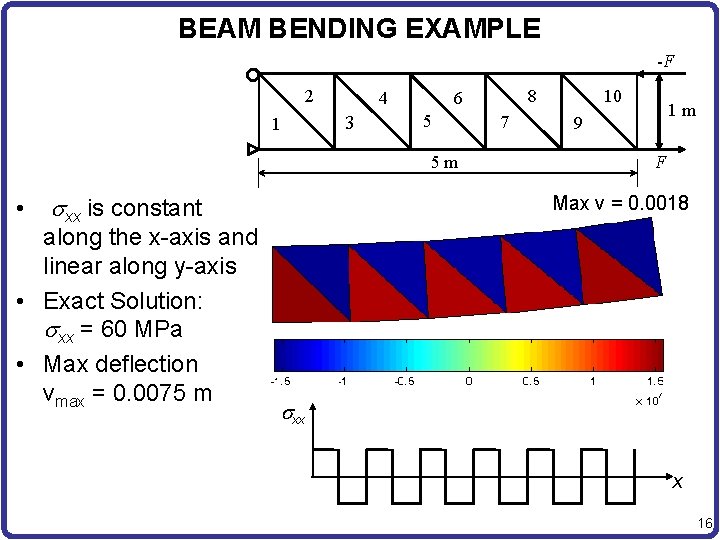
BEAM BENDING EXAMPLE -F 2 1 4 3 5 5 m • sxx is constant along the x-axis and linear along y-axis • Exact Solution: sxx = 60 MPa • Max deflection vmax = 0. 0075 m 10 8 6 7 1 m 9 F Max v = 0. 0018 sxx x 16
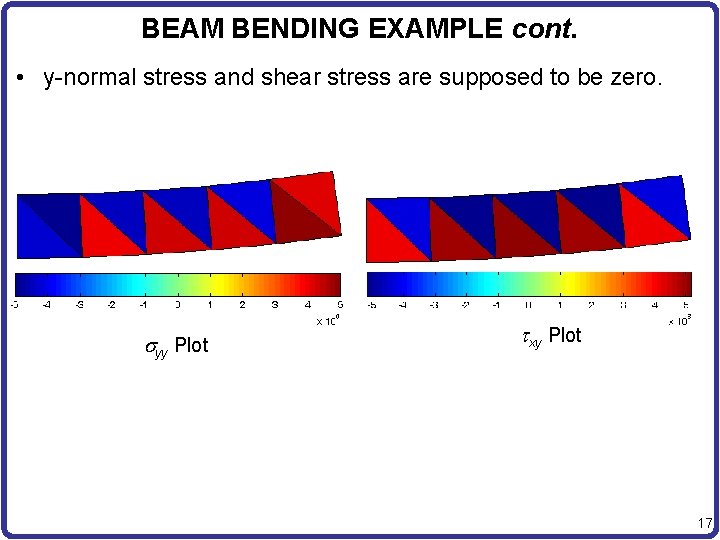
BEAM BENDING EXAMPLE cont. • y-normal stress and shear stress are supposed to be zero. syy Plot txy Plot 17
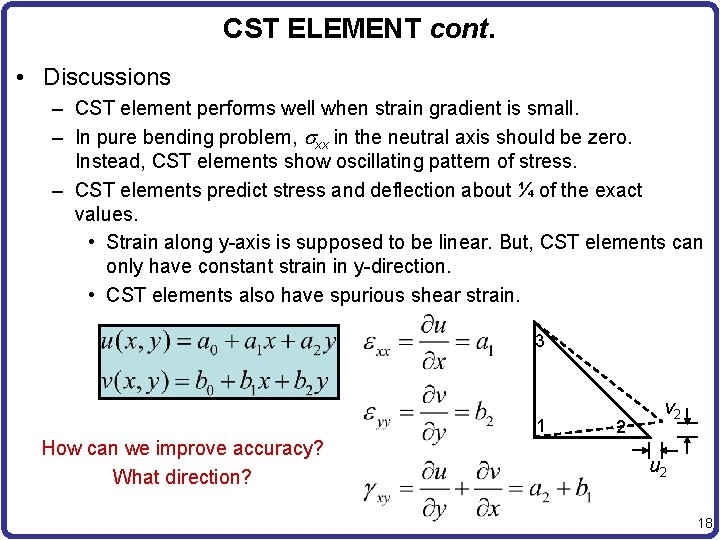
CST ELEMENT cont. • Discussions – CST element performs well when strain gradient is small. – In pure bending problem, sxx in the neutral axis should be zero. Instead, CST elements show oscillating pattern of stress. – CST elements predict stress and deflection about ¼ of the exact values. • Strain along y-axis is supposed to be linear. But, CST elements can only have constant strain in y-direction. • CST elements also have spurious shear strain. 3 1 How can we improve accuracy? What direction? 2 v 2 u 2 18
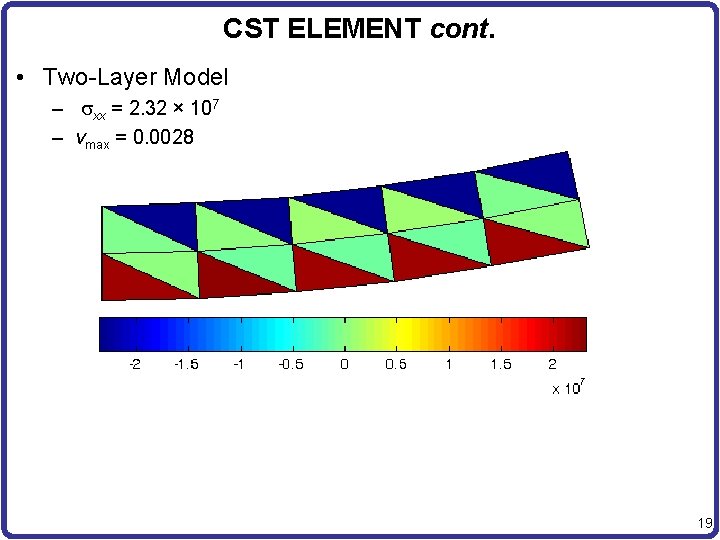
CST ELEMENT cont. • Two-Layer Model – sxx = 2. 32 × 107 – vmax = 0. 0028 19