
CSSE 374 GRASPing at the First Five Patterns

- Slides: 33
CSSE 374: GRASP’ing at the First Five Patterns Principles Steve Chenoweth Office: Moench Room F 220 Phone: (812) 877 -8974 Email: chenowet@rose-hulman. edu Chandan Rupakheti Office: Moench Room F 203 Phone: (812) 877 -8390 Email: rupakhet@rose-hulman. edu These slides and others derived from Shawn Bohner, Curt Clifton, Alex Lo, and others involved in delivering 374.
Learning Outcomes: Patterns, Tradeoffs Identify criteria for the design of a software system and select patterns, create frameworks, and partition software to satisfy the inherent trade-offs. Examine GRASP Patterns: n n n Creator Information Expert Controller Low Coupling High Cohesion Q 3 Pattern – math style. See http: //www. alfredo-haeberli. com/products/pattern/1. html.
On Design n n There is no “one true correct design” There are wrong designs ¨ Inflexible ¨ Unreliable ¨ “Ugly” n GRASP and other OO guidelines (SRP, etc) are meant to help make decisions but are not rules that must be followed. There are good reasons to break them occasionally.
Recall GRASP: Creator n Problem: Who should be responsible for creating a new instance of some class? n Solution: Make B responsible for creating A if… ¨B Most important contains or is a composition of A ¨ B records A ¨ B closely uses A ¨ B has the data to initialize A The more matches the better.
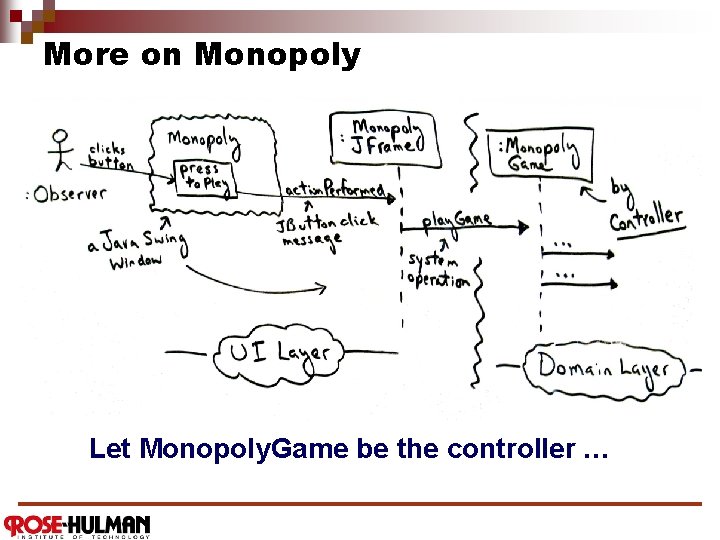
Question -n n n How generic is the “creator” pattern? It sounds like an object either is injected with properties by whatever makes it, gets properties or creates properties. This term just did not feel well-defined. The “creator” pattern gives some basic heuristics on which object should create which other objects. It is very basic and perhaps obvious but in a system of interacting objects it’s not always easy to determine. Refer to Monopoly example: Text 17. 8, p 282
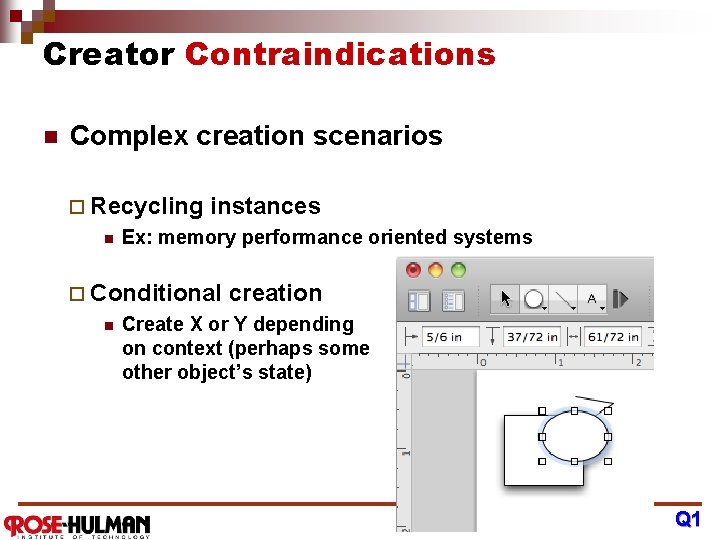
Creator Contraindications n Complex creation scenarios ¨ Recycling n instances Ex: memory performance oriented systems ¨ Conditional n creation Create X or Y depending on context (perhaps some other object’s state) Q 1
Recall GRASP: Information Expert n Problem: What is a general principle of assigning responsibilities? n Solution: Assign a responsibility to the class that has the necessary information Q 2
Information Expert Contraindications n Sometimes Information Expert will suggest a solution that leads to coupling or cohesion problems n Consider: Who should be responsible for saving a Sale in a database? Q 3
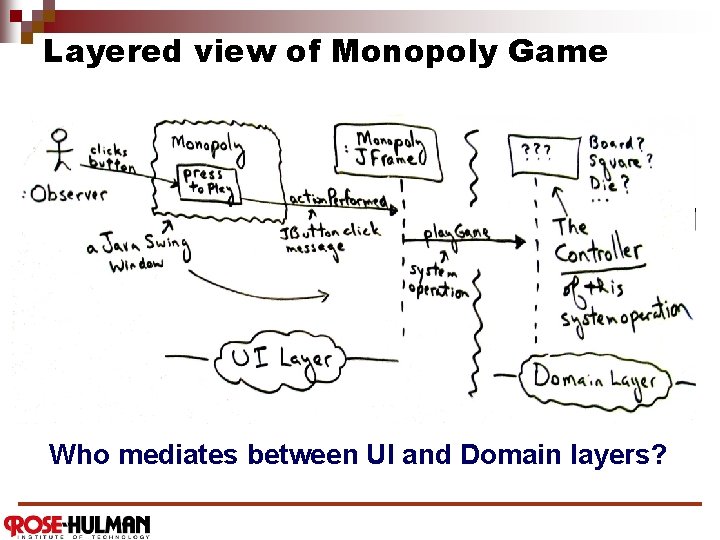
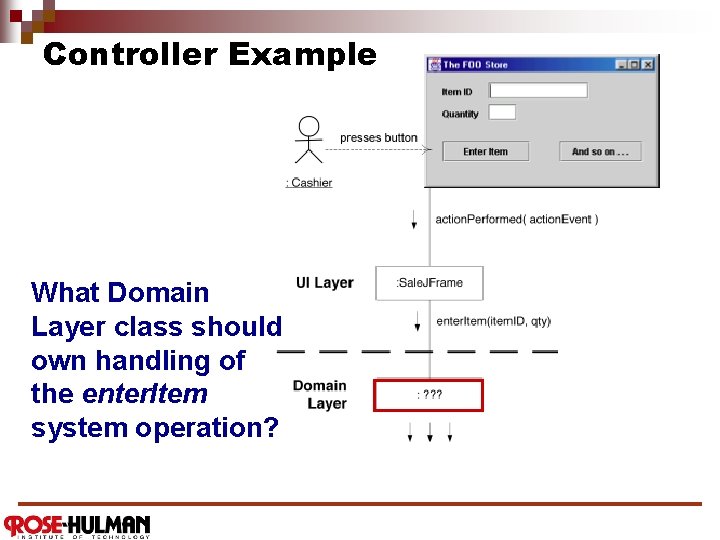
GRASP: Controller n Problem: What is the first object beyond the UI layer that receives and coordinates a system operation? n Solution: Assign the responsibility to either… ¨A façade controller, representing the CONTROL overall system and handling all system operations, or ¨ A use case controller, that handles all system events for a single use case Q 4
Layered view of Monopoly Game Who mediates between UI and Domain layers?
More on Monopoly Let Monopoly. Game be the controller …
Controller Example What Domain Layer class should own handling of the enter. Item system operation?
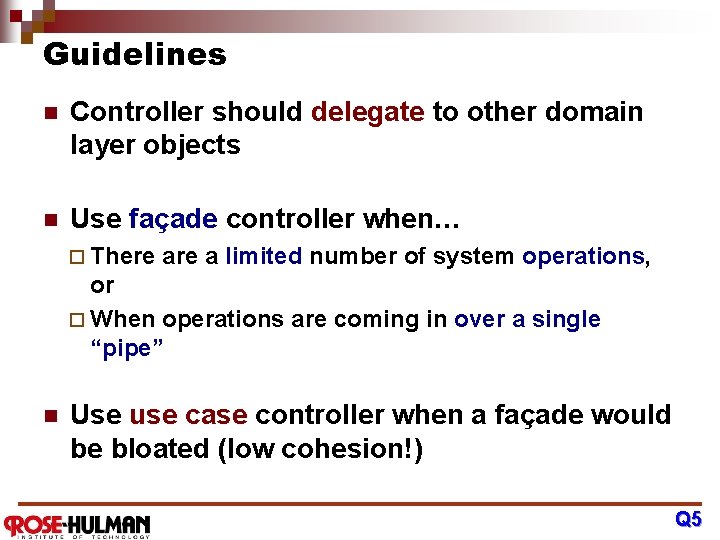
Guidelines n Controller should delegate to other domain layer objects n Use façade controller when… ¨ There a limited number of system operations, or ¨ When operations are coming in over a single “pipe” n Use use case controller when a façade would be bloated (low cohesion!) Q 5
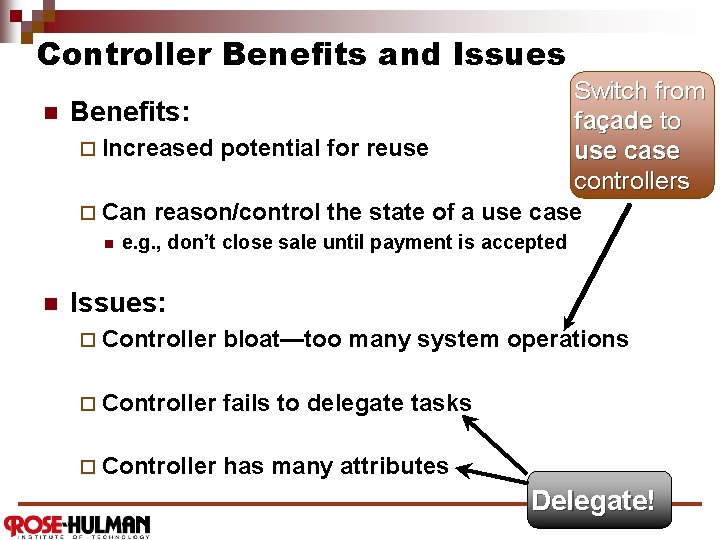
Controller Benefits and Issues Switch from n Benefits: façade to ¨ Increased potential for reuse case controllers ¨ Can reason/control the state of a use case n n e. g. , don’t close sale until payment is accepted Issues: ¨ Controller bloat—too many system operations ¨ Controller fails to delegate tasks ¨ Controller has many attributes Delegate!
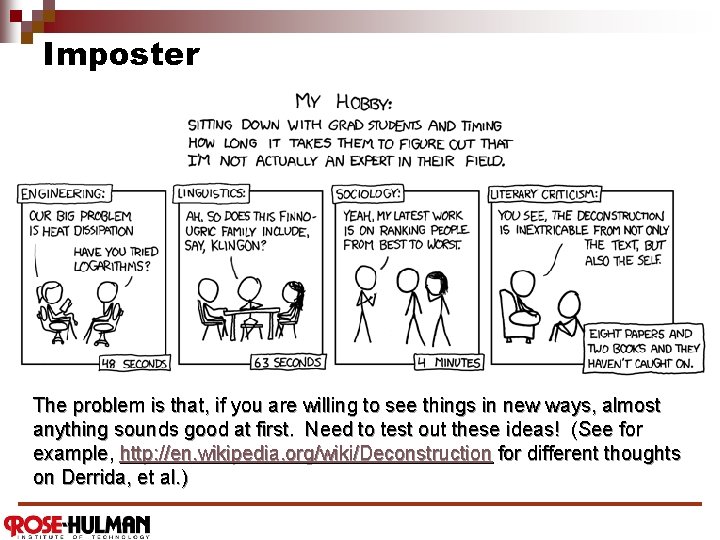
Imposter The problem is that, if you are willing to see things in new ways, almost anything sounds good at first. Need to test out these ideas! (See for example, http: //en. wikipedia. org/wiki/Deconstruction for different thoughts on Derrida, et al. )
Coupling n A measure of how strongly one element: An Eva luat ive Prin cipl e ¨ is connected to, ¨ has knowledge of, or ¨ relies on other elements n Goal: Low (or weak) coupling n What are some problems with high coupling? Q 6
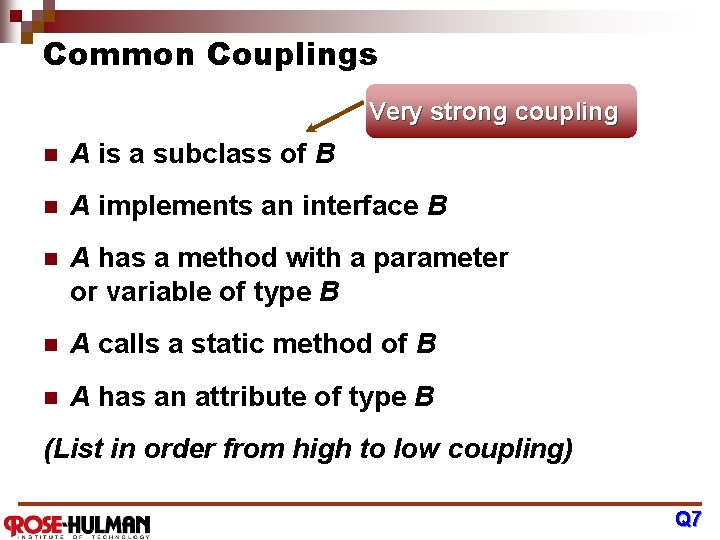
Common Couplings Very strong coupling n A is a subclass of B n A implements an interface B n A has a method with a parameter or variable of type B n A calls a static method of B n A has an attribute of type B (List in order from high to low coupling) Q 7
GRASP: Low Coupling Problem: How do you support low dependency, low change impact, and increased reuse? Solution: Assign a responsibility so that coupling remains low. Use this principle to evaluate alternatives.
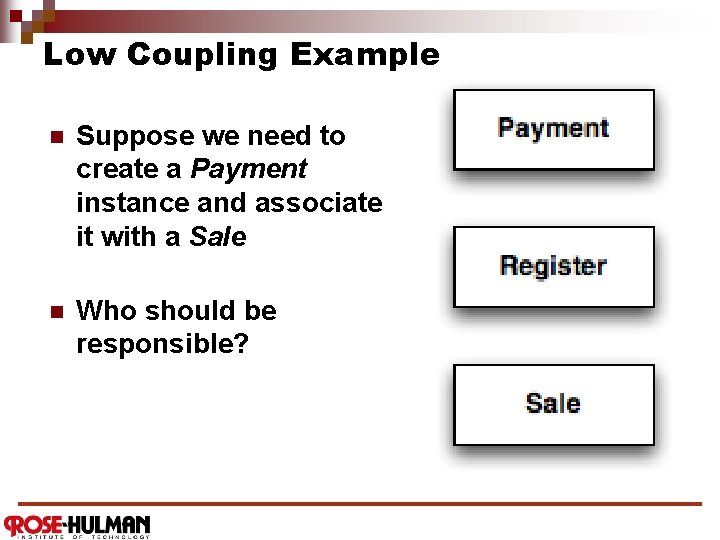
Low Coupling Example n Suppose we need to create a Payment instance and associate it with a Sale n Who should be responsible?
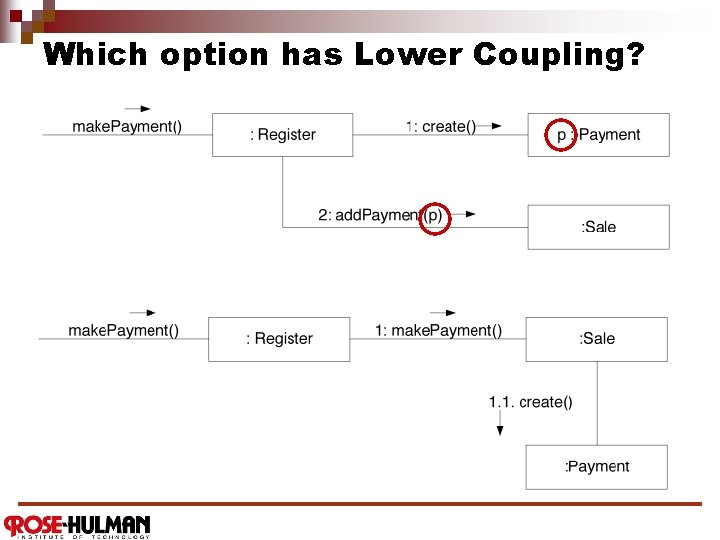
Which option has Lower Coupling?
Some real coupling no-no’s n n “Coordinating coupling” – A passes a parameter to B that is used in B to determine the actions of B (like “flag passing”) “Common environment coupling” – A and B contain references to some shared data area that incorporates knowledge about its structure and organization. Any change to the format of the block requires that all the modules using it must also be modified. From Software Design, by David Budgen, 2 nd ed, 2003, p. 77.
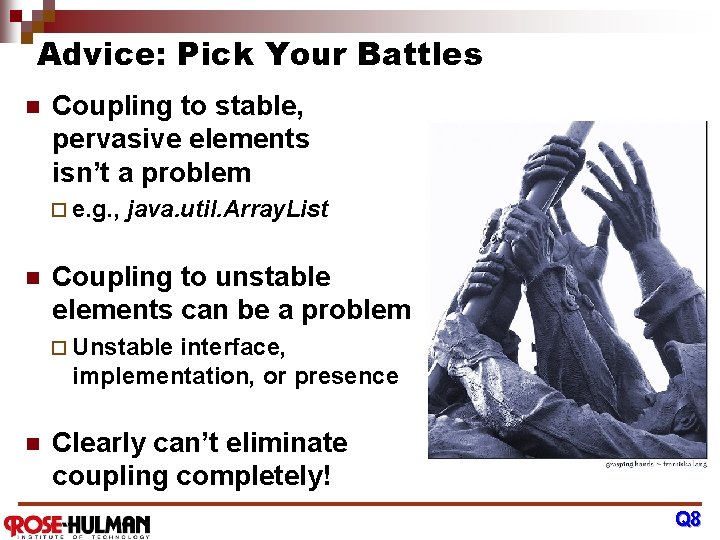
Advice: Pick Your Battles n Coupling to stable, pervasive elements isn’t a problem ¨ e. g. , n java. util. Array. List Coupling to unstable elements can be a problem ¨ Unstable interface, implementation, or presence n Clearly can’t eliminate coupling completely! Q 8
Common Couplings … Revisited Very strong coupling n A is a subclass of B n We might want to use subclassing in OO design, so this warning means “pick your parent classes carefully. ” They may change, but these changes shouldn’t require rewriting the child classes!
Cohesion Ano Eva ther luat ive Prin cipl e n A measure of how strongly related and focused the responsibilities of a class (or method or package…) are n Goal: high (strong) cohesion n What are some problems with low cohesion? Q 9
GRASP: High Cohesion Problem: How do you keep objects focused, understandable, and manageable, and as a side-effect, support low coupling? Solution: Assign a responsibility so that cohesion remains high. Use this principle to evaluate alternatives. Rosie recommends focused objects that work well together. From http: //lottabruhn. typepad. com/lotta_bruhn_illustration/patterns/.
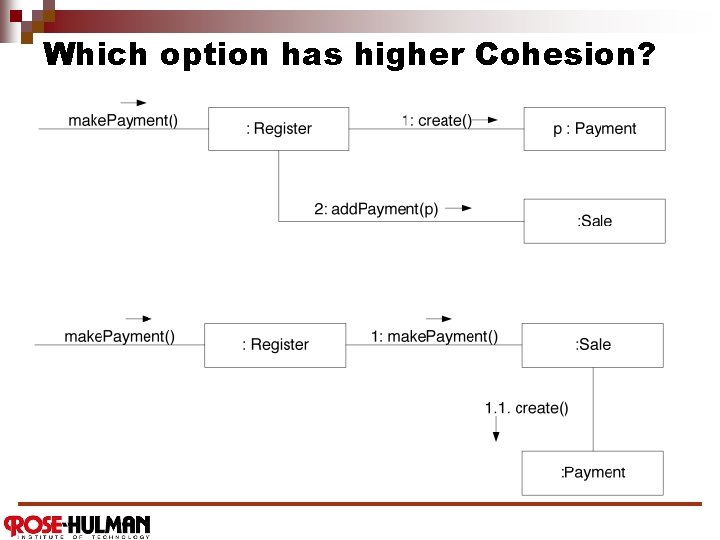
Which option has higher Cohesion?
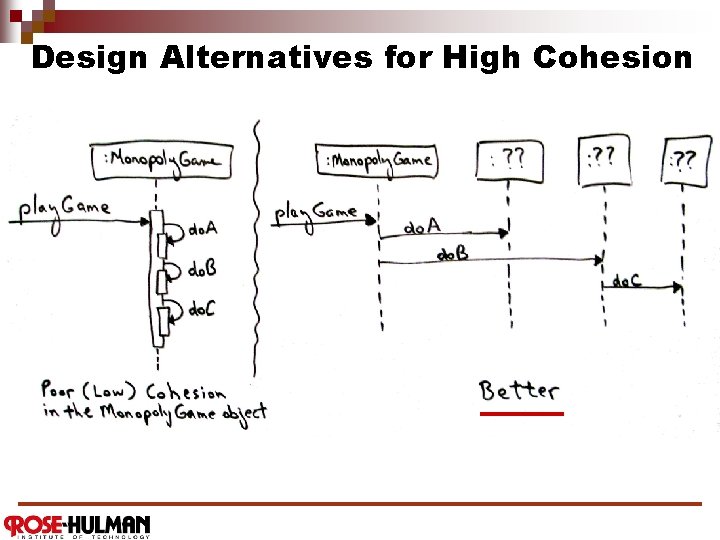
Design Alternatives for High Cohesion
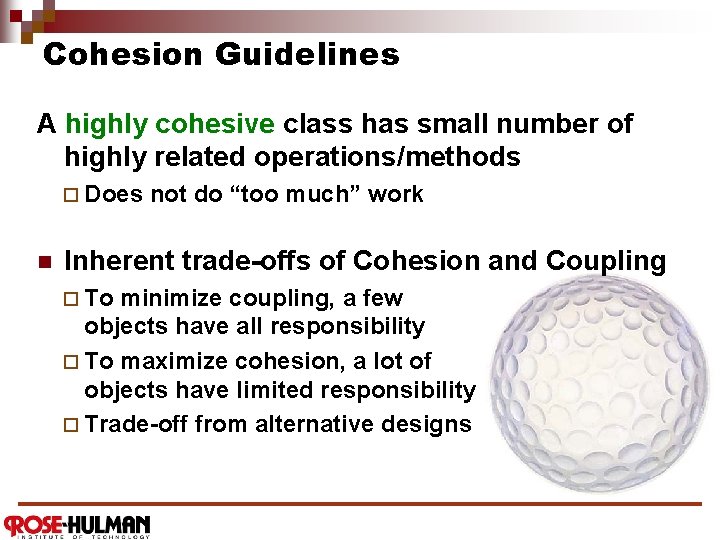
Cohesion Guidelines A highly cohesive class has small number of highly related operations/methods ¨ Does n not do “too much” work Inherent trade-offs of Cohesion and Coupling ¨ To minimize coupling, a few objects have all responsibility ¨ To maximize cohesion, a lot of objects have limited responsibility ¨ Trade-off from alternative designs
There are cohesion no-no’s as well! Don’t do the following: n “Logical cohesion” – Operations put together because they are logically similar, but which involve very different actions internally. ¨ Like n system startup or shutdown operations “Coincidental cohesion” – Putting things together just to avoid more coding tasks, but the things have no conceptual link. ¨ Often relates to filling up one large class with stuff, to avoid having to create new classes and call their methods. From Software Design, by David Budgen, 2 nd ed, 2003, p. 79.
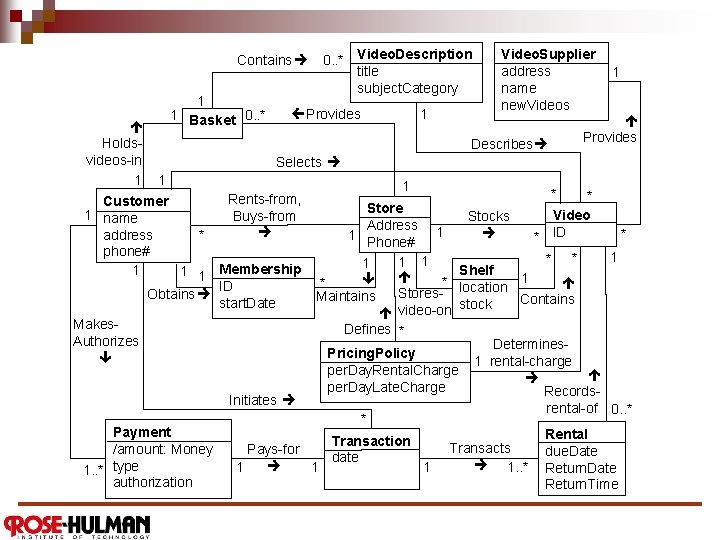
Exercise on Creator Examples n Break up into your project teams n Given the following: ¨ Domain 1. 2. Model for BBVS Identify a couple potential Controller Patterns Identify a couple potential Information Expert Patterns
Contains 1 1 Basket 0. . * Video. Description title subject. Category Video. Supplier address name new. Videos 1 Provides 1 Provides Holds. Describes videos-in Selects 1 1 1 * * Rents-from, Customer Store 1 name Video Buys-from Stocks Address 1 * address * 1 Phone# * ID phone# 1 * * 1 1 1 Shelf 1 1 1 Membership * location 1 * ID Stores. Obtains Maintains Contains start. Date stock video-on Makes. Defines * Authorizes Determines. Pricing. Policy 1 rental-charge per. Day. Rental. Charge per. Day. Late. Charge Records. Initiates rental-of 0. . * * Payment Rental Transaction Transacts /amount: Money Pays-for due. Date date 1. . * Return. Date 1 1. . * type authorization Return. Time
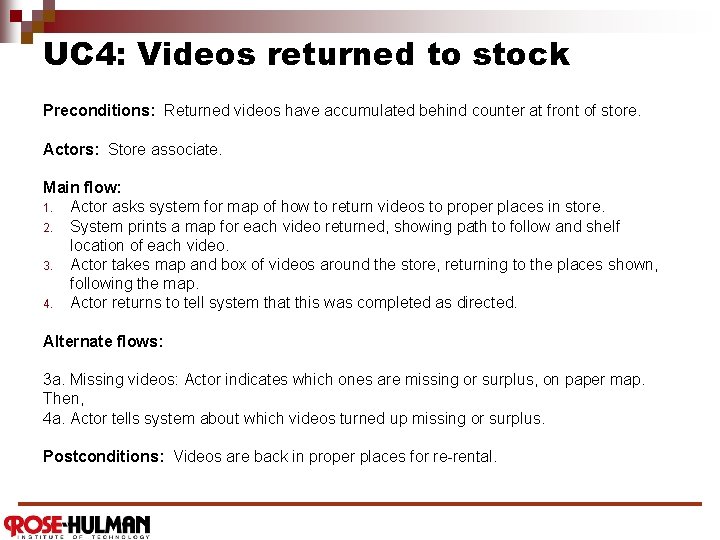
UC 4: Videos returned to stock Preconditions: Returned videos have accumulated behind counter at front of store. Actors: Store associate. Main flow: 1. Actor asks system for map of how to return videos to proper places in store. 2. System prints a map for each video returned, showing path to follow and shelf location of each video. 3. Actor takes map and box of videos around the store, returning to the places shown, following the map. 4. Actor returns to tell system that this was completed as directed. Alternate flows: 3 a. Missing videos: Actor indicates which ones are missing or surplus, on paper map. Then, 4 a. Actor tells system about which videos turned up missing or surplus. Postconditions: Videos are back in proper places for re-rental.
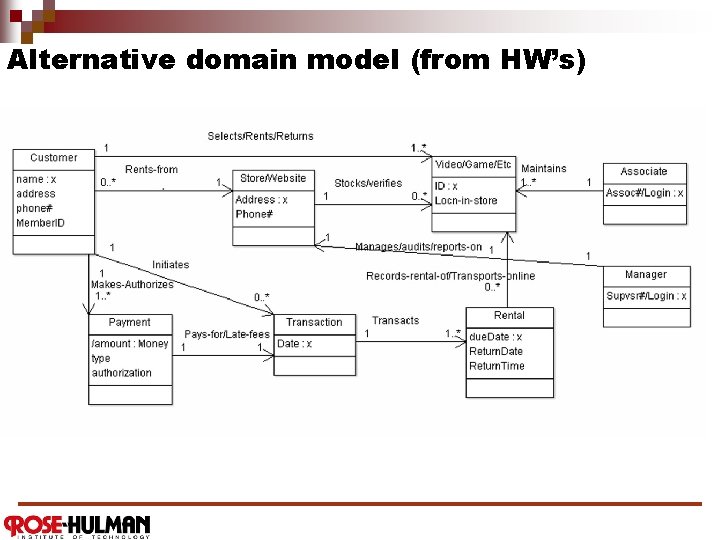
Alternative domain model (from HW’s)