
CSP Guarded Commands Monitor begin executing every call
CSP Guarded Commands • Monitor: begin executing every call as soon as possible, waiting if the object is not in a proper state and signaling when the state is proper • CSP: the called object establishes conditions under which the call is accepted; calls not satisfying these conditions are held pending (no need for programmed wait/signal operations). Rendezvous • Monitor: the monitor is passive (has no independent task/thread/activity) • CSP: synchronization between peer, autonomous activities. CS 5204 Spring 99 1
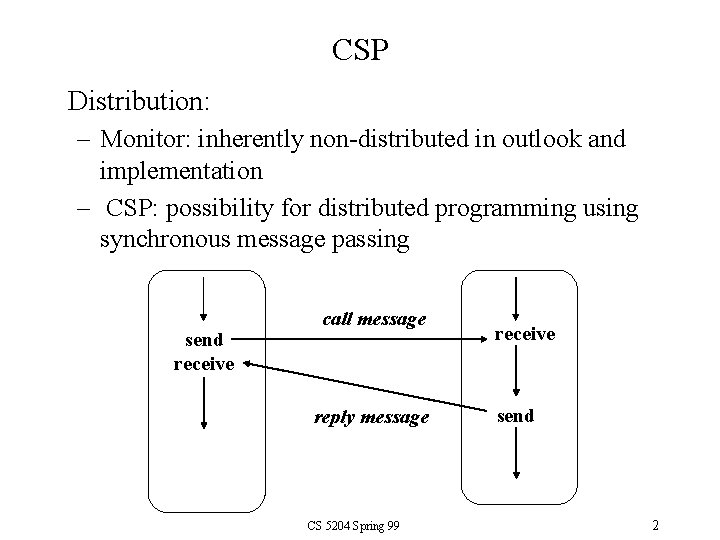
CSP Distribution: – Monitor: inherently non distributed in outlook and implementation – CSP: possibility for distributed programming using synchronous message passing send receive call message reply message CS 5204 Spring 99 receive send 2
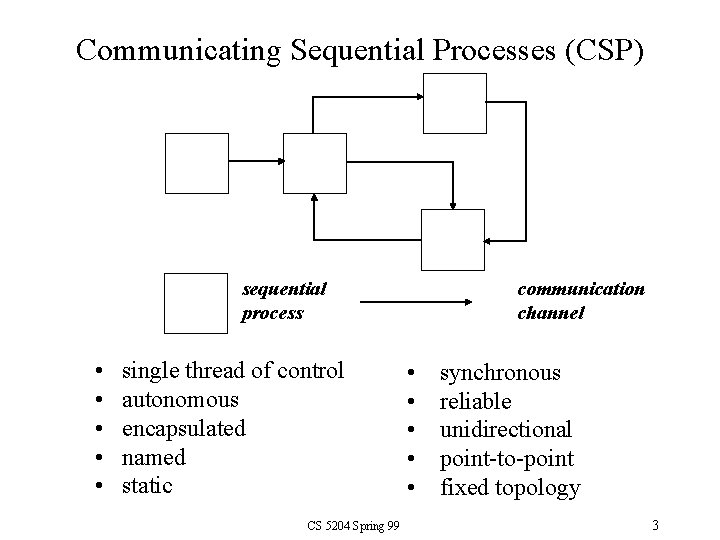
Communicating Sequential Processes (CSP) sequential process • • • single thread of control autonomous encapsulated named static CS 5204 Spring 99 communication channel • • • synchronous reliable unidirectional point to point fixed topology 3
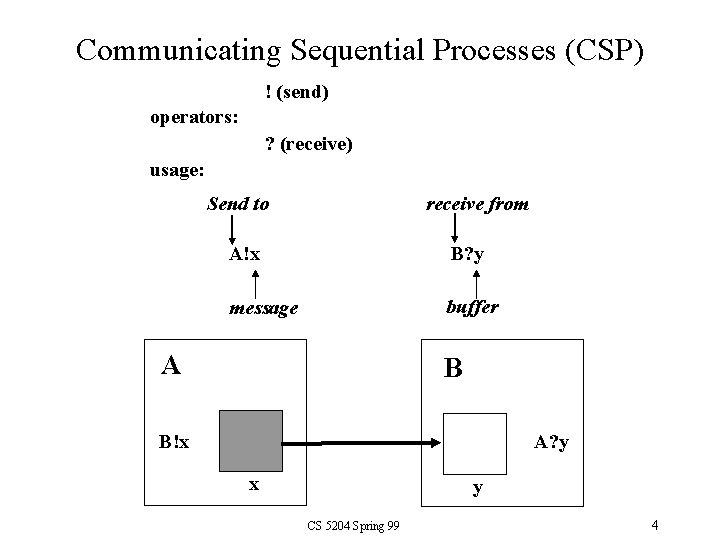
Communicating Sequential Processes (CSP) ! (send) operators: ? (receive) usage: Send to receive from A!x B? y message buffer A B B!x A? y x y CS 5204 Spring 99 4
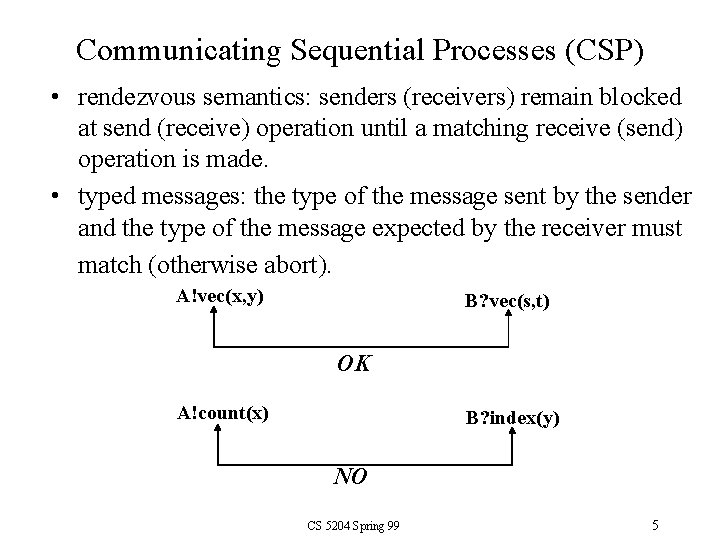
Communicating Sequential Processes (CSP) • rendezvous semantics: senders (receivers) remain blocked at send (receive) operation until a matching receive (send) operation is made. • typed messages: the type of the message sent by the sender and the type of the message expected by the receiver must match (otherwise abort). A!vec(x, y) B? vec(s, t) OK A!count(x) B? index(y) NO CS 5204 Spring 99 5
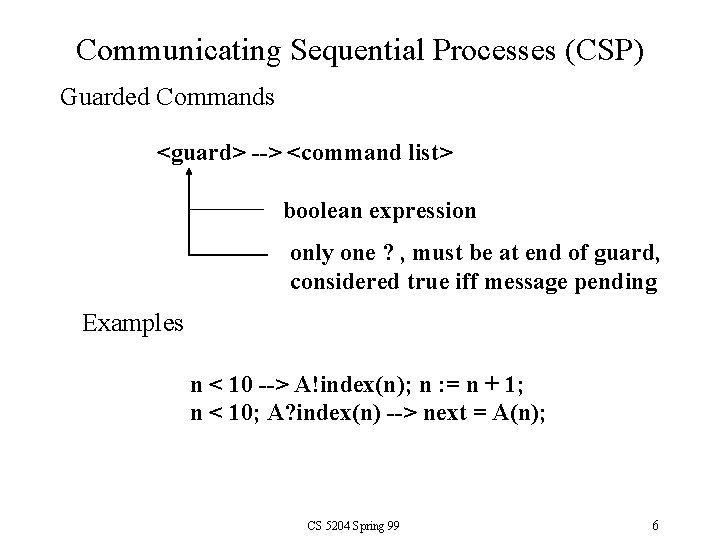
Communicating Sequential Processes (CSP) Guarded Commands <guard> > <command list> boolean expression only one ? , must be at end of guard, considered true iff message pending Examples n < 10 > A!index(n); n : = n + 1; n < 10; A? index(n) > next = A(n); CS 5204 Spring 99 6
![Communicating Sequential Processes (CSP) Alternative Command [ G 1 > S 1 [] G](http://slidetodoc.com/presentation_image_h2/230b60965fbb39f50ee6c24105a9f70b/image-7.jpg "Communicating Sequential Processes (CSP) Alternative Command [ G 1 > S 1 [] G")
Communicating Sequential Processes (CSP) Alternative Command [ G 1 > S 1 [] G 2 > S 2 []. . . Gn [] >Sn ] 1. evaluate all guards 2. if more than on guard is true, nondeterministically select one. 3. if no guard is true, terminate. Note: if all true guards end with an input command for which there is no pending message, then delay the evaluation until a message arrives. If all senders have terminated, then the alternative command terminates. Repetitive Command * [ G 1 > S 1 [] G 2 > S 2 []. . . Gn [] >Sn ] repeatedly execute the alternative command until it terminates CS 5204 Spring 99 7
![Communicating Sequential Processes (CSP) Examples: [x >= y > m : = x []](http://slidetodoc.com/presentation_image_h2/230b60965fbb39f50ee6c24105a9f70b/image-8.jpg "Communicating Sequential Processes (CSP) Examples: [x >= y > m : = x []")
Communicating Sequential Processes (CSP) Examples: [x >= y > m : = x [] y >= x > m ; + y ] i : = 0; * [ i < size; content(i) != n > i : = i + 1 ] * [ c: character; west? c > east!c ] * [ n : integer; X? insert(n) > INSERT [] n : integer; X? has(n) > SEARCH; X!(i < size) ] Bounded. Buffer: : buffer: (0. . 9) portion; in, out : integer; in : = 0; out : = 0; * [ in < out + 10; producer? buffer(in mod 10) > in : = in + 1; [] out < in; consumer? more() > consumer!buffer(out mod 10); out : = out + 1; ] CS 5204 Spring 99 8
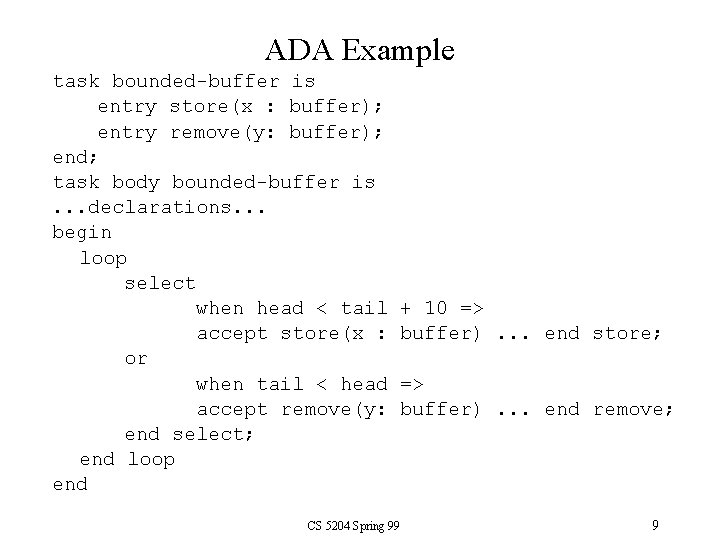
ADA Example task bounded buffer is entry store(x : buffer); entry remove(y: buffer); end; task body bounded buffer is. . . declarations. . . begin loop select when head < tail accept store(x : or when tail < head accept remove(y: end select; end loop end CS 5204 Spring 99 + 10 => buffer). . . end store; => buffer). . . end remove; 9
- Slides: 9