
CSP 517 Natural Language Processing Winter 2015 Parts

![Common Errors § Common errors [from Toutanova & Manning 00] NN/JJ NN official knowledge](https://slidetodoc.com/presentation_image_h2/5e8f5830a5727cf17d84c4b213af1bd3/image-12.jpg "Common Errors § Common errors [from Toutanova & Manning 00] NN/JJ NN official knowledge")
![[Collins 02] Linear Models: Perceptron § The perceptron algorithm § Iteratively processes the training](https://slidetodoc.com/presentation_image_h2/5e8f5830a5727cf17d84c4b213af1bd3/image-21.jpg "[Collins 02] Linear Models: Perceptron § The perceptron algorithm § Iteratively processes the training")
![Conditional Random Fields (CRFs) [Lafferty, Mc. Callum, Pereira 01] § Maximum entropy (logistic regression)](https://slidetodoc.com/presentation_image_h2/5e8f5830a5727cf17d84c4b213af1bd3/image-27.jpg "Conditional Random Fields (CRFs) [Lafferty, Mc. Callum, Pereira 01] § Maximum entropy (logistic regression)")
- Slides: 34
CSP 517 Natural Language Processing Winter 2015 Parts of Speech Yejin Choi [Slides adapted from Dan Klein, Luke Zettlemoyer]
Overview § POS Tagging § Feature Rich Techniques § Maximum Entropy Markov Models (MEMMs) § Structured Perceptron § Conditional Random Fields (CRFs)
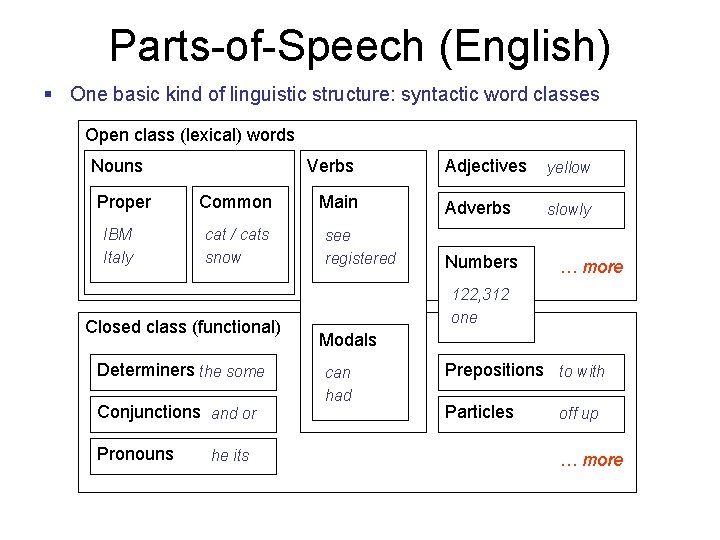
Parts-of-Speech (English) § One basic kind of linguistic structure: syntactic word classes Open class (lexical) words Nouns Proper IBM Italy Verbs Common cat / cats snow Closed class (functional) Determiners the some Conjunctions and or Pronouns he its Main see registered Adjectives yellow Adverbs slowly Numbers … more 122, 312 one Modals can had Prepositions to with Particles off up … more
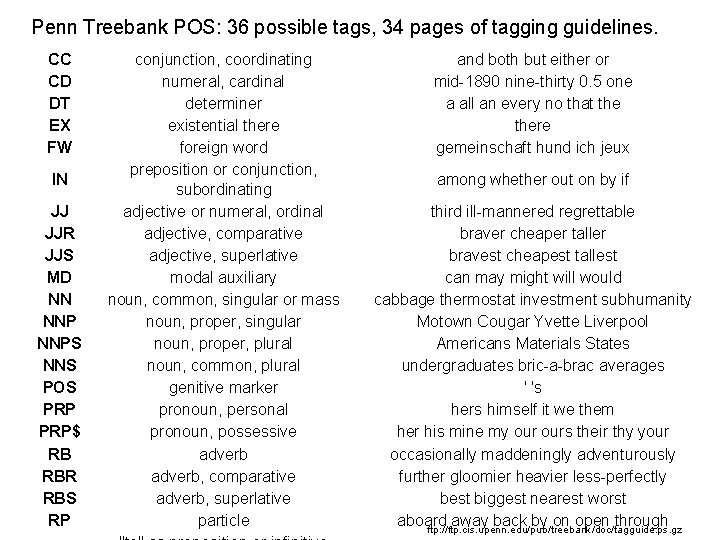
Penn Treebank POS: 36 possible tags, 34 pages of tagging guidelines. CC CD DT EX FW IN JJ JJR JJS MD NN NNPS NNS POS PRP$ RB RBR RBS RP conjunction, coordinating numeral, cardinal determiner existential there foreign word preposition or conjunction, subordinating adjective or numeral, ordinal adjective, comparative adjective, superlative modal auxiliary noun, common, singular or mass noun, proper, singular noun, proper, plural noun, common, plural genitive marker pronoun, personal pronoun, possessive adverb, comparative adverb, superlative particle and both but either or mid-1890 nine-thirty 0. 5 one a all an every no that there gemeinschaft hund ich jeux among whether out on by if third ill-mannered regrettable braver cheaper taller bravest cheapest tallest can may might will would cabbage thermostat investment subhumanity Motown Cougar Yvette Liverpool Americans Materials States undergraduates bric-a-brac averages ' 's hers himself it we them her his mine my ours their thy your occasionally maddeningly adventurously further gloomier heavier less-perfectly best biggest nearest worst aboard away back by on open through ftp: //ftp. cis. upenn. edu/pub/treebank/doc/tagguide. ps. gz
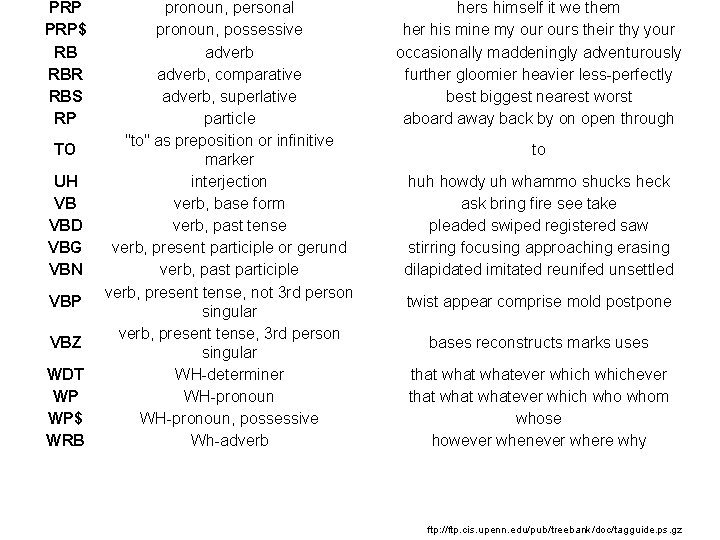
PRP PRP$ RB RBR RBS RP TO UH VB VBD VBG VBN VBP VBZ WDT WP WP$ WRB pronoun, personal pronoun, possessive adverb, comparative adverb, superlative particle "to" as preposition or infinitive marker interjection verb, base form verb, past tense verb, present participle or gerund verb, past participle verb, present tense, not 3 rd person singular verb, present tense, 3 rd person singular WH-determiner WH-pronoun, possessive Wh-adverb hers himself it we them her his mine my ours their thy your occasionally maddeningly adventurously further gloomier heavier less-perfectly best biggest nearest worst aboard away back by on open through to huh howdy uh whammo shucks heck ask bring fire see take pleaded swiped registered saw stirring focusing approaching erasing dilapidated imitated reunifed unsettled twist appear comprise mold postpone bases reconstructs marks uses that whatever whichever that whatever which whom whose however whenever where why ftp: //ftp. cis. upenn. edu/pub/treebank/doc/tagguide. ps. gz
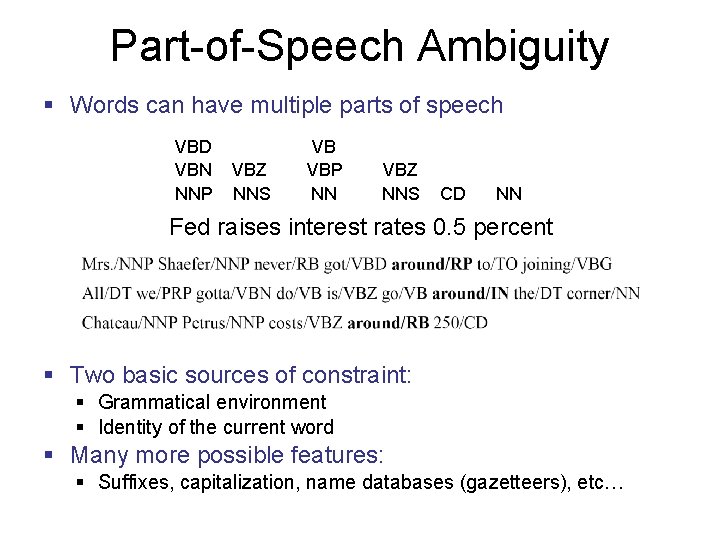
Part-of-Speech Ambiguity § Words can have multiple parts of speech VBD VBN NNP VBZ NNS VB VBP NN VBZ NNS CD NN Fed raises interest rates 0. 5 percent § Two basic sources of constraint: § Grammatical environment § Identity of the current word § Many more possible features: § Suffixes, capitalization, name databases (gazetteers), etc…
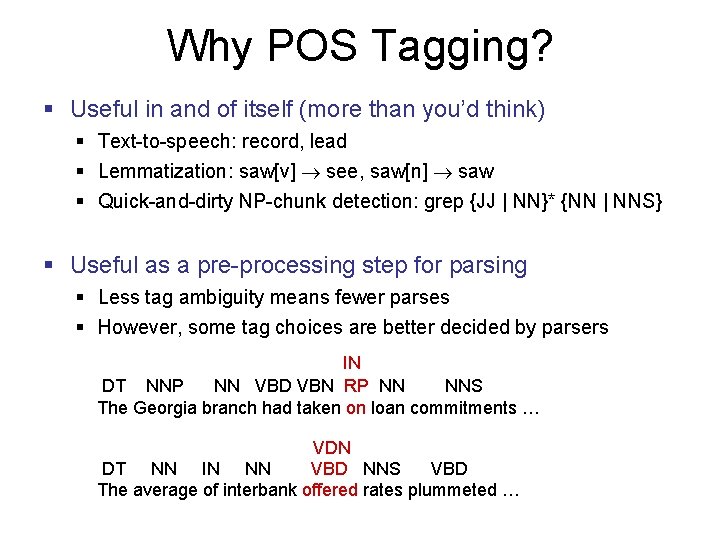
Why POS Tagging? § Useful in and of itself (more than you’d think) § Text-to-speech: record, lead § Lemmatization: saw[v] see, saw[n] saw § Quick-and-dirty NP-chunk detection: grep {JJ | NN}* {NN | NNS} § Useful as a pre-processing step for parsing § Less tag ambiguity means fewer parses § However, some tag choices are better decided by parsers IN DT NNP NN VBD VBN RP NN NNS The Georgia branch had taken on loan commitments … VDN DT NN IN NN VBD NNS VBD The average of interbank offered rates plummeted …
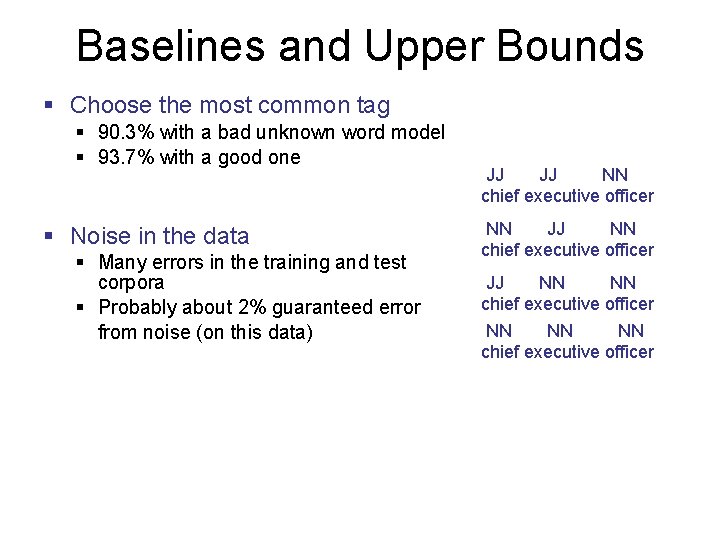
Baselines and Upper Bounds § Choose the most common tag § 90. 3% with a bad unknown word model § 93. 7% with a good one § Noise in the data § Many errors in the training and test corpora § Probably about 2% guaranteed error from noise (on this data) JJ JJ NN chief executive officer NN JJ NN chief executive officer JJ NN NN chief executive officer NN NN NN chief executive officer
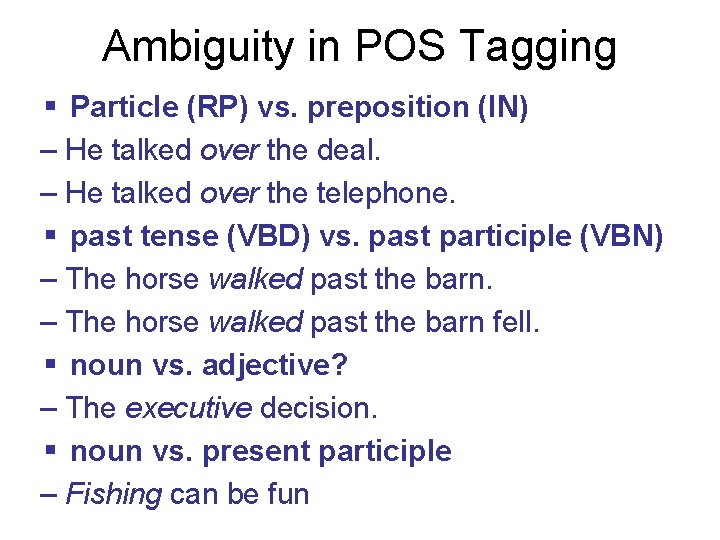
Ambiguity in POS Tagging § Particle (RP) vs. preposition (IN) – He talked over the deal. – He talked over the telephone. § past tense (VBD) vs. past participle (VBN) – The horse walked past the barn fell. § noun vs. adjective? – The executive decision. § noun vs. present participle – Fishing can be fun
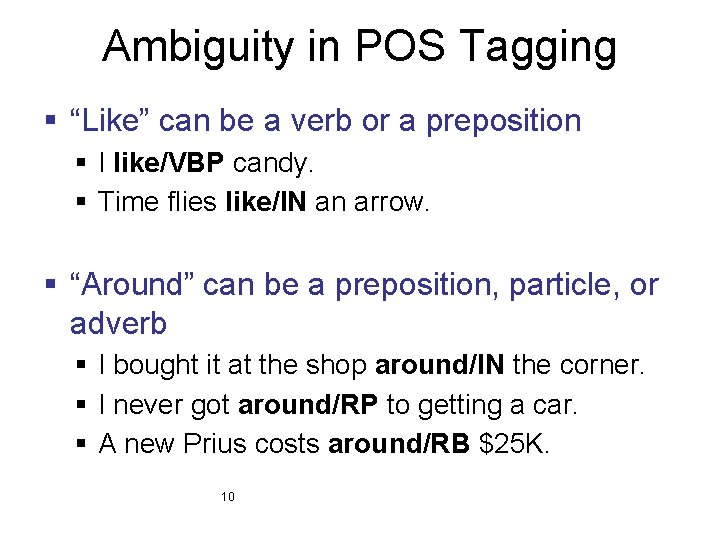
Ambiguity in POS Tagging § “Like” can be a verb or a preposition § I like/VBP candy. § Time flies like/IN an arrow. § “Around” can be a preposition, particle, or adverb § I bought it at the shop around/IN the corner. § I never got around/RP to getting a car. § A new Prius costs around/RB $25 K. 10
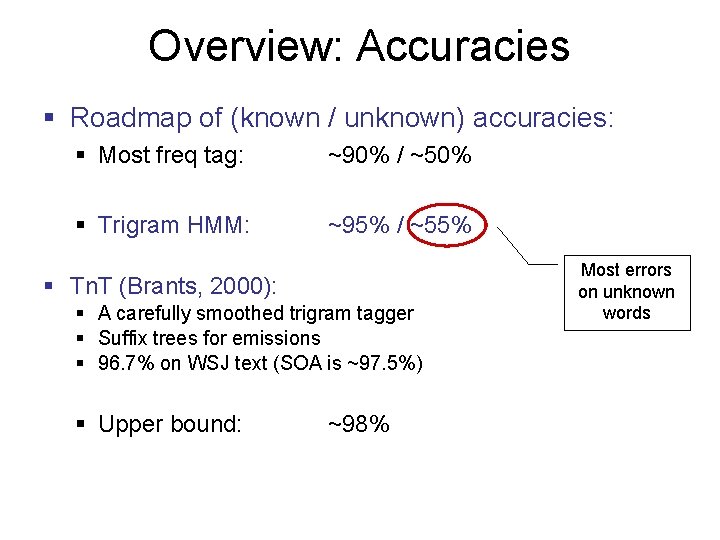
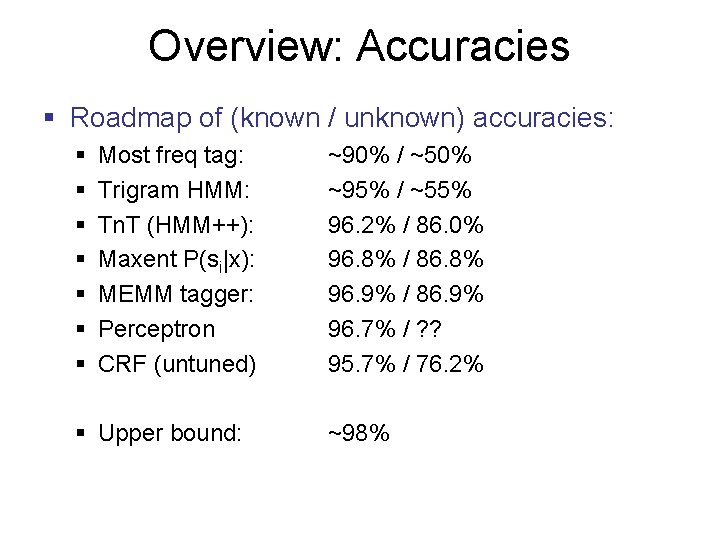
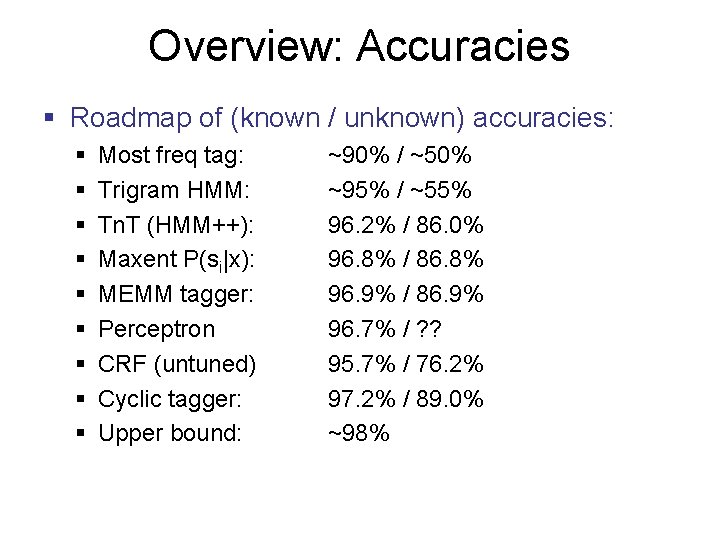
Overview: Accuracies § Roadmap of (known / unknown) accuracies: § Most freq tag: ~90% / ~50% § Trigram HMM: ~95% / ~55% § Tn. T (Brants, 2000): § A carefully smoothed trigram tagger § Suffix trees for emissions § 96. 7% on WSJ text (SOA is ~97. 5%) § Upper bound: ~98% Most errors on unknown words
Common Errors § Common errors [from Toutanova & Manning 00] NN/JJ NN official knowledge VBD RP/IN DT NN made up the story RB VBD/VBN NNS recently sold shares
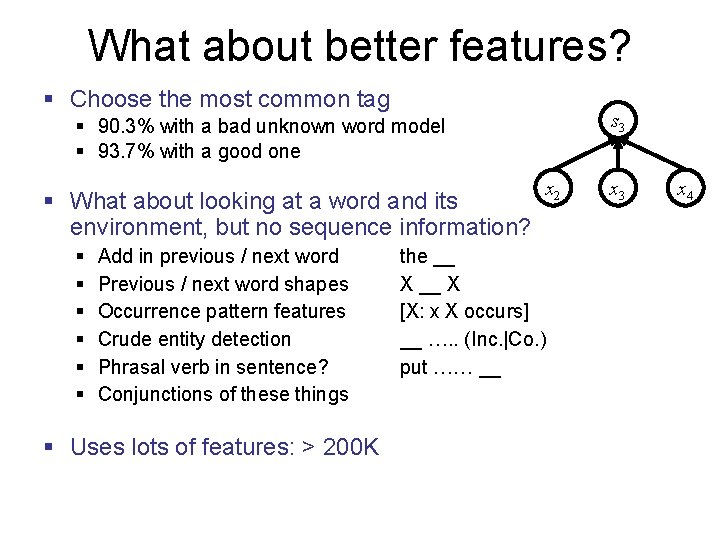
What about better features? § Choose the most common tag s 3 § 90. 3% with a bad unknown word model § 93. 7% with a good one § What about looking at a word and its environment, but no sequence information? § § § Add in previous / next word Previous / next word shapes Occurrence pattern features Crude entity detection Phrasal verb in sentence? Conjunctions of these things § Uses lots of features: > 200 K x 2 the __ X [X: x X occurs] __ …. . (Inc. |Co. ) put …… __ x 3 x 4
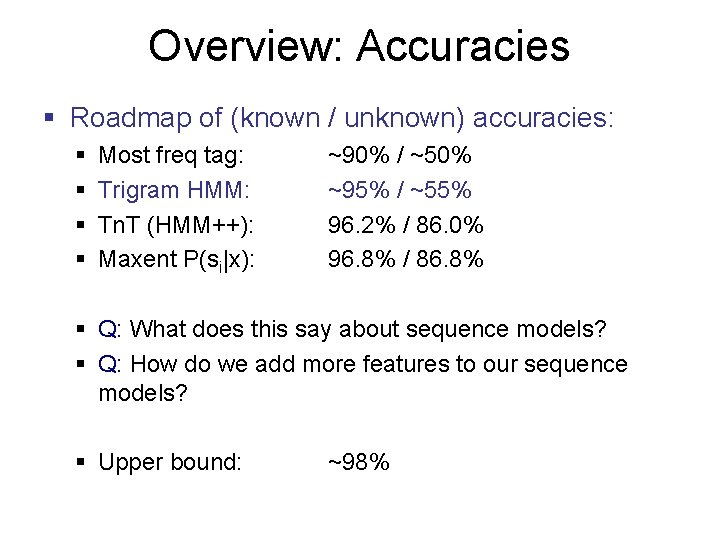
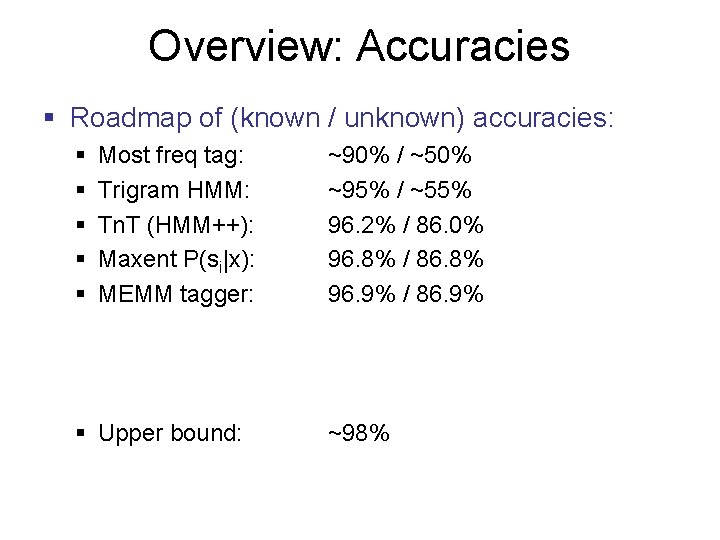
Overview: Accuracies § Roadmap of (known / unknown) accuracies: § § Most freq tag: Trigram HMM: Tn. T (HMM++): Maxent P(si|x): ~90% / ~50% ~95% / ~55% 96. 2% / 86. 0% 96. 8% / 86. 8% § Q: What does this say about sequence models? § Q: How do we add more features to our sequence models? § Upper bound: ~98%
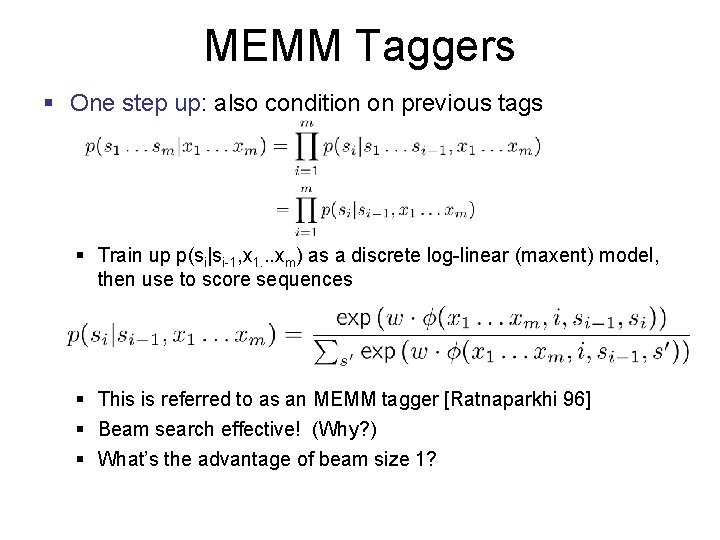
MEMM Taggers § One step up: also condition on previous tags § Train up p(si|si-1, x 1. . . xm) as a discrete log-linear (maxent) model, then use to score sequences § This is referred to as an MEMM tagger [Ratnaparkhi 96] § Beam search effective! (Why? ) § What’s the advantage of beam size 1?
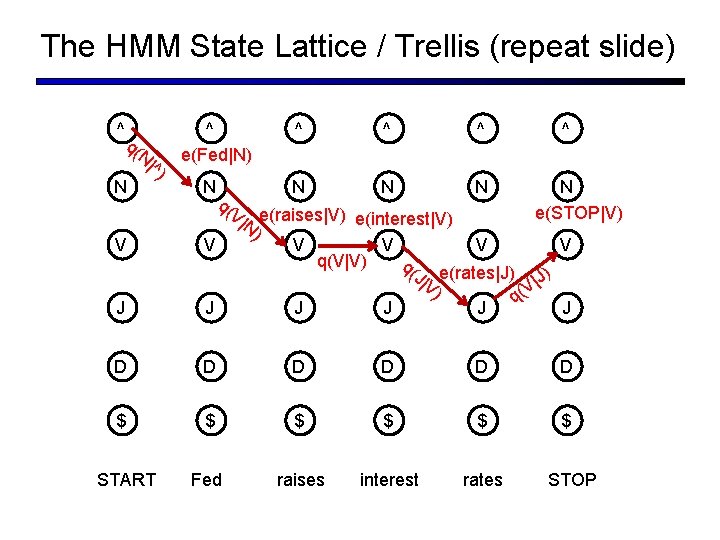
The HMM State Lattice / Trellis (repeat slide) ^ q( N| N ^) ^ e(Fed|N) ^ ^ J N N q( V| e(raises|V) e(interest|V) e(STOP|V) N) V V V q(V|V) q( J| e(rates|J) V) V q( J J J D D D $ $ $ Fed raises interest rates V START N STOP
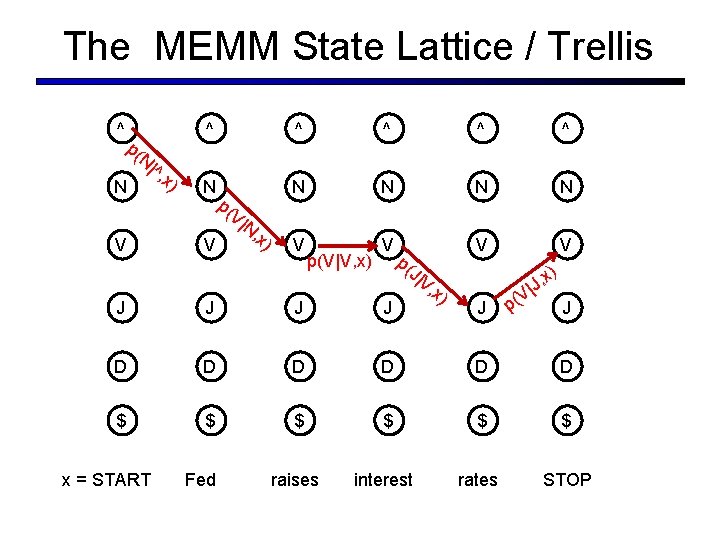
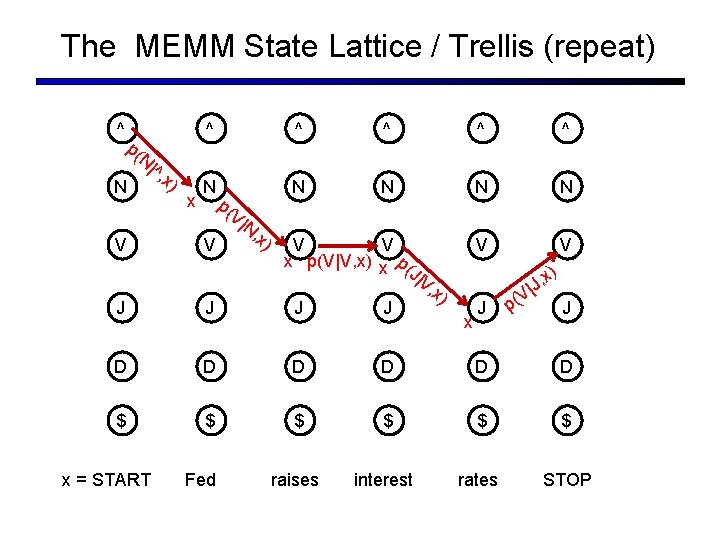
The MEMM State Lattice / Trellis ^ p( ^ N| N V ^, x ) N V p( V| N, x) ^ ^ N N V V p(V|V, x) p( J| V, x) p( V J J D D D $ $ $ raises interest rates STOP x = START Fed J x) , J | J
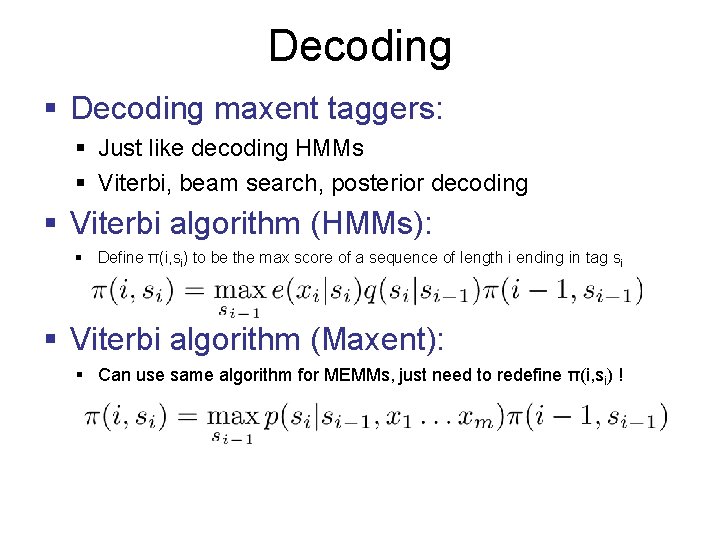
Decoding § Decoding maxent taggers: § Just like decoding HMMs § Viterbi, beam search, posterior decoding § Viterbi algorithm (HMMs): § Define π(i, si) to be the max score of a sequence of length i ending in tag si § Viterbi algorithm (Maxent): § Can use same algorithm for MEMMs, just need to redefine π(i, si) !
Overview: Accuracies § Roadmap of (known / unknown) accuracies: § § § Most freq tag: Trigram HMM: Tn. T (HMM++): Maxent P(si|x): MEMM tagger: § Upper bound: ~90% / ~50% ~95% / ~55% 96. 2% / 86. 0% 96. 8% / 86. 8% 96. 9% / 86. 9% ~98%
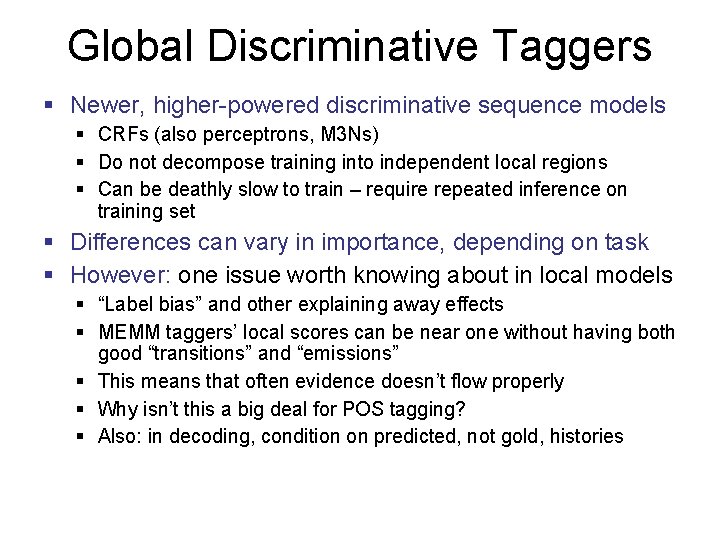
Global Discriminative Taggers § Newer, higher-powered discriminative sequence models § CRFs (also perceptrons, M 3 Ns) § Do not decompose training into independent local regions § Can be deathly slow to train – require repeated inference on training set § Differences can vary in importance, depending on task § However: one issue worth knowing about in local models § “Label bias” and other explaining away effects § MEMM taggers’ local scores can be near one without having both good “transitions” and “emissions” § This means that often evidence doesn’t flow properly § Why isn’t this a big deal for POS tagging? § Also: in decoding, condition on predicted, not gold, histories
[Collins 02] Linear Models: Perceptron § The perceptron algorithm § Iteratively processes the training set, reacting to training errors § Can be thought of as trying to drive down training error § The (online) perceptron algorithm: § Start with zero weights § Visit training instances (xi, yi) one by one Sentence: x=x 1…xm § Make a prediction § If correct (y*==yi): no change, goto next example! § If wrong: adjust weights Challenge: How to compute argmax efficiently? Tag Sequence: y=s 1…sm
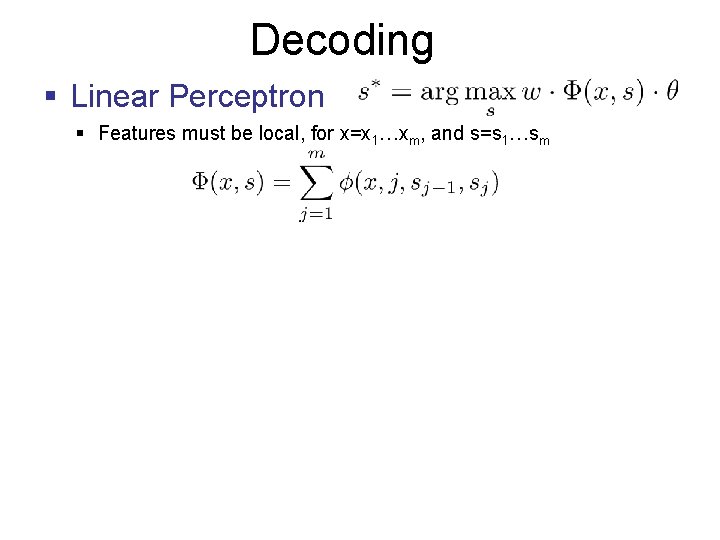
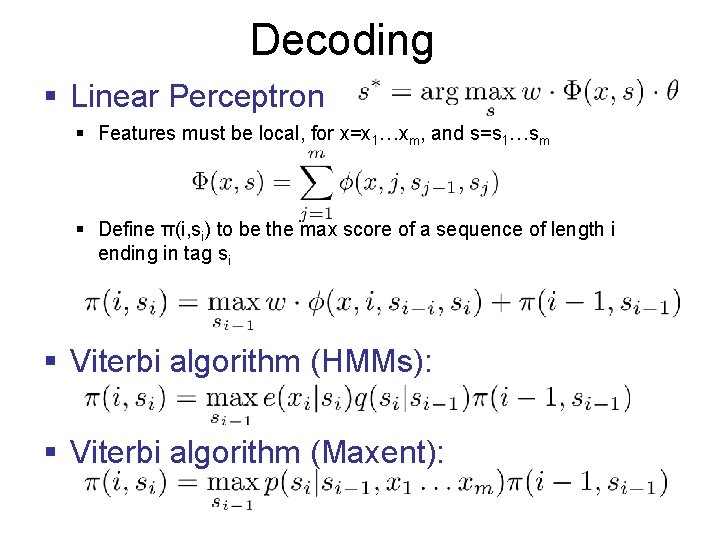
Decoding § Linear Perceptron § Features must be local, for x=x 1…xm, and s=s 1…sm
The MEMM State Lattice / Trellis (repeat) ^ p( ^ N| N V ^, x ) x N V p( V| N, x) ^ ^ N N V V x p(V|V, x) x p(J | V, x) p( V J J D D D $ $ $ raises interest rates STOP x = START Fed x J x) , J | J
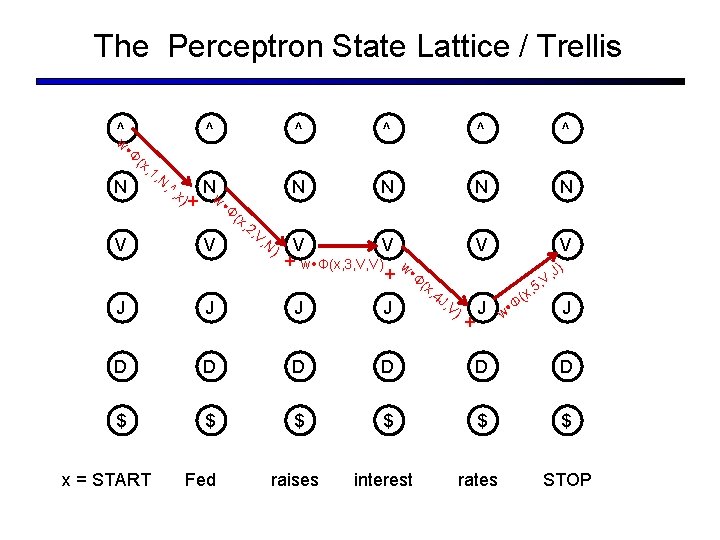
The Perceptron State Lattice / Trellis ^ w N Φ (x , 1 , N V , ^, x) + ^ ^ ^ Nw N N V V + w Φ(x, 3, V, V) + V V V Φ (x , 2 , V , N ) w Φ (x J) , V , , 4 J, V) Φ J J D D D $ $ $ raises interest rates STOP x = START Fed + J , 5 (x w J
Decoding § Linear Perceptron § Features must be local, for x=x 1…xm, and s=s 1…sm § Define π(i, si) to be the max score of a sequence of length i ending in tag si § Viterbi algorithm (HMMs): § Viterbi algorithm (Maxent):
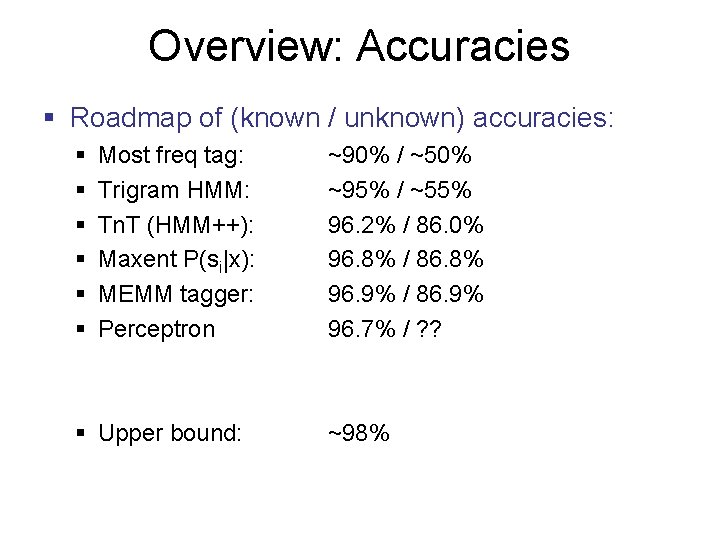
Overview: Accuracies § Roadmap of (known / unknown) accuracies: § § § Most freq tag: Trigram HMM: Tn. T (HMM++): Maxent P(si|x): MEMM tagger: Perceptron § Upper bound: ~90% / ~50% ~95% / ~55% 96. 2% / 86. 0% 96. 8% / 86. 8% 96. 9% / 86. 9% 96. 7% / ? ? ~98%
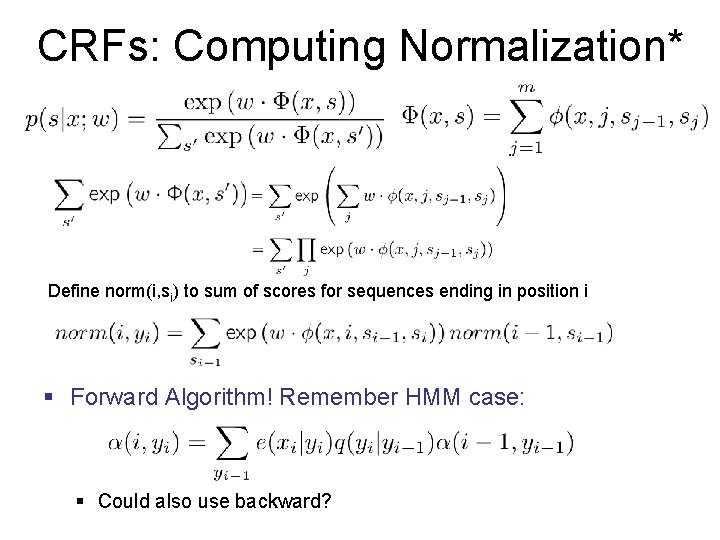
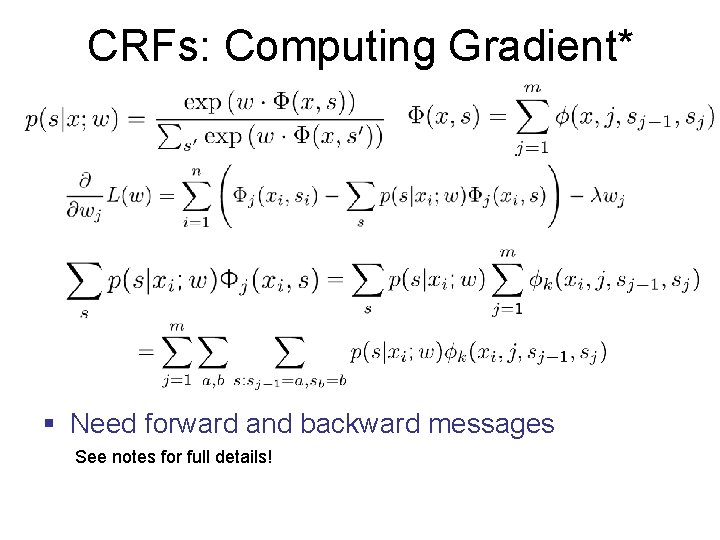
Conditional Random Fields (CRFs) [Lafferty, Mc. Callum, Pereira 01] § Maximum entropy (logistic regression) Sentence: x=x 1…xm Tag Sequence: y=s 1…sm § Learning: maximize the (log) conditional likelihood of training data § Computational Challenges? § Most likely tag sequence, normalization constant, gradient
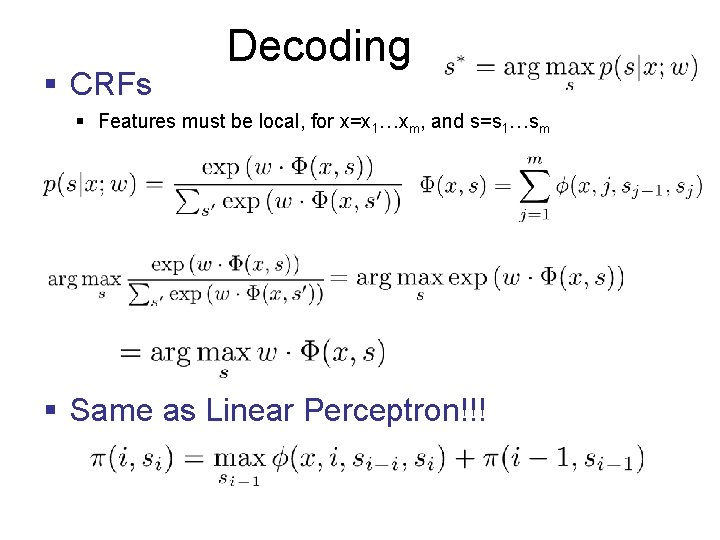
§ CRFs Decoding § Features must be local, for x=x 1…xm, and s=s 1…sm § Same as Linear Perceptron!!!
CRFs: Computing Normalization* Define norm(i, si) to sum of scores for sequences ending in position i § Forward Algorithm! Remember HMM case: § Could also use backward?
CRFs: Computing Gradient* § Need forward and backward messages See notes for full details!
Overview: Accuracies § Roadmap of (known / unknown) accuracies: § § § § Most freq tag: Trigram HMM: Tn. T (HMM++): Maxent P(si|x): MEMM tagger: Perceptron CRF (untuned) § Upper bound: ~90% / ~50% ~95% / ~55% 96. 2% / 86. 0% 96. 8% / 86. 8% 96. 9% / 86. 9% 96. 7% / ? ? 95. 7% / 76. 2% ~98%
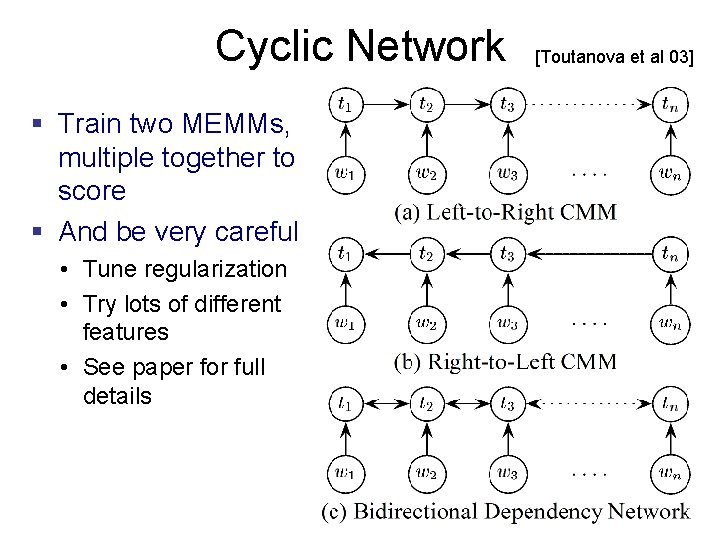
Cyclic Network § Train two MEMMs, multiple together to score § And be very careful • Tune regularization • Try lots of different features • See paper for full details [Toutanova et al 03]
Overview: Accuracies § Roadmap of (known / unknown) accuracies: § § § § § Most freq tag: Trigram HMM: Tn. T (HMM++): Maxent P(si|x): MEMM tagger: Perceptron CRF (untuned) Cyclic tagger: Upper bound: ~90% / ~50% ~95% / ~55% 96. 2% / 86. 0% 96. 8% / 86. 8% 96. 9% / 86. 9% 96. 7% / ? ? 95. 7% / 76. 2% 97. 2% / 89. 0% ~98%
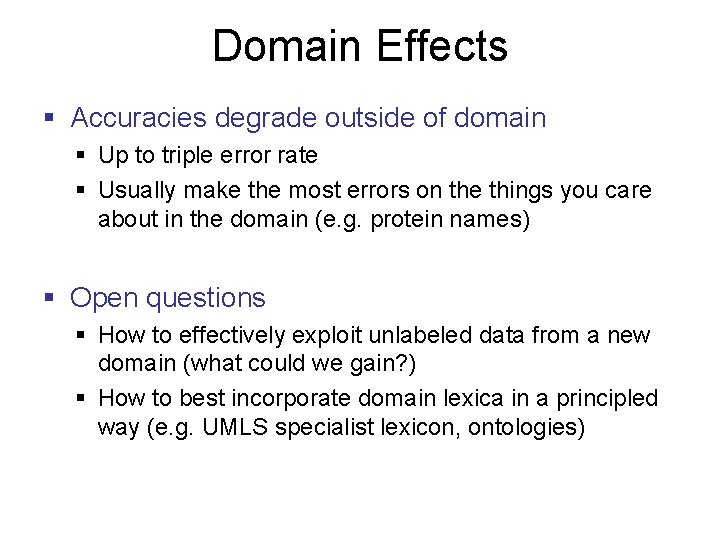
Domain Effects § Accuracies degrade outside of domain § Up to triple error rate § Usually make the most errors on the things you care about in the domain (e. g. protein names) § Open questions § How to effectively exploit unlabeled data from a new domain (what could we gain? ) § How to best incorporate domain lexica in a principled way (e. g. UMLS specialist lexicon, ontologies)